Page 11 of 389
9
4008_en_Chap00b_vue-ensemble_ed01-2014
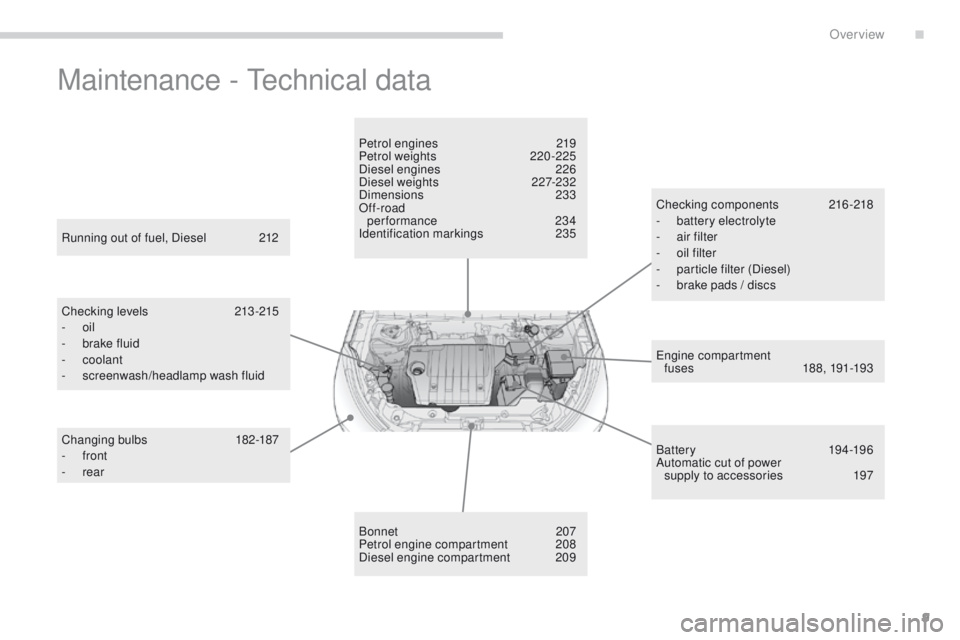
Maintenance - technical data
engine compartment
fuses 1 88, 191-193
Running out of fuel, Diesel
2
12
Checking levels
21
3 -215
-
oil
-
b
rake fluid
-
coolant
-
s
creenwash/headlamp wash fluid
Changing bulbs
1
82-187
-
front
-
rear Petrol engines
2
19
Petrol weights
2
20 -225
Diesel engines
2
26
Diesel weights
2
27-232
Dimensions
233
Off-road performance
234
Identification markings
2
35
Bonnet
207
Petrol engine compartment
2
08
Diesel engine compartment
2
09 Bat ter y
19
4 -19 6
Automatic cut of power supply to accessories
1
97
Checking components
2
16-218
-
b
attery electrolyte
-
a
ir filter
-
o
il filter
-
p
article filter (Diesel)
-
b
rake pads / discs
.
Over view
Page 13 of 389
11
4008_en_Chap00c_eco-conduite_ed01-2014
Limit the causes of excess consumption
Spread loads throughout the vehicle; place the heaviest items in the
bottom of the boot, as close as possible to the rear seats.
Limit the loads carried in the vehicle and reduce wind resistance
(roof bars, roof rack, bicycle carrier, trailer...). u
s
e a roof box in
preference.
Remove roof bars and roof racks after use.
At the end of winter, remove snow tyres and refit your summer tyres.
Observe the recommendations on
maintenance
Check the tyre pressures regularly, when cold, referring to the label in
the door aperture, driver's side.
Carry out this check in particular:
-
b
efore a long journey,
-
a
t each change of season,
-
a
fter a long period out of use.
Don't forget the spare wheel and the tyres on any trailer or caravan.
Have your vehicle serviced regularly (engine oil, oil filter, air filter...) and
observe the schedule of operations recommended by the manufacturer.
When refuelling, do not continue after the third cut-off of the nozzle to
avoid any over flow.
At the wheel of your new vehicle, it is only after the first 1 800 miles
(3
000 kilometres) that you will see the fuel consumption settle down to
a consistent average.
.
eco-driving
Page 29 of 389
27
4008_en_Chap01_controle-de-marche_ed01-2014
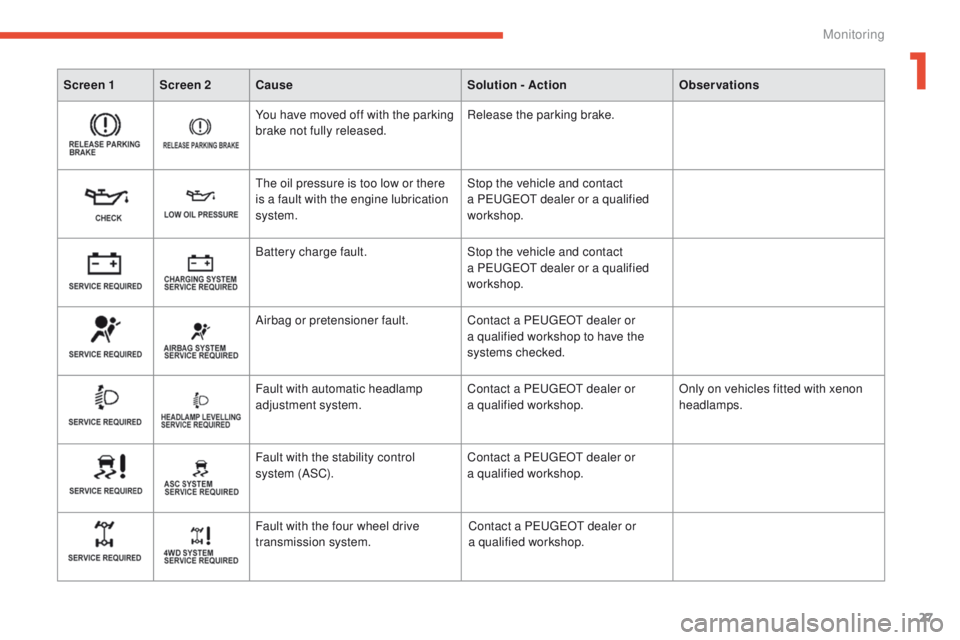
Screen 1 Screen 2Cause Solution - ActionObservations
You have moved off with the parking
brake not fully released.Release the parking brake.
th
e oil pressure is too low or there
is a fault with the engine lubrication
system. Stop the vehicle and contact
a P
e
uge
Ot
dealer or a qualified
workshop.
Battery charge fault. Stop the vehicle and contact
a P
e
uge
Ot
dealer or a qualified
workshop.
Airbag or pretensioner fault. Contact a P
e
uge
Ot
dealer or
a qualified workshop to have the
systems checked.
Fault with automatic headlamp
adjustment system. Contact a P
e
uge
Ot
dealer or
a qualified workshop. Only on vehicles fitted with xenon
headlamps.
Fault with the stability control
system (ASC). Contact a P
e
uge
Ot
dealer or
a qualified workshop.
Fault with the four wheel drive
transmission system. Contact a P
e
uge
Ot
dealer or
a qualified workshop.
1
Monitoring
Page 31 of 389
29
4008_en_Chap01_controle-de-marche_ed01-2014
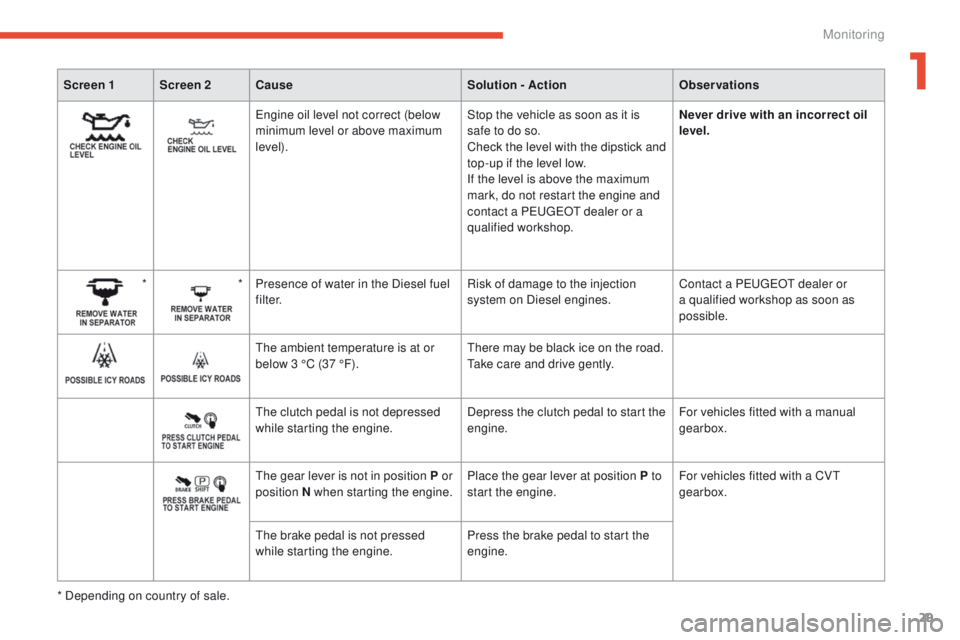
Screen 1 Screen 2Cause Solution - ActionObservations
engine oil level not correct (below
minimum level or above maximum
level).Stop the vehicle as soon as it is
safe to do so.
Check the level with the dipstick and
top-up if the level low.
If the level is above the maximum
mark, do not restart the engine and
contact a P
e
uge
Ot
dealer or a
qualified workshop. Never drive with an incorrect oil
level.
* * Presence of water in the Diesel fuel
f i l t e r. Risk of damage to the injection
system on Diesel engines.Contact a P
e
uge
Ot
dealer or
a qualified workshop as soon as
possible.
th
e ambient temperature is at or
below 3 °C (37 °F).
th
ere may be black ice on the road.
ta
ke care and drive gently.
th
e clutch pedal is not depressed
while starting the engine. Depress the clutch pedal to start the
engine.For vehicles fitted with a manual
gearbox.
th
e gear lever is not in position P or
position N when starting the engine. Place the gear lever at position P to
start the engine.For vehicles fitted with a CV
t
gearbox.
th
e brake pedal is not pressed
while starting the engine. Press the brake pedal to start the
engine.
* Depending on country of sale.
1
Monitoring
Page 175 of 389
173
4008_en_Chap07_info-pratiques_ed01-2014
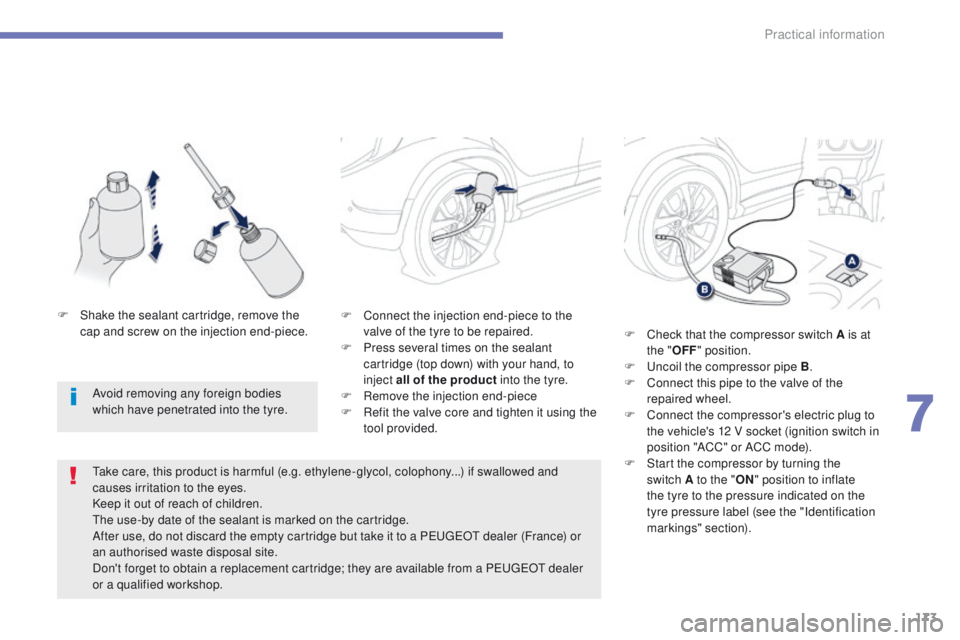
F Connect the injection end-piece to the valve of the tyre to be repaired.
F
P
ress several times on the sealant
cartridge (top down) with your hand, to
inject all of the product into the tyre.
F
R
emove the injection end-piece
F
R
efit the valve core and tighten it using the
tool provided.
ta
ke care, this product is harmful (e.g. ethylene-glycol, colophony...) if swallowed and
causes irritation to the eyes.
Keep it out of reach of children.
th
e use-by date of the sealant is marked on the cartridge.
After use, do not discard the empty cartridge but take it to a P
e
uge
Ot
dealer (France) or
an authorised waste disposal site.
Don't forget to obtain a replacement cartridge; they are available from a P
e
uge
Ot
dealer
or a qualified workshop. F
C
heck that the compressor switch A is at
the " OFF" position.
F
u
n
coil the compressor pipe B.
F
C
onnect this pipe to the valve of the
repaired wheel.
F
C
onnect the compressor's electric plug to
the vehicle's 12 V socket (ignition switch in
position "ACC" or ACC mode).
F
S
tart the compressor by turning the
switch
A to the "ON" position to inflate
the tyre to the pressure indicated on the
tyre pressure label (see the "Identification
markings" section).
Avoid removing any foreign bodies
which have penetrated into the tyre.
F
S
hake the sealant cartridge, remove the
cap and screw on the injection end-piece.
7
Practical information
Page 210 of 389
208
4008_en_Chap08_verifications_ed01-2014
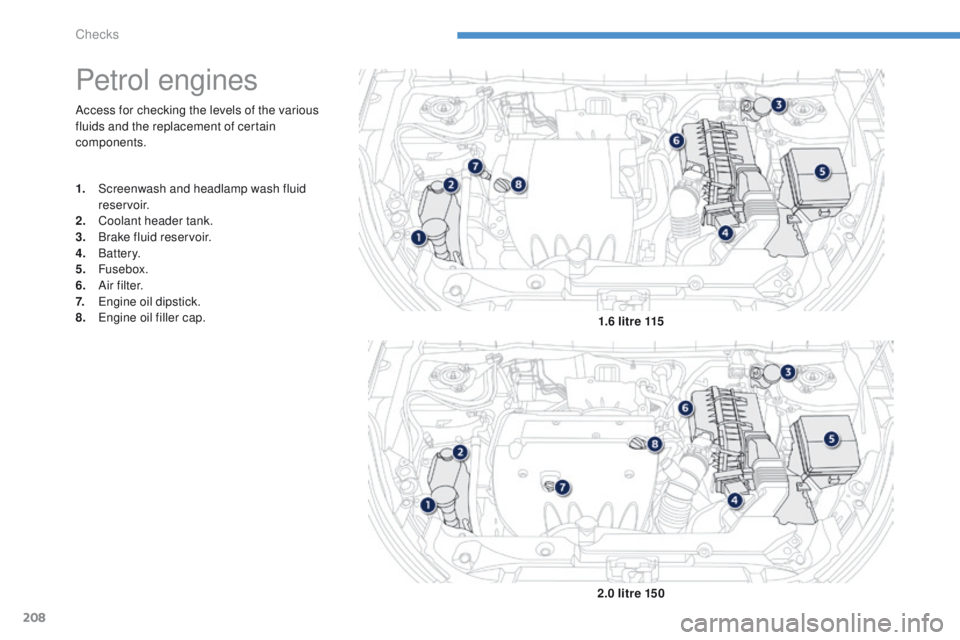
Access for checking the levels of the various
fluids and the replacement of certain
components.
Petrol engines
1. Screenwash and headlamp wash fluid reservoir.
2.
C
oolant header tank.
3.
B
rake fluid reservoir.
4.
B
attery.
5.
Fusebox.
6.
A
i r f i l t e r.
7.
e
n
gine oil dipstick.
8.
e
n
gine oil filler cap. 1.6 litre 115
2.0 litre 150
Checks
Page 211 of 389
209
4008_en_Chap08_verifications_ed01-2014
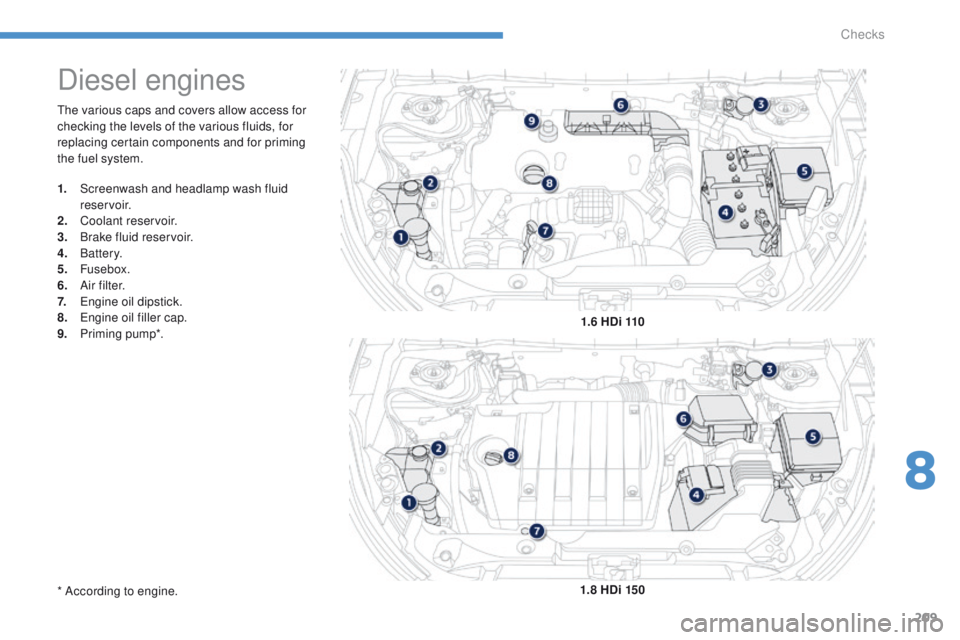
the various caps and covers allow access for
checking the levels of the various fluids, for
replacing certain components and for priming
the fuel system.
Diesel engines
1. Screenwash and headlamp wash fluid reservoir.
2.
C
oolant reservoir.
3.
B
rake fluid reservoir.
4.
B
attery.
5.
Fusebox.
6.
A
i r f i l t e r.
7.
e
n
gine oil dipstick.
8.
e
n
gine oil filler cap.
9.
P
riming pump*. 1.6 HDi 110
1.8 HDi 150
* According to engine.
8
Checks
Page 213 of 389

211
4008_en_Chap08_verifications_ed01-2014
Quality of the fuel used for
petrol engines
the petrol engines are per fectly compatible
with e1 0 type petrol biofuels (containing 10 %
ethanol), conforming to
e
u
ropean standards
eN 2
28 and e
N 1
5376.
e8
5 type fuels (containing up to 85 % ethanol)
are reserved exclusively for vehicles marketed
for the use of this type of fuel (BioFlex
vehicles).
t
h
e quality of the ethanol must
comply with
e
u
ropean standard e
N 1
5293.
For Brazil only, special vehicles are marketed
to run on fuels containing up to 100 % ethanol
(
e
10 0 t y p e).
Quality of the fuel used for
Diesel engines
the Diesel engines are per fectly compatible
with biofuels which conform to current and
future e
u
ropean standards (Diesel fuel
which complies with standard
e
N 5
90 mixed
with a biofuel which complies with standard
eN
14214) available at the pumps (containing
up to 7
% Fatty Acid Methyl e
s
ter).
th
e B30 biofuel can be used in certain Diesel
engines; however, this use is subject to strict
application of the special servicing conditions.
Contact a P
e
uge
Ot
dealer or a qualified
workshop.
th
e use of any other type of (bio)fuel
(vegetable or animal oils, pure or diluted,
domestic fuel...) is strictly prohibited (risk of
damage to the engine and fuel system).
1.6 litre petrol engines, even though they have
been designed to operate on 95 RON petrol,
can accept 90 RON petrol without engine
adjustments, but with a slight deterioration in
performance.
2.0 litre petrol engines can accept 90 RON or
higher petrol.
8
Checks