Page 259 of 416
257
308_en_Chap07_info-pratiques_ed01-2015
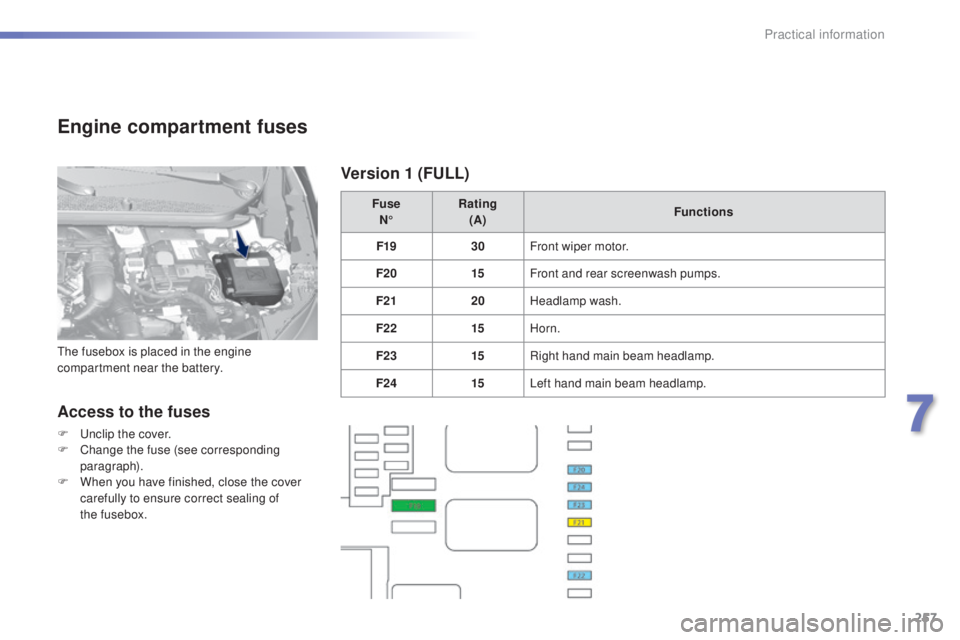
Engine compartment fuses
Access to the fuses
F unclip the cover.
F C hange the fuse (see corresponding
paragraph).
F
W
hen you have finished, close the cover
carefully to ensure correct sealing of
the
fusebox. Fuse
N° Rating
(A) Functions
F19 30Front wiper motor.
F20 15Front and rear screenwash pumps.
F21 20Headlamp wash.
F22 15Horn.
F23 15Right hand main beam headlamp.
F24 15Left hand main beam headlamp.
th
e fusebox is placed in the engine
compartment near the battery.
Version 1 (FULL)
7
Practical information
Page 265 of 416

263
308_en_Chap07_info-pratiques_ed01-2015
System which manages the duration of use of certain functions to conserve a sufficient level of
charge in the battery.
After the engine has stopped, you can still use functions such as the audio and telematics
system, windscreen wipers, dipped beam headlamps, courtesy lamps, etc. for a maximum
combined duration of about forty minutes.
energy economy mode
Switching to economy
mode
A message then appears in the instrument
panel screen indicating that the vehicle has
switched to economy mode and the active
functions are put on standby.
If a telephone call is being made at this time,
it
will be maintained for around 10 minutes with
the Bluetooth hands-free system of your audio
system.
Exiting economy mode
these functions are reactivated automatically
next time the vehicle is driven.
In order to restore the use of these functions
immediately, start the engine and let it run:
-
f
or less than ten minutes, to use the
equipment for approximately five minutes,
-
f
or more than ten minutes, to use the
equipment for up to approximately
thirty
minutes.
Let the engine run for the duration specified to
ensure that the battery charge is sufficient.
Do not repeatedly and continuously restart the
engine in order to charge the battery.
A flat battery prevents the engine from starting
(refer to the "Battery" section).
Load reduction mode
System which manages the use of certain
functions according to the level of charge
remaining in the battery.
When the vehicle is being driven, the load
reduction function temporarily deactivates
certain functions, such as the air conditioning,
the heated rear screen...
th
e deactivated functions are reactivated
automatically as soon as conditions permit.
7
Practical information
Page 266 of 416
264
308_en_Chap07_info-pratiques_ed01-2015
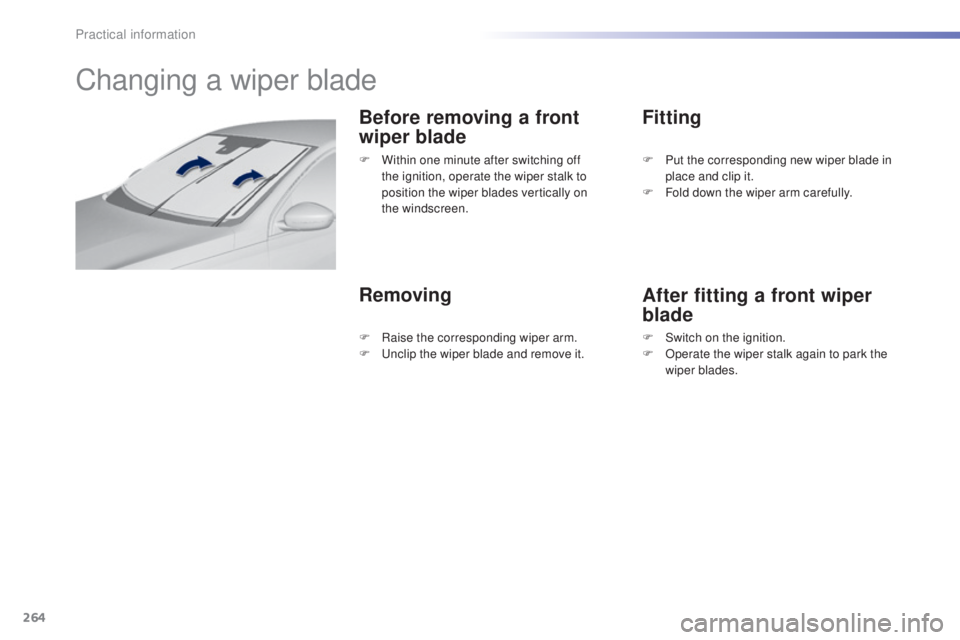
Changing a wiper blade
Before removing a front
wiper blade
RemovingFitting
After fitting a front wiper
blade
F Within one minute after switching off
the ignition, operate the wiper stalk to
position the wiper blades vertically on
the
windscreen. F
P ut the corresponding new wiper blade in
place and clip it.
F
F
old down the wiper arm carefully.
F
Ra
ise the corresponding wiper arm.
F
u
n
clip the wiper blade and remove it. F
S
witch on the ignition.
F
O
perate the wiper stalk again to park the
wiper blades.
Practical information
Page 269 of 416
267
308_en_Chap07_info-pratiques_ed01-2015
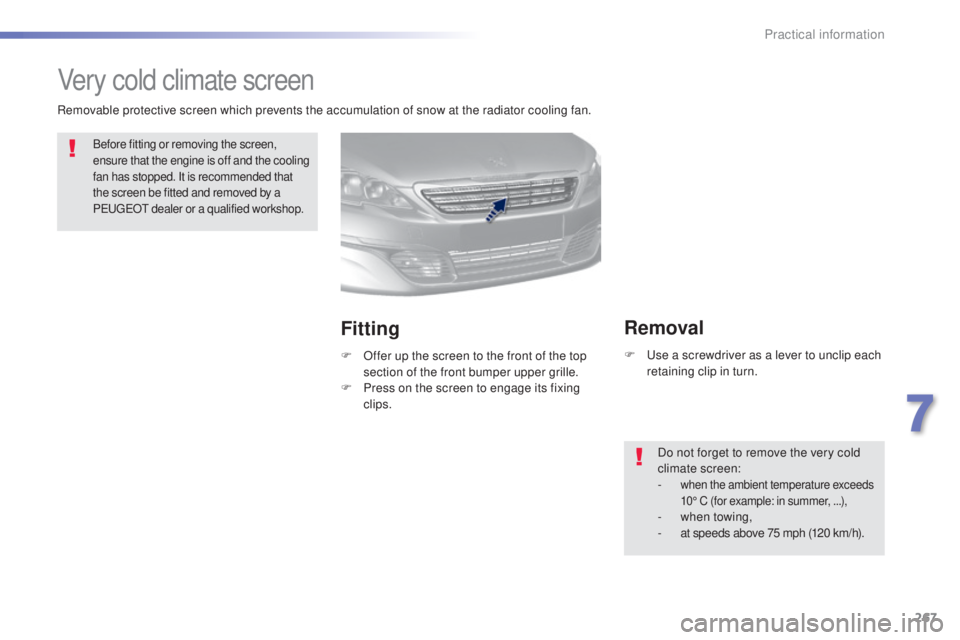
Very cold climate screen
Before fitting or removing the screen,
ensure that the engine is off and the cooling
fan has stopped. It is recommended that
the screen be fitted and removed by a
P
e
uge
Ot
dealer or a qualified workshop.
Fitting
F Offer up the screen to the front of the top section of the front bumper upper grille.
F
P
ress on the screen to engage its fixing
clips.
Removal
F use a screwdriver as a lever to unclip each retaining clip in turn.
Do not forget to remove the very cold
climate screen:
-
when the ambient temperature exceeds
10° C (for example: in summer, ...),
- when towing,
- at speeds above 75 mph (120 km/h).
Removable protective screen which prevents the accumulation of snow at the radiator cooling fan.
7
Practical information
Page 275 of 416
273
308_en_Chap07_info-pratiques_ed01-2015
the fitting of electrical equipment
or accessories which are not
recommended by P
e
uge
Ot
may result
in a failure of your vehicle's electronic
system and excessive electrical
consumption.
Contact a P
e
uge
Ot
dealer
for information on the range of
recommended equipment and
accessories.
Installation of radio
communication
transmitters
Before installing any after-market radio
communication transmitter, you can
contact a P
e
uge
Ot
dealer for the
specification of transmitters which can
be fitted (frequency, maximum power,
aerial position, specific installation
requirements), in line with the Vehicle
el
ectromagnetic Compatibility
Directive
(2004/104/
eC
). Depending on the legislation in force in
the country, certain safety equipment
may be compulsory: high visibility
safety vests, warning triangles,
breathalyzers, spare bulbs, spare fuses,
fire extinguisher, first aid kit, mud flaps
at the rear of the vehicle.
By visiting a P
e
uge
Ot
dealer, you can also
obtain products for cleaning and maintenance
(exterior and interior) - including ecological
products in the "
t
e
C
HNA
t
u
Re" r
ange, topping
up products (screenwash...), touch-up pens
and paint aerosols for the exact colour of your
vehicle, refills (cartridge for the temporary
puncture repair kit...), ...
"Multimedia"
Multimedia support, hands-free kit, DVD player,
driving aids, vehicle tracking system, ...
7
Practical information
Page 278 of 416
276
308_en_Chap08_verifications_ed01-2015
the various caps and covers allow access for
checking the levels of the various fluids and for
replacing certain components.
Petrol engine
1. Screenwash and headlamp wash reservoir.
2. Coolant reservoir.
3.
B
rake fluid filler.
4.
B
attery / Fuses.
5.
Fusebox.
6.
A
i r f i l t e r.
7.
e
n
gine oil dipstick.
8.
e
n
gine oil filler cap.
th
is engine is shown as an example. t
h
e locations of the engine oil dipstick and filler cap may vary.
Checks
Page 279 of 416
277
308_en_Chap08_verifications_ed01-2015
the various caps and covers allow access for
checking the levels of the various fluids, for
replacing certain components and for priming
the fuel system.
* According to engine.
Diesel engine
1. Screenwash and headlamp wash reservoir.
2. Coolant reservoir.
3.
B
rake fluid filler.
4.
B
attery / Fuses.
5.
Fusebox.
6.
A
i r f i l t e r.
7.
e
n
gine oil dipstick.
8.
e
n
gine oil filler cap.
9.
P
riming pump*.
th
is engine is shown as an example. t
h
e locations of the engine oil dipstick and filler cap may vary.
8
Checks
Page 282 of 416
280
308_en_Chap08_verifications_ed01-2015
Range indicators
When switching on the ignition, an indicator
gives an estimate of the distance that can
be travelled with your vehicle before engine
starting is automatically prevented, once the
vehicle starts using the reserve of AdBlue
® or
after a fault is detected with the SCR system.
In the event of simultaneous system fault and
low AdBlue
® level, the shortest range is the one
displayed.
In the event of the risk of non-starting related to a lack of AdBlue®
the engine start prevention system
required by regulations is activated
automatically once the AdBlue
® tank is
e m pt y.
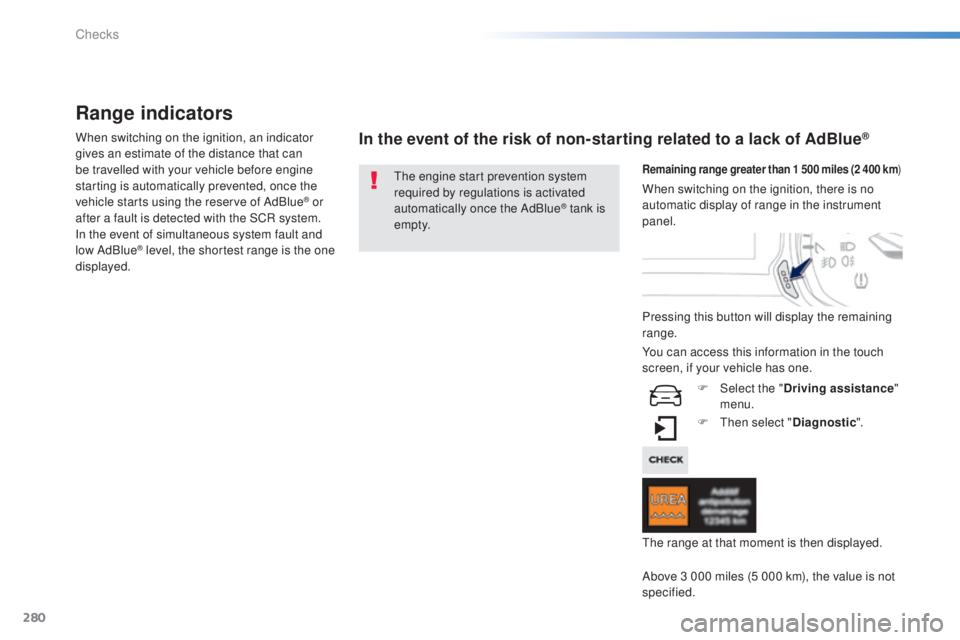
Remaining range greater than 1 500 miles (2 400 km )
Pressing this button will display the remaining
range.
F
t
hen
select "Diagnostic ".
Above 3 000 miles (5 000 km), the value is not
specified. When switching on the ignition, there is no
automatic display of range in the instrument
panel.
th
e range at that moment is then displayed.
You can access this information in the touch
screen, if your vehicle has one.
F
Sel
ect the "Driving assistance "
menu.
Checks