2015 Peugeot 208 dashboard
[x] Cancel search: dashboardPage 12 of 341
10
208_en_Chap01_vue-ensemble_ed01-2015
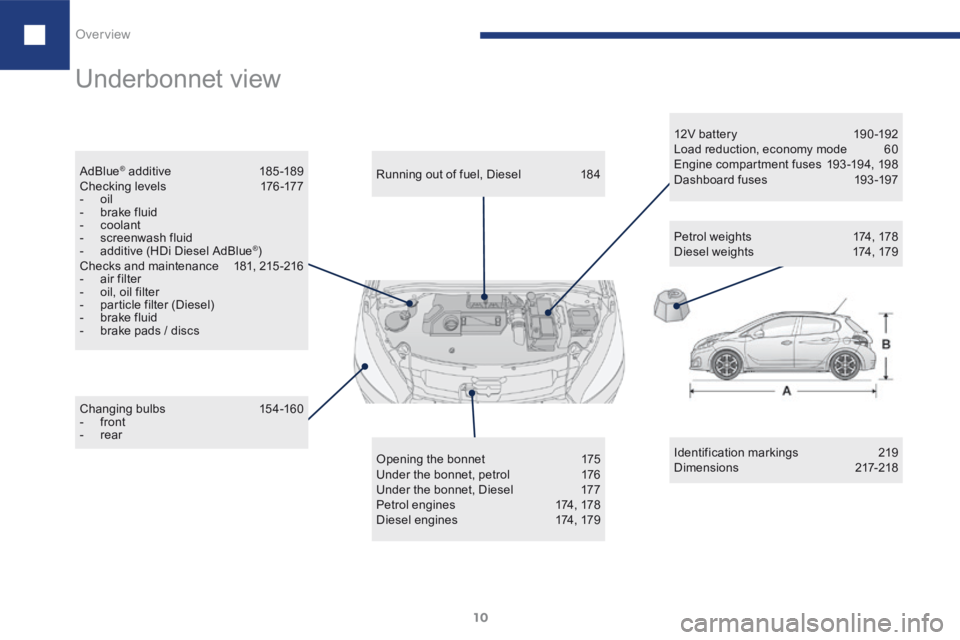
Underbonnet view
Identification markings 219
Dimensions 217-218
Changing bulbs
154-160
- front
- rear Running out of fuel, Diesel
184
Opening the bonnet 175
Under the bonnet, petrol 176
Under the bonnet, Diesel 177
Petrol engines 174, 178
Diesel engines 174, 17912V bat ter y
19 0 -192
Load reduction, economy mode 60
Engine compartment fuses 193-194, 198
Dashboard fuses 193-197
Petrol weights 174, 178
Diesel weights 174, 179
AdBlue
® additive
185 -189
C h e c k i n g l eve l s 176 -17 7
- oil
- brake fluid
- coolant
- screenwash fluid
- additive (HDi Diesel AdBlue
®)
Checks and maintenance 181, 215-216
- air filter
- oil, oil filter
- particle filter (Diesel)
- brake fluid
- brake pads / discs
Over view
Page 15 of 341
13
208_en_Chap02_ Acces-Demarrage_ed01-2015
Starting
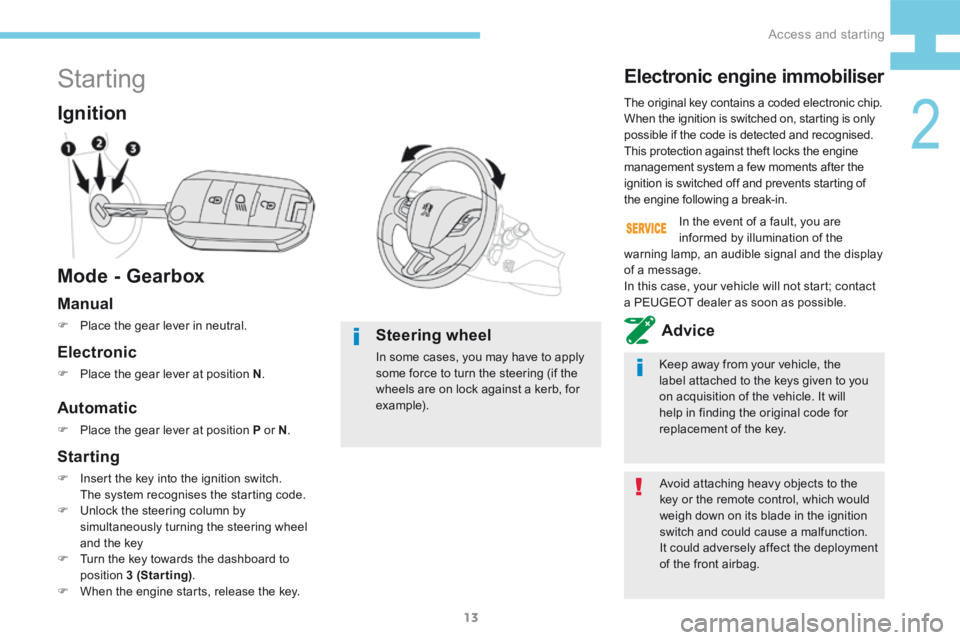
Mode - Gearbox Ignition
Avoid attaching heavy objects to the
key or the remote control, which would
weigh down on its blade in the ignition
switch and could cause a malfunction.
It could adversely affect the deployment
of the front airbag.
The original key contains a coded electronic chip.
When the ignition is switched on, starting is only
possible if the code is detected and recognised.
This protection against theft locks the engine
management system a few moments after the
ignition is switched off and prevents starting of
the engine following a break-in.
Electronic engine immobiliser
Keep away from your vehicle, the
label attached to the keys given to you
on acquisition of the vehicle. It will
help in finding the original code for
replacement of the key.
In the event of a fault, you are
informed by illumination of the
warning lamp, an audible signal and the display
of a message.
In this case, your vehicle will not start; contact
a PEUGEOT dealer as soon as possible.
Manual
F Place the gear lever in neutral.Advice
Automatic
F Place the gear lever at position P or N .
Electronic
F Place the gear lever at position N .
Steering wheel
In some cases, you may have to apply
some force to turn the steering (if the
wheels are on lock against a kerb, for
example).
Starting
F Insert the key into the ignition switch.
The system recognises the starting code.
F Unlock the steering column by
simultaneously turning the steering wheel
and the key
F Turn the key towards the dashboard to
position 3 (Starting) .
F When the engine starts, release the key.
2
Access and starting
Page 51 of 341
49
208_en_Chap03_Indicateurs_ed01-2015
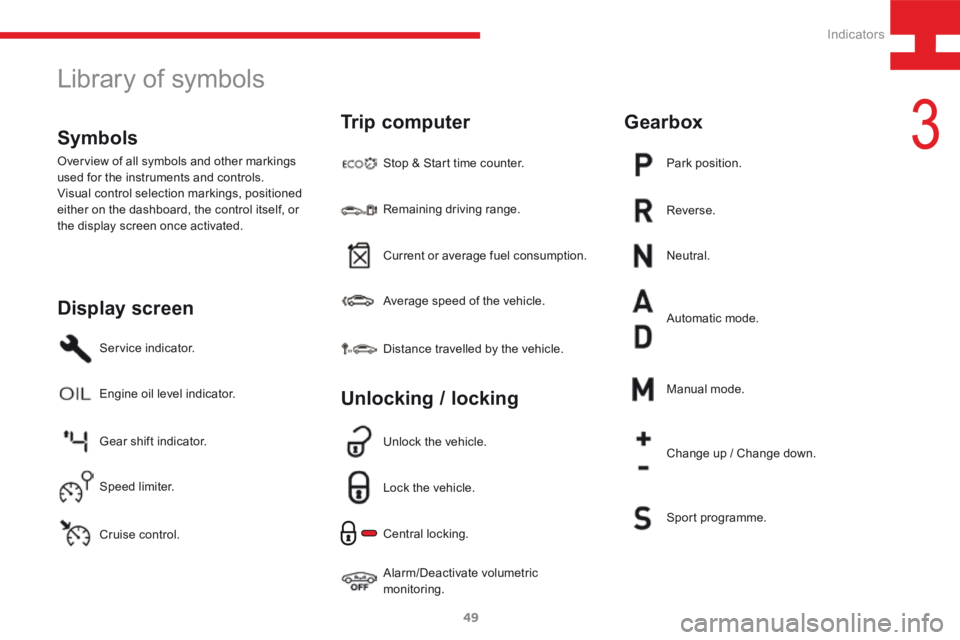
Service indicator.
Gear shift indicator.Stop & Start time counter.
Average speed of the vehicle.
Engine oil level indicator.
Cruise control. Current or average fuel consumption.
Speed limiter. Remaining driving range.
Distance travelled by the vehicle.
Unlock the vehicle.
Neutral.
Automatic mode. Reverse. Park position.
Lock the vehicle.
Alarm/Deactivate volumetric
monitoring. Central locking. Manual mode.
Change up / Change down.
Sport programme.
Display screen
Trip computer
Unlocking / lockingGearbox
Symbols
Overview of all symbols and other markings
used for the instruments and controls.
Visual control selection markings, positioned
either on the dashboard, the control itself, or
the display screen once activated.
Library of symbols
3
Indicators
Page 72 of 341
70
208_en_Chap04_confort_ed01-2015
In order for the ventilation and air conditioning to be fully effective, follow the operation and
maintenance guidelines below:
F To obtain an even air distribution, take care not to obstruct the exterior air intake grilles
located at the base of the windscreen, the nozzles, the vents and the air outlets, as well
as the air extractor located in the boot.
F Do not cover the sunshine sensor, located on the dashboard; this is used for regulation
of the air conditioning system.
F The air conditioning system only works with the engine running.
F Operate the air conditioning system for at least 5 to 10 minutes, once or twice a month
to keep it in per fect working order.
F Ensure that the passenger compartment filter is in good condition and have the filter
elements replaced regularly.
We recommend the use of a combined passenger compartment filter. Thanks to its
special active additive, it contributes to the purification of the air breathed by the
occupants and the cleanliness of the passenger compartment (reduction of allergic
symptoms, bad odours and greasy deposits).
F To ensure correct operation of the air conditioning system, you are also advised to have
it checked regularly as recommended in the warranty and maintenance record.
F If the system does not produce cold air, switch it off and contact a PEUGEOT dealer or
a qualified workshop.
When towing the maximum load on a steep gradient in high temperatures, switching off the
air conditioning increases the available engine power and so improves the towing ability.
Advice
If after an extended stop in sunshine,
the interior temperature is very high, first
ventilate the passenger compartment for
a few moments.
Put the air flow control at a setting high
enough to quickly change the air in the
passenger compartment.
The air conditioning system does not
contain chlorine and does not present
any danger to the ozone layer.
The condensation created by the air
conditioning results in a discharge
of water under the vehicle which is
perfectly normal.
Stop & Start
The heating and air conditioning systems only work when the engine is running. To maintain
a comfortable temperature in the passenger compartment, you can temporarily deactivate
the Stop & Start system (see the corresponding section).
Passenger compartment filter
Depending on the environment (e.g.
dusty atmosphere) and the use of the
vehicle (e.g. city driving), replace it
twice as often if necessar y .
A clogged passenger compartment filter may
have an adverse effect on the per formance
of the air conditioning system and generate
undesirable odours.
Refer to the manufacturer's service schedule.
Comfort
Page 107 of 341
105
208_en_Chap04_confort_ed01-2015
Airbags
General information
The airbags do not operate when the
ignition is switched off.Deployment of one or more of the
airbags is accompanied by a slight
emission of smoke and a noise, due
to the activation of the pyrotechnic
cartridge incorporated in the system.
This smoke is not harmful, but sensitive
individuals may experience slight
irritation.
The noise of detonation related to the
deployment of one or more airbags may
result in a slight loss of hearing for a
short time.
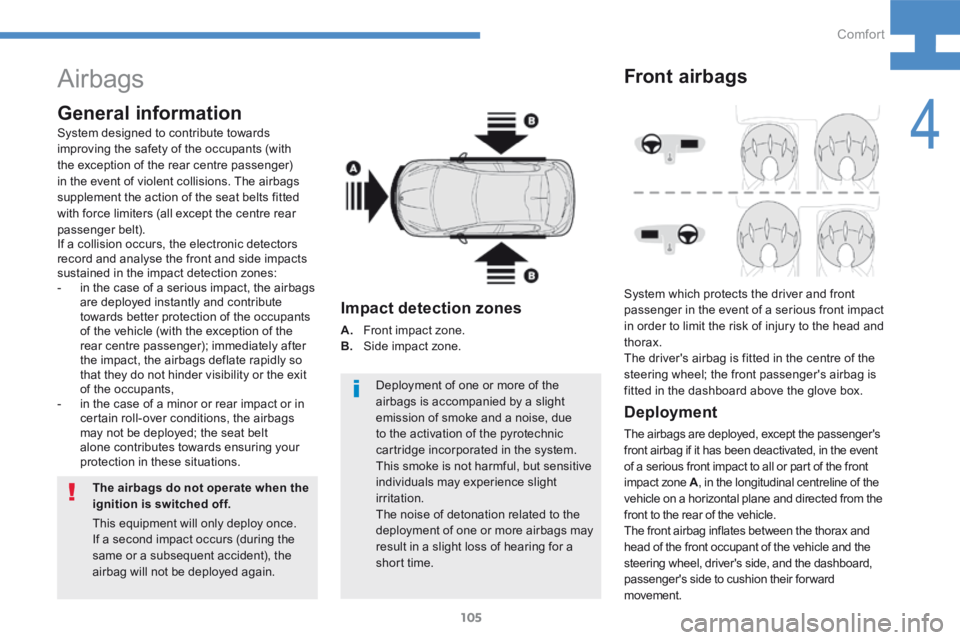
Impact detection zones
A.
Front impact zone.
B. Side impact zone.
Front airbags
Deployment
The airbags are deployed, except the passenger's
front airbag if it has been deactivated, in the event
of a serious front impact to all or part of the front
impact zone A, in the longitudinal centreline of the
vehicle on a horizontal plane and directed from the
front to the rear of the vehicle.
The front airbag inflates between the thorax and
head of the front occupant of the vehicle and the
steering wheel, driver's side, and the dashboard,
passenger's side to cushion their forward
movement. System which protects the driver and front
passenger in the event of a serious front impact
in order to limit the risk of injury to the head and
thorax.
The driver's airbag is fitted in the centre of the
steering wheel; the front passenger's airbag is
fitted in the dashboard above the glove box.
This equipment will only deploy once.
If a second impact occurs (during the
same or a subsequent accident), the
airbag will not be deployed again.
System designed to contribute towards
improving the safety of the occupants (with
the exception of the rear centre passenger)
in the event of violent collisions. The airbags
supplement the action of the seat belts fitted
with force limiters (all except the centre rear
passenger belt).
If a collision occurs, the electronic detectors
record and analyse the front and side impacts
sustained in the impact detection zones:
-
in the case of a serious impact, the airbags
are deployed instantly and contribute
towards better protection of the occupants
of the vehicle (with the exception of the
rear centre passenger); immediately after
the impact, the airbags deflate rapidly so
that they do not hinder visibility or the exit
of the occupants,
- in the case of a minor or rear impact or in
certain roll-over conditions, the airbags
may not be deployed; the seat belt
alone contributes towards ensuring your
protection in these situations.
4
Comfort
Page 110 of 341
108
208_en_Chap04_confort_ed01-2015
Sit in a normal upright position.
Wear a correctly adjusted seat belt.
Do not allow anything to come between
the occupants and the airbags (a child, pet,
object...), do not attach or fix anything near
to the airbags or their trajectories when
inflating as this could cause injuries when
the airbags are deployed.
Never modify the original definition of your
vehicle, particularly in the area directly
around the airbags.
After an accident or if the vehicle has been
stolen or broken into, have the airbag
systems checked.
All work on the airbag system must be
carried out by a PEUGEOT dealer or a
qualified workshop.
Even if all of the precautions mentioned
are observed, a risk of injury or of minor
burns to the head, chest or arms when an
airbag is deployed cannot be ruled out. The
bag inflates almost instantly (within a few
milliseconds) then deflates within the same
time discharging the hot gas via openings
provided for this purpose.Lateral airbags
Use only approved covers on the seats,
compatible with the deployment the lateral
airbags. For information on the range of seat
covers suitable for your vehicle, you can
contact a PEUGEOT dealer.
Refer to the "Accessories" section.
Do not fix or attach anything to the seat
backs (clothing...). This could cause injury
to the chest or arms if the lateral airbag is
deployed.
Do not sit with the upper part of the body any
nearer to the door than necessary.
Front airbags
Do not drive holding the steering wheel by its
spokes or resting your hands on the centre
part of the wheel.
Passengers must not place their feet on the
dashboard.
Do not smoke as deployment of the airbags
can cause burns or the risk of injury from a
cigarette or pipe.
Never remove or pierce the steering wheel or
hit it violently.
Do not fit or attach anything to the steering
wheel or dashboard, this could cause
injuries with deployment of the airbags.
Guidelines to follow:Curtain airbags
Do not fix or attach anything to the roof. This
could cause injury to the head if the curtain
airbag is deployed.
If fitted on your vehicle, do not remove the
grab handles installed on the roof, they play
a part in securing the curtain airbags.
Comfort
Page 163 of 341
161
208_en_Chap07_ Amenagements_ed01-2015
Fittings
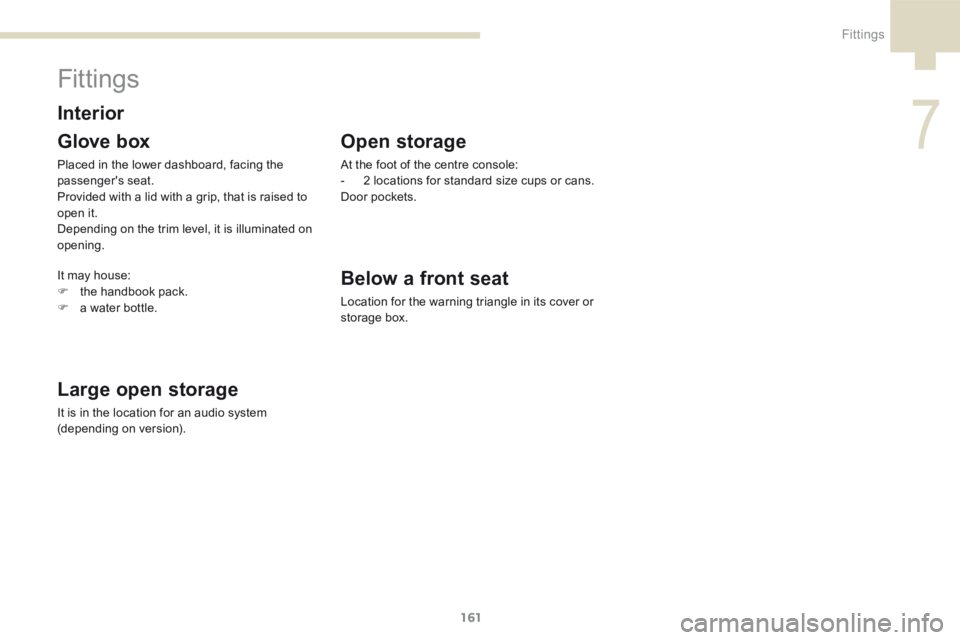
Glove box
Placed in the lower dashboard, facing the
passenger's seat.
Provided with a lid with a grip, that is raised to
open it.
Depending on the trim level, it is illuminated on
opening.
Large open storage
It is in the location for an audio system
(depending on version).
InteriorBelow a front seat
Location for the warning triangle in its cover or
storage box.
Open storage
At the foot of the centre console:
- 2 locations for standard size cups or cans.
Door pockets.
It may house:
F the handbook pack.
F a water bottle.
7
Fittings
Page 195 of 341
193
208_en_Chap08_Informations-pratiques_ed01-2015
Fuses
Changing
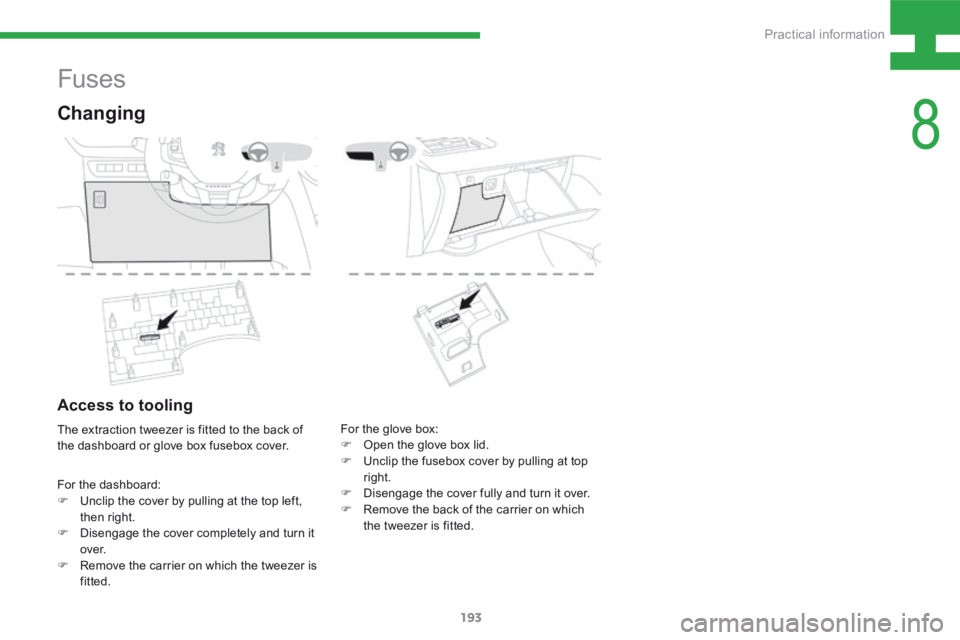
For the dashboard:
F Unclip the cover by pulling at the top left,
then right.
F Disengage the cover completely and turn it
ove r.
F Remove the carrier on which the tweezer is
fitted.
The extraction tweezer is fitted to the back of
the dashboard or glove box fusebox cover.
Access to tooling
For the glove box:
F
Open the glove box lid.
F Unclip the fusebox cover by pulling at top
right.
F Disengage the cover fully and turn it over.
F Remove the back of the carrier on which
the tweezer is fitted.
8
Practical information