2015 Peugeot 208 wheel
[x] Cancel search: wheelPage 127 of 341
125
208_en_Chap05_conduite_ed01-2015
In bad weather and in winter, ensure
that the sensors are not covered by
road dirt, ice or snow.
In the event of a fault, have the system
checked by a PEUGEOT dealer or a
qualified workshop.
If the system is deactivated during a
manoeuvre, the drive should reactivate
it manually to repeat the measurement. If the lateral distance between your vehicle
and the space is too great, the system may
not be able to measure the space.
Anything projecting beyond the envelope
of the vehicle (long or wide load) is not
taken into account by the Park Assist
system during a manoeuvre.
Deactivation
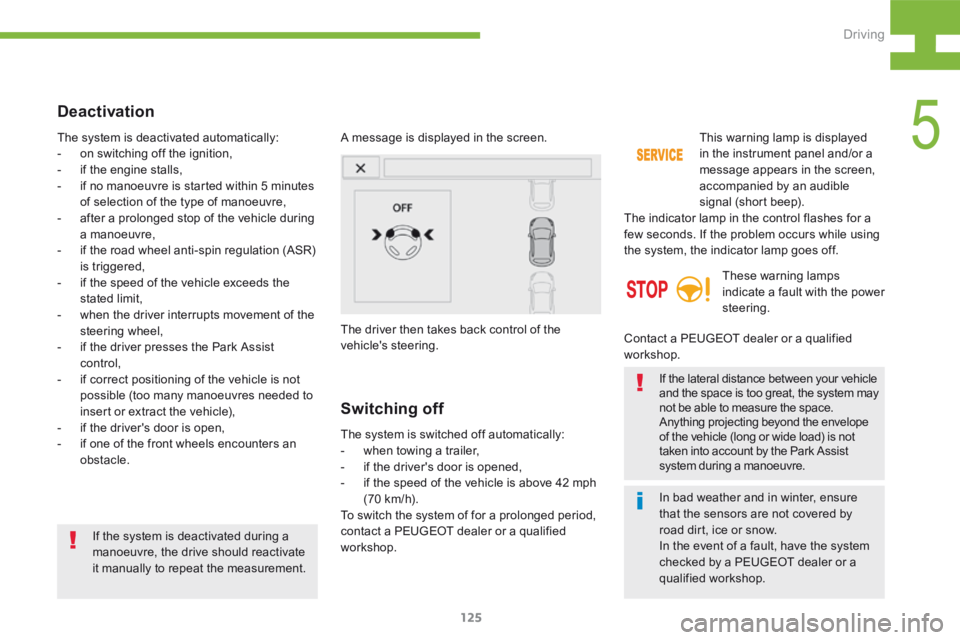
A message is displayed in the screen.
The driver then takes back control of the
vehicle's steering.
The system is deactivated automatically:
-
on switching off the ignition,
- if the engine stalls,
- if no manoeuvre is started within 5 minutes
of selection of the type of manoeuvre,
- after a prolonged stop of the vehicle during
a manoeuvre,
- if the road wheel anti-spin regulation (ASR)
is triggered,
- if the speed of the vehicle exceeds the
stated limit,
- when the driver interrupts movement of the
steering wheel,
- if the driver presses the Park Assist
control,
- if correct positioning of the vehicle is not
possible (too many manoeuvres needed to
insert or extract the vehicle),
- if the driver's door is open,
- if one of the front wheels encounters an
obstacle.
Switching off
The system is switched off automatically:
- when towing a trailer,
- if the driver's door is opened,
- if the speed of the vehicle is above 42 mph
(70 km/h).
To switch the system of for a prolonged period,
contact a PEUGEOT dealer or a qualified
workshop. This warning lamp is displayed
in the instrument panel and/or a
message appears in the screen,
accompanied by an audible
signal (short beep).
The indicator lamp in the control flashes for a
few seconds. If the problem occurs while using
the system, the indicator lamp goes off.
These warning lamps
indicate a fault with the power
steering.
Contact a PEUGEOT dealer or a qualified
workshop.
5
Driving
Page 128 of 341
126
208_en_Chap05_conduite_ed01-2015
Speed limiter
"LIMIT"
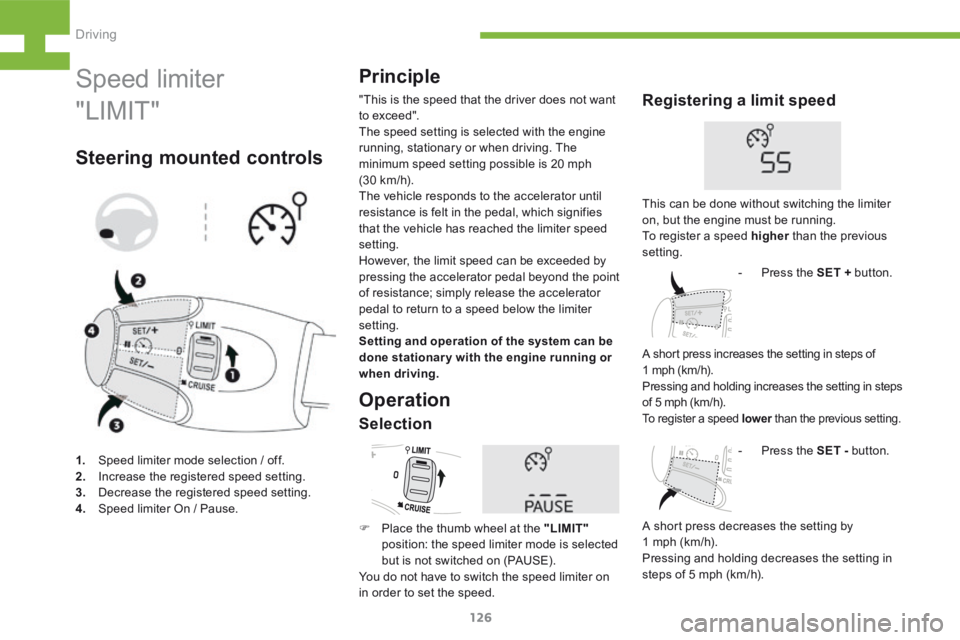
Steering mounted controlsPrinciple
"This is the speed that the driver does not want
to exceed".
The speed setting is selected with the engine
running, stationary or when driving. The
minimum speed setting possible is 20 mph
(30
km/h).
The vehicle responds to the accelerator until
resistance is felt in the pedal, which signifies
that the vehicle has reached the limiter speed
setting.
However, the limit speed can be exceeded by
pressing the accelerator pedal beyond the point
of resistance; simply release the accelerator
pedal to return to a speed below the limiter
setting.
Setting and operation of the system can be
done stationar y with the engine running or
when driving .
Operation
F Place the thumb wheel at the "LIMIT"
position: the speed limiter mode is selected
but is not switched on (PAUSE).
You do not have to switch the speed limiter on
in order to set the speed.
Selection
1. Speed limiter mode selection / off.
2. Increase the registered speed setting.
3. Decrease the registered speed setting.
4. Speed limiter On / Pause.
Registering a limit speed
This can be done without switching the limiter
on, but the engine must be running.
To register a speed higher than the previous
setting.
- Press the SET + button.
A short press increases the setting in steps of
1 mph (km/h).
Pressing and holding increases the setting in steps
of 5 mph (km/h).
To register a speed lower than the previous setting.
- Press the SET - button.
A short press decreases the setting by
1 mph (km/h).
Pressing and holding decreases the setting in
steps of 5 mph (km/h).
Driving
Page 129 of 341
127
208_en_Chap05_conduite_ed01-2015
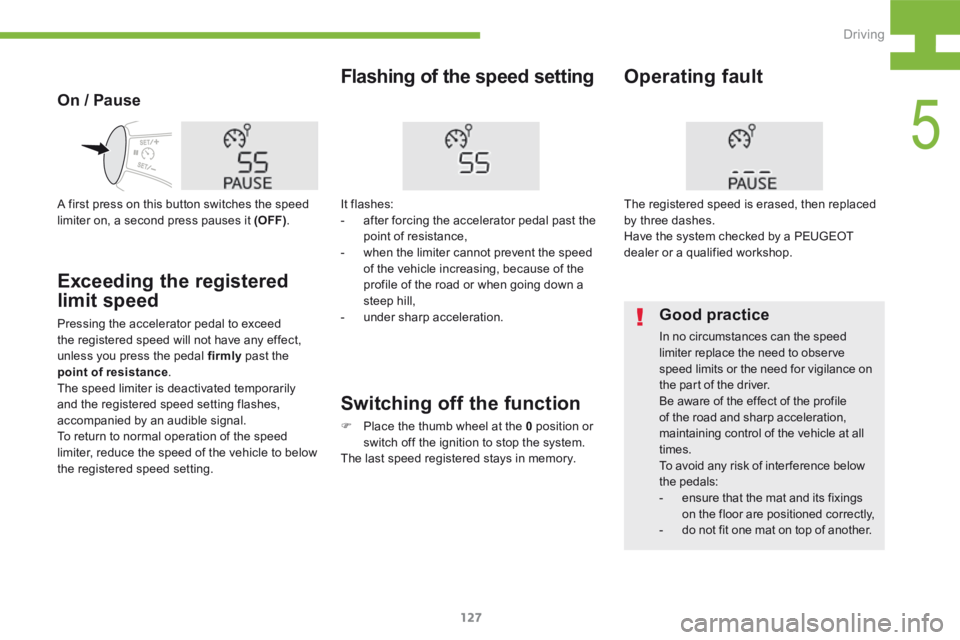
On / Pause
Flashing of the speed setting
Exceeding the registered
limit speed
Pressing the accelerator pedal to exceed
the registered speed will not have any effect,
unless you press the pedal firmly past the
point of resistance .
The speed limiter is deactivated temporarily
and the registered speed setting flashes,
accompanied by an audible signal.
To return to normal operation of the speed
limiter, reduce the speed of the vehicle to below
the registered speed setting. It flashes:
-
after forcing the accelerator pedal past the
point of resistance,
- when the limiter cannot prevent the speed
of the vehicle increasing, because of the
profile of the road or when going down a
steep hill,
- under sharp acceleration.Good practice
In no circumstances can the speed
limiter replace the need to observe
speed limits or the need for vigilance on
the part of the driver.
Be aware of the effect of the profile
of the road and sharp acceleration,
maintaining control of the vehicle at all
times.
To avoid any risk of inter ference below
the pedals:
- ensure that the mat and its fixings
on the floor are positioned correctly,
- do not fit one mat on top of another.
Operating fault
The registered speed is erased, then replaced
by three dashes.
Have the system checked by a PEUGEOT
dealer or a qualified workshop.
Switching off the function
F Place the thumb wheel at the 0 position or
switch off the ignition to stop the system.
The last speed registered stays in memory.
A first press on this button switches the speed
limiter on, a second press pauses it (OFF)
.
5
Driving
Page 130 of 341
128
208_en_Chap05_conduite_ed01-2015
Cruise control
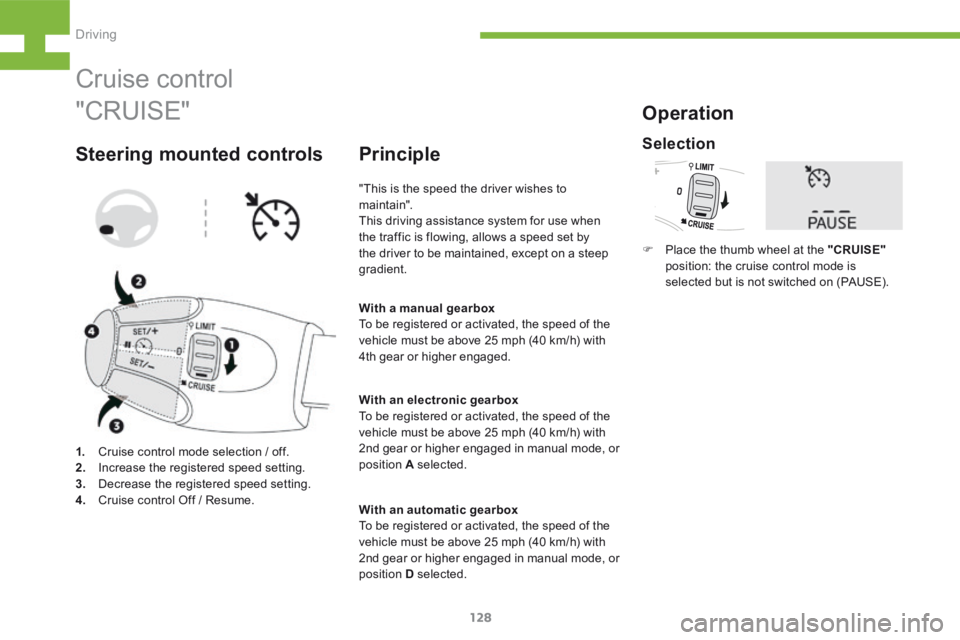
Steering mounted controls
1. Cruise control mode selection / off.
2. Increase the registered speed setting.
3. Decrease the registered speed setting.
4. Cruise control Off / Resume. "This is the speed the driver wishes to
maintain".
This driving assistance system for use when
the traffic is flowing, allows a speed set by
the driver to be maintained, except on a steep
gradient.
Principle
Operation
With a manual gearbox
To be registered or activated, the speed of the
vehicle must be above 25 mph (40 km/h) with
4th gear or higher engaged.
"CRUISE"
Selection
F
Place the thumb wheel at the "CRUISE"
position: the cruise control mode is
selected but is not switched on (PAUSE).
With an electronic gearbox
To be registered or activated, the speed of the
vehicle must be above 25 mph (40 km/h) with
2nd gear or higher engaged in manual mode, or
position A selected.
With an automatic gearbox
To be registered or activated, the speed of the
vehicle must be above 25 mph (40 km/h) with
2nd gear or higher engaged in manual mode, or
position D selected.
Driving
Page 132 of 341
130
208_en_Chap05_conduite_ed01-2015
Be vigilant when modifying the cruise
control setting by pressing and holding,
as the speed of your vehicle may
increase or decrease quickly.
Do not use the cruise control on
slippery roads or in heavy traffic.
On a steep descent, the cruise control
will not be able to prevent the vehicle
from exceeding the registered speed.
The cruise control system cannot in
any circumstances replace the need
to observe speed limits or the need for
vigilance on the part of the driver.
To avoid any risk of jamming of the
pedals:
- ensure that the mat is positioned
and secured to the floor correctly,
- never fit one mat on top of another.
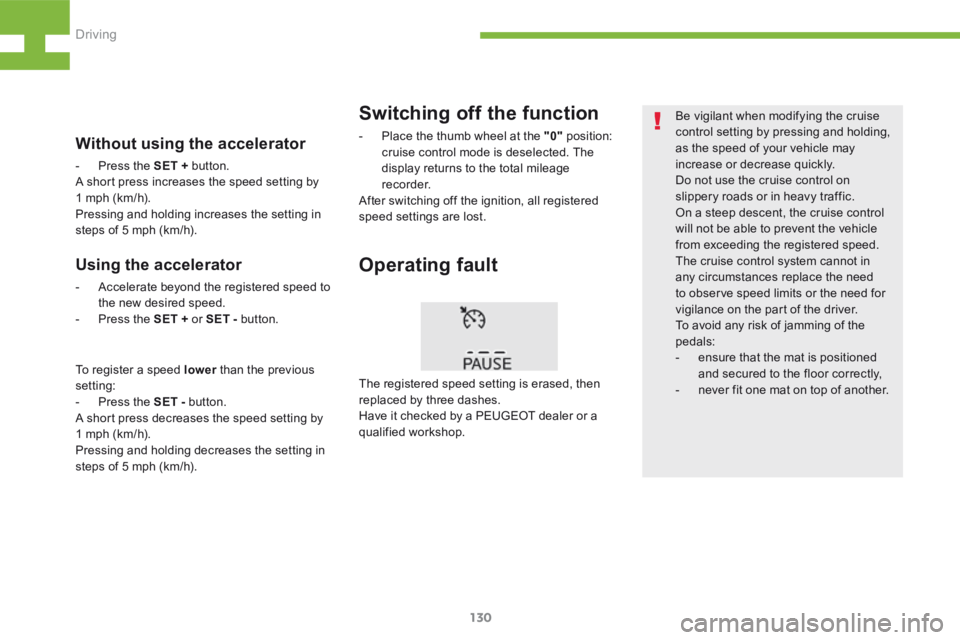
Operating fault
The registered speed setting is erased, then
replaced by three dashes.
Have it checked by a PEUGEOT dealer or a
qualified workshop.
Switching off the function
- Place the thumb wheel at the "0" position:
cruise control mode is deselected. The
display returns to the total mileage
recorder.
After switching off the ignition, all registered
speed settings are lost.Without using the accelerator
- Press the SET + button.
A short press increases the speed setting by
1 mph (km/h).
Pressing and holding increases the setting in
steps of 5 mph (km/h).
Using the accelerator
- Accelerate beyond the registered speed to
the new desired speed.
- Press the SET + or SET - button.
To register a speed lower than the previous
setting:
- Press the SET - button.
A short press decreases the speed setting by
1 mph (km/h).
Pressing and holding decreases the setting in
steps of 5 mph (km/h).
Driving
Page 138 of 341
136
208_en_Chap05_conduite_ed01-2015
Road holding
Definition
Electronic Stability Control (ESC) comprising
the following systems:
- anti-lock braking system (ABS) and
electronic brake force distribution (EBFD),
- emergency braking assistance,
- wheel anti-slip regulation (ASR) or traction
control,
- dynamic stability control (DSC).
Anti-lock braking system (ABS)
and electronic brake force
distribution (EBFD)
Definition
These systems improve the stability and
manoeuvrability of your vehicle when braking
and contribute towards improved control in
corners, in particular on poor or slippery road
surfaces.
The ABS prevents wheel lock in the event of
emergency braking.
The electronic brake force distribution system
manages the braking pressure wheel by wheel.
Emergency braking assistance
Definition
In an emergency, this system enables you to
reach the optimum braking pressure more
quickly and therefore reduce the stopping
distance.
It is triggered in relation to the speed at which
the brake pedal is pressed. This is felt by a
reduction in the resistance of the pedal and an
increase in the effectiveness of the braking.
Anti-slip regulation (ASR)
Definition
This system (also known as Traction Control)
optimises traction in order to avoid wheel
slip by acting on the brakes of the driving
wheels and on the engine. It also improves
the directional stability of the vehicle on
acceleration.
Dynamic stability control (DSC)
Definition
If there is a difference between the path
followed by the vehicle and that required by the
driver, this system monitors each wheel and
automatically acts on the brake of one or more
wheels and on the engine to return the vehicle
to the required path, within the limits of the laws
of physics.
Driving
Page 139 of 341
137
208_en_Chap05_conduite_ed01-2015
Anti-lock braking system
(ABS) and electronic brake
force distribution (EBFD)
Operation
In emergency braking, press
very firmly without releasing the
pressure. When changing wheels (tyres and rims),
make sure that these are approved for
your vehicle.
Normal operation of the ABS may make
itself felt by slight vibrations of the brake
pedal.
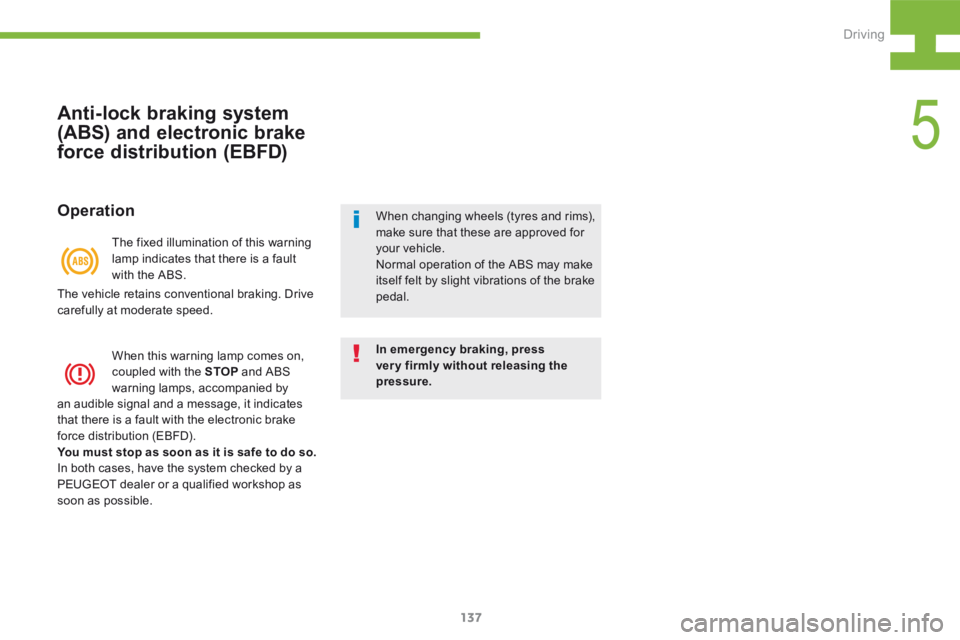
The fixed illumination of this warning
lamp indicates that there is a fault
with the ABS.
When this warning lamp comes on,
coupled with the STOP
and ABS
warning lamps, accompanied by
The vehicle retains conventional braking. Drive
carefully at moderate speed.
an audible signal and a message, it indicates
that there is a fault with the electronic brake
force distribution (EBFD).
You must stop as soon as it is safe to do so.
In both cases, have the system checked by a
PEUGEOT dealer or a qualified workshop as
soon as possible.
5
Driving
Page 140 of 341
138
208_en_Chap05_conduite_ed01-2015
Limits of operation
The DSC system offers exceptional
safety in normal driving, but this should
not encourage the driver to take extra
risks or drive at high speed.
The correct operation of the system
depends on observation of the
manufacturer's recommendations
regarding the wheels (tyres and rims),
the braking components, the electronic
components and the PEUGEOT
assembly and repair procedures.
After an impact, have the system
checked by a PEUGEOT dealer or a
qualified workshop.Fixed illumination
The DSC/ASR system has a fault.
Have the system checked by a PEUGEOT
dealer or a qualified workshop.
F
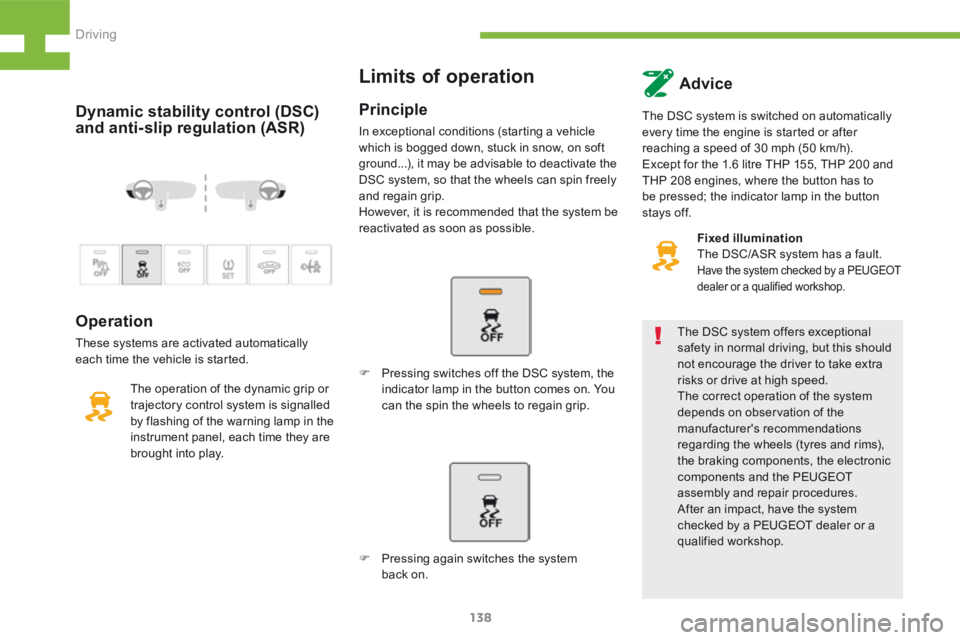
Pressing switches off the DSC system, the
indicator lamp in the button comes on. You
can the spin the wheels to regain grip.
Principle
In exceptional conditions (starting a vehicle
which is bogged down, stuck in snow, on soft
ground...), it may be advisable to deactivate the
DSC system, so that the wheels can spin freely
and regain grip.
However, it is recommended that the system be
reactivated as soon as possible.
Advice
The DSC system is switched on automatically
every time the engine is started or after
reaching a speed of 30 mph (50 km/h).
Except for the 1.6 litre THP 155, THP 200 and
THP 208 engines, where the button has to
be pressed; the indicator lamp in the button
stays of f.
F Pressing again switches the system
back on.Dynamic stability control (DSC)
and anti-slip regulation (ASR)
Operation
These systems are activated automatically
each time the vehicle is started.
The operation of the dynamic grip or
trajectory control system is signalled
by flashing of the warning lamp in the
instrument panel, each time they are
brought into play.
Driving