Page 26 of 271
24
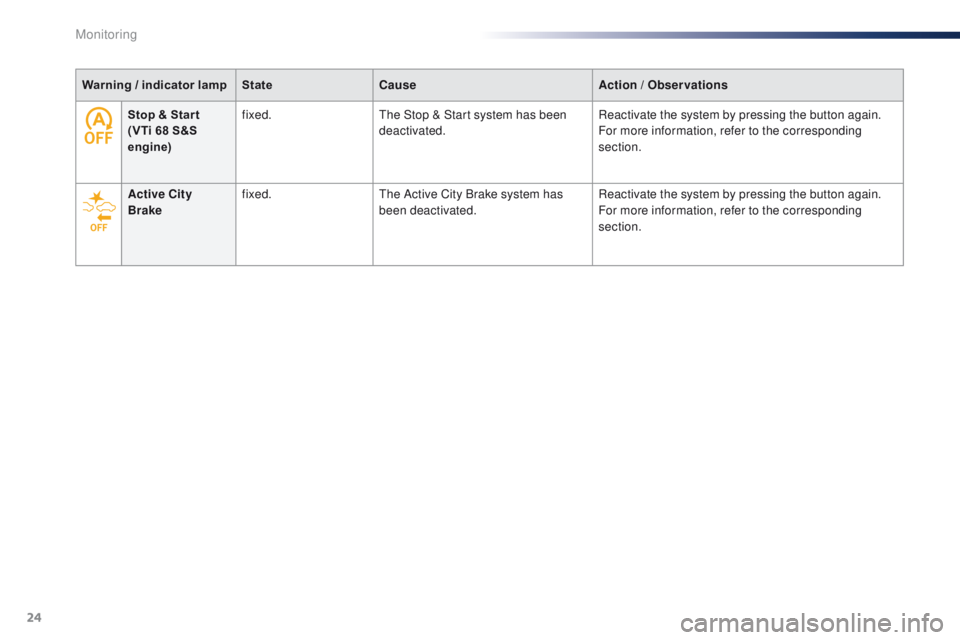
Warning / indicator lampStateCause Action / Observations
Stop & Star t
( VTi 68 S&S
engine) fixed.
th
e Stop & Start system has been
deactivated. Reactivate the system by pressing the button again.
For more information, refer to the corresponding
section.
Active City
Brake fixed.
th
e Active City Brake system has
been deactivated. Reactivate the system by pressing the button again.
For more information, refer to the corresponding
section.
Monitoring
Page 51 of 271
49
108_en_Chap03_confort_ed01-2015
Mirrors
Manual door mirrors
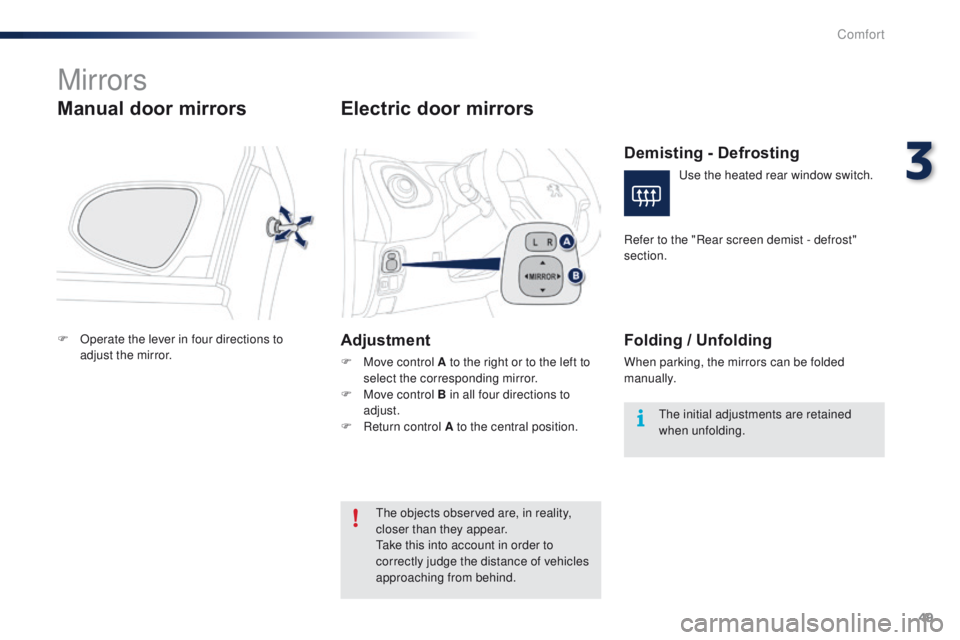
F Operate the lever in four directions to adjust the mirror.
Electric door mirrors
Adjustment
F Move control A to the right or to the left to select the corresponding mirror.
F
M
ove control B in all four directions to
adjust.
F
R
eturn control A to the central position.
th
e objects observed are, in reality,
closer than they appear.
ta
ke this into account in order to
correctly judge the distance of vehicles
approaching from behind.
Demisting - Defrosting
use the heated rear window switch.
Refer to the "Rear screen demist - defrost"
section.
Folding / Unfolding
When parking, the mirrors can be folded
manually.
th
e initial adjustments are retained
when unfolding.
3
Comfort
Page 59 of 271
57
108_en_Chap03_confort_ed01-2015
For maximum cooling or heating of the
cabin, it is possible to go beyond the
minimum 14 or maximum 28 value.
F
P
ress the temperature adjustment
button down or up until "LO" or
"HI" is displayed.
A setting around 21
gives optimum comfort.
However, depending on your requirements, a
setting between 18 and 24 is normal.
On entering the vehicle, if the interior is very
cold or hot, there is no need to change the
value displayed in order to reach the required
level of comfort. t
h
e system corrects the
temperature difference automatically and as
quickly as possible.
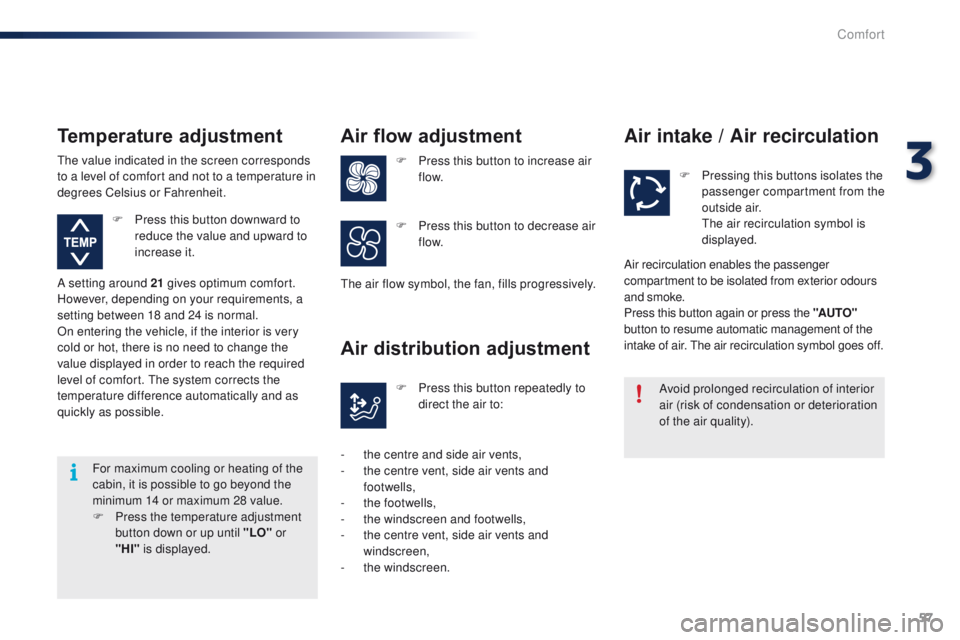
Temperature adjustment
F Press this button downward to reduce the value and upward to
increase it.
th
e value indicated in the screen corresponds
to a level of comfort and not to a temperature in
degrees Celsius or Fahrenheit.
Air flow adjustment
F Press this button to increase air f low.
th
e air flow symbol, the fan, fills progressively. F
P
ress this button to decrease air
f low.
Air distribution adjustment
- the centre and side air vents,
- t he centre vent, side air vents and
footwells,
-
t
he footwells,
-
t
he windscreen and footwells,
-
t
he centre vent, side air vents and
windscreen,
-
t
he windscreen. F
P
ress this button repeatedly to
direct the air to:
Air intake / Air recirculation
Avoid prolonged recirculation of interior
air (risk of condensation or deterioration
of the air quality). F
P
ressing this buttons isolates the
passenger compartment from the
outside air.
t
h
e air recirculation symbol is
displayed.
Air recirculation enables the passenger
compartment to be isolated from exterior odours
and smoke.
Press this button again or press the "AUTO"
button to resume automatic management of the
intake of air. t
h
e air recirculation symbol goes off.
3
Comfort
Page 81 of 271
79
108_en_Chap05_conduite_ed01-2015
System which reduces fuel consumption by recommending the most appropriate gear.
gear shift indicator
Operation
example:
- Y ou are in third gear.
-
Y
ou press the accelerator pedal.
-
t
h
e system may suggest that you engage
a higher gear.
Depending on the driving situation and your
vehicle's equipment, the system may advise
you to change gear.
the
gear engagement recommendations must
not be considered compulsory. In fact, the
configuration of the road, the amount of traffic
and safety remain determining factors when
choosing the best gear. t
her
efore, the driver
remains responsible for deciding whether or not
to follow the advice given by the system.
th
is function cannot be deactivated.
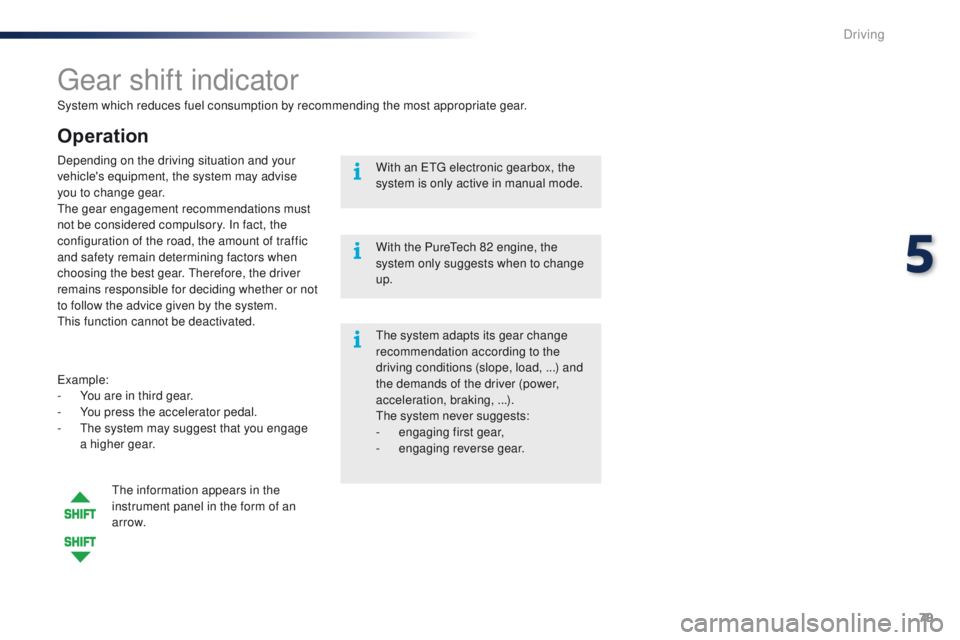
th
e information appears in the
instrument panel in the form of an
ar row.
th
e system adapts its gear change
recommendation according to the
driving conditions (slope, load, ...) and
the demands of the driver (power,
acceleration, braking,
...).
th
e system never suggests:
-
e
ngaging first gear,
-
enga
ging reverse gear.
With an
etg electronic gearbox, the
system is only active in manual mode.
With the Pure
te
ch 82 engine, the
system only suggests when to change
up.
5
Driving
Page 96 of 271
94
108_en_Chap06_visibilite_ed01-2015
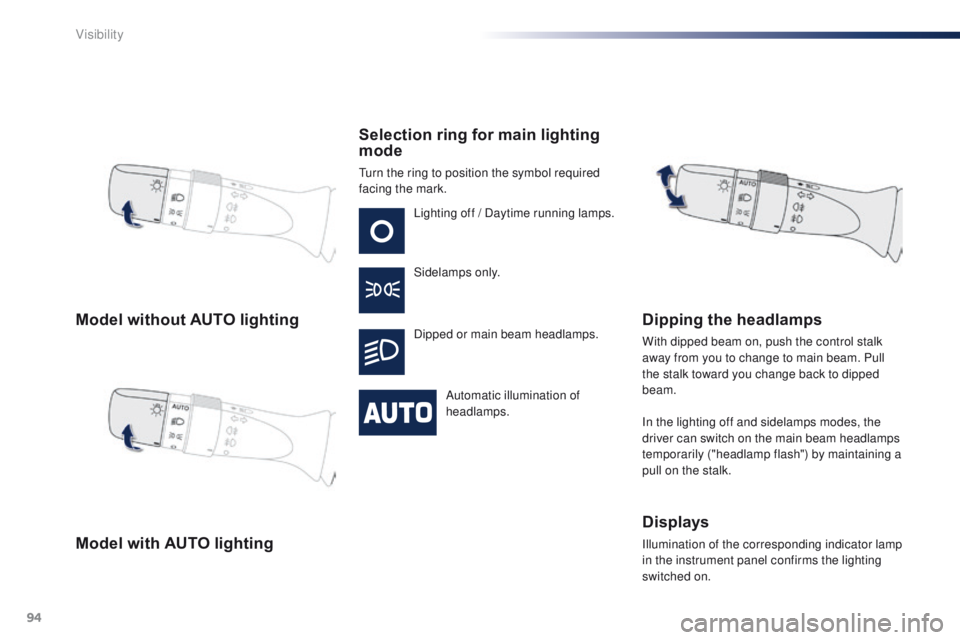
Model without AUTO lighting
Model with AUTO lightingSelection ring for main lighting
mode
turn the ring to position the symbol required
facing the mark.
Lighting off / Daytime running lamps.
Sidelamps only.
Dipped or main beam headlamps.
Automatic illumination of
headlamps.
Dipping the headlamps
With dipped beam on, push the control stalk
away from you to change to main beam. Pull
the stalk toward you change back to dipped
beam.
In the lighting off and sidelamps modes, the
driver can switch on the main beam headlamps
temporarily ("headlamp flash") by maintaining a
pull on the stalk.
Displays
Illumination of the corresponding indicator lamp
in the instrument panel confirms the lighting
switched on.
Visibility
Page 97 of 271

95
108_en_Chap06_visibilite_ed01-2015
Foglamp selection ring
the front foglamps operate with dipped and
main beam headlamps.
Rotate and release the ring:
F
fo
rward once to switch on the rear foglamp,
F
f
or ward again to switch on the front
foglamps,
F
r
ear ward once to switch off the front
foglamps,
F
r
ear ward again to switch of the rear
foglamp. Front foglamps and rear
foglamp In good or rainy weather, both day
and night, the front foglamps and the
rear foglamp are prohibited. In these
situations, the power of their beams
may dazzle other drivers.
t
he
y should
only be used in fog or snow.
In these weather conditions, it is your
responsibility to switch on the foglamps
and dipped beam headlamps manually
as the sunshine sensor may detect
sufficient light.
Do not forget to switch off the front
foglamps and the rear foglamp when
they are no longer necessary.
Switching off the lamps when
the ignition is switched off
On switching off the ignition, all of the
lamps turn off immediately, except for
dipped beam if guide-me-home lighting
is activated.
Switching on the lamps
after the ignition is
switched off
to reactivate the lighting control, rotate
the ring to the "0" position - lamps off,
then to the desired position.
On opening the driver's door a
temporary audible signal warns the
driver that the lighting is on.
When the headlamps switch off with automatic
illumination of headlamps (A
u
t
O m
odel)
or when the dipped beam headlamps are
switched off manually, the foglamps and
sidelamps remain on.
F
t
u
rn the ring rear ward to switch off all the
lamps.
6
Visibility
Page 110 of 271

108
108_en_Chap07_securite_ed01-2015
Active City Brake
Active City Brake is a driving assistance system that aims to avoid a frontal collision or reduce the speed of an impact if the driver does not react or
reacts too late (brake application too late).
th
is system is designed to improve
driving safety.
It remains the driver's responsibility to
continuously monitor the state of the
traffic and to assess the distances and
relative speeds of other vehicles.
Active City Brake can in no
circumstances replace the need for
vigilance on the part of the driver.
Never look at the laser sensor through
an optical instrument (magnifying glass,
microscope...) at a distance of less than
10 centimetres: risk of eye injury.
Automatic braking occurs later than if
done by the driver, so as to intervene
only when there is a high risk of
collision.
Principle
using a laser sensor and a camera located at
the top of the windscreen, this system detects
a vehicle running in the same direction or
stationary ahead of your vehicle.
When necessary, the vehicle's braking system
is operated automatically to reduce the speed
of impact or to help avoid a collision with the
vehicle ahead.
Conditions for activation
Active City Brake only operates if the following
conditions are met:
●
t
he engine is running,
●
t
he vehicle is in a for ward gear,
●
t
he speed is between 9 and 87 mph
(15 and 140 km/h) for triggering the alert ;
the difference in speed between your
vehicle and the one ahead is more than
about 9 mph (15 km/h),
●
t
he speed is between about 18 and 50 mph
(30 and 80 km/h) for braking assistance ;
the difference in speed between your
vehicle and the one ahead is more than
about 18 mph (30 km/h),
●
t
he speed is between about 6 and 50 mph
(10 and 80 km/h) for automatic braking ;
the difference in speed between your
vehicle and the one ahead is more than
about 6 mph (10 km/h),
●
t
he braking assistance systems
(ABS,
e
B
FD, e
B
A) are not faulty,
●
t
he trajectory control systems (TRC, DSC)
are not deactivated or faulty,
●
t
he vehicle is not in a tight corner,
●
t
he system has not been triggered during
the previous 10 seconds.
Safety
Page 120 of 271
118
108_en_Chap07_securite_ed01-2015
Lateral airbags
Deployment
they are deployed unilaterally in the event
of a serious side impact applied to all or part
of the side impact zone B, perpendicular to
the longitudinal centreline of the vehicle on a
horizontal plane and directed from the outside
towards the inside of the vehicle.
th
e lateral airbag inflates between the hip and
shoulder of the front occupant of the vehicle
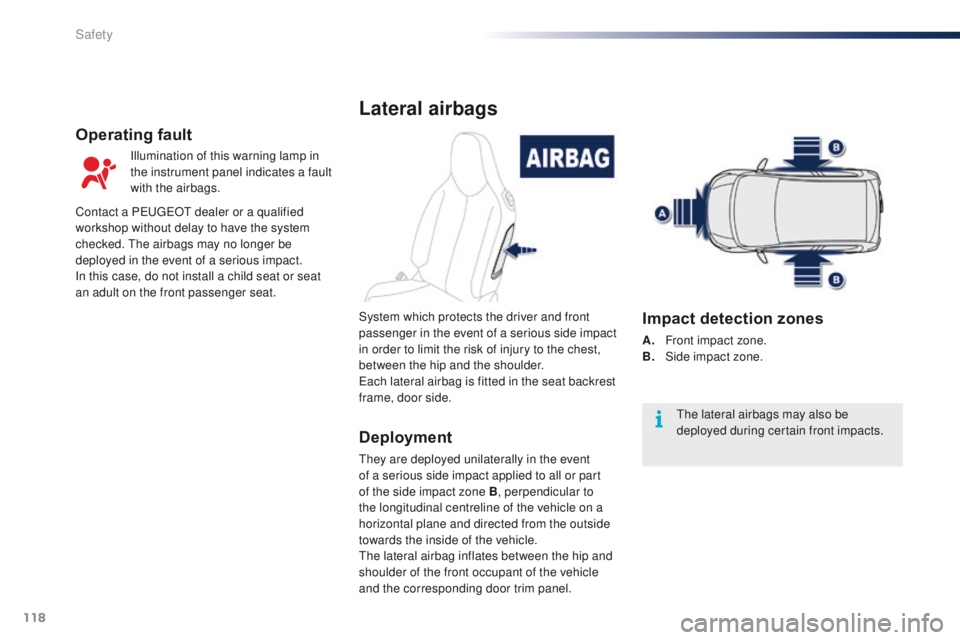
and the corresponding door trim panel. System which protects the driver and front
passenger in the event of a serious side impact
in order to limit the risk of injury to the chest,
between the hip and the shoulder.
ea
ch lateral airbag is fitted in the seat backrest
frame, door side.
Impact detection zones
A. Front impact zone.
B. S ide impact zone.
Operating fault
Illumination of this warning lamp in
the instrument panel indicates a fault
with the airbags.
Contact a P
e
uge
Ot
dealer or a qualified
workshop without delay to have the system
checked.
t
h
e airbags may no longer be
deployed in the event of a serious impact.
In this case, do not install a child seat or seat
an adult on the front passenger seat.
th
e lateral airbags may also be
deployed during certain front impacts.
Safety