Page 20 of 396
1 Safety—Seats, seat belts and
supplemental restraint system
Seats............................................1-2
Front manual seat adjustment . . ..................1-2
Flexible seating .................................1-4
Head restraints/Headrests ..........................1-8
Adjustable head restraint/headrest
components ...................................1-9
Non-adjustable head restraint/headrest
components .................................. 1-10
Remove ...................................... 1-10
Install ........................................ 1-11
Adjust ........................................ 1-11
Front-seat active head restraints ................1-12
Seat belts ....................................... 1-13
Precautions on seat belt usage ..................1-13
Seat belt warning light ......................... 1-16
Pregnant women .............................. 1-16
Injured persons ................................ 1-16
Three-point type seat belt with retractor ..........1-16
Seat belt extenders ............................ 1-23
Seat belt maintenance ......................... 1-23
Child safety ...................................... 1-24
Infants ........................................ 1-25Small children
................................. 1-25
Larger children ................................ 1-25
Child restraints ................................... 1-26
Precautions on child restraints ..................1-26
LATCH (Lower Anchors and Tethers for
CHildren) System ............................. 1-28
Rear-facing child restraint installation using
LATCH....................................... 1-31
Rear-facing child restraint installation using
the seat belts ................................. 1-33
Forward-facing child restraint installation
using LATCH .................................. 1-36
Installing top tether strap .......................1-38
Rear bench seat ............................... 1-39
Forward-facing child restraint installation
using the seat belts ............................ 1-39
Installing top tether strap .......................1-43
Rear bench seat ............................... 1-43
Booster seats ................................. 1-44
Supplemental
restraint system (SRS) . . .............1-47
Precautions on SRS ........................... 1-47
Supplemental air bag warning labels .............1-61
Supplemental air bag warning light ..............1-62
Page 24 of 396
A. Straps
Folding the rear bench seat
To fold the rear bench seat flat for maximum
cargo hauling:1. Disconnect and secure the center seat belt and tongues into the retractor base. For
additional information, refer to “Stowing the
center seat belt” in this section. Then prop-
erly stow the outboard seat belts in the seat
belt hooks before folding down the rear
seats. For additional information, refer to
“Seat belt hook” in this section. The head restraint/headrest must be re-
moved before folding down the seatbacks.
To remove the head restraint/headrest, push
and hold the lock knob while moving the
head restraint/headrest in an upward direc-
tion. Store the head restraint/headrest prop-
erly so it is not loose in the vehicle.
Pull the strap forward, located in the center
of each seat cushion, and fold each seat
cushion toward the front of the vehicle.
�2Then pull the straps located on the outside
edge of each seatback to fold the seatbacks
forward.
LRS2490LRS2549
Safety—Seats, seat belts and supplemental restraint system1-5
Page 25 of 396
3. This provides a level cargo floor.4. To return the bench seats to a seating posi-
tion, reverse this process. Raise the seat-
backs to an upright position. Make
sure to hold the seat belts above the
seat cushion, then push the seat cush-
ion down into place.
5. To return the head restraint/headrest to the normal position, align the head
restraint/headrest stalks with the holes in the
seat. Push and hold the lock knob and push
the head restraint/headrest down until it
locks in place.
Removing the rear row bench seat
cushions
The rear seat cushion can be removed to provide
additional space when folding the rear seatbacks
flat. To remove the rear bench seat cushions:
LRS2482LRS2483
1-6Safety—Seats, seat belts and supplemental restraint system
Page 26 of 396
A. Straps
1. Pull the straps forward, located in the centerof each seat cushion, to fold the seat cush-
ions forward.
B. Release handles (red)
2. Lift up and fold each of the red releasehandles on the seat base toward the front of
the vehicle. This will release the seat cushion
from the seat base. 3. Then lift up on the seat cushion to remove it
from the seat base. Be sure to store it in a
secure place.
To return the rear seatback to a seating position: 1. Push the anchor bars on the bottom of the seat cushions down into the seat base.
2. Rotate the seat cushion toward the rear of the vehicle and push down until they are
folded flat to secure each seat cushion to the
seat base. Make sure to hold the seat
belts above the seat cushion and prop-
erly push the seat cushion down into
place.
LRS2490LRS2491LRS2500
Safety—Seats, seat belts and supplemental restraint system1-7
Page 27 of 396
WARNING
●Never allow anyone to ride in the cargo
area or on the rear seat when it is in the
fold-down position. Use of these areas
by passengers without proper restraints
could result in serious injury in an acci-
dent or sudden stop.
● Do not allow people to ride in any area
of your vehicle that is not equipped with
seats and seat belts. Be sure everyone
in your vehicle is in a seat and using a
seat belt properly. Never ride in the rear
seat unless the seat bottom cushions
are in place and latched.
● Properly secure all cargo with ropes or
straps to help prevent it from sliding or
shifting. In a sudden stop or collision,
unsecured cargo could cause personal
injury.
● When returning the seatbacks to the
upright position, be certain they are
completely secured in the latched posi-
tion. If they are not completely secured,
passengers may be injured in an acci-
dent or sudden stop. ●
If the seat cushions are removed for any
reason, they should be securely stored
to prevent them from causing injury to
passengers or damage to the vehicle in
case of sudden braking or an accident.
WARNING
Head restraints/headrests supplement
the other vehicle safety systems. They may
provide additional protection against in-
jury in certain rear end collisions. Adjust-
able head restraints/headrests must be
adjusted properly, as specified in this sec-
tion. Check the adjustment after someone
else uses the seat. Do not attach anything
to the head restraint/headrest stalks or
remove the head restraint/headrest. Do
not use the seat if the head
restraint/headrest has been removed. If
the head restraint/headrest was removed,
reinstall and properly adjust the head
restraint/headrest before an occupant
uses the seating position. Failure to fol-
low these instructions can reduce the ef-
fectiveness of the head
restraints/headrests. This may increase
the risk of serious injury or death in a
collision.
HEAD RESTRAINTS/HEADRESTS
1-8Safety—Seats, seat belts and supplemental restraint system
Page 29 of 396
NON-ADJUSTABLE HEAD
RESTRAINT/HEADREST
COMPONENTS
1. Removable head restraint/headrest
2. Single notch
3. Lock knob
4. Stalks
REMOVE
Use the following procedure to remove the head
restraint/headrest:1. Pull the head restraint/headrest up to the highest position.
2. Push and hold the lock knob.
3. Remove the head restraint/headrest from the seat.
4. Store the head restraint/headrest properly in a secure place so it is not loose in the
vehicle. 5. Reinstall and properly adjust the head
restraint/headrest before an occupant uses
the seating position.
LRS2299LRS2302
1-10Safety—Seats, seat belts and supplemental restraint system
Page 51 of 396
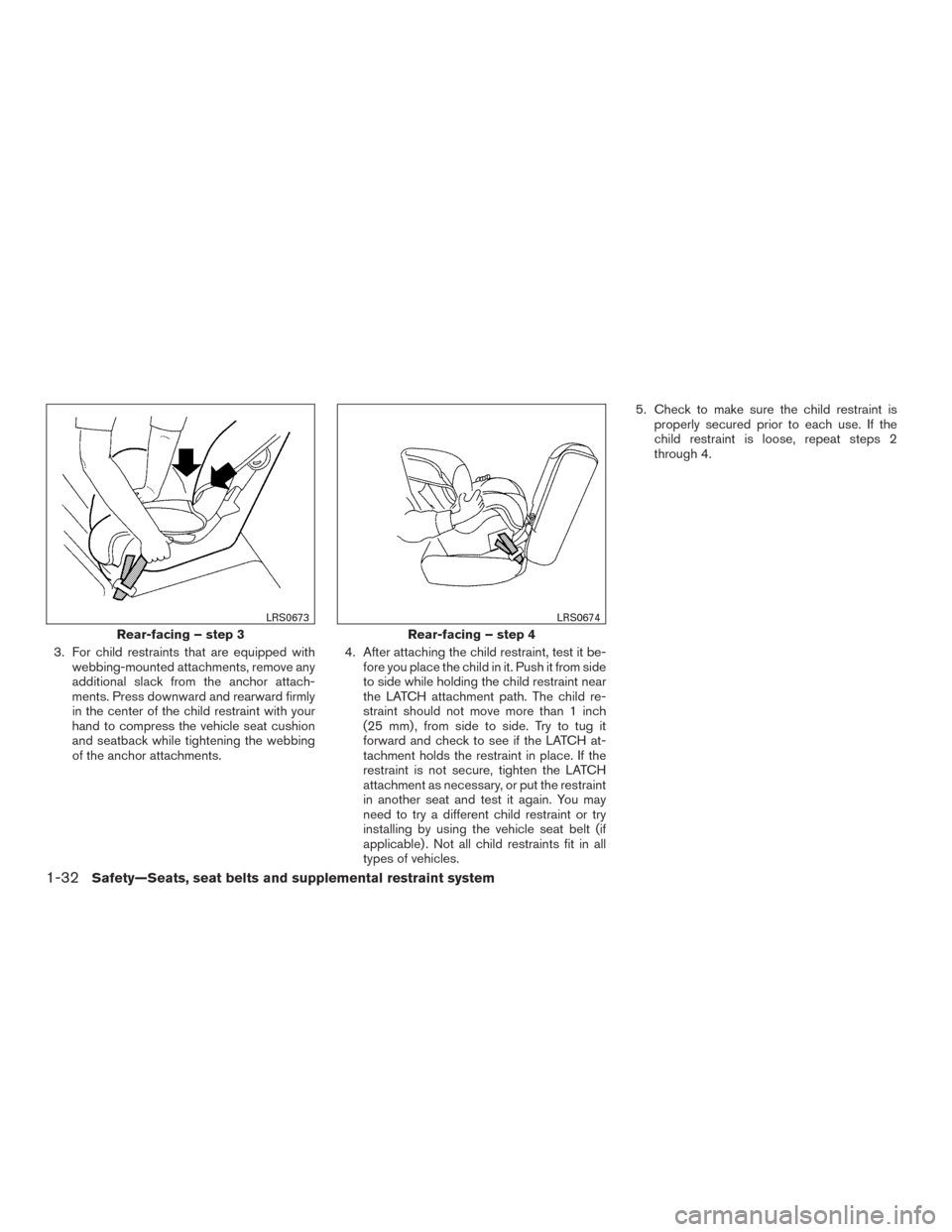
3. For child restraints that are equipped withwebbing-mounted attachments, remove any
additional slack from the anchor attach-
ments. Press downward and rearward firmly
in the center of the child restraint with your
hand to compress the vehicle seat cushion
and seatback while tightening the webbing
of the anchor attachments. 4. After attaching the child restraint, test it be-
fore you place the child in it. Push it from side
to side while holding the child restraint near
the LATCH attachment path. The child re-
straint should not move more than 1 inch
(25 mm) , from side to side. Try to tug it
forward and check to see if the LATCH at-
tachment holds the restraint in place. If the
restraint is not secure, tighten the LATCH
attachment as necessary, or put the restraint
in another seat and test it again. You may
need to try a different child restraint or try
installing by using the vehicle seat belt (if
applicable) . Not all child restraints fit in all
types of vehicles. 5. Check to make sure the child restraint is
properly secured prior to each use. If the
child restraint is loose, repeat steps 2
through 4.
Rear-facing – step 3
LRS0673
Rear-facing – step 4
LRS0674
1-32Safety—Seats, seat belts and supplemental restraint system
Page 54 of 396
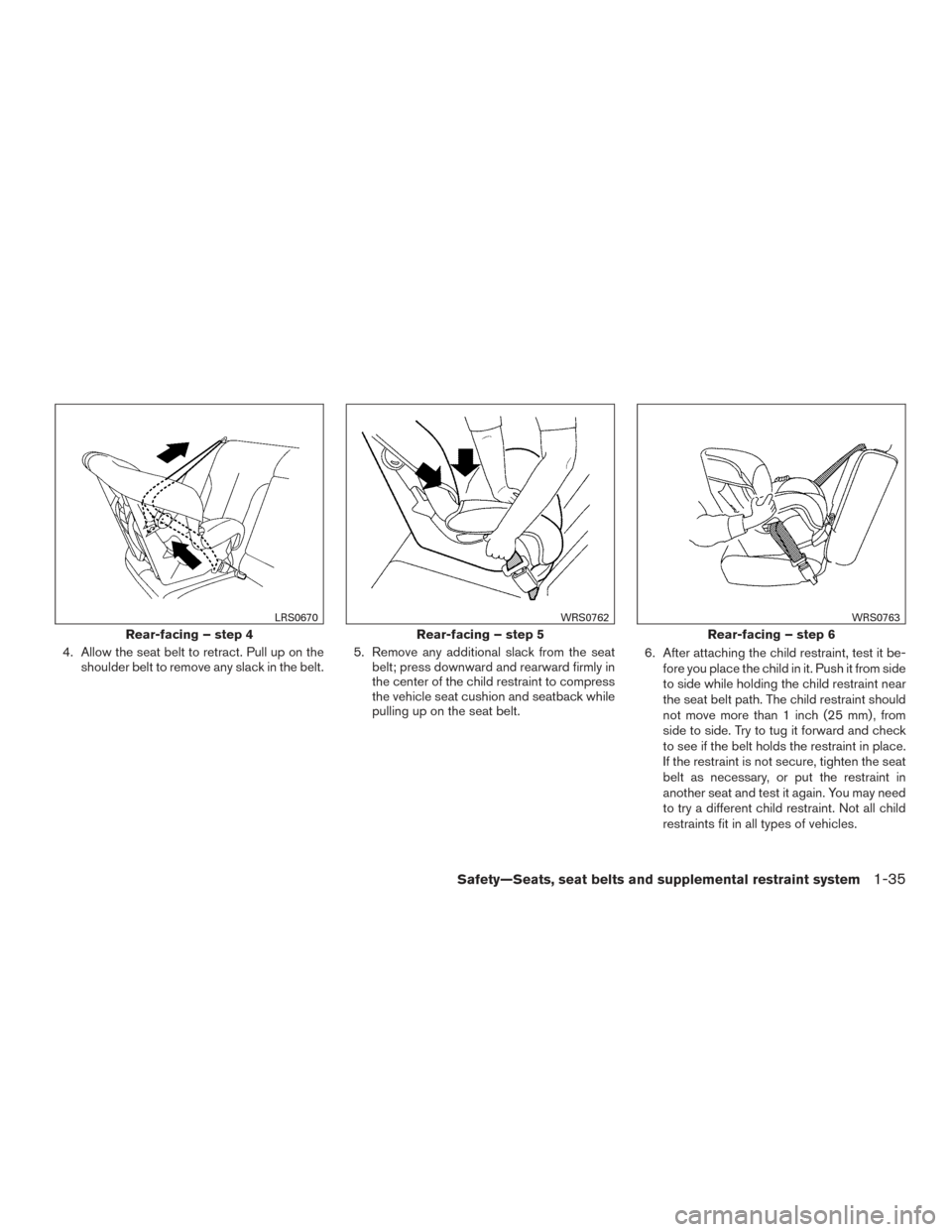
4. Allow the seat belt to retract. Pull up on theshoulder belt to remove any slack in the belt. 5. Remove any additional slack from the seat
belt; press downward and rearward firmly in
the center of the child restraint to compress
the vehicle seat cushion and seatback while
pulling up on the seat belt. 6. After attaching the child restraint, test it be-
fore you place the child in it. Push it from side
to side while holding the child restraint near
the seat belt path. The child restraint should
not move more than 1 inch (25 mm) , from
side to side. Try to tug it forward and check
to see if the belt holds the restraint in place.
If the restraint is not secure, tighten the seat
belt as necessary, or put the restraint in
another seat and test it again. You may need
to try a different child restraint. Not all child
restraints fit in all types of vehicles.
Rear-facing – step 4
LRS0670
Rear-facing – step 5
WRS0762
Rear-facing – step 6
WRS0763
Safety—Seats, seat belts and supplemental restraint system1-35