2015 NISSAN GT-R engine
[x] Cancel search: enginePage 254 of 358
6 In case of emergency
Hazard warning flasher switch..................�-..................�-......... 6-�f
Roadside assistance progra�b ..................�-..................�-.......... 6-�f
E�bergency engine shut off ..................�-..................�-................ 6-3
Flat tire ..................�-..................�-..................�-..................�-................ 6-3 Tire Pressure Monitoring Syste�b (TPMS) ..................�-. 6-3
Run-flat tires ..................�-..................�-..................�-..................�- 6-4 Ju�bp starting ..................�-..................�-..................�-..................�-.... 6-5
Push starting ..................�-..................�-..................�-..................�-..... 6-7
If your vehicle overheats ..................�-..................�-..................�-.. 6-8
Towing your vehicle ..................�-..................�-..................�-.......... 6-9
Towing reco�b�bended by NISSAN ..................�-........... 6-9
Vehicle recovery (freeing a stuck vehicle) .............. 6-10
6 In case of emergency
Hazard warning flasher switch ..................�-..................�-......... 6-�f
Roadside assistance progra�b ..................�-..................�-.......... 6-�f
E�bergency engine shut off ..................�-..................�-................ 6-3
Flat tire ..................�-..................�-..................�-..................�-................ 6-3 Tire Pressure Monitoring Syste�b (TPMS) ..................�-. 6-3
Run-flat tires ..................�-..................�-..................�-..................�- 6-4 Ju�bp starting ..................�-..................�-..................�-..................�-.... 6-5
Push starting ..................�-..................�-..................�-..................�-..... 6-7
If your vehicle overheats ..................�-..................�-..................�-.. 6-8
Towing your vehicle ..................�-..................�-..................�-.......... 6-9
Towing reco�b�bended by NISSAN ..................�-........... 6-9
Vehicle recovery (freeing a stuck vehicle) .............. 6-10
Page 256 of 358
To shut off the engine in an emergency situation
while dri�fing, perform the following procedure:
.�bapidly push the push-button ignition switch
3 consecuti�fe times in less than 1.5
seconds, or
. Push and hold the push-button ignition
switch for more than 2 seconds.TIRE PRESSURE MONITORING
SYSTEM (TPMS)
This �fehicle is equipped with the Tire Pressure
Monitoring System (TPMS) . It monitors tire
pressure of all tires. When the low tire pressure
warning light is lit, one or more of your tires is
significantly under-inflated. If the �fehicle is being
dri�fen with low tire pressure, the TPMS will
acti�fate and warn you of it by the low tire
pressure warning light (in the instrument panel)
or the warning message (on the display) . This
system will acti�fate only when the �fehicle is
dri�fen at speeds abo�fe 16 MPH (25 km/h) .
(
“Low tire pressure warning light” page 2-
27) (“Tire Pressure Monitoring System
(TPMS)” page 5-4)
WARNING
. If the low tire pressure warning light
illuminates while driving, avoid sud-
den steering maneuvers or abrupt
braking, reduce vehicle speed, pull
off the road to a safe location and
stop the vehicle as soon as possi-
ble. Driving with under-inflated tires
may permanently damage the tires
and increase the likelihood of tire
failure. Serious vehicle damage could occur and may lead to an
accident and could result in serious
personal injury. Check the tire pres-
sure for all four tires. Adjust the tire
pressure to the recommended COLD
tire pressure shown on the Tire and
Loading Information label to turn
the low tire pressure warning light
off. If the light still illuminates while
driving after adjusting the tire pres-
sure, a tire may be flat.
. When a wheel is replaced, the TPMS
will not function and the low tire
pressure warning light will flash for
approximately 1 minute. The light
will remain on after 1 minute. Con-
tact a GT-R certified NISSAN dealer
as soon as possible for tire replace-
ment and/or system resetting.
. Replacing tires with those not ori-
ginally specified by NISSAN could
affect the proper operation of the
TPMS.
. Do not inject any tire liquid or
aerosol tire sealant into the tires,
as this may cause a malfunction of
the tire pressure sensors.
In case of emergency6-3
EMERGENCY ENGINE SHUT OFF FLAT TIRE
Page 257 of 358
6-4In case of emergency
NOTE:
.You can check the pressure of all four
tires on the multi function display. See
the separate Multi Function Display
Owner’s Manual.
. The tires of this vehicle are filled with
nitrogen gas. When the tire pressure is
low, fill the tires with nitrogen. Contact
a GT-R certified NISSAN dealer for
information on filling the tires with
nitrogen.
. If nitrogen is not available, compressed
air may be safely used under normal
driving conditions. However, NISSAN
recommends refilling with nitrogen for
maximum tire performance.
RUN-FLAT TIRES
Run-flat tires are those tires that can be used
te�fporarily if they are punctured. �b“Run-flat
tires” page 8-39)
Also, see the tire safety infor�fation in the
Warranty Infor�fation Booklet.
WARNING
. Although you can continue driving
with a punctured run-flat tire, re-
member that vehicle handling sta-
bility is reduced, which could lead to
an accident and personal injury.
Also, driving a long distance at high
speeds may damage the tires.
. Do not drive at speeds above 50
MPH (80 km/h) and do not drive
more than 50 miles (80 km) with a
punctured run-flat tire. The actual
distance the vehicle can be driven
on a flat tire depends on outside
temperature, vehicle load, road con-
ditions and other factors.
. Drive safely at reduced speeds.
Avoid hard cornering or braking,
which may cause you to lose control
of the vehicle.
NOTICE
.Never install tire chains on a punc-
tured run-flat tire, as this could
damage your vehicle.
. Avoid driving over any projection or
pothole, as the clearance between
the vehicle and the ground is smal-
ler than normal.
. Do not enter an automated car wash
with a punctured run-flat tire.
. Have the punctured tire replaced by
your GT-R certified NISSAN dealer
as soon as possible, as the tire’s
performance capability is reduced.
If you have a flat tire and have to stop the
vehicle, follow the instructions below.
1. Safely �fove the vehicle off the road and away fro�f traffic.
2. Turn on the hazard warning flashers.
3. Park on a level surface and apply the parking brake. Move the shift lever to the
&Pposition.
4. Turn off the engine.
5. Raise the hood to warn other traffic, and to signal professional road assistance person-
nel that you need assistance.
Page 258 of 358
6. Have all passengers get out of the vehiclean\f stan\f in a safe place, away fro\b traffic
an\f clear of the vehicle.
For the tire re\boving proce\fure, see the
following section. (
“Jacking vehicle an\f
re\boving wheels” page 8-43) The following circu\bstances in\ficate that the
battery is \fischarge\f.
.
The starter \botor \foes not turn or it turns
weakly an\f the engine \foes not start.
. The vehicle lights are \buch \fi\b\ber than
usual.
. The soun\f of the horn is weak. The horn
\bakes no soun\f.
NOTICE
When the battery is discharged, do not
close either of the front doors. The
automatic window adjusting function
will not work, and the side roof panel
may be damaged.
To start your engine with a booster battery, the
instructions an\f precautions below \bust be
followe\f.
For the battery \baintenance infor\bation, see the
following section. (
“Battery” page 8-17)
WARNING
. If done incorrectly, jump starting
can lead to a battery explosion,
resulting in severe injury or death.
It could also damage your vehicle.
. Explosive hydrogen gas is always
present in the vicinity of the battery.
Keep all sparks and flames away
from the battery.
. Do not allow battery fluid to come
into contact with eyes, skin, clothing
or painted surfaces. Battery fluid is
a corrosive sulphuric acid solution
which can cause severe burns. If the
fluid should come into contact with
anything, immediately flush the con-
tacted area with water.
. Keep the battery out of the reach of
children.
. The booster battery must be rated at
12 volts. Use of an improperly rated
battery can damage your vehicle.
. Whenever working on or near a
battery, always wear suitable eye
protectors (for example, goggles or
industrial safety spectacles) and
In case of emergency6-5
JUMP STARTING
Page 260 of 358
electrical systems (light, heater, air condi-
tioner, etc.�f .
3. Remove the �battery cover. Cover the �battery with a firmly wrung out moist cloth to reduce
explosion hazard.
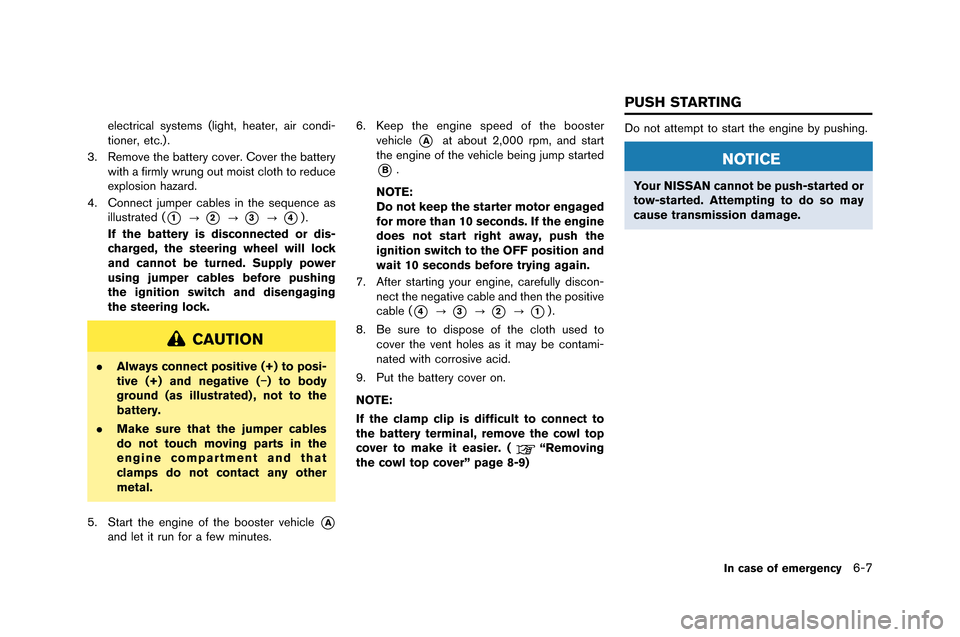
4. Connect jumper ca�bles in the sequence as illustrated (
*1?*2?*3?*4�f.
If the battery is disconnected or dis-
charged, the steering wheel will lock
and cannot be turned. Supply power
using jumper cables before pushing
the ignition switch and disengaging
the steering lock.
CAUTION
. Always connect positive (+) to posi-
tive (+) and negative (í) to body
ground (as illustrated) , not to the
battery.
. Make sure that the jumper cables
do not touch moving parts in the
engine compartment and that
clamps do not contact any other
metal.
5. Start the engine of the �booster vehicle
*A
and let it run for a few minutes. 6. Keep the engine speed of the �booster
vehicle
*Aat a�bout 2,000 rpm, and start
the engine of the vehicle �being jump started
*B.
NOTE:
Do not keep the starter motor engaged
for more than 10 seconds. If the engine
does not start right away, push the
ignition switch to the OFF position and
wait 10 seconds before trying again.
7. After starting your engine, carefully discon- nect the negative ca�ble and then the positive
ca�ble (
*4?*3?*2?*1�f.
8. Be sure to dispose of the cloth used to cover the vent holes as it may �be contami-
nated with corrosive acid.
9. Put the �battery cover on.
NOTE:
If the clamp clip is difficult to connect to
the battery terminal, remove the cowl top
cover to make it easier. (
“Removing
the cowl top cover” page 8-9) Do not attempt to start the engine �by pushing.
NOTICE
Your NISSAN cannot be push-started or
tow-started. Attempting to do so may
cause transmission damage.
In case of emergency6-7
PUSH STARTING
Page 261 of 358
6-8In case of emergency
WARNING
.Do not continue to drive if your
vehicle overheats. Doing so could
cause engine damage or a vehicle
fire.
. To avoid the danger of being
scalded, never remove the radiator
filler cap and the coolant reservoir
cap while the engine is still hot.
When the cap is removed, pressur-
ized hot water will spurt out, possi-
bly causing serious injury.
. Do not open the hood if steam is
coming out.
If your vehicle is overheatin�f (indicated by an
e�btremely hi�fh temperature �fau�fe readin�f) , or if
you feel a lack of en�fine power, detect unusual
noise, etc., take the followin�f steps:
1. Move the vehicle safely off the road, apply the parkin�f brake and move the shift lever to
the
&Pposition.
Do not stop the engine.
2. Turn off the air conditioner. Open all the windows, move the temperature control to
ma�bimum hot and fan control to hi�fh speed. 3. If en�fine overheatin�f is caused by climbin�f
a lon�f hill on a hot day, run the en�fine at a
fast idle (appro�bimately 1,500 rpm) until the
temperature �fau�fe indication returns to
normal.
4. Get out of the vehicle. Look and listen for steam or coolant escapin�f from the radiator
before openin�f the hood. (If steam or
coolant is escapin�f, turn off the en�fine.)
Do not open the hood further until no steam
or coolant can be seen.
5. Open the en�fine hood.
WARNING
If steam or water is coming from the
engine, stand clear to prevent getting
burned.
6. Visually check drive belts for dama�fe or looseness. Also check if the coolin�f fan is
runnin�f. The radiator hoses and radiator
should not leak water. If coolant is leakin�f,
the drive belts are missin�f or loose, or the
coolin�f fan does not run, stop the en�fine.
WARNING
Be careful not to allow your hands, hair,
jewelry or clothing to come into contact
with, or get caught in, engine belts or
the engine cooling fan. The engine
cooling fan can start at any time.
7. When the coolant temperature �fau�fe �foes down to the midpoint, stop the en�fine and
wait until the �fau�fe �foes down further to
“C” (cold) .
8. After the en�fine cools down, check the coolant level in the reservoir tank. Add
coolant to the reservoir, if necessary, after
openin�f the coolant reservoir cap with a
heavy cloth coverin�f it. (
“En�fine cool-
in�f system” pa�fe 8-10)
9. Have your vehicle repaired at the nearest GT-R certified NISSAN dealer.
IF YOUR VEHICLE OVERHEATS
Page 276 of 358
8 Maintenance and do-it-yourself
Maintenance requirement..................�l..................�l..................�l. 8-3
Scheduled maintenance ..................�l..................�l............... 8-3
�feneral maintenance ..................�l..................�l..................�l.. 8-3
Where to go �bor service ..................�l..................�l............... 8-3
�feneral maintenance ..................�l..................�l..................�l........ 8-4 Explanation o�b maintenance items ..................�l............... 8-4
Maintenance precautions ..................�l..................�l..................�l. 8-6
Engine compartment check locations ..................�l............... 8-8 Removing the cowl top cover ..................�l..................�l..... 8-9
Engine cooling system ..................�l..................�l..................�l... 8-10
Checking engine coolant level ..................�l..................�l. 8-11
Changing engine coolant ..................�l..................�l.......... 8-12
Engine oil ..................�l..................�l..................�l..................�l........ 8-13
Checking engine oil level ..................�l..................�l.......... 8-13
Changing engine oil and �bilter ..................�l..................�l.. 8-14
Transmission oil ..................�l..................�l..................�l............... 8-14
Power steering �bluid ..................�l..................�l..................�l........ 8-14
Brake �bluid ..................�l..................�l..................�l..................�l....... 8-15
Window washer �bluid ..................�l..................�l..................�l..... 8-16
Battery ..................�l..................�l..................�l..................�l.............. 8-17
Precautions ..................�l..................�l..................�l................. 8-17
Fluid level check ..................�l..................�l..................�l........ 8-18
Jump starting ..................�l..................�l..................�l.............. 8-19 Drive belts ..................�l..................�l..................�l..................�l...... 8-19
Spark plugs ..................�l..................�l..................�l..................�l.... 8-20
Replacing spark plugs ..................�l..................�l............. 8-20
Air cleaner ..................�l..................�l..................�l..................�l...... 8-21
Windshield wiper blades ..................�l..................�l................ 8-22 Cleaning ..................�l..................�l..................�l..................�l.. 8-22
Replacing the wiper blades ..................�l..................�l... 8-22
Brakes ..................�l..................�l..................�l..................�l............. 8-23 Sel�b-adjusting brakes ..................�l..................�l............... 8-23
Brake pad wear warning ..................�l..................�l......... 8-23
High per�bormance brake system ..................�l............. 8-23
Replacing the brake pads ..................�l..................�l....... 8-24
Fuses ..................�l..................�l..................�l..................�l............... 8-24
Engine compartment ..................�l..................�l................ 8-24
Passenger compartment ..................�l..................�l......... 8-25
Intelligent Key battery replacement ..................�l................ 8-27
Lights ..................�l..................�l..................�l..................�l............... 8-29 Headlights ..................�l..................�l..................�l................. 8-30
Exterior and interior lights ..................�l..................�l....... 8-30
Wheels and tires ..................�l..................�l..................�l............ 8-32
Tire pressure ..................�l..................�l..................�l............ 8-32
Tire and loading in�bormation label ..................�l.......... 8-35
Checking the tire pressure ..................�l..................�l..... 8-36
8 Maintenance and do-it-yourself
Maintenance requirement ..................�l..................�l..................�l. 8-3
Scheduled maintenance ..................�l..................�l............... 8-3
�feneral maintenance ..................�l..................�l..................�l.. 8-3
Where to go �bor service ..................�l..................�l............... 8-3
�feneral maintenance ..................�l..................�l..................�l........ 8-4 Explanation o�b maintenance items ..................�l............... 8-4
Maintenance precautions ..................�l..................�l..................�l. 8-6
Engine compartment check locations ..................�l............... 8-8 Removing the cowl top cover ..................�l..................�l..... 8-9
Engine cooling system ..................�l..................�l..................�l... 8-10
Checking engine coolant level ..................�l..................�l. 8-11
Changing engine coolant ..................�l..................�l.......... 8-12
Engine oil ..................�l..................�l..................�l..................�l........ 8-13
Checking engine oil level ..................�l..................�l.......... 8-13
Changing engine oil and �bilter ..................�l..................�l.. 8-14
Transmission oil ..................�l..................�l..................�l............... 8-14
Power steering �bluid ..................�l..................�l..................�l........ 8-14
Brake �bluid ..................�l..................�l..................�l..................�l....... 8-15
Window washer �bluid ..................�l..................�l..................�l..... 8-16
Battery ..................�l..................�l..................�l..................�l.............. 8-17
Precautions ..................�l..................�l..................�l................. 8-17
Fluid level check ..................�l..................�l..................�l........ 8-18
Jump starting ..................�l..................�l..................�l.............. 8-19 Drive belts ..................�l..................�l..................�l..................�l...... 8-19
Spark plugs ..................�l..................�l..................�l..................�l.... 8-20
Replacing spark plugs ..................�l..................�l............. 8-20
Air cleaner ..................�l..................�l..................�l..................�l...... 8-21
Windshield wiper blades ..................�l..................�l................ 8-22 Cleaning ..................�l..................�l..................�l..................�l.. 8-22
Replacing the wiper blades ..................�l..................�l... 8-22
Brakes ..................�l..................�l..................�l..................�l............. 8-23 Sel�b-adjusting brakes ..................�l..................�l............... 8-23
Brake pad wear warning ..................�l..................�l......... 8-23
High per�bormance brake system ..................�l............. 8-23
Replacing the brake pads ..................�l..................�l....... 8-24
Fuses ..................�l..................�l..................�l..................�l............... 8-24
Engine compartment ..................�l..................�l................ 8-24
Passenger compartment ..................�l..................�l......... 8-25
Intelligent Key battery replacement ..................�l................ 8-27
Lights ..................�l..................�l..................�l..................�l............... 8-29 Headlights ..................�l..................�l..................�l................. 8-30
Exterior and interior lights ..................�l..................�l....... 8-30
Wheels and tires ..................�l..................�l..................�l............ 8-32
Tire pressure ..................�l..................�l..................�l............ 8-32
Tire and loading in�bormation label ..................�l.......... 8-35
Checking the tire pressure ..................�l..................�l..... 8-36
Page 278 of 358
Some day-to-day and regular maintenance is
essential to maintain your vehicle good mechan-
ical condition�f as well as its emission and engine
performance�b
It is the owner’s responsibility to make sure that
the scheduled maintenance�f as well as general
maintenance�f is performed�b
As the vehicle owner�f you are the only one who
can ensure that your vehicle receives the proper
maintenance care�b You are a vital link in the
maintenance chain�b
SCHEDULED MAINTENANCE
For your convenience�f both required and op-
tional scheduled maintenance items are de-
scribed and listed in your NISSAN Service and
Maintenance Guide�b You must refer to that guide
to ensure that necessary maintenance is per-
formed on your vehicle at regular intervals�b
GENERAL MAINTENANCE
General maintenance includes those items
which should be checked during normal day-
to-day operation�b They are essential for proper
vehicle operation�b It is your responsibility to
perform these procedures regularly as pre-
scribed�b
Performing general maintenance checks re-
quires minimal mechanical skill and only a fewgeneral automotive tools�b
These checks or inspections can be done by
yourself�f a qualified technician or�f if you prefer�f a
GT-R certified NISSAN dealer�b
WHERE TO GO FOR SERVICE
GT-R certified NISSAN dealers are required to
have additional training and equipment and are
the only NISSAN dealers authorized to perform
warranty work on key vehicle performance
systems such as engine�f transmission�f suspen-
sion and brakes�b
If maintenance service is required or your vehicle
appears to malfunction�f have the systems
checked and serviced by a GT-R certified
NISSAN dealer�b
NISSAN technicians are well-trained specialists
and are kept up to date with the latest service
information through technical bulletins�f service
tips�f and in-dealer information systems�b They are
completely qualified to work on NISSAN vehi-
cles
before work begins�b
You can be confident that a GT-R certified
NISSAN dealer’s service department performs
the best job to meet the maintenance require-
ments on your vehicle�b
To find a GT-R certified NISSAN dealer near
you�f call 1-866-668-1GTR in the US or 1-800- 387-0122 in Canada�f or go to www�b gtrnissan�b
com/�b
Maintenance and do-it-yourself8-3
MAINTENANCE REQUIREMENT