2015 MITSUBISHI OUTLANDER SPORT weight
[x] Cancel search: weightPage 30 of 384
Extending a luggage compartment Seat and restraint systems 4-9
4
N00405500105
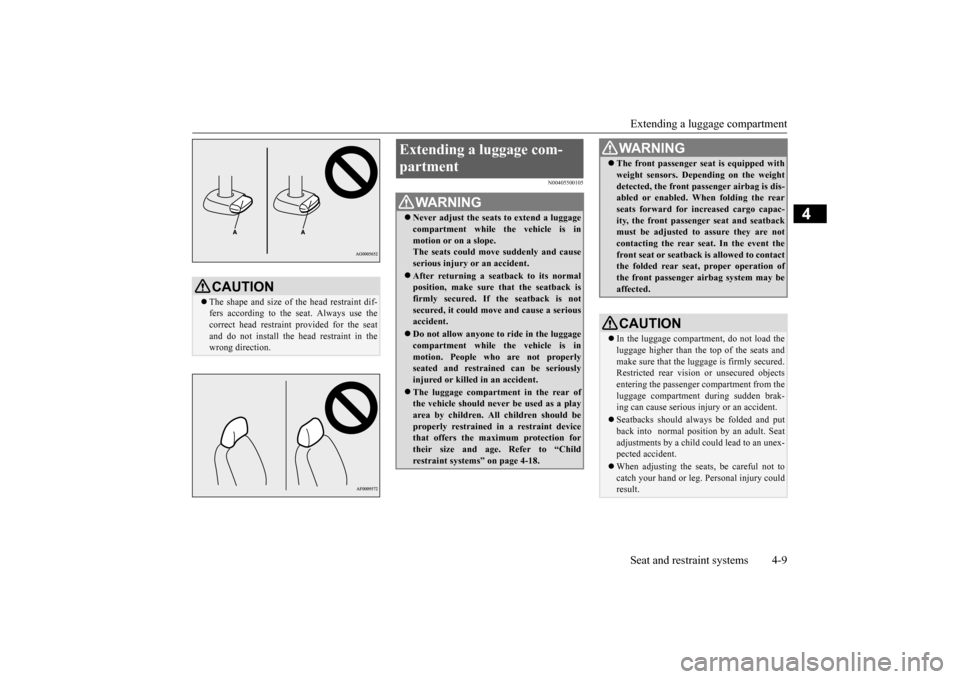
CAUTION The shape and size of the head restraint dif- fers according to the seat. Always use thecorrect head restraint provided for the seat and do not install the head restraint in the wrong direction.
Extending a luggage com- partment
WA R N I N G Never adjust the seats to extend a luggage compartment while the vehicle is in motion or on a slope. The seats could move suddenly and causeserious injury or an accident. After returning a seatback to its normal position, make sure that the seatback is firmly secured. If the seatback is not secured, it could move and cause a seriousaccident. Do not allow anyone to
ride in the luggage
compartment while the vehicle is in motion. People who are not properly seated and restrained can be seriouslyinjured or killed in an accident. The luggage compartment in the rear of the vehicle should never be used as a play area by children. All children should be properly restrained in a restraint devicethat offers the maximum protection for their size and age. Refer to “Child restraint systems” on page 4-18.
The front passenger seat is equipped with weight sensors. Depending on the weight detected, the front passenger airbag is dis- abled or enabled. When folding the rear seats forward for increased cargo capac-ity, the front passenger seat and seatback must be adjusted to assure they are not contacting the rear seat. In the event thefront seat or seatback is allowed to contact the folded rear seat, proper operation of the front passenger airbag system may beaffected.CAUTION In the luggage compartment, do not load the luggage higher than the top of the seats and make sure that the luggage is firmly secured.Restricted rear vision or unsecured objects entering the passenger compartment from the luggage compartment during sudden brak-ing can cause serious injury or an accident. Seatbacks should always be folded and put back into normal position by an adult. Seat adjustments by a child could lead to an unex- pected accident. When adjusting the seats, be careful not to catch your hand or leg. Personal injury could result.WA R N I N G
BK0206700US.bo
ok 9 ページ 2014年3月25日 火曜日 午後4時42分
Page 40 of 384
Child restraint systems
Seat and restraint systems 4-19
4
The child restraint system should be appropri- ate for your child’s weight and height, and should properly fit your vehicle’s seat. For detailed information, refer to the instruc-tion manual accompanying the child restraint system. All children should be properly restrained in a restraint device that offers the maximum protection for their size and age.Be sure to check local, state, or provincial requirements for child size and age that may vary from the recommendations listed below. Children less than 1 year old and who weigh 22 pounds (10 kg) or less MUST ride in a rear-facing child safety seat that MUST ONLY be used in the rear seat. Children older than 1
year of age and who
weigh less than 40 pounds (18 kg) or who are less than 40 inches (100 cm) tallMUST be in a forward-facing restraint that MUST ONLY be used in the rear seat.
Children who weigh more than 40 pounds (18 kg) or who are more than 40 inches (100 cm) tall, regardless of age, should use a suitable child seat or a booster seatin the rear seat until the vehicle’s lap-and- shoulder belt fits them properly.
Guidelines for child restraint system selection
WA R N I N G All children must be seated in the rear seat, and properly restrained. Accident statistics show that children of all sizes and ages are safer when properlyrestrained in the rear seat, rather than in the front seat. Any child who is too large to use a child restraint system should ride in the rear seat and wear the lap-and-shoulder beltproperly. The shoulder belt must be posi- tioned over the shoulder and across the chest, not across their neck, and with thelap belt positioned low on the child’s hips, not across their stomach. If necessary, a booster seat should be used to help achievea proper seat belt fit. Follow the booster seat manufacturer’s instructions. Only use a booster seat that is certified as comply-ing with Federal Motor Vehicle Safety Standards or Motor Vehicle Restraint Sys- tems and Booster Seats Safety Regula- tions.
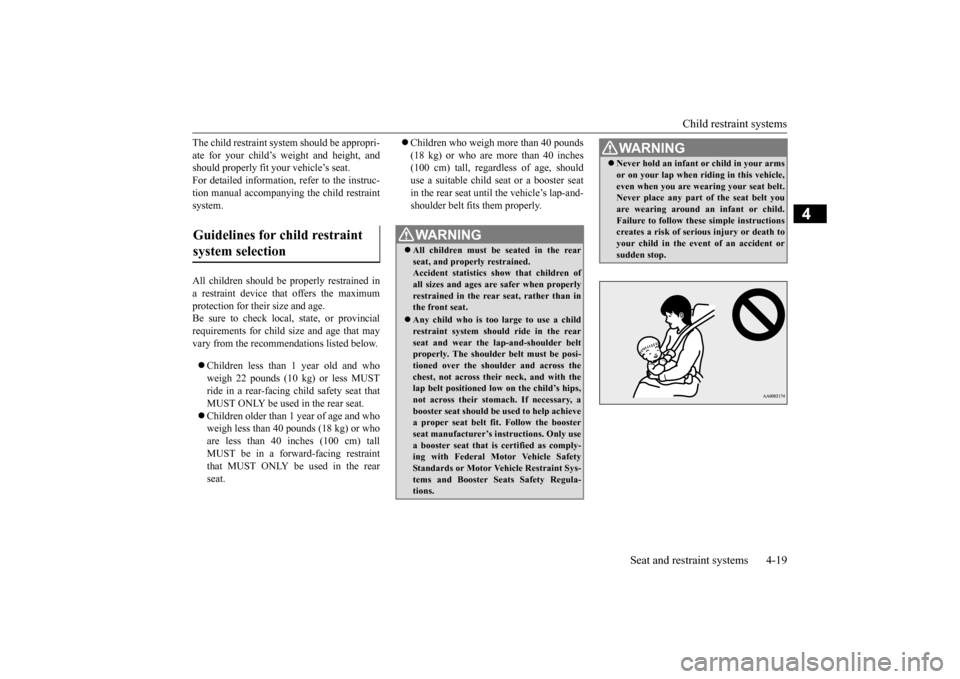
WA R N I N G Never hold an infant or child in your arms or on your lap when riding in this vehicle, even when you are wearing your seat belt. Never place any part of the seat belt you are wearing around an infant or child.Failure to follow these simple instructions creates a risk of serious injury or death to your child in the event of an accident orsudden stop.
BK0206700US.bo
ok 19 ページ 2014年3月25日 火曜日 午後4時42分
Page 41 of 384
Child restraint systems 4-20 Seat and restraint systems
4
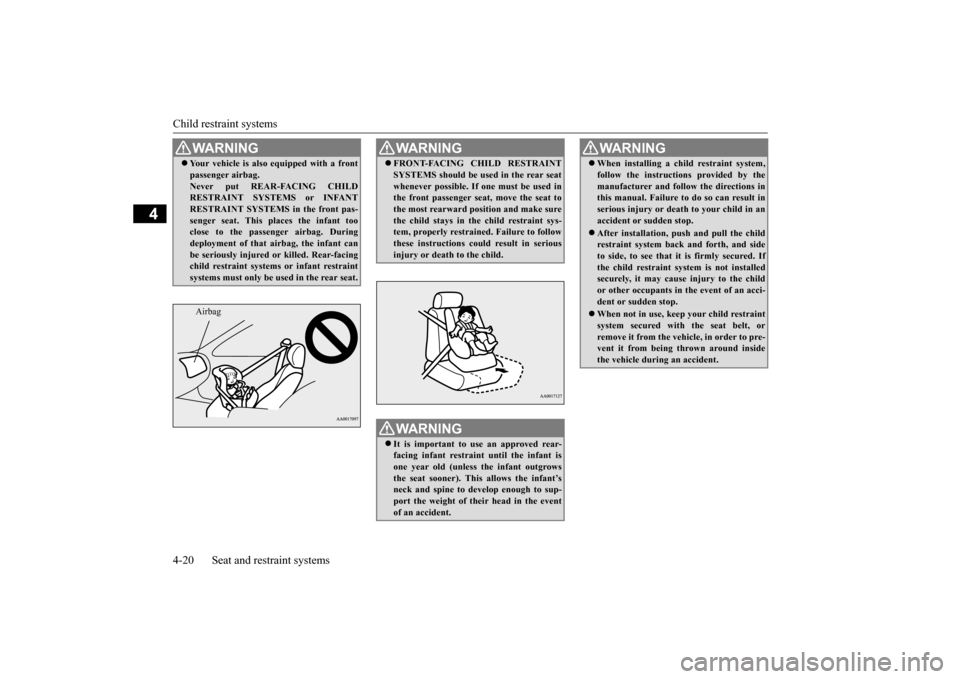
WA R N I N G Your vehicle is also equipped with a front passenger airbag. Never put REAR-FACING CHILD RESTRAINT SYSTEMS or INFANT RESTRAINT SYSTEMS in the front pas-senger seat. This places the infant too close to the passenger airbag. During deployment of that airbag, the infant canbe seriously injured or killed. Rear-facing child restraint systems or infant restraint systems must only be used in the rear seat.Airbag
WA R N I N G FRONT-FACING CHILD RESTRAINT SYSTEMS should be used in the rear seat whenever possible. If one must be used in the front passenger seat, move the seat to the most rearward position and make surethe child stays in the child restraint sys- tem, properly restrained. Failure to follow these instructions could result in seriousinjury or death to the child.WA R N I N G It is important to use an approved rear- facing infant restraint until the infant isone year old (unless the infant outgrows the seat sooner). This allows the infant’s neck and spine to develop enough to sup-port the weight of their head in the event of an accident.
When installing a child restraint system, follow the instructions provided by the manufacturer and follow the directions in this manual. Failure to do so can result in serious injury or death to your child in anaccident or sudden stop. After installation, push and pull the child restraint system back
and forth, and side
to side, to see that it is firmly secured. If the child restraint system is not installedsecurely, it may cause injury to the child or other occupants in the event of an acci- dent or sudden stop. When not in use, keep your child restraint system secured with the seat belt, orremove it from the vehicle, in order to pre- vent it from being thrown around inside the vehicle during an accident.WA R N I N G
BK0206700US.bo
ok 20 ページ 2014年3月25日 火曜日 午後4時42分
Page 46 of 384
Child restraint systems
Seat and restraint systems 4-25
4
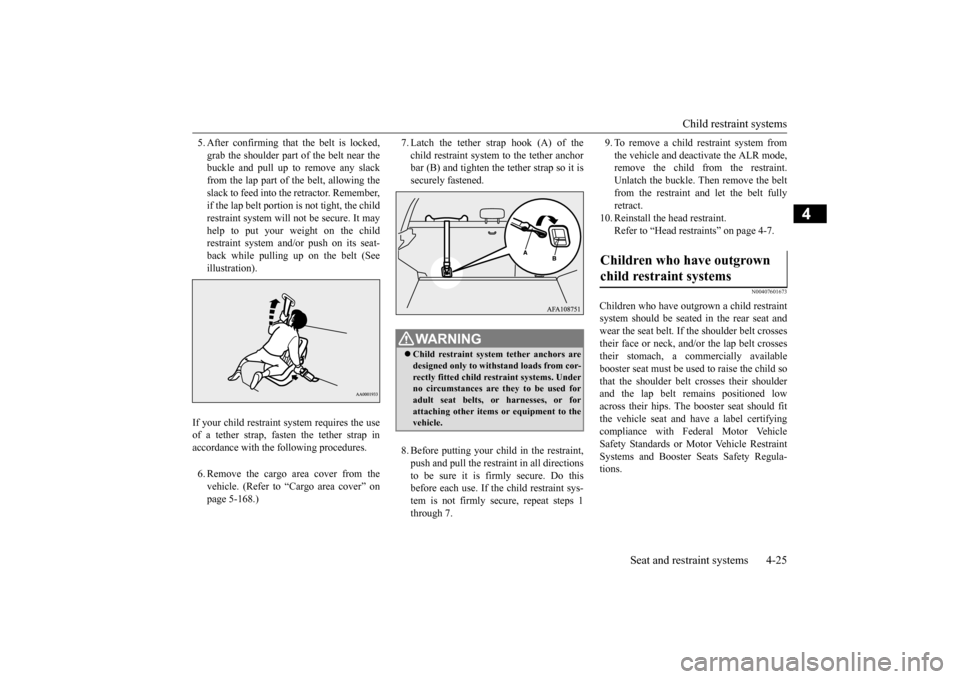
5. After confirming that the belt is locked, grab the shoulder part of the belt near the buckle and pull up to remove any slack from the lap part of the belt, allowing theslack to feed into the retractor. Remember, if the lap belt portion is not tight, the child restraint system will not be secure. It mayhelp to put your weight on the child restraint system and/or push on its seat- back while pulling up on the belt (Seeillustration). 6. Remove the cargo area cover from the vehicle. (Refer to “Cargo area cover” on page 5-168.)
7. Latch the tether strap hook (A) of the child restraint system to the tether anchor bar (B) and tighten the tether strap so it is securely fastened. 8. Before putting your child in the restraint, push and pull the restraint in all directionsto be sure it is firmly secure. Do this before each use. If the child restraint sys- tem is not firmly secure, repeat steps 1through 7.
9. To remove a child restraint system from the vehicle and deactivate the ALR mode, remove the child from the restraint. Unlatch the buckle. Then remove the beltfrom the restraint and let the belt fully retract.
10. Reinstall the head restraint.
Refer to “Head restraints” on page 4-7.
N00407601673
Children who have outgrown a child restraintsystem should be seated in the rear seat and wear the seat belt. If the shoulder belt crosses their face or neck, and/or the lap belt crossestheir stomach, a commercially available booster seat must be used to raise the child so that the shoulder belt crosses their shoulderand the lap belt remains positioned low across their hips. The booster seat should fit the vehicle seat and have a label certifyingcompliance with Federal Motor Vehicle Safety Standards or Motor Vehicle Restraint Systems and Booster Seats Safety Regula-tions.
If your child restraint system requires the use of a tether strap, fasten the tether strap in accordance with the following procedures.
WA R N I N G Child restraint system tether anchors are designed only to withstand loads from cor- rectly fitted child restraint systems. Under no circumstances are they to be used foradult seat belts, or harnesses, or for attaching other items or equipment to the vehicle.
Children who have outgrown child restraint systems
BK0206700US.bo
ok 25 ページ 2014年3月25日 火曜日 午後4時42分
Page 50 of 384
Supplemental Restraint System (SRS) - airbag
Seat and restraint systems 4-29
4
N00407800450
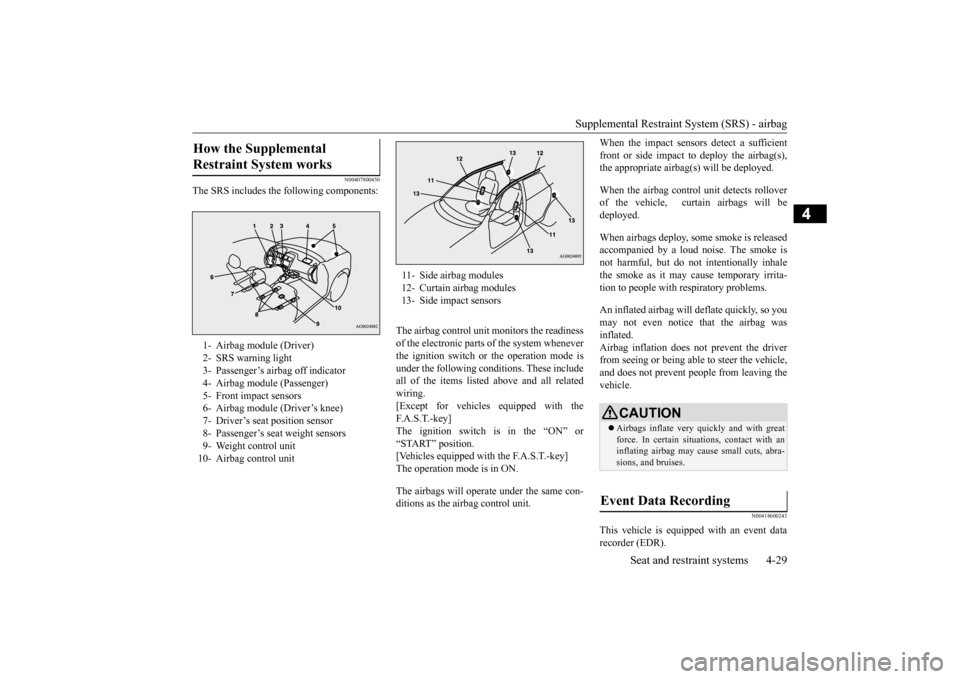
The SRS includes the following components:
The airbag control unit monitors the readiness of the electronic parts of the system whenever the ignition switch or the operation mode is under the following conditions. These includeall of the items listed above and all relatedwiring. [Except for vehicles equipped with the F. A . S . T. - k e y ] The ignition switch is in the “ON” or “START” position. [Vehicles equipped with the F.A.S.T.-key]The operation mode is in ON. The airbags will operate under the same con- ditions as the airbag control unit.
When the impact sensors detect a sufficient front or side impact to deploy the airbag(s), the appropriate airbag(s) will be deployed. When the airbag control unit detects rollover of the vehicle, curtain airbags will bedeployed. When airbags deploy, some smoke is released accompanied by a loud noise. The smoke is not harmful, but do not intentionally inhalethe smoke as it may cause temporary irrita-tion to people with respiratory problems. An inflated airbag will deflate quickly, so you may not even notice that the airbag was inflated.Airbag inflation does not prevent the driver from seeing or being able to steer the vehicle, and does not prevent people from leaving thevehicle.
N00418600243
This vehicle is equipped with an event datarecorder (EDR).
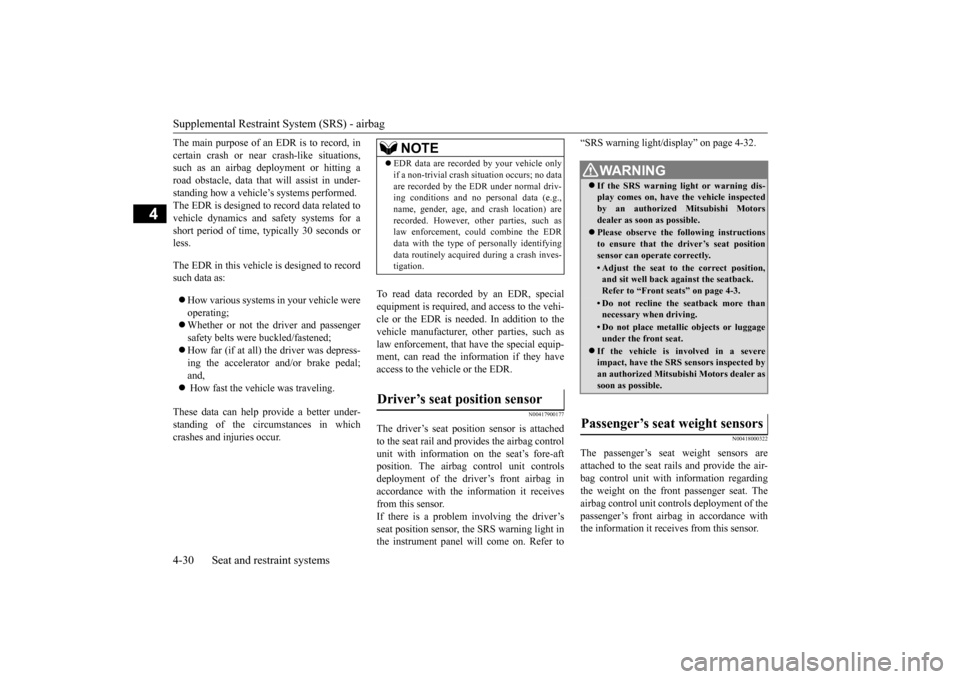
How the Supplemental Restraint System works 1- Airbag module (Driver) 2- SRS warning light3- Passenger’s airbag off indicator4- Airbag module (Passenger) 5- Front impact sensors 6- Airbag module (Driver’s knee)7- Driver’s seat position sensor 8- Passenger’s seat weight sensors 9- Weight control unit10- Airbag control unit
11- Side airbag modules12- Curtain airbag modules13- Side impact sensors
CAUTION Airbags inflate very quickly and with great force. In certain situations, contact with an inflating airbag may cause small cuts, abra- sions, and bruises.
Event Data Recording
BK0206700US.bo
ok 29 ページ 2014年3月25日 火曜日 午後4時42分
Page 51 of 384
Supplemental Restraint System (SRS) - airbag 4-30 Seat and restraint systems
4
The main purpose of an EDR is to record, in certain crash or near crash-like situations, such as an airbag deployment or hitting a road obstacle, data that will assist in under-standing how a vehicle’s systems performed. The EDR is designed to record data related to vehicle dynamics and safety systems for ashort period of time, typically 30 seconds or less. The EDR in this vehicle is designed to record such data as: How various systems in your vehicle were operating; Whether or not the driver and passenger safety belts were buckled/fastened; How far (if at all) the driver was depress- ing the accelerator and/or brake pedal; and, How fast the vehicle was traveling.
These data can help provide a better under- standing of the circumstances in which crashes and injuries occur.
To read data recorded by an EDR, special equipment is required, and access to the vehi- cle or the EDR is needed. In addition to the vehicle manufacturer, other parties, such aslaw enforcement, that have the special equip- ment, can read the information if they have access to the vehicle or the EDR.
N00417900177
The driver’s seat position sensor is attachedto the seat rail and provides the airbag controlunit with information on the seat’s fore-aft position. The airbag control unit controls deployment of the driver’s front airbag inaccordance with the information it receives from this sensor. If there is a problem involving the driver’sseat position sensor, the SRS warning light in the instrument panel will come on. Refer to
“SRS warning light/display” on page 4-32.
N00418000322
The passenger’s seat weight sensors are attached to the seat rails and provide the air- bag control unit with information regarding the weight on the front passenger seat. Theairbag control unit controls deployment of the passenger’s front airbag in accordance with the information it receives from this sensor.
NOTE
EDR data are recorded by your vehicle only if a non-trivial crash situation occurs; no data are recorded by the EDR under normal driv- ing conditions and no personal data (e.g., name, gender, age, and crash location) arerecorded. However, other parties, such as law enforcement, could combine the EDR data with the type of personally identifyingdata routinely acquired during a crash inves- tigation.
Driver’s seat position sensor
WA R N I N G If the SRS warning light or warning dis- play comes on, have the vehicle inspectedby an authorized Mitsubishi Motors dealer as soon as possible. Please observe the following instructions to ensure that the driver’s seat position sensor can operate correctly.• Adjust the seat to the correct position,and sit well back against the seatback.Refer to “Front seats” on page 4-3.• Do not recline the seatback more thannecessary when driving.• Do not place metallic objects or luggageunder the front seat.
If the vehicle is involved in a severe impact, have the SRS sensors inspected by an authorized Mitsubishi Motors dealer as soon as possible.
Passenger’s seat weight sensors
BK0206700US.bo
ok 30 ページ 2014年3月25日 火曜日 午後4時42分
Page 52 of 384
Supplemental Restraint System (SRS) - airbag
Seat and restraint systems 4-31
4
The passenger’s front airbag will not deploy in an impact when the weight on the seat is sensed to be less than approximately 66 pounds (30 kg). In this case, the passengerairbag off indicator will come on. Refer to “Passenger’s airbag off indicator” on page 4-31.If there is a problem involving the passenger seat weight sensors, the SRS warning light in the instrument panel will come on. Refer to“SRS warning light/display” on page 4-32.
N00418100280
The passenger airbag off indicator is located in the instrument panel.
WA R N I N G If any of the following conditions occur, you should have your vehicle inspected by an authorized Mitsubishi Motors dealer assoon as possible:• The SRS warning light does not initiallycome on when the ignition switch or the operation mode is under the following conditions.• [Except for vehicles equipped with theF. A . S . T. - k e y ]The ignition switch is in the “ON” or “START” position. [Vehicles equipped with the F.A.S.T.-key] The operation mode is in ON.• The SRS warning light does not go outafter several seconds.• The SRS warning light comes on whileyou are driving.
To ensure that the passenger’s seat weight sensors can correctly sense the weight being applied to the seat, observe the fol- lowing instructions. Failure to follow these instructions can adversely affect the per-formance of the passenger’s airbag sys- tem.• Adjust the seat to the correct position,and sit well back against the seatback. Refer to “Front seats” on page 4-3.• Do not recline the seatback more thannecessary.• Never have more than one person (adultor child) sitting on the seat.• Do not place anything between the seatand the floor console.• Do not hang anything on the front pas-senger’s seatback.• Do not remove the head restraints.• When attaching a child restraint system, secure it firmly.• Do not place luggage or other objects onthe seat.• Do not use a seat cover or a cushion.• Do not remove the seats and seat belts.• Do not modify or replace the seat and seat belt.• Do not place luggage or other objectsunder the seat.• Do not place the floor mat on the seatrails.WA R N I N G
• Do not expose the sensors to liquids or vapors.• Do not subject the sensors to shock.• Do not allow rear-seat occupants to pushthe front passenger seat with their feet or force the front passenger seat upward.• Do not allow rear-seat occupants to graspthe front passenger’s seatback or puttheir arms around it.• When attaching a child restraint systemin the rear seat, make sure it does not interfere with the front seat.
If the vehicle is involved in a severe impact, have the SRS sensors inspected by an authorized Mitsubishi Motors dealer assoon as possible.
Passenger’s airbag off indicator
WA R N I N G
BK0206700US.bo
ok 31 ページ 2014年3月25日 火曜日 午後4時42分
Page 53 of 384
Supplemental Restraint System (SRS) - airbag 4-32 Seat and restraint systems
4
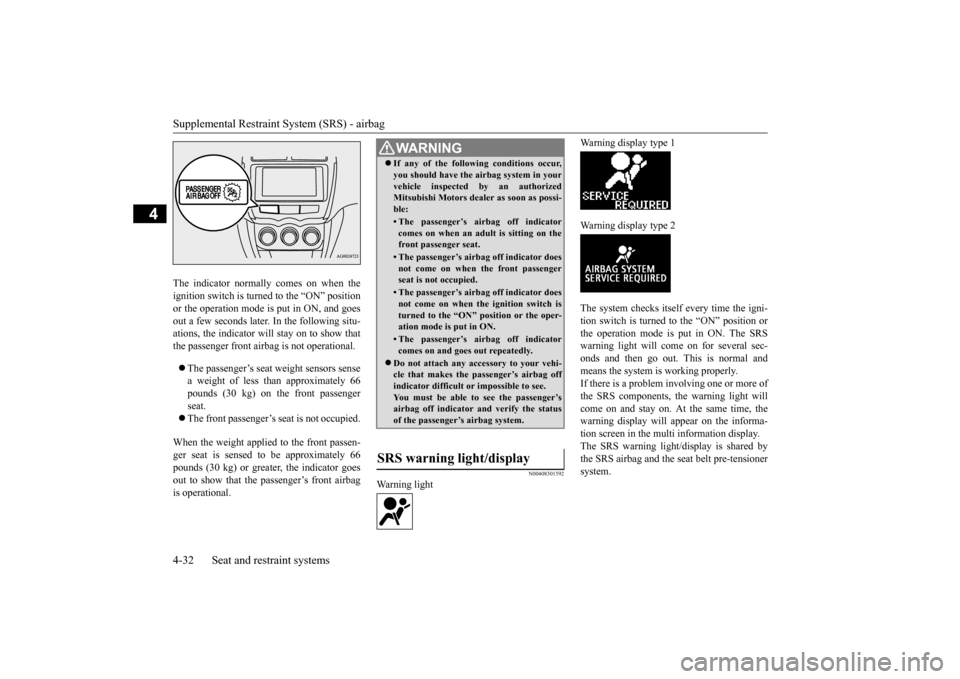
The indicator normally comes on when the ignition switch is turned to the “ON” position or the operation mode is put in ON, and goesout a few seconds later. In the following situ- ations, the indicator will stay on to show that the passenger front airbag is not operational. The passenger’s seat weight sensors sense a weight of less than approximately 66pounds (30 kg) on the front passenger seat. The front passenger’s seat is not occupied.
When the weight applied to the front passen- ger seat is sensed to be approximately 66 pounds (30 kg) or greater, the indicator goes out to show that the passenger’s front airbagis operational.
N00408301592
Warning light
Warning display type 1 Warning display type 2The system checks itself every time the igni- tion switch is turned to the “ON” position orthe operation mode is put in ON. The SRS warning light will come on for several sec- onds and then go out. This is normal andmeans the system is working properly. If there is a problem involving one or more of the SRS components, the warning light willcome on and stay on. At the same time, the warning display will appear on the informa- tion screen in the multi information display.The SRS warning light/display is shared bythe SRS airbag and the seat belt pre-tensioner system.
WA R N I N G If any of the following conditions occur, you should have the airbag system in your vehicle inspected by an authorized Mitsubishi Motors dealer as soon as possi- ble:• The passenger’s airbag off indicatorcomes on when an adult is sitting on thefront passenger seat.• The passenger’s airbag off indicator doesnot come on when the front passenger seat is not occupied.• The passenger’s airbag off indicator doesnot come on when the ignition switch is turned to the “ON” position or the oper-ation mode is put in ON.• The passenger’s airbag off indicatorcomes on and goes out repeatedly.
Do not attach any accessory to your vehi- cle that makes the passenger’s airbag off indicator difficult or impossible to see. You must be able to see the passenger’sairbag off indicator and verify the status of the passenger’s airbag system.
SRS warning light/display
BK0206700US.bo
ok 32 ページ 2014年3月25日 火曜日 午後4時42分