Page 341 of 384
Tires 9-18 Vehicle care and maintenance
9
Cold inflation pressure must not go above the maximum values molded into the tire side- wall. After driving several miles, your tire inflation pressure may increase 2 to 6 psi (14to 41 kPa) from the cold inflation pressure. Do not let air out of the tires to get back to the specified cold pressure, or your tires will betoo low. Check your tires each time you refuel. If one tire looks lower than the others, check thepressure for all of them.You should also take the following safety pre- cautions: Keep your tires inflated to the recom- mended pressures. (See the tire and load-ing information placard attached to the driver’s door sill.) Stay within the recommended load limits. Make sure that the weight of any load in your vehicle is evenly distributed. Drive at safe speeds. After filling your tires to the correct pres- sure, check them for damage and air leaks. Be sure to reinstall the caps on thevalve stems.
N00939600241 N00939700141
The following maintenance steps are recom- mended:
Check tire pressures regularly. Have regular maintenance done on the wheel balance and front and rear suspen- sion alignment. Rotate your tires regularly as described in the “Tire rotation” section on page 9-19.
N00939800184
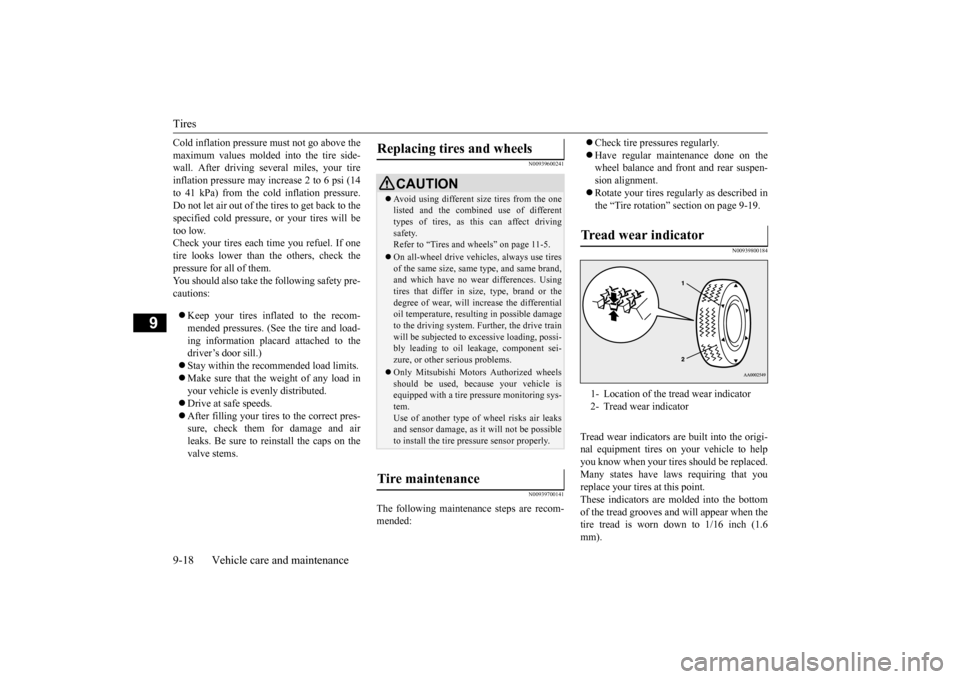
Tread wear indicators are built into the origi- nal equipment tires on your vehicle to helpyou know when your tires should be replaced. Many states have laws requiring that you replace your tires at this point.These indicators are molded into the bottom of the tread grooves and will appear when the tire tread is worn down to 1/16 inch (1.6mm).
Replacing tires and wheels
CAUTION Avoid using different
size tires from the one
listed and the combined use of different types of tires, as this can affect driving safety.Refer to “Tires and wheels” on page 11-5. On all-wheel drive vehicles, always use tires of the same size, same type, and same brand, and which have no wear differences. Using tires that differ in size, type, brand or thedegree of wear, will increase the differential oil temperature, resulting in possible damage to the driving system. Further, the drive trainwill be subjected to excessive loading, possi- bly leading to oil leakage, component sei- zure, or other serious problems. Only Mitsubishi Motors Authorized wheels should be used, because your vehicle isequipped with a tire pressure monitoring sys- tem. Use of another type of wheel risks air leaksand sensor damage, as it will not be possible to install the tire pressure sensor properly.
Tire maintenance
Tr e a d w e a r i n d i c a t o r 1- Location of the tread wear indicator 2- Tread wear indicator
BK0206700US.bo
ok 18 ページ 2014年3月25日 火曜日 午後4時42分
Page 343 of 384
Clutch pedal free play (if so equipped) 9-20 Vehicle care and maintenance
9
N00940000320
In some areas of the country, snow tires are required for winter driving. If snow tires arerequired in your area, you must choose snow tires of the same size and type as the original tires provided with your vehicle. Snow tiresshould also be installed on all four wheels. Otherwise your safety and vehicle handling can be reduced.Even where laws may permit it, snow tiresshould not be operated at sustained speeds over 75 mph (120 km/h).
N00940100116 N00940201101
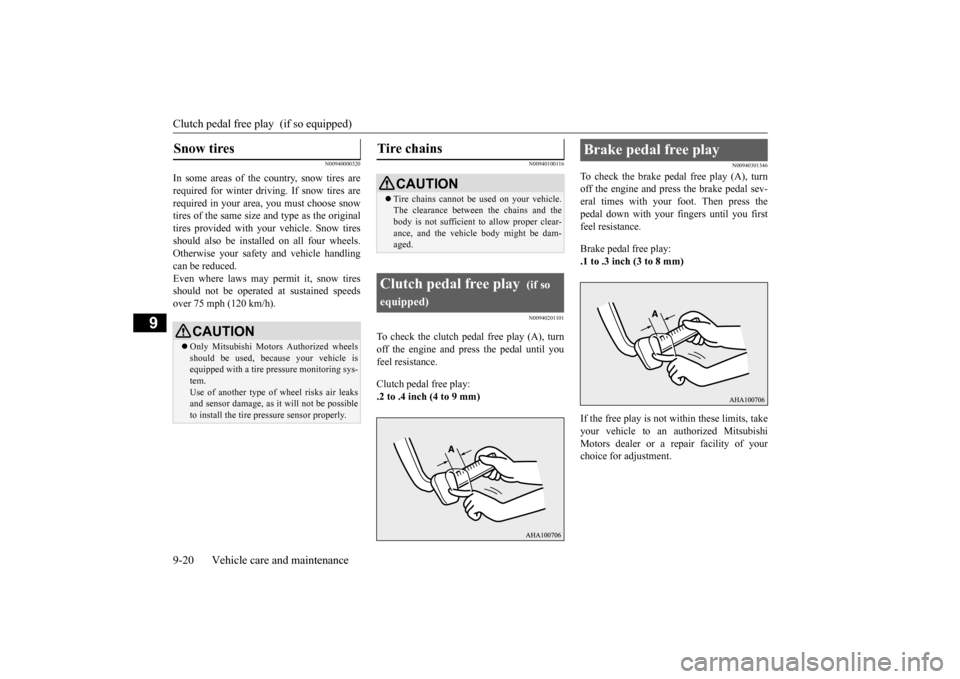
To check the clutch pedal free play (A), turn off the engine and press the pedal until you feel resistance. Clutch pedal free play: .2 to .4 inch (4 to 9 mm)
N00940301346
To check the brake pedal free play (A), turnoff the engine and press the brake pedal sev-eral times with your foot. Then press the pedal down with your fingers until you first feel resistance. Brake pedal free play: .1 to .3 inch (3 to 8 mm) If the free play is not within these limits, take your vehicle to an authorized Mitsubishi Motors dealer or a repair facility of your choice for adjustment.
Snow tires
CAUTION Only Mitsubishi Motors Authorized wheels should be used, because your vehicle isequipped with a tire pressure monitoring sys- tem. Use of another type of wheel risks air leaksand sensor damage, as it will not be possible to install the tire pressure sensor properly.
Tire chains
CAUTION Tire chains cannot be used on your vehicle. The clearance between the chains and the body is not sufficient to allow proper clear- ance, and the vehicle body might be dam-aged.
Clutch pedal free play
(if so
equipped)
Brake pedal free play
BK0206700US.bo
ok 20 ページ 2014年3月25日 火曜日 午後4時42分
Page 363 of 384
Cleaning the outside of your vehicle 9-40 Vehicle care and maintenance
9
N00945700058
To protect your vehicle’s finish, wash it often and thoroughly. If desired, you may wax yourvehicle using a nonabrasive automobile wax.
N00945800033
Industrial pollution, road tar, bird droppings,tree sap, insect remains, sea water and otherforeign matters can damage the finish on your vehicle. Generally, the longer any foreign materialstays on the finish, the worse the damage. Wash your vehicle as soon as possible when- ever the finish gets soiled.
N00945900597
Chemicals contained in the dirt and dustpicked up from air, rain, snow, or road sur-faces can damage the paint and body of your vehicle if left on. Frequent washing and waxing is the best wayto protect your vehicle from this damage. Do not wash the vehicle in direct sunlight. Park the vehicle in the shade and spray it withwater to remove dust. Next, using plenty of
clean water and a car washing mitt or sponge, wash the vehicle from top to bottom. Use a mild car washing soap if necessary. Rinse thoroughly and wipe dry with a cham-ois or soft cloth. After washing the vehicle, carefully clean the joints and flanges of the doors, hood, etc., where dirt is likely toremain.
Salt and other chemicals spread on winter roads in some geographical areas can have a detrimental effect on the vehicle underbody.
Cleaning the outside of your vehicle Foreign material Wa s h i n g
CAUTION When washing the underside of your vehicle or the wheels, wear a pair of gloves to pro- tect your hands. If your vehicle has rain sensor wipers, place the wiper switch lever in the “OFF” positionto deactivate the rain sensor before washing the vehicle. Otherwise, the wipers will oper- ate in the presence of water spray on thewindshield and may get damaged as a result. Never spray or splash water on the electrical parts in the engine compartment. This may damage them. Be careful also when washing the underbody to ensure that water does notenter the engine compartment. Avoid automatic car washers that use rotat- ing brushes. These brushes may scratch the paint surface and make it dull. Scratches are more noticeable on darker col- ored vehicles.
Some hot water washing equipment uses high pressure and heat to clean your vehicle. Because hot water can damage plastics parts and seep inside your vehicle, make sure you do the following when using such equip-ment:• Keep the washing nozzle at least 28 inches(70 cm) away from the vehicle body.• When washing around the door glass, holdthe nozzle at a distance of more than 28 inches (70 cm) and at a right angle to the glass surface.
Make sure to do the following when using an automatic car wash, with help from eitherthis manual or the car wash operator, to avoid damaging your vehicle:• Fold the outside rearview mirrors.• Remove the antenna.• Tape the wiper arm assembly.• If your vehicle is equipped with a rearspoiler or roof rails, check with the car wash operator before using the car wash.• If your vehicle is equipped with the rainsensor wipers, place the wiper switch leverin the “OFF” position to deactivate the rain sensor.
During cold weather
CAUTION
BK0206700US.bo
ok 40 ページ 2014年3月25日 火曜日 午後4時42分