2015 MERCEDES-BENZ SPRINTER ignition
[x] Cancel search: ignitionPage 14 of 334

Hydroplaning
..................................... 155 I
Immobilizer .......................................... 61
Indicator lamp
see Warning and indicator lamps
Indicators
see Turn signals
Insect protection on the radiator ......27
Installing a wheel
Installing the adapter (spare
wheel ) ............................................ 309
Instrument cluster
Fuel gage ...................................... .181
Important safety notes .................. 180
Instrument cluster lighting ............. 181
Outside temperature displa y.......... 181
Overview .......................................... 34
Speedometer ................................. 181
Tachometer ................................... 181
Warning and indicator lamps ........... 35
Instrument cluster lighting .............. 181
Instrument lighting
see Instrument cluster lighting
Interior lighting ................................... 97
Front ................................................ 97
Motion detectors ............................. 99
Notes on replacing bulbs ............... 105
Replacing bulb s............................. 105
Switching the rear compartment
lighting on centrally ......................... 98
Interior motion sensor
Arming ............................................. 62
Deactivating ..................................... 62
Function ........................................... 62
Switching off .................................... 62 J
Jack Jacking points ................................ 307
Preparation .................................... 307
Storage location ............................ 274
Using ............................................. 307
Jump-starting ..................................... 276 K
Key Position in the ignition lock ............ 138
Key positions ..................................... 138
Kickdown ........................................... 144 L
Lamps see Warning and indicator lamps
Lane Keeping Assist
Activating/deactivating ................. 166
Function/note s............................. 165
Language
Display (vehicles with steering
wheel buttons) ............................... 190
Lashing points and tie downs
Permissible tensile load ................. 327
LATCH-type (ISOFIX) child seat
anchors ................................................ 53
License plate lamp
Replacing bulb s............................. 103
License plate lamp (Chassis Cab)
Replacing bulb s............................. 104
Light sensor ......................................... 93
Lighting
see Lights
Lighting
see Lights
Lights
Activating/deactivating daytime
running lamps (on-board com-
puter with steering wheel but-
tons) .............................................. 192
Activating/deactivating surround
lighting (vehicles with steering
wheel buttons) ............................... 193
Automatic headlamp mode .............. 93
Bulb failure indicator ........................ 92
Cornering light function ................... 95
Driving abroad ............................... 153
Fog lamps ........................................ 93
Hazard warning lamps ..................... 95
High beam flasher ............................ 94
High-beam headlamp s..................... 94
Highbeam Assist .............................. 96
Important safety notes .................... 92 12
Index
Page 19 of 334

Side windows
Cleaning ......................................... 267
Hinged side windows ....................... 78
Important safety information ........... 78
Opening/closing .............................. 78
Overview .......................................... 78
Problem (malfunction) ..................... 79
Resetting ......................................... 79
Sliding door
Child-proof locks .............................. 56
Cleaning ......................................... 269
Closing assist ................................... 73
Important safety notes .................... 72
Opening/closing .............................. 72
Opening/closing from the inside ..... 73
Opening/closing from the out-
side .................................................. 73
SmartKey
Changing the battery ....................... 69
Changing the locking system set-
tings ............................................... 194
Checking the battery ....................... 68
Display message ............................2 17
Door central locking/unlocking ....... 66
Important safety notes .................... 66
Loss ................................................. 70
Problem (malfunction) ..................... 70
SmartKey positions (ignition lock) .. 138
Snow chains ...................................... 287
Sockets .............................................. 236
Spare wheel
General notes ................................ 312
Important safety notes .................. 312
Removing/mounting ..................... .313
Special seat belt retractor .................. 52
Specialist workshop ............................ 25
Speed, controlling
see Cruise control
Speedometer
Digital (vehicles with steering
wheel buttons) ............................... 191
Digital (vehicles without steering
wheel buttons) ............................... 182
Selecting display unit (vehicles
with steering- wheel buttons) ....... .190
see Instrument cluster Sprinter Dealer
see Qualified specialist workshop
Standing lamps
Replacing bulbs ............................ .100
Replacing bulbs (rear) .................... 103
Standing lamps (Chassis Cab)
Replacing bulbs (rear) .................... 104
Start-off assist
Display message ............................ 205
Starting (engine) ................................ 139
Station
see Radio
Steering wheel
Adjusting ......................................... 88
Button overview ............................... 37
Cleaning ......................................... 270
Step
see Electrical step
Stickers
General safety notes ........................ 22
Stowage spaces
see Stowage spaces and stowagecompartments
Stowage spaces and stowage com-
partments
Eyeglasses compartment .............. .231
Glove box ....................................... 230
Important safety notes .................. 230
Paper holder .................................. 233
Stowage compartment above the
windshield ..................................... 232
Stowage compartment in the cen-
ter console ..................................... 232
Stowage compartment in the
dashboard ...................................... 231
Stowage space above the head-
liner ............................................... 232
Stowage space under the rear
bench seat ..................................... 233
Stowage space under the twin co-
driver's sea t................................... 232
Summer tires ..................................... 286
Switch unit
see Control panel
Switching off the alarm (ATA) ............ 61
Switching the heater booster func-
tion on/off ......................................... 130 Index
17
Page 34 of 334
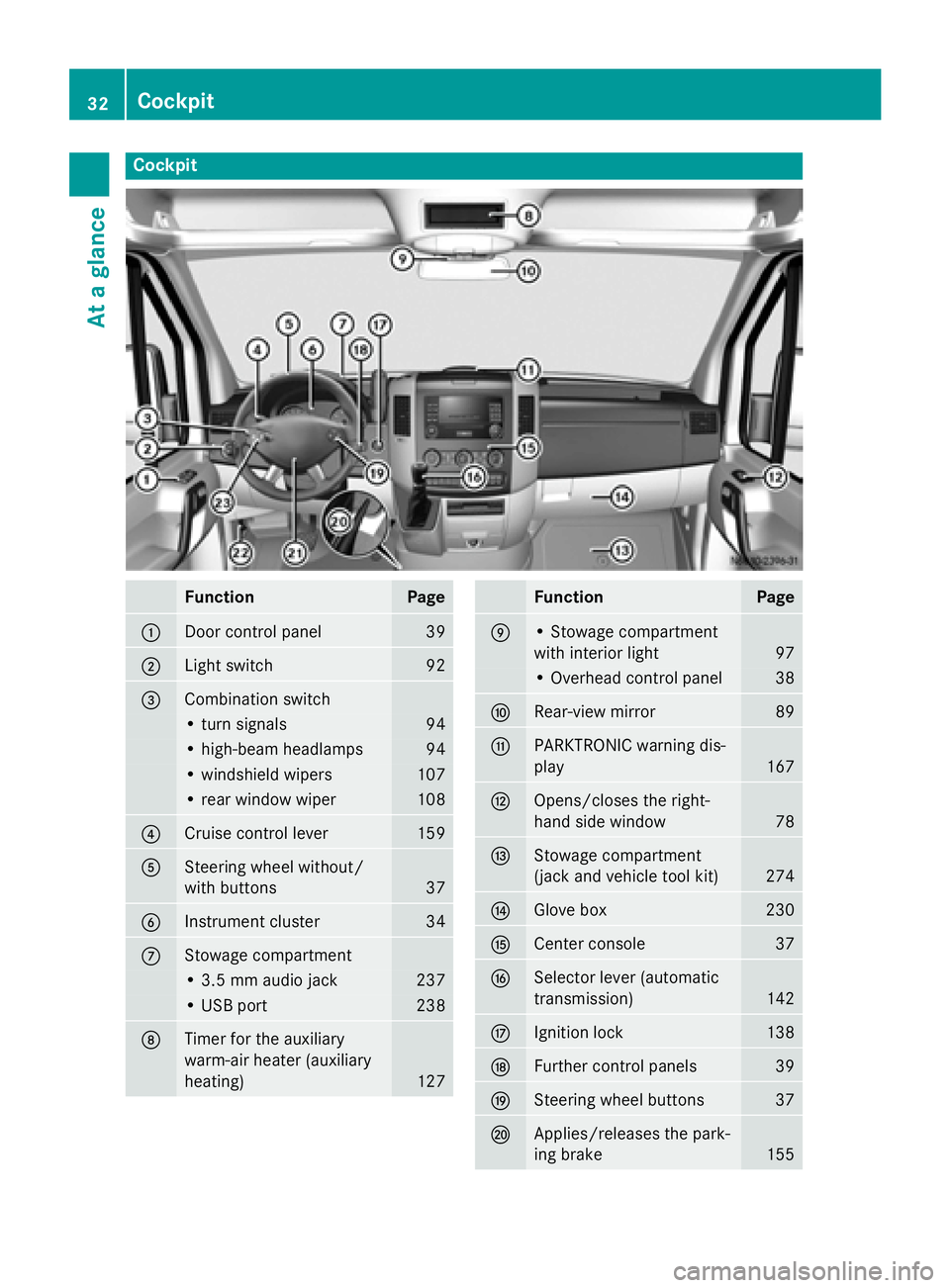
Cockpit
Function Page
0043
Door control panel 39
0044
Light switch 92
0087
Combination switch
• turn signals 94
• high-beam headlamps 94
• windshield wipers 107
• rear window wiper 108
0085
Cruise control lever 159
0083
Steering wheel without/
with buttons
37
0084
Instrument cluster 34
006B
Stowage compartment
• 3.5 mm audio jack 237
• USB port 238
006C
Timer for the auxiliary
warm-air heater (auxiliary
heating)
127 Function Page
006D
• Stowage compartment
with interior light
97
• Overhead control panel 38
006E
Rear-view mirror 89
006F
PARKTRONIC warning dis-
play
167
0070
Opens/closes the right-
hand side window
78
0071
Stowage compartment
(jack and vehicle tool kit)
274
0072
Glove box 230
0073
Center console 37
0074
Selector lever (automatic
transmission)
142
0075
Ignition lock 138
0076
Further control panels 39
0077
Steering wheel buttons 37
0078
Applies/releases the park-
ing brake
15532
CockpitAt a glance
Page 42 of 334

Control panel between the steering
wheel and the ignition lock Function Page
0039
0038
Switches the central rear
compartment lighting
on/off
9740
Further control panelsAt a glance
Page 44 of 334

Useful information
This Operator's Manual describes all models
as well as standard and optional equipment of your vehicle that were available at the time of going to print. Country-specific variations are
possible. Note that your vehicle may not be
equipped with all of the described functions.
This also applies to systems and functions
relevant to safety.
Read the information on qualified specialist
workshops (Y page 25). Occupant safety
Restraint system introduction
The restraint system reduces the risk of vehi- cle occupants coming into contact with parts of the vehicle's interior in the event of an
accident. The restraint system can also
reduce the forces to which vehicle occupants
are subjected during an accident.
The restraint system comprises:
R Seat belt system
R Air bags
R Child restraint system
R Child seat securing systems
The components of the restraint system work
in conjunction with each other. They can only
deploy their protective function if, at all times,
all vehicle occupants:
R have fastened their seat belts correctly
(Y page 45)
R have adjusted their seat and head restraint
properly (Y page 82).
As the driver, you also have to make sure that
the steering wheel is adjusted correctly.
Observe the information relating to the cor-
rect driver's seat position (Y page 82).
You also have to make sure that an air bag can inflate properly if deployed (Y page 47).
An air bag supplements a correctly worn seat
belt. As an additional safety device, the air
bag increases the level of protection for vehi- cle occupants in the event of an accident. For
example, if, in the event of an accident, the
protection offered by the seat belt is suffi-
cient, the air bags are not deployed. When an
accident occurs, only the air bags that
increase protection in that particular accident
situation are deployed. However, seat belts
and air bags generally do not protect against objects penetrating the vehicle from the out-
side.
Information on restraint system operation
can be found under "Deployment of Emer-
gency Tensioning Devices and air bags"
(Y page 49).
For more information about children traveling with you in the vehicle and on child restraint
systems, see "Children in the vehicle"
(Y page 51). Important safety notes
G
WARNING
Modifications to the restraint system, may
cause it to no longer work as intended. The
restraint system may then not perform its
intended protective function and may fail in an accident or trigger unexpectedly, for example.
This poses an increased risk of injury or even fatal injury.
Never modify parts of the restraint system.
Never tamper with the wiring, the electronic
components or their software.
If it is necessary to modify an airbag system to
accommodate a person with disabilities, con- tact an authorized Sprinter dealership for
details. USA only: contact our Customer
Assistance Center at 1‑877‑762 ‑8267 for
details. Restraint system warning lamp
The restraint systems functions are checked
after the ignition is switched on and at regular
intervals when the engine is running. This 42
Occupant safetySafety
Page 45 of 334

allows malfunctions to be detected in good
time.
When the ignition is switched on, the 0075
restraint system warning lamp in the instru-
ment cluster lights up. It goes out no later
than a few seconds after the vehicle is star-
ted. The components of the restraint system
are on standby.
A malfunction has occurred if the 0075
restraint system warning lamp:
R does not light up after the ignition is
switched on.
R does not switch off after a few seconds.
R goes out, but then lights up again, e.g. when
the engine is running. G
WARNING
If restraint system is malfunctioning, restraint system components may be triggered unin-
tentionally or might not be triggered at all in
the event of an accident with a high rate of
vehicle deceleration. This can affect the Emer- gency Tensioning Device or air bag, for exam-
ple. This poses an increased risk of injury or
even fatal injury.
Have the restraint system checked and
repaired in a qualified specialist workshop as
soon as possible. Seat belts
Introduction Seat belts are the most effective means of
restricting the movement of vehicle occu-
pants in the event of an accident or the vehi-
cle rolling over. This reduces the risk of vehi- cle occupants coming into contact with parts
of the vehicle interior or being ejected from
the vehicle. Furthermore, the seat belt helps
to keep the vehicle occupant in the best posi- tion in relation to the air bag. The seat belt system comprises:
R Seat belts
R Emergency Tensioning Devices and seat
belt force limiters for the driver's and front-
passenger seat belts
On vehicles with two seats on the front-
passenger side, both seat belts on the
front-passenger side have an Emergency
Tensioning Device. Only the seat belt on the
outer front-passenger seat has a seat belt
force limiter.
The seat belt system only includes Emer-
gency Tensioning Devices and seat belt force
limiters for the driver and front passenger if
the vehicle is equipped with a driver's air bag.
If the seat belt is pulled out of the belt outlet quickly or with a jerky movement, the belt
retractor locks. The belt strap cannot be
extracted any further.
The Emergency Tensioning Device tightens
the seat belt in an accident, pulling the belt
close against the body. However it does not
pull the vehicle occupant back in the direction
of the backrest.
The Emergency Tensioning Device does not
correct an incorrect seat position or the rout- ing of an incorrectly fastened seat belt.
When triggered, seat belt force limiters help
to reduce the force exerted by the seat belt on
the vehicle occupant.
The seat belt force limiters are synchronized
with the front air bags, which absorb part of
the deceleration force. This can reduce the
force exerted on the vehicle occupants during an accident.
! If the front-passenger seat is unoccupied,
do not insert the belt tongue into the buckle of the front-passenger seat. This may oth-
erwise lead to the triggering of the Emer-
gency Tensioning Device in the event of anaccident, which will then need to be
replaced.
Vehicles with two seats on the front-
passenger side: the Emergency Tensioning
Device of the inner front-passenger seat is Occupant safety
43Safety Z
Page 48 of 334

X
Adjust the seat (Y page 82).
The seat backrest must be in an almost
upright position.
X Pull the seat belt smoothly from belt sash
guide 0087and engage belt tongue 0044into
belt buckle 0043.
X If necessary, pull upwards on the shoulder
section of the seat belt to tighten the belt
across your body. The shoulder section of the belt must always
run over the center of the shoulder. Adjust the
belt outlet if necessary.
X To raise: slide belt guide 0087upwards.
The belt outlet engages in various posi-
tions.
X To lower: press belt guide release 0085and
slide belt guide 0087downwards.
X Let go of belt guide release 0085in the
desired position and make sure that the
belt guide engages.
All seat belts in the vehicle, except the driv-
er's seat belt, are equipped with a special seat belt retractor to secure child restraint sys-
tems properly. Further information can be
found under "Special seat belt retractor"
(Y page 52).
Releasing seat belts !
Make sure that the seat belt is fully rolled
up. Otherwise, the seat belt or belt tongue
will be trapped in the door or in the seat
mechanism. This could damage the door,
the door trim panel and the seat belt. Dam-
aged seat belts can no longer fulfill their protective function and must be replaced.
Visit a qualified specialist workshop.
X
Press release button 0043, hold belt
tongue 0044firmly and guide it back towards
belt outlet 0087.
Belt warning for drivers and co-drivers The
0076 seat belt warning lamp in the instru-
ment cluster is a reminder for all occupants to
fasten their seat belts. It may light up contin-
uously or flash. A warning tone may also
sound.
Regardless of whether the driver has already
fastened their seat belt, the 0076seat belt
warning lamp lights up for 6 second s each
time the ignition is switched on. After the
engine is started, it goes out as soon as the
driver's seat belt had been fastened.
If the driver's seat belt is not fastened after
the engine is started, an additional warning
tone will sound. This warning tone switches
off after a maximum of 6 seconds or once the
driver's seat belt is fastened.
If a vehicle speed of 15 mph (25 km/h) is
exceeded and the driver has still not fastened their seat belt, a warning tone sounds again.
The warning tone sounds for 60 seconds or
until the driver has fastened their seat belt. 46
Occupant safetySafety
Page 52 of 334

may cause short-term breathing difficulties in
people with asthma or other respiratory prob-
lems. To avoid this, you may wish to get out of
the vehicle or open the windows as soon as it is safe to do so.
Air bags and pyrotechnic Emergency Tension-
ing Devices (ETDs) contain perchlorate mate- rial, which may require special handling and
regard for the environment. National guide-
lines must be observed during disposal. In
California, see www.dtsc.ca.gov/
HazardousWaste/Perchlorate/
index.cfm.
Method of operation During the first stage of a collision, the
restraint system control unit evaluates impor-
tant physical data relating to vehicle deceler- ation or acceleration, such as:
R duration
R direction
R intensity
Based on the evaluation of this data, the
restraint system control unit triggers the
Emergency Tensioning Devices during a fron- tal or rear collision.
An Emergency Tensioning Device can only be
triggered, if:
R the ignition is switched on.
R the components of the restraint system are
operational; see "Restraint system warning
lamp" (Y page 42)
R the belt tongue is engaged in the buckle on
the respective front-passenger seat
Vehicles with two seats on the front-
passenger side: the Emergency Tensioning
Device on the inner front-passenger seat is
triggered independently of the lock status of
the seat belt. If the restraint system control unit detects a
more severe accident, further components of
the restraint system are activated independ-
ently of each other in certain frontal collision
situations:
R Front air bags
R Window curtain air bag on the side of
impact
The activation threshold of the Emergency
Tensioning Devices and the air bag are deter- mined by evaluating the rate of vehicle decel-
eration or acceleration which occurs at vari-
ous points in the vehicle. This process is pre-
emptive in nature. Deployment should take
place in good time at the start of the collision.
The rate of vehicle deceleration or accelera-
tion and the direction of the force are essen- tially determined by:
R the distribution of forces during the colli-
sion
R the collision angle
R the deformation characteristics of the vehi-
cle
R the characteristics of the object with which
the vehicle has collided
Factors which can only be seen and measured after a collision has occurred do not play a
decisive role in the deployment of an air bag.
Nor do they provide an indication of air bag
deployment.
The vehicle can be deformed considerably,
without an air bag being deployed. This is the
case if only parts which are relatively easily
deformed are affected and the rate of decel-
eration is not high. Conversely, air bags may
be deployed even though the vehicle suffers
only minor deformation. This is the case if, for
example, very rigid vehicle parts such as lon- gitudinal body members are hit, and sufficient
deceleration occurs as a result. 50
Occupant safetySafety