2015 MERCEDES-BENZ M-Class ROD
[x] Cancel search: RODPage 33 of 466

crashes and injuries occur. NOTE: EDR data is
recorded by your vehicle only if a non-trivial
crash situation occurs; no data is recorded by the EDR under normal driving conditions andno personal data (e.g., name, gender, age,
and crash location) are recorded. However,
other parties, such as law enforcement, can
combine the EDR data with the type of per-
sonal identification data routinely acquired
during a crash investigation.
Access to the vehicle and/or the EDR is nee-
ded to read data that is recorded by an EDR,
and special equipment is required. In addition
to the vehicle manufacturer, other parties
that have the special equipment, such as law enforcement, can read the information by
accessing the vehicle or the EDR.
EDR data may be used in civil and criminal
matters as a tool in accident reconstruction,
accident claims, and vehicle safety. Since the Crash Data Retrieval CDR tool that is used to
extract data from the EDR is commercially
available, Mercedes-Benz USA, LLC
("MBUSA") expressly disclaims any and all lia- bility arising from the extraction of this infor-
mation by unauthorized Mercedes-Benz per-
sonnel.
MBUSA will not share EDR data with others
without the consent of the vehicle owners or,
if the vehicle is leased, without the consent of the lessee. Exceptions to this representation
include responses to subpoenas by law
enforcement; by federal, state or local gov-
ernment; in connection with or arising out of
litigation involving MBUSA or its subsidiaries
and affiliates; or, as required by law.
Warning: The EDR is a component of the Sup-
plemental Restraint System ("SRS") Module.
Tampering with, altering, modifying or remov- ing the EDR component may result in a mal-
function of the SRS Module and other sys-
tems.
State laws or regulations regarding EDRs that
conflict with federal regulation are pre-emp-
ted. This means that in the event of such con- flict, the federal regulation governs. As of February 2013, 13 states have enacted laws
relating to EDRs. Information on copyright
General information
Information on license for free and open-
source software used in your vehicle and its
electronic components is available on the fol-
lowing website:
http://www.mercedes-benz.com/
opensource Introduction
31 Z
Page 46 of 466

Useful information
i This Operator's Manual describes all
models and all standard and optional equip- ment of your vehicle available at the time of
publication of the Operator's Manual.
Country-specific differences are possible.
Please note that your vehicle may not be
equipped with all features described. This
also applies to safety-related systems and
functions.
i Read the information on qualified special-
ist workshops (Y page 29). Panic alarm
X
To activate: press0033button 0043for at
least one second.
An alarm sounds and the exterior lighting
flashes.
X To deactivate: press0033button 0043
again.
or
X Insert the SmartKey into the ignition lock.
or X Press the KEYLESS-GO Start/Stop button.
The KEYLESS-GO key must be in the vehi-
cle. Occupant safety
Restraint system: introduction
The restraint system reduces the risk of occu-
pants hitting parts of the vehicle interior in the
event of an accident. Furthermore, the
restraint system may also reduce the forces
exerted on the vehicle occupants when an
accident occurs.
The restraint system includes:
R Seat belt system
R Air bags
R Child restraint system
R Child seat securing system
The components of the restraint system work
in conjunction with each other. They can only
offer the intended level of protection if all
vehicle occupants:
R are correctly wearing their seat belts.
(Y page 47)
R adjust their seat and head restraint prop-
erly (Y page 105).
The driver is also responsible for ensuring
that the steering wheel has been correctly
positioned. Observe the information relating
to the correct driver's seat position
(Y page 104).
Always ensure the air bag can inflate properly if deployed (Y page 50).
An air bag supplements a correctly fastened
seat belt and is an additional safety device
providing increased protection for vehicle
occupants in appropriate accident situations.
For example, if the protection already provi-
ded by a correctly fastened seat belt will suf-
fice, the air bags are not deployed. Further-
more, only the air bags that would increase
the degree of protection afforded to the vehi- cle occupants in the event of an accident are deployed. Seat belts and air bags generally do
not protect against objects penetrating the
vehicle from the outside.
Information on the restraint system operation can be found under "Triggering of belt ten-
sioners and air bags" (Y page 58).44
Occupant safetySafety
Page 48 of 466

Depending on the person in the front-
passenger seat, the front-passenger front air
bag must either be disabled or enabled; see
the following points. You must make sure of
this both before and during a journey.
R Children in a child restraint system:
whether the front-passenger front air bag is
enabled or deactivated depends on the
installed child restraint system, and the age
and size of the child. Therefore, be sure to
observe the notes on the "Occupant clas-
sification system (OCS)" (Y page 53) and
on "Children in the vehicle" (Y page 61).
There you will also find instructions on
backwards- and forwards-facing child
restraint systems on the front-passenger
seat.
R All other persons: depending on the clas-
sification of the person in the front-
passenger seat, the front-passenger front
air bag is enabled or deactivated
(Y page 53). Be sure to observe the notes
on "Seat belts“ (Y page 46) and "Air bags"
(Y page 50). There you can also find infor-
mation on the correct seat position. Seat belts
Introduction A correctly fastened seat belt is the most
effective means of restraining the movement
of vehicle occupants in the event of an acci-
dent or overturn. This reduces the risk of
vehicle occupants coming into contact with
parts of the vehicle interior or being thrown
from the vehicle. Furthermore, the seat belt
helps to keep the vehicle occupants in the
best position in relation to the air bag.
The seat belt system consists of:
R Seat belts
R Emergency Tensioning Devices for the
front seat belts and the outer seat belts in
the rear compartment
R Belt force limiters If the seat belt is pulled quickly or suddenly
from the belt sash guide, the inertia reel
locks. The belt strap cannot be pulled out fur-
ther.
Emergency Tensioning Devices tighten the
seat belts in an accident, pulling them close
against the occupant's body. They do not,
however, pull vehicle occupants back
towards the backrest.
Emergency Tensioning Devices do not cor-
rect an incorrect seat position or incorrectly
worn seat belts.
When activated, the belt force limiters reduce
the force exerted by the seat belt on the vehi-
cle occupants.
The belt force limiters for the front seats are
synchronized with the front air bags, which
absorb part of the deceleration force. This
makes it possible to reduce the forces to
which vehicle occupants are subjected during an accident.
! If the front-passenger seat is unoccupied,
do not insert the belt tongue into the buckle of the front-passenger seat. This may oth-
erwise lead to the triggering of the Emer-
gency Tensioning Device in the event of anaccident, which will then need to be
replaced.
Important safety notes The use of seat belts and child restraint sys-
tems is required by law in:
R all 50 states
R the U.S. territories
R the District of Columbia
R all Canadian provinces
Even where this is not required by law, all
vehicle occupants should correctly fasten
their seat belts before starting the journey. G
WARNING
If the seat belt is incorrectly fastened, it can-
not protect as intended. Furthermore, an
incorrectly fastened seat belt can cause addi- tional injury, for example, in an accident, dur- 46
Occupant safetySafety
Page 52 of 466

six seconds or when the driver's seat belt is
fastened.
If the vehicle's speed exceeds 15 mph
(25 km/h) once and the driver's and front-
passenger seat belts are not fastened, a
warning tone sounds. A warning tone also
sounds with increasing intensity for
60 seconds or until the driver or front
passenger have fastened their seat belts.
If the driver or front passenger unfasten their seat belts during the journey, the seat belt
warning is activated again.
i For more information on the
0076seat
belt warning lamp, see "Warning and indi-
cator lamps in the instrument cluster, seat
belts" (Y page 318). Air bags
Introduction The installation point of an air bag can be rec-
ognized by the AIR BAG symbol.
An air bag complements the correctly fas-
tened seat belt. It is no substitute for the seat
belt. The air bag provides additional protec-
tion in applicable accident situations.
Not all air bags are deployed in an accident.
The different air bag systems function inde-
pendently from one another (Y page 58).
However, no system available today can com- pletely eliminate injuries and fatalities.
It is also not possible to rule out a risk of injury
caused by an air bag due to the high speed at which the air bag must be deployed.
Important safety notes G
WARNING
If you do not sit in the correct seat position,
the air bag cannot protect as intended and
could even cause additional injury when
deployed. This poses an increased risk of
injury or even fatal injury. To avoid hazardous situations, always make
sure that all of the vehicle's occupants:
R have fastened their seat belts correctly,
including pregnant women
R are sitting correctly and maintain the great-
est possible distance to the air bags
R follow the following instructions
Always make sure that there are no objects
between the air bag and the vehicle's occu-
pants.
R Adjust the seats properly before beginning
your journey. Always make sure that the
seat is in an almost upright position. The
center of the head restraint must support
the head at about eye level.
R Move the driver's and front-passenger
seats as far back as possible. The driver's
seat position must allow the vehicle to be
driven safely.
R Only hold the steering wheel on the out-
side. This allows the air bag to be fully
deployed.
R Always lean against the backrest while driv-
ing. Do not lean forwards or lean against
the door or side window. You may other-
wise be in the deployment area of the air
bags.
R Always keep your feet in the footwell in
front of the seat. Do not put your feet on the
dashboard, for example. Your feet may oth- erwise be in the deployment area of the air
bag.
R For this reason, always secure persons less
than 5 ft (1.50 m) tall in suitable restraint
systems. Up to this height, the seat belt
cannot be worn correctly.
If a child is traveling in your vehicle, also
observe the following notes:
R Always secure children under 12 years of
age and less than 5 ft (1.50 m)in height in
suitable child restraint systems.
R Child restraint systems should be installed
on the rear seats. 50
Occupant safetySafety
Page 55 of 466

When deployed, the window curtain air bag
offers additional protection for the head.
However, it does not protect your chest or
arms.
In the event of a side impact, the window cur-
tain air bag is deployed on the side on which
the impact occurs.
If the system determines that window curtain air bag deployment can offer additional pro-
tection to that provided by the seat belt, a
window curtain air bag may deploy in other
accident situations (Y page 58).Occupant Classification System
(OCS)
Introduction The Occupant Classification System (OCS)
categorizes the person in the front-passenger
seat. Depending on that result, the front-
passenger front air bag is either enabled or
deactivated.
The system does not deactivate:
R the side impact air bag
R the window curtain air bag
R the Emergency Tensioning Devices
In the following situation, the side impact air
bag and Emergency Tensioning Device are
disabled: the OCS system detects that the
front-passenger seat is occupied, but the seat belt tongue is not inserted in the belt buckle
of the front-passenger seat.
Prerequisites To be classified correctly, the front passenger
must sit:
R with the seat belt fastened correctly
R in an almost upright position with their
back against the seat backrest
R with their feet resting on the floor, if possi-
ble If the front passenger does not observe these
conditions, OCS may produce a false classi-
fication, e.g. because the front passenger:
R transfers their weight by supporting them-
selves on a vehicle armrest
R sits in such a way that their weight is raised
from the seat cushion
If it is absolutely necessary to install a child
restraint system on the front-passenger seat,
be sure to observe the correct positioning of
the child restraint system. Never place
objects under or behind the child restraint
system, e.g. cushions. The entire base of the
child restraint system must always rest on the
seat cushion of the front-passenger seat. The
backrest of the forwards-facing child restraint system must, as far as possible, be resting on
the backrest of the front-passenger seat.
The child restraint system must not touch the roof or be put under strain by the head
restraint. Adjust the angle of the seat back-
rest and the head restraint position accord-
ingly.
Only then can OCS be guaranteed to function correctly. Always observe the child restraint
system manufacturer's installation instruc-
tions.
Occupant Classification System opera-
tion (OCS) PASSENGER AIR BAG OFF indicator lamp
0043
informs you whether the front-passenger
front air bag is deactivated.
X Turn the SmartKey to position 1or 2in the
ignition lock, or press the Start/Stop but- Occupant safety
53Safety Z
Page 62 of 466

How the air bag system works is deter-
mined by the severity of the accident detec- ted, especially the vehicle deceleration or
acceleration, and the apparent type of acci- dent:
R frontal collision
R side impact
R rollover PRE-SAFE
®
(anticipatory occupant
protection system)
Introduction In certain hazardous situations, PRE-SAFE
®
takes pre-emptive measures to protect the
vehicle occupants.
Important safety notes !
Make sure that there are no objects in the
footwell or behind the seats. There is a dan- ger that the seats and/or objects could be
damaged when PRE-SAFE ®
is activated.
Although your vehicle is equipped with PRE-
SAFE ®
, the possibility of injury in the event of
an accident cannot be ruled out. Always
adapt your driving style to suit the prevailing
road and weather conditions and maintain a
safe distance from the vehicle in front. Drive
carefully.
Function PRE-SAFE
®
intervenes:
R in emergency braking situations, e.g. when
BAS is activated
R in critical driving situations, e.g. when phys-
ical limits are exceeded and the vehicle
understeers or oversteers severely
R on vehicles with the Active Driving Assis-
tance package: if BAS PLUS intervenes
powerfully or the radar sensor system
detects an imminent danger of collision in
certain situations PRE-SAFE
®
takes the following measures
depending on the hazardous situation detec-
ted:
R the front seat belts are pre-tensioned.
R if the vehicle skids, the sliding sunroof and
the side windows are closed so that only a
small gap remains. The panorama roof with power tilt/sliding panel is completely
closed.
R vehicles with the memory function: the
front-passenger seat is adjusted if it is in an
unfavorable position.
R vehicles with a multicontour seat: the air
pressure in the side bolsters of the seat
backrest is increased.
If the hazardous situation passes without
resulting in an accident, PRE-SAFE ®
slackens
the belt pre-tensioning. On vehicles with mul-
ticontour seats, the air pressure in the side
bolsters is reduced again. All settings made
by PRE-SAFE ®
can then be reversed.
If the seat belt pre-tensioning is not reduced:
X Move the seat backrest or seat back
slightly when the vehicle is stationary.
The seat belt pre-tensioning is reduced and
the locking mechanism is released.
The seat-belt adjustment is an integral part of
the PRE-SAFE ®
convenience function. Infor-
mation about the convenience function can
be found under "Belt adjustment"
(Y page 49). Automatic measures after an acci-
dent
Immediately after an accident, the following
measures are implemented, depending on
the type and severity of the impact:
R by activating the hazard warning lamps
R the emergency lighting is activated
R the vehicle doors are unlocked
R the front side windows are lowered 60
Occupant safetySafety
Page 66 of 466
ISOFIX is a standardized securing system for
specially designed child restraint systems on
the rear seats. LATCH-type (ISOFIX) securing rings 0043for two LATCH-type (ISOFIX) child
restraint systems are installed on the left and
right rear seats.
Non-LATCH-type (ISOFIX) child seats may
also be used and can be installed using the
vehicle's seat belt system. Install child seats
according to the manufacturer's instructions. Top Tether
Introduction Top Tether provides an additional connection
between a child restraint system, secured
with a LATCH-type (ISOFIX) child seat mount,and the rear seat. This helps reduce the risk of
injury even further. If the child restraint sys-
tem has a Top Tether belt, this should be used at all times.
Important safety notes G
WARNING
If the rear seats or the rear seat backrests are not locked, they could fold forwards in the
event of an accident, heavy braking or sudden changes of direction. As a result, child
restraint systems cannot perform their inten-
ded protective function. Rear seats and rear
seat backrests that are not locked can also
cause additional injuries, e.g. in the event of
an accident. This poses an increased risk of
injury or even fatal injury.
Always lock the rear seats and rear seat
backrests after installing a Top Tether belt.
Observe the lock verification indicator. Adjust the rear seat backrests so that they are in an
upright position. Top Tether anchorage points
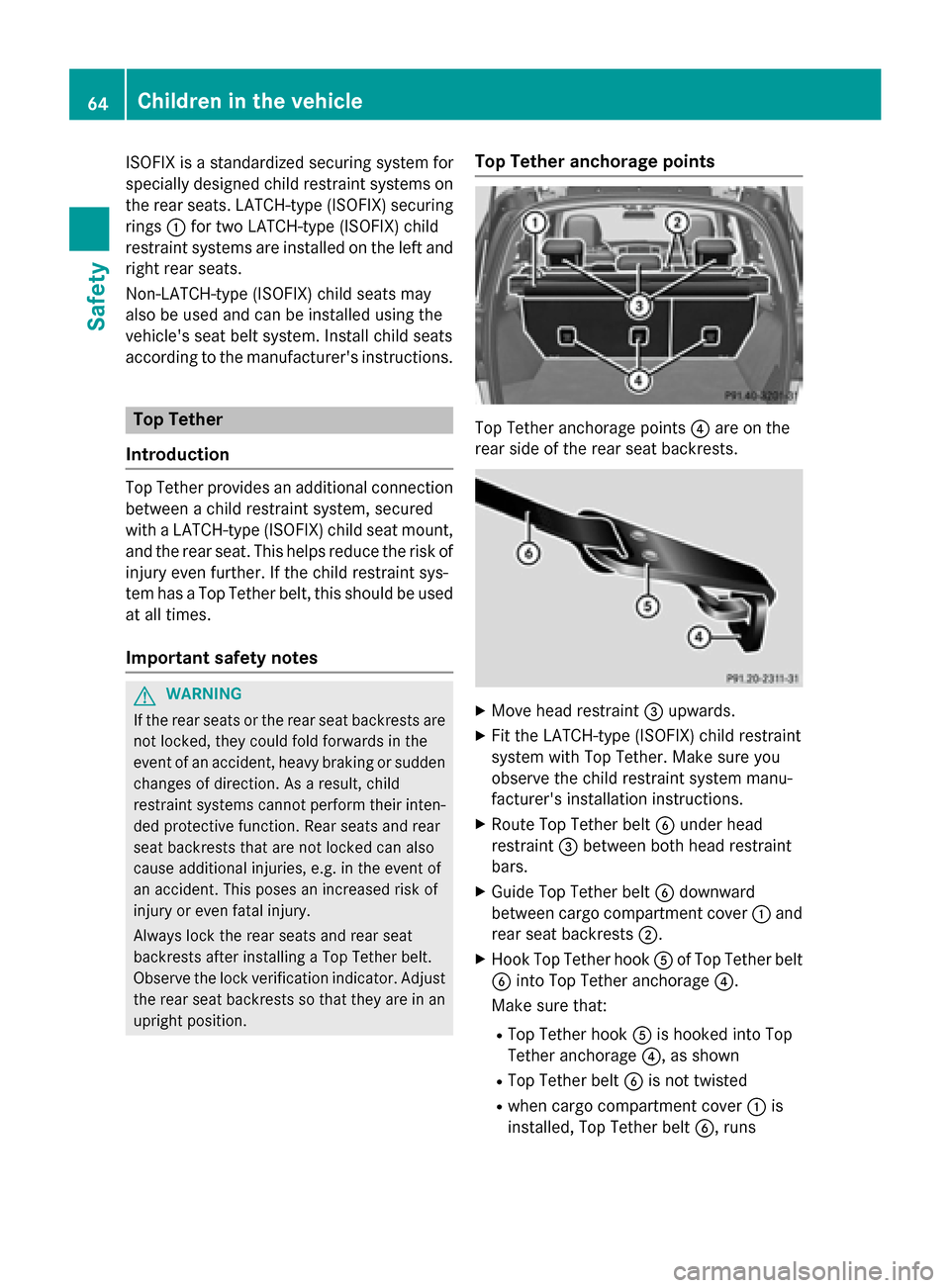
Top Tether anchorage points
0085are on the
rear side of the rear seat backrests. X
Move head restraint 0087upwards.
X Fit the LATCH-type (ISOFIX) child restraint
system with Top Tether. Make sure you
observe the child restraint system manu-
facturer's installation instructions.
X Route Top Tether belt 0084under head
restraint 0087between both head restraint
bars.
X Guide Top Tether belt 0084downward
between cargo compartment cover 0043and
rear seat backrests 0044.
X Hook Top Tether hook 0083of Top Tether belt
0084 into Top Tether anchorage 0085.
Make sure that:
R Top Tether hook 0083is hooked into Top
Tether anchorage 0085, as shown
R Top Tether belt 0084is not twisted
R when cargo compartment cover 0043is
installed, Top Tether belt 0084, runs64
Children in the vehicleSafety
Page 162 of 466

G
WARNING
Flammable materials introduced through
environmental influence or by animals can
ignite if in contact with the exhaust system or parts of the engine that heat up. There is a risk
of fire.
Carry out regular checks to make sure that
there are no flammable foreign materials in
the engine compartment or in the exhaust
system.
! Do not depress the accelerator when
starting the engine.
General notes i
Vehicles with a gasoline engine:
the
catalytic converter is preheated for up to
30 seconds after a cold start. The sound of the engine may change during this time.
Automatic transmission X
Shift the transmission to position P
(Y page 168).
The transmission position display in the
multifunction display shows
P (Y page 168).
i You can start the engine in transmission
position Pand N.
Starting procedure with the SmartKey X
To start a gasoline engine: turn the
SmartKey to position 3in the ignition lock
(Y page 157) and release it as soon as the
engine is running.
X To start a diesel engine: turn the Smart-
Key to position 2in the ignition lock
(Y page 157).
The 0028 preglow indicator lamp in the
instrument cluster lights up.
X When the 0028preglow indicator lamp
goes out, turn the SmartKey to position 3
(Y page 157) and release it as soon as the
engine is running. i
You can start the engine without preglow
if the engine is warm.
Using KEYLESS-GO to start the engine X
Depress the brake pedal and keep it
depressed.
X To start a gasoline engine: press the
Start/Stop button (Y page 158) once.
The engine starts.
X To start a diesel engine: press the Start/
Stop button once (Y page 158).
Preglow is activated and the engine starts.
i The Start/Stop button can be used to
start the vehicle without inserting the
SmartKey into the ignition lock. The Start/
Stop button must be inserted in the ignition
lock and the SmartKey must be in the vehi-
cle. This mode for starting the engine oper-
ates independently of the ECO start/stop
automatic engine start function. Pulling away
Automatic transmission G
WARNING
If the engine speed is above the idling speed
and you engage transmission position Dor R,
the vehicle could pull away suddenly. There is a risk of an accident.
When engaging transmission position Dor R,
always firmly depress the brake pedal and do not simultaneously accelerate.
X Depress the brake pedal and keep it
depressed.
X Shift the transmission to position Dor R
(Y page 168).
X Release the brake pedal.
X Carefully depress the accelerator pedal.
The electric parking brake (Y page 184) is
automatically released. 160
DrivingDriving and parking