2015 MERCEDES-BENZ E-CLASS SALOON lock
[x] Cancel search: lockPage 78 of 497
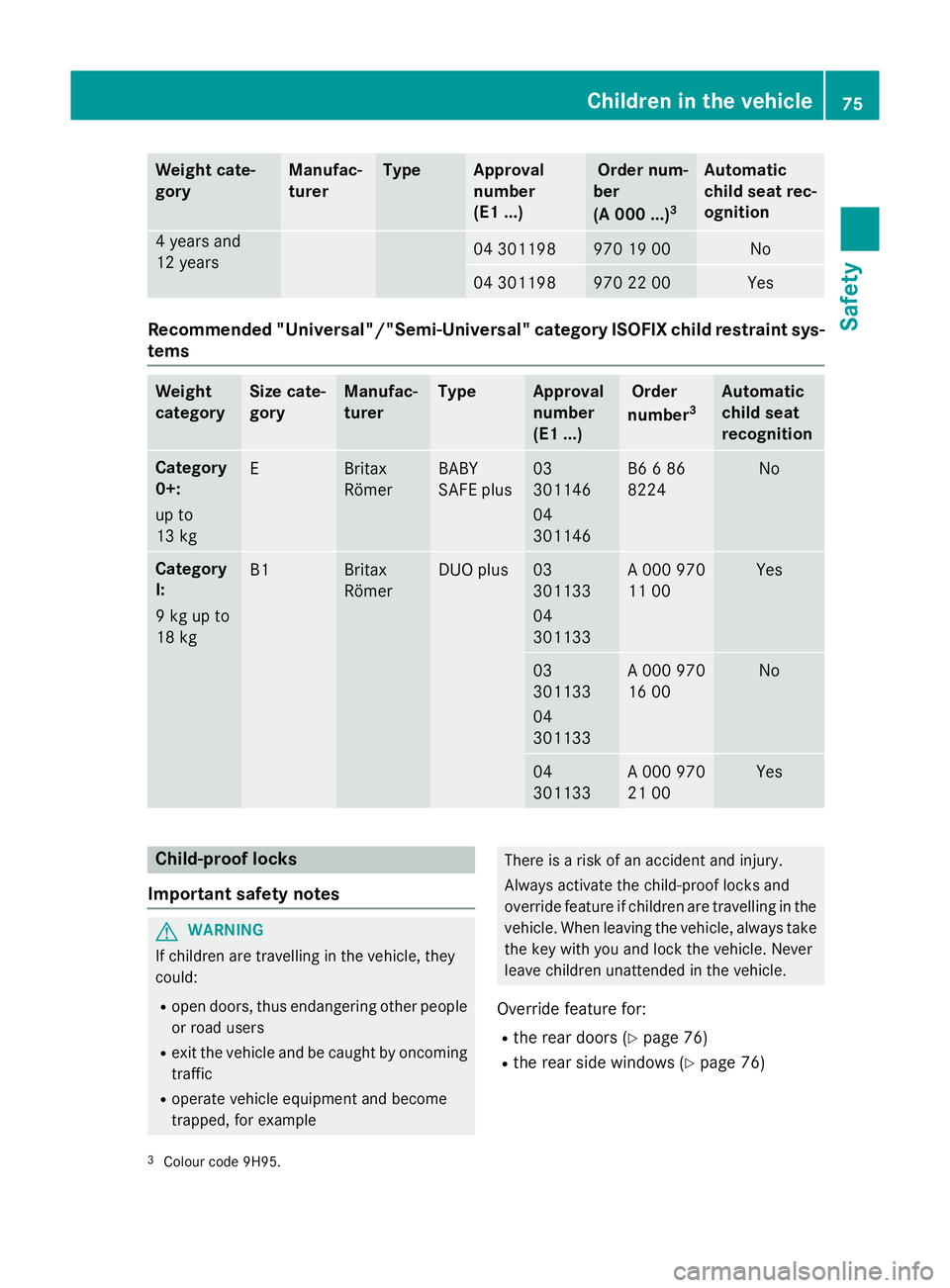
Weight cate-
gory Manufac-
turer Type Approval
number
(E1 ...) Order num-
ber
(A 000 ...) 3 Automatic
chil
dseat rec-
ognition 4y
ears and
12 years 04 301198 970 19 00 No
04 301198 970 22 00 Yes
Recommended "Universal"/"Semi-Universal" category ISOFIXc
hildr estraint sys-
tems Weight
category Size cate-
gory Manufac-
turer Type Approval
number
(E1 ...) Order
number 3 Automatic
chil
dseat
recognition Category
0+:
up to
13 kg
E Britax
Römer BABY
SAFE plus 03
301146
04
301146 B6
686
8224 No
Category
I:
9kgupto
18 kg
B1 Britax
Römer DUO plus 03
301133
04
301133 A0
00 970
11 00 Yes
03
301133
04
301133 A0
00 970
16 00 No
04
301133 A0
00 970
21 00 Yes
Child-proof locks
Important safety notes G
WARNING
If children are travelling in the vehicle, they
could:
R open doors, thus endangering other people
or road users
R exit the vehicl eand be caught by oncoming
traffic
R operate vehicl eequipment and become
trapped, for example There is
arisk of an accident and injury.
Always activate the child-proof locks and
override feature if children are travelling in the vehicle. When leaving the vehicle, alwayst ake
the key with you and lock the vehicle. Never
leave children unattende dinthe vehicle.
Overrid efeature for:
R the rear doors (Y page76)
R the rear side windows (Y page76)
3 Colour code 9H95. Children in the vehicle
75Safety Z
Page 79 of 497
G
WARNING
If you leave children unattended in the vehi-
cle, they may be abletos et the vehiclein
motion if, for example, they:
R release the parking brake
R shift the automatic transmission out of park
position Por shift manua ltransmission into
neutral
R start the engine
In addition, they may operate vehicl eequip-
ment and become trapped. There is arisk of
an accident and injury.
When leaving the vehicle, alwayst ake the key
with you and lock the vehicle. Never leave
children unattended in the vehicle. G
WARNING
If persons (particularly children) are exposed
to heatorc old foraprolonged period, there is
ar isk of serious or even fatal injuries. Never
leave persons (particularly children) unatten-
ded in the vehicle. G
WARNING
If the child restraint system is placed in direct sunlight, the parts coul dbecome very hot.
Childre ncouldbes uffer burns by touching
these parts, in particular on the metallic parts
of the child restraint system. There is arisk of
injury.
If you and yourc hild leave the vehicle, always
make sure that the child restraint system is
not in direct sunlight. Cove ritwithablanket,
for example. If the child restraint system has
been expose dtodirect sunlight, leave it to
cool downb efore securing the child in it.
Never leave children unattended in the vehi-
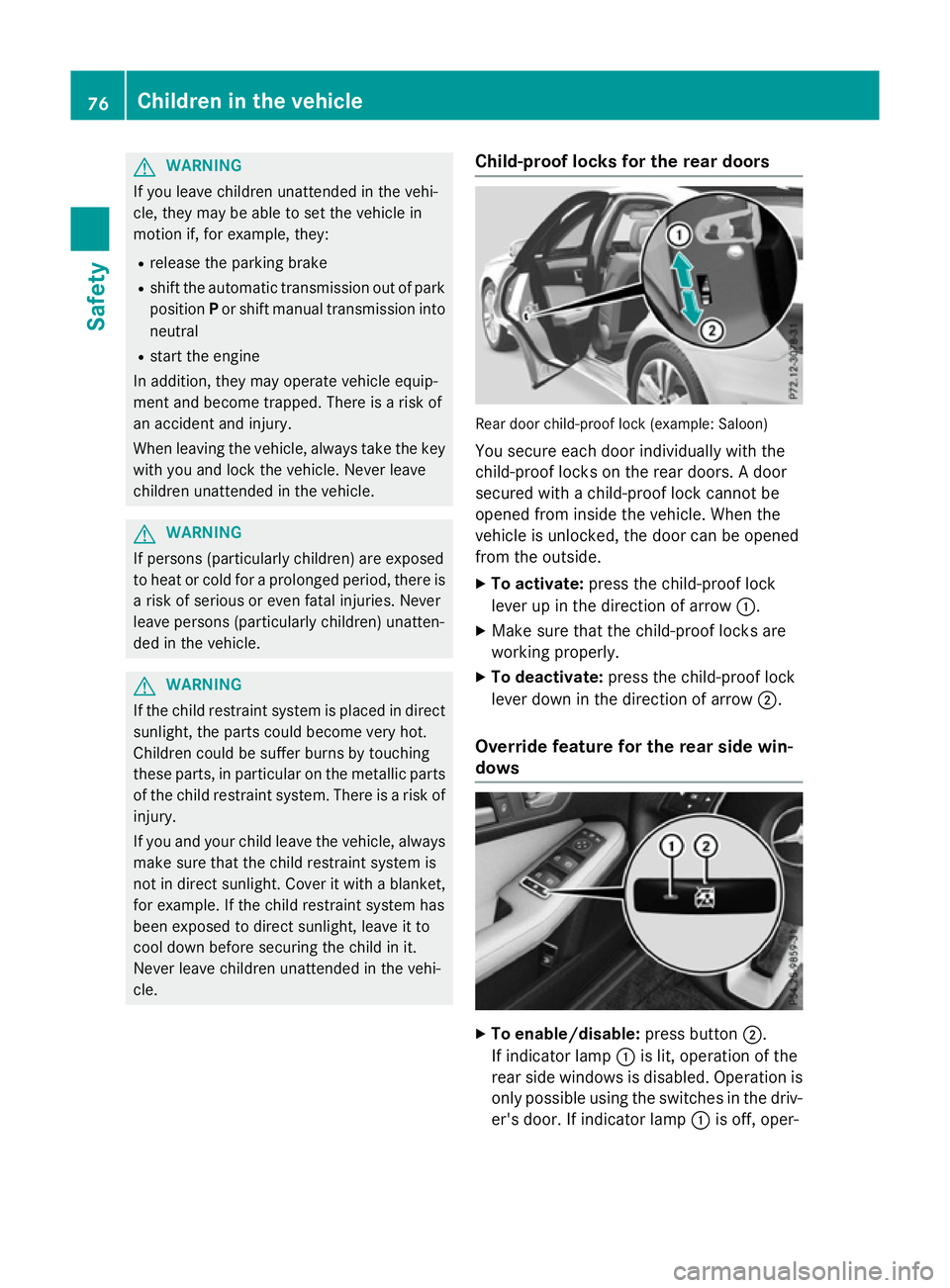
cle. Child-proof locks for the rear doors Rea
rdoor child-proof lock (example: Saloon)
You secure each door individually with the
child-proof locks on the rear doors. Adoor
secure dwithachild-proof lock cannot be
opened from insid ethe vehicle. When the
vehicl eisunlocked ,the door can be opened
from the outside.
X To activate: press the child-proof lock
leve rupint he direction of arrow :.
X Make sure that the child-proof locks are
working properly.
X To deactivate: press the child-proof lock
leve rdow nint he direction of arrow ;.
Override feature for the rear side win-
dows X
To enable/disable: press button;.
If indicator lamp :is lit, operation of the
rear side windows is disabled. Operation is
only possible using the switches in the driv- er's door. If indicator lamp :is off, oper- 76
Children in the vehicleSafety
Page 80 of 497
atio
nisp ossible usin gthe switches in the
rear compartment. Pet
sint hevehicle G
WARNING
If you leave animals unsupervised or unse-
cured in th evehicle ,the ym ay push abutton
or as witch ,for example.
They could:
R activat evehicle equipmen tand become
trapped, for example
R switch vehicle systems on or off ,thus
endangering other road users
In th eevent of an accident, sudde nbraking or
abrupt changes of direction ,unsecured ani-
mals could be flun garoun dthe vehicle ,injur-
ing th evehicle occupants .Ther eisar iskofan
acciden tand injury.
Never leave animals unattende dinthevehi-
cle .Always secure animals correctly durin ga
journey, e.g .inananimal transpor tbox. Driving safety systems
Driving safety systems overview
In this section, you will fin dinformatio nabout
th ef ollowin gdriving safety systems:
R AB S(Anti-lock Braking System)
(Y page 77)
R BA S(Brake AssistSystem) (Y page 78)
R BA SP LUS(Brake AssistSystem PLUS) with
Cross-Traffic Assist (Y page 78)
R COLLISION PREVENTION ASSIST PLUS
(distanc ewarning function and Adaptive
Brake Assist )(Y page 80)
R Adaptive brak elamps (Y page 83)
R ESP ®
(E lectronic Stability Program)
(Y page 83)
R EB D( electronic brakeforce distribution)
(Y page 86)
R ADAPTIV EBRAKE (Y page 86) R
PRE-SAFE ®
Brake (Y page 87)
R STEE RCONTROL (Y page 89) Important safety notes
If you fail to adapt your driving style or if you
are inattentive, th edriving safety systems can
neither reduc ethe riskofana ccidentnor
override th elaws of physics. Drivin gsafety
systems are merely aids designe dtoassist
driving .You are responsible for maintaining
th ed istanc etothevehicle in front, for vehicle
speed, for braking in good time, and for stay- ing in lane .Always adapt your driving style to
suit th eprevailin groad and weather condi-
tions and maintain asafe distanc efromt he
vehicle in front. Drive carefully.
The driving safety systems describe donly
work as effectivel yaspossible when there is
adequat econtac tbetween th etyres and the
road surface. Pleas epay special attentio nto
th en otes on tyres, recommended minimum
tyr etread depths etc. (Y page 416).
In wintry driving conditions, always use winter
tyres (M+ Styres) and ,ifnecessary, snow
chains .Onlyint hisw ay will th edriving safety
systems describe dinthiss ectio nwork as
effectivel yaspossible. ABS (Anti-lock Braking System)
General notes AB
Sr egulate sbrak epressure in suc haway
that th ewheels do no tloc kw hen you brake.
This allows you to continue steering th evehi-
cle when braking.
The yellow !ABSw arning lamp in the
instrumen tcluste rlight supw hen th eignition
is switched on .Itgoes out when th eengineis
running.
Important safety notes i
Observ
ethe "Important safety notes" sec-
tio n(Ypage 77). Driving safety systems
77Safety Z
Page 81 of 497

G
WARNING
If ABS is faulty, the wheels coul dlock when
braking. The steerability and braking charac-
teristics may be severely impaired .Addition-
ally, further driving safety systems are deac-
tivated. There is an increased dange rofskid-
ding and accidents.
Drive on carefully.H ave ABS checked imme-
diately at aqualified specialist workshop.
If ABS is malfunctioning, other systems,
including driving safety systems ,willa lso
become inoperative. Observe the information on the ABS warning lamp (Y page332) and
display messages which may be show ninthe
instrument cluster (Y page300).
ABS works from aspee dofa bout8km/h,
regardless of road-surface conditions. ABS
works on slippery surfaces, even when you
only brake gently.
Brakes X
If ABS intervenes: continue to depress the
brake peda lwith force until the braking sit-
uation is over.
X To make afull brake application:
depress the brake peda lwith full force.
If ABS intervenes when braking, you willf eel a
pulsing in the brake pedal.
The pulsating brake peda lcan be an indica-
tion of hazardous road conditions; this serves
as areminde rtotake extra care while driving. BAS (Brake Assist System)
General notes BAS operates in emergency braking situa-
tions. If you depress the brake peda lquickly,
BAS automatically boosts the braking force,
thus shortening the stopping distance. Important safety notes i
Observe the "Important safety notes" sec-
tion (Y page77). G
WARNING
If BAS is malfunctioning, the braking distance
in an emergency braking situation is
increased. There is arisk of accident.
In an emergency braking situation, depress
the brake peda lwith full force. ABS prevents
the wheels from locking.
Brakes X
Keep the brake peda ldepressed firmly until
the emergency braking situation is over.
ABS prevents the wheels from locking.
The brakes willf unction as usual once you
release the brake pedal. BAS is deactivated. BAS PLUS(
Brake Assist System
PLUS) with Cross-Traffic Assist
General notes i
Observe the "Important safety notes" sec-
tion (Y page77).
BAS PLUS is only available on vehicles with
the Driving Assistance package.
For BAS PLUS to assist you when driving, the
rada rsensor system and the camera system
must be operational.
With the help of asensor system and acam-
era system, BAS PLUS can detect obstacles:
R that are in the path of yourv ehiclefor an
extended period of time
R that cross the path of yourv ehicle
In addition, pedestrians in the path of your
vehicl ecan be detected.
BAS PLUS detects pedestrians using typical
characteristics such as the body contours
and posture of aperso nstanding upright.
If the rada rsensor system or the camera sys-
tem is malfunctioning, BAS PLUS functions
are restricted or no longer available.T he78
Driving safety systemsSafety
Page 83 of 497
When driving at
aspee dabove 30 km/h :if
you depress the brake peda lsharply,B AS
PLUS automatically increases the brake pres- sure to adegre esuited to the traffic situation.
BAS PLUS provides braking assistance in haz- ardous situations with vehicles in front within
as pee drange between 7km/h and
250 km/h.
Up to aspee dofa pproximately 70 km/h, BAS
PLUS may react to:
R stationary objects in the path of yourv ehi-
cle, e.g. stoppe dorparked vehicles
R pedestrians in the path of yourv ehicle
R obstacles crossing yourp ath, which move
in the detection range of the sensors and
are recognised by them
i If BAS PLUS demands particularly high
braking force, preventative passenger pro-
tection measures (PRE-SAFE ®
)a re activa-
ted simultaneously.
X Keep the brake peda ldepressed until the
emergency braking situation is over.
ABS prevents the wheels from locking.
BAS PLUS is deactivated and the brakes func-
tion as usual, if:
R you release the brake pedal
R there is no longer arisk of collision
R no obstacl eisdetected in front of your
vehicle
R you depress the accelerator pedal
R you activate kickdown COLLISIONP
REVENTIONASSIST
PLUS
General notes COLLISION PREVENTIO
NASSIST PLUS con-
sists of adistance warning function with an
autonomous braking function and Adaptive
Brake Assist.
COLLISION PREVENTIO NASSIST PLUS can
help you to minimise the risk of acollision with the vehicl
einfront or reduce the effects
of such acollision.
If COLLISION PREVENTIO NASSIST PLUS
detects that there is arisk of acollision, you
willbew arned visuallya nd acoustically.Ify ou
do not react to the visual and audible collision warning, autonomous braking can be initiated
in critical situations. If you apply the brake
yourself in acritical situation, the COLLISION
PREVENTIO NASSIST PLUS Adaptive Brake
Assist assists you.
Switchin gthe soun don/off COLLISION PREVENTIO
NASSIST PLUS is
activated after every ignition cycle .You can
activate or deactivate COLLISION PREVEN-
TION ASSIST PLUS in the on-board computer
(Y page2 87). When deactivated, the dis-
tance warning function and the autonomous
braking function are alsod eactivated.
If COLLISION PREVENTIO NASSIST PLUS is
deactivated, the æsymbol appears in the
assistance graphics display.
Important safety notes In particular, the detection of obstacles can
be impaired in the case of:
R dirt on the sensors or obscured sensors
R snow or heavy rain
R interference by other rada rsources
R strong rada rreflections, for example, in
multi-storey car parks
R an arrow vehicl etravelling in front, e.g. a
motorcycle
R av ehicl etravelling in front on adifferent
line
R new vehicles or after aservice on the COL-
LISION PREVENTIO NASSIST PLUS system
Please observe the information in the sec-
tion on running-in the vehicle
(Y page1 78).
Following damage to the front end of the vehi-
cle, have the configuration and operation of
the rada rsensor checked at aqualified spe- 80
Driving safety systemsSafety
Page 85 of 497
The autonomous braking function is available
in the following speed ranges:
R from 7km/ htoa pprox. 105 km/hf or mov-
ing objects
R from 7km/ htoa pprox. 50 km/h for sta-
tionar yobjects
If the autonomou sbraking functio ndeman ds
particularl yhighb raking force, preventative
passenge rprotection measures (PRE-SAFE ®
)
ar ea ctivated simultaneously.
Adaptive Brake Assist i
Observe the "Important safety notes" sec-
tio n(Ypage 77).
Adaptive Brake Assist provide sbraking assis-
tanc einh azardous situations at speeds
above 7km/h .Itusesr adar senso rtechnol-
og ytoa ssessthe traffi csituation. G
WARNING
Adaptive Brake Assist cannot always clearly
identify objects and complex traffi csitua-
tions.
In such cases ,Adaptive Brake Assist can:
R intervene unnecessarily
R not intervene
There is ariskofana ccident.
Alway spaycarefu lattentio ntothe traffi csit-
uatio nand be ready to brake. Terminate the
interventio ninanon-critical driving situation. G
WARNING
Adaptive Brake Assist does not react:
R to people or animals
R to oncoming vehicles
R to crossing traffic
R when cornering
As aresult, the Adaptive Brake Assist ma ynot
intervene in al lcritica lconditions .The re is a
risk of an accident.
Alway spaycarefu lattentio ntothe traffi csit-
uatio nand be ready to brake. Due to the nature of the system, particularly
complicated bu
tnon-critical driving condi-
tions ma yalsoc ause Brake Assist to inter-
vene.
If Adaptive Brake Assist is not availabl edueto
am alfu nctio ninthe rada rsen sors ystem, the
brake syste mremains availabl ewithf ull
brake boosting effect and BAS.
With the help of Adaptive Brake Assist, the
distance warning signa lcan detect obstacles
tha tare in the path of your vehicl efor an
extende dperio doft ime.
If Adaptive Brake Assist detects ariskofc ol-
lision with the vehicl einfront, it calculates
the braking force necessary to avoi dacolli-
sion. If yo uapply the brakes forcefully ,Adap-
tiv eB rake Assist will automaticall yincrease
the braking force to alevel suitabl efor the
traffi cconditions.
X Kee pthe brake peda ldep resse duntilthe
emergency braking situatio niso ver.
ABS prevents the wheels fro mlocking.
Th eb rakes will work normally agai nif:
R yo ur elease the brake pedal
R there is no longe rany dange rofacollision
R no obstacle is detecte dinfront of your
vehicle
Adaptive Brake Assist is the ndeactivated.
If Adaptive Brake Assist demands particularly high braking force, preventativ epassenger
protection measures (PRE-SAFE ®
)a re activa-
ted simultaneously.
Up to aspeed of approximately 250 km/h,
Adaptive Brake Assist is capable of reacting
to moving objects tha thavea lready been
detecte dassuchatl east once ove rthe period
of observation.
Up to aspeed of approximately 70 km/h,
Adaptive Brake Assist reacts to stationary
obstacles. 82
Driving safet
ysystemsSafety
Page 89 of 497
R
engin etorque is restricted to alimited
degree and the drive wheels are able to spin
The spinning of the wheels results in acut-
tinga ction for better traction on loose sur-
faces.
R ESP ®
still provides support when you brake
firmly
Characteristics when ESP ®
is deactivated
If ESP ®
is deactivated and one or more wheels
start to spin, the ÷ESP®
warning lamp in
the instrument cluster does not flash. In such
situations, ESP ®
will not stabilise the vehicle.
If you deactivat eESP®
:
R ESP ®
no longer improves driving stability
R engin etorque is restricted to alimited
degree and the drive wheels are able to spin
The spinning of the wheels results in acut-
tinga ction for better traction on loose sur-
faces.
R traction control is still activated
R PRE-SAFE ®
is no longer available; it is also
not activated if you brake firmly with assis-
tanc efrom ESP ®
R PRE-SAFE ®
Brak eisnol onger available; it
is also not activated if you brake firmly with
assistanc efrom ESP ®
R ESP ®
still provides support when you brake
firmly
ESP ®
trailer stabilisation General notes
If your vehicle/trailer combination begins to
lurch, ESP
®
assists you in this situation .ESP ®
slows the vehicle down by brakin gand limit-
ing the engin eoutput until the vehicle/trailer
combination has stabilised.
Important safet ynotes G
WARNING
If road and weather conditions are poor,
trailer stabilisation will not be able to prevent the vehicle/trailer combination from swerv- ing. Trailers with
ahigh centre of gravity can
tip over before ESP ®
can detec tthis. There is
ar isk of an accident.
Always adapt your driving style to the prevail- ing road and weather conditions.
If your vehicle/trailer combination begins to
lurch, you can only stabilise the vehicle/
trailer combination by depressing the brake
firmly.
ESP ®
trailer stabilisation is activ eabove
speeds of about 65 km/h.
ESP ®
trailer stabilisation does not work if
ESP ®
is deactivated or disabled because of a
malfunction. EBD (electronic brak
eforce distribu-
tion)
General notes EBDm
onitors and controls the brake pres-
sure on the rear wheels to improve driving
stability while braking.
Important safet ynotes i
Observe the "Important safety notes" sec-
tion for driving safety systems (Y page 77). G
WARNING
If EBDism alfunctioning, the rear wheels can
lock, e.g. under full braking. This increases the risk of skidding and an accident.
You should therefore adapt your driving style
to the differen thandling characteristics. Have
the brake system checked at aqualified spe-
cialist workshop.
Observe information regarding indicator and
warning lamps (Y page 332) as well as dis-
play messages (Y page 302). ADAPTIVE BRAKE
i Observe the "Important safety notes" sec-
tion (Y page 77). 86
Driving safet
ysystemsSafety
Page 92 of 497
You can prevent the intervention of PRE-
SAFE ®
Brak eata ny tim eby:
R depressing the accelerator pedal further
R activatin gkickdown
R releasin gthe brak epedal
The braking action of PRE-SAFE ®
Brak eis
ended automatically if:
R you manoeuvre to avoid the obstacle
R there is no longer arisk of collision
R there is no longer an obstacle detected in
front of your vehicle STEER CONTROL
General notes STEER CONTROL helps you by transmitting a
noticeable steerin gforce to the steering
wheel in the direction required for vehicle
stabilisation.
This steerin gsupport is provided in particular
if:
R both right wheels or both left wheels are on
as lippery road surfac ewhen you brake
heavily
R the vehicle starts to skid
Important safet ynotes i
Observe the "Importan
tsafet ynotes" sec-
tion (Y page 77).
No steerin gsupport is provided by STEER
CONTROL ,if:
R ESP ®
is malfunctioning
R the steerin gisfaulty
Power steerin gwill, however ,continue to
function. Protection against theft
Immobiliser
The immobiliser prevent syour vehicle from
being started without the correc tkey. X
To activat ewith th ekey: remove the key
fro mt he ignition lock.
X To activat ewith KEYLESS-GO: switchthe
ignition off and open the driver's door.
X To deactivate: switchont he ignition.
When leavin gthe vehicle, always tak ethe key
with you and lock the vehicle. Anyone can
star tthe engin eifavalid key has been left
inside the vehicle.
i The immobiliser is always deactivated
when you star tthe engine. ATA (Anti-Theft Alar
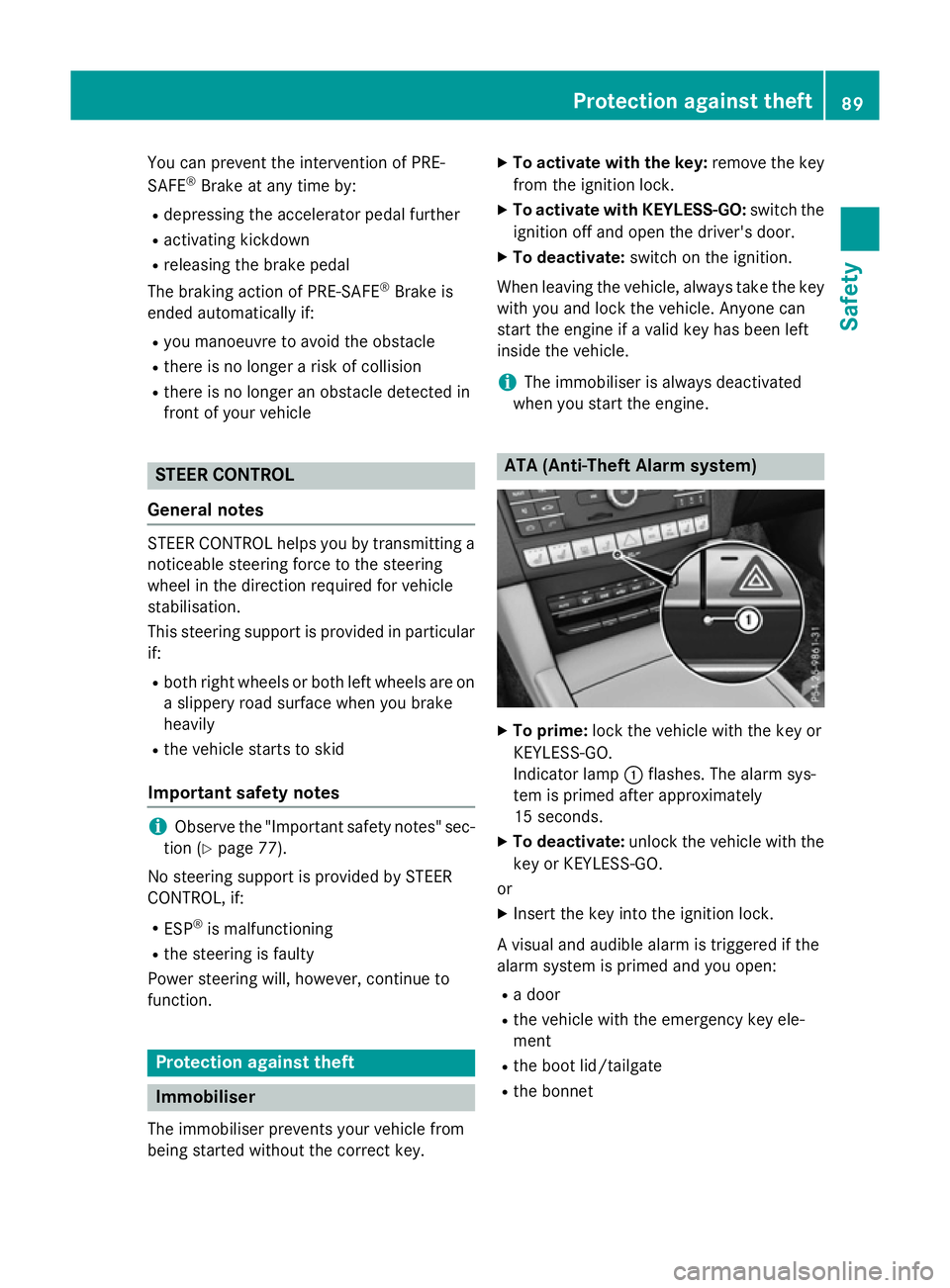
msystem) X
To prime: lock the vehicle with the key or
KEYLESS-GO.
Indicator lamp :flashes .The alarm sys-
tem is prime dafter approximately
15 seconds.
X To deactivate: unlockthe vehicle with the
key or KEYLESS-GO.
or X Insert the key int othe ignition lock.
Av isual and audible alarm is triggered if the
alarm system is primed and you open:
R ad oor
R the vehicle with the emergenc ykey ele-
ment
R the boot lid/tailgate
R the bonnet Protection against theft
89Safety Z