2015 MERCEDES-BENZ E-CLASS SALOON lock
[x] Cancel search: lockPage 51 of 497
Infants and childre
nmust never travel sit-
ting on the lap of avehicle occupant. In the
event of an accident, they could be crushed betwee nthe vehicle occupant and seat
belt.
R objects are never secured with aseat belt if
the seat belt is also being used by one of the vehicle's occupants.
Seat belts are only intended to secure and
restrain vehicle occupants. Alwayso bserve
the "Loading guidelines" for securing objects,
luggage or loads (Y page 342).
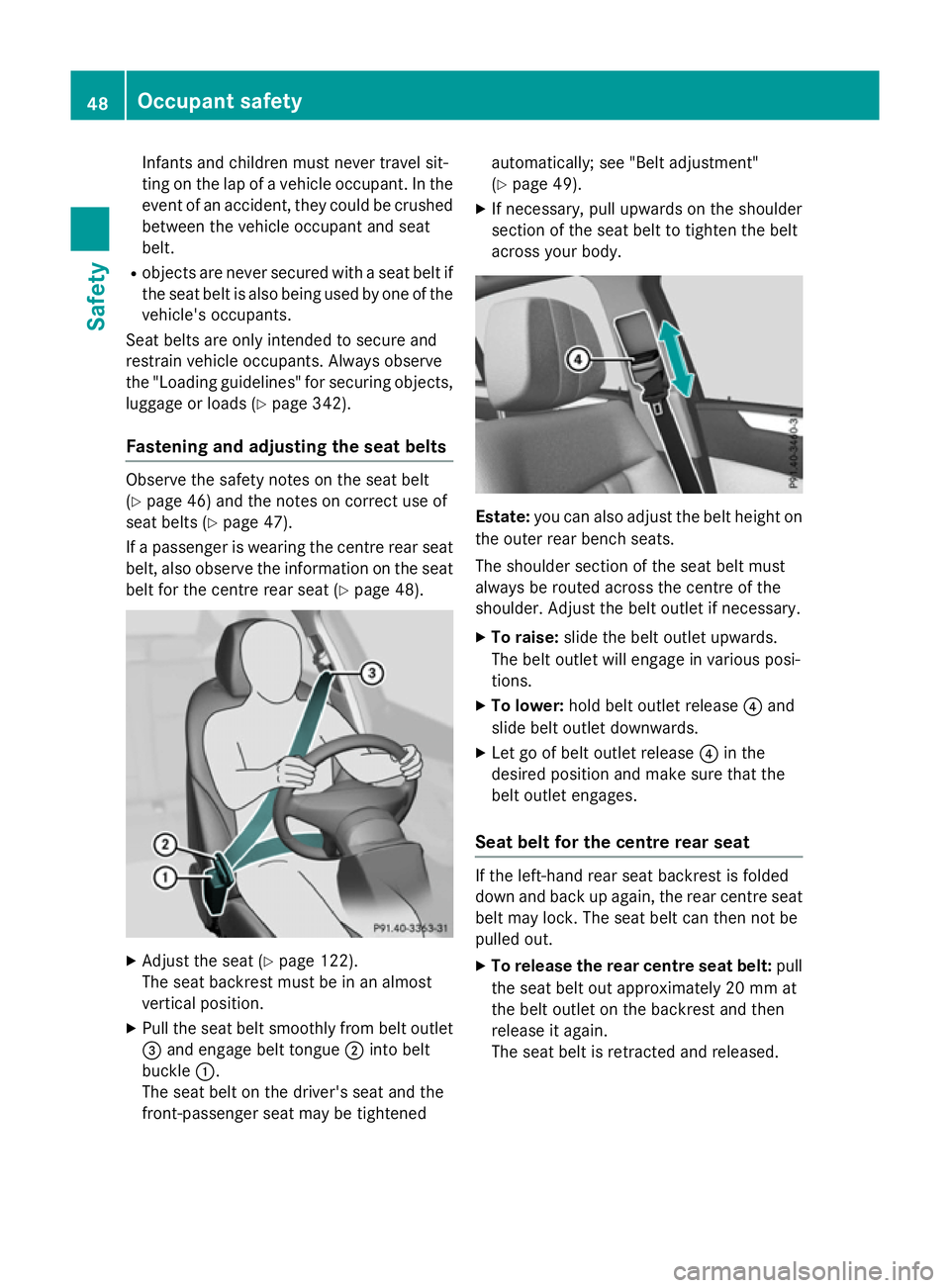
Fastening and adjusting the seat belts Observe the safety notes on the seat belt
(Y page 46) and the notes on correct use of
seat belts (Y page 47).
If ap assenger is wearing the centre rear seat
belt, also observe the information on the seat belt for the centre rear seat (Y page 48).X
Adjust the seat (Y page 122).
The seat backrest must be in an almost
vertical position.
X Pullt he seat belt smoothly from belt outlet
= and engage belt tongue ;into belt
buckle :.
The seat belt on the driver's seat and the
front-passenger seat may be tightened automatically; see "Belt adjustment"
(Y
page 49).
X If necessary ,pullu pwards on the shoulder
section of the seat belt to tighten the belt
across yourb ody. Estate:
you can also adjustt he belt heighton
the outer rear bench seats.
The shoulder section of the seat belt must
alwaysber outed across the centre of the
shoulder. Adjust the belt outlet if necessary.
X To raise: slidethe belt outlet upwards.
The belt outlet wille ngage in variousposi-
tions.
X To lower: hold belt outlet release ?and
slideb elt outlet downwards.
X Let go of belt outlet release ?in the
desire dpositio nand make sure that the
belt outlet engages.
Seat beltf or the centre rear seat If the left-hand rear seat backrest is folded
down and back up again, the rear centre seat
belt may lock. The seat belt can then not be
pulled out.
X To release the rear centre seat belt: pull
the seat belt out approximately 20 mm at
the belt outlet on the backrest and then
release it again.
The seat belt is retracted and released. 48
Occupant safetySafety
Page 56 of 497
When deployed, the windowbag enhances the
level of protection for the head. However, it
does not protec tthe chest or arms.
In the event of aside impact, the windowbag
is deployed on the side on which the impact
occurs.
If the system determines that they can offer
additional protection to that provided by the
seat belt, awindowbag may be deployed in
other accident situation s(Ypage 53). Deployment of belt tensioners and air-
bags
Important safety notes G
WARNING
After the airbag deploys, the airbag parts are
hot. There is arisk of injury.
Do not touch the airbag parts. Have a
deployed airbag replaced at aqualified spe-
cialist workshop as soon as possible. G
WARNING
Pyrotechnic seat belt tensioners that have
been deployed are no longer operational and
are unable to perform their intended protec-
tive function. This poses an increased risk of
injury or even fatal injury.
Therefore, have pyrotechnic belt tensioners
which have been triggered immediately
replaced at aqualified specialist workshop.
Mercedes-Benz recommends that you have
the vehicle towed to aqualified specialist
workshop after an accident .Take this into
account ,particularly if aseat belt tensioner
was triggered or an airbag was deployed.
An electric motor is used by PRE-SAFE ®
to
trigger the tightening of the seat belt in haz-
ardous situations. This procedure is reversi-
ble.
If the belt tensioners are triggered or an air-
bag is deployed, you will hear abang, and a
small amount of powder may also be released. The
6restraint system warning
lamp lights up.
Only in rare cases will the bang affect your
hearing. In general, the powder released is
not hazardous to health but may cause short- term breathin gdifficulties to persons suffer-
ing from asthma or other pulmonary condi-
tions. Provided it is safe to do so, you should
leave the vehicle immediately or open the
window in order to preven tbreathin gdifficul-
ties.
Operation During the first stage of
acollision, the
restraint system control unit evaluates impor-
tant physical data relating to vehicle deceler- ation or acceleration, such as:
R duration
R direction
R intensity
Based on the evaluation of this data, the
restraint system control unit trigger sthe seat
belt tensioners in the event of ahead-on or
rear collision.
As eat belt tensioner can only be triggered if:
R the ignition is switched on
R the componentsoft he restraint system are
operational; see "Restraint system warning lamp" (Y page 45)
R the belt tongue has engaged in the belt
buckle of the respective fron tseat
The seat belt tensioners in the rear compart-
ment are triggered independently of the lock
status of the seat belts.
If the restraint system control unit detect sa
high severit yofanaccident,incertain head-
on collisions, additional componentsoft he
restraint system are deployed independently
of each another:
R Fron tairbags and driver's kneebag
R Windowbag, if the system determines that
deployment can offer additional protection
to that provided by the seat belt Occupant safety
53Safety Z
Page 60 of 497

R
vehicles with the memory function: the
front-passenge rseat is adjusted if it is in an
unfavourable position.
R vehicles with amulticontour seat or active
multicontour seat: the air pressure in the
side bolsters of the backrest is increased.
If the hazardous situation passes without
resulting in an accident, PRE-SAFE ®
slackens
the beltp re-tensioning. On vehicles with mul-
ticontour seats/active multicontour seats,
the air pressure in the side bolsters is reduced
again. All settings made by PRE-SAFE ®
can
then be reversed.
If the seat beltp re-tensioning is not reduced:
X Move the seat backrest or seat back
slightly when the vehicl eisstationary.
Seat beltp re-tensioning is reduced and the
locking mechanism is released.
The seat-belt adjustment is an integral part of
the PRE-SAFE ®
convenience function. Infor-
mation about the convenience function can
be found under "Bel tadjustment"
(Y page4 9). PRE-SAFE
®
PLUS( anticipatory occu-
pant protectio nPLUS)
Introduction PRE-SAFE
®
PLUS is only available in vehicles
with the Driving Assistance package.
Using the rada rsensor system, PRE-SAFE ®
PLUS is abletod etect thatahead-on or rear-
end collision is imminent. In certain hazard-
ous situations, PRE-SAFE ®
PLUS takes pre-
emptive measures to protect the vehicle
occupants.
Important safety notes The intervention of PRE-SAFE
®
PLUS cannot
prevent an imminent collision.
The drive risnot warned before the interven-
tion of PRE-SAFE ®
PLUS. PRE-SAFE
®
PLUS does not intervene:
R if the vehicl eisreversing
R when the vehicl eistowing atrailer and
there is arisk of arear-end collision
PRE-SAFE ®
PLUS does not perform braking
actions while the vehicl eisinmotion or when
Parking Guidance is active.
Function PRE-SAFE
®
PLUS intervenes in certain situa-
tions if the rada rsensor system detects an
imminent head-on or rear-end collision.
PRE-SAFE ®
PLUS takes the following meas-
ures depending on the hazardous situation
detected:
R If the rada rsensor system detects that a
head-on collision is imminent, the seat
belts are pre-tensioned.
R If the rada rsensor system detects that a
rear-end collision is imminent:
- the rear hazard warning lamp sare acti-
vated and flas hatahigher frequency.
- the brake pressure is increase difthe
drive rappliest he brakes when the vehi-
cle is stationary.
- the seat belts are pre-tensioned.
The PRE-SAFE ®
PLUS braking application is
cancelled:
R if the accelerator peda lisdepressed when
ag earise ngaged
R if the risk of acollision passes or is no lon-
ger detected
R if DISTRONIC PLUS indicates an intention
to pulla way
If the hazardous situation passes without
resulting in an accident, the original settings
are restored. Occupant safety
57Safety Z
Page 61 of 497
Automati
cmeasures after an acci-
dent
Immediately after an accident, th efollowing
measures are implemented, depending on
th et ypea nd severity of th eimpact:
R theh azard warning lamp sare activated
R thee mergenc ylighting is activated
R thev ehicl edoor sare unlocked
R thef ront side windows are lowered
R vehicles wit hamemory function :the elec-
trically adjustable steering whee lisraised
R thee ngineiss witched off and th efuel sup-
ply is cut off
R vehicles wit hthe Mercedes-Benz emer-
gency call system: automatic emergency
call
R vehicles wit hthe hybrid driv esystem: the
hybrid system and th ehigh-voltage electri-
cal system are deactivated Children in th
evehicle Important safety notes
Acciden tstatistics sho wthatc hildren
secured in th erear seat sare safer than chil-
dre nsecured in th efront seats. Fo rthisr ea-
son ,Mercedes-Benz strongly advises that you
instal lachild restrain tsystem on arear seat.
Children are generally bette rprotected there.
If ac hild younger than twelve years old and
under 1.50 minh eight is travellin ginthe
vehicle:
R always secure th echild in achild restraint
system suitable for Mercedes-Benz vehi-
cles. The child restrain tsystem mus tbe
appropriat etotheage, weigh tand siz eof
th ec hild
R be sur etoobservethe instruction sand
safet ynotes in this section in addition to
th ec hild restrain tsystem manufacturer's
installation instructions
Do no tfitar earward-facing child restraint
system on th ecentre rear seat. G
WARNING
If you leav echildren unattended in th evehi-
cle ,the ym ay be able to set th evehicl ein
motion if, for example, they:
R release th eparking brake
R shif tthe automatic transmission out of park
position Por shif tmanual transmission into
neutral
R start th eengine
In addition ,the ym ay operate vehicl eequip-
men tand become trapped .There is ariskof
an acciden tand injury.
When leaving th evehicle, always tak ethe key
wit hyou and loc kthe vehicle. Never leave
children unattended in th evehicle. G
WARNING
If person s(particularly children )are exposed
to heat or cold for aprolonged period, there is
ar iskofs erious or eve nfatal injuries. Never
leav eperson s(particularly children )unatten-
ded in th evehicle. G
WARNING
If th echild restrain tsystem is placed in direct
sunlight, th epartsc ould become ver yhot.
Children could be suffer burn sbytouching
these parts, in particular on th emetallic parts
of th echild restrain tsystem. There is ariskof
injury.
If you and your child leav ethe vehicle, always
mak esuret hatthe child restrain tsystem is
no tind irectsunlight. Cove ritwithab lanket,
for example. If th echild restrain tsystem has
been exposed to direc tsunlight, leav eitto
cool down before securin gthe child in it.
Never leav echildren unattended in th evehi-
cle.
Always ensur etha tall vehicl eoccupant shave
their seat belt sfastene dcorrectly and are sit-
ting properly. Particular attention mus tbe
paid to children.
Observ ethe safet ynotes on th eseat belt
(Y page 46) and th enotes on how to use the
seat belt properly (Y page 47).58
Childre
ninthevehicleSafety
Page 63 of 497
accident. This pose
sanincreased risk of
injury or even fatal injury.
If th echild weigh smoret han2 2kg,only use
ISOFIX child restraint systems with whic hthe
child is also secured with th evehicle seat belt.
Als osecure th echild restraint system with the
Top Tether belt ,ifavailable.
When fittin gachild restraint system, be sure
to observ ethe manufacturer' sinstallation
and operatin ginstruction sand th einstruc-
tions for correc tuse of th echild restraint sys-
te m( Ypage 70).
Before ever ytrip, mak esure that th eISOFIX
child restraint system is engaged correctly in bot hISOFI Xsecurin grings.
! When fittin
gthe child restraint system,
mak esure that th eseat belt for th ecentre
seat does no tget trapped. Otherwise, the
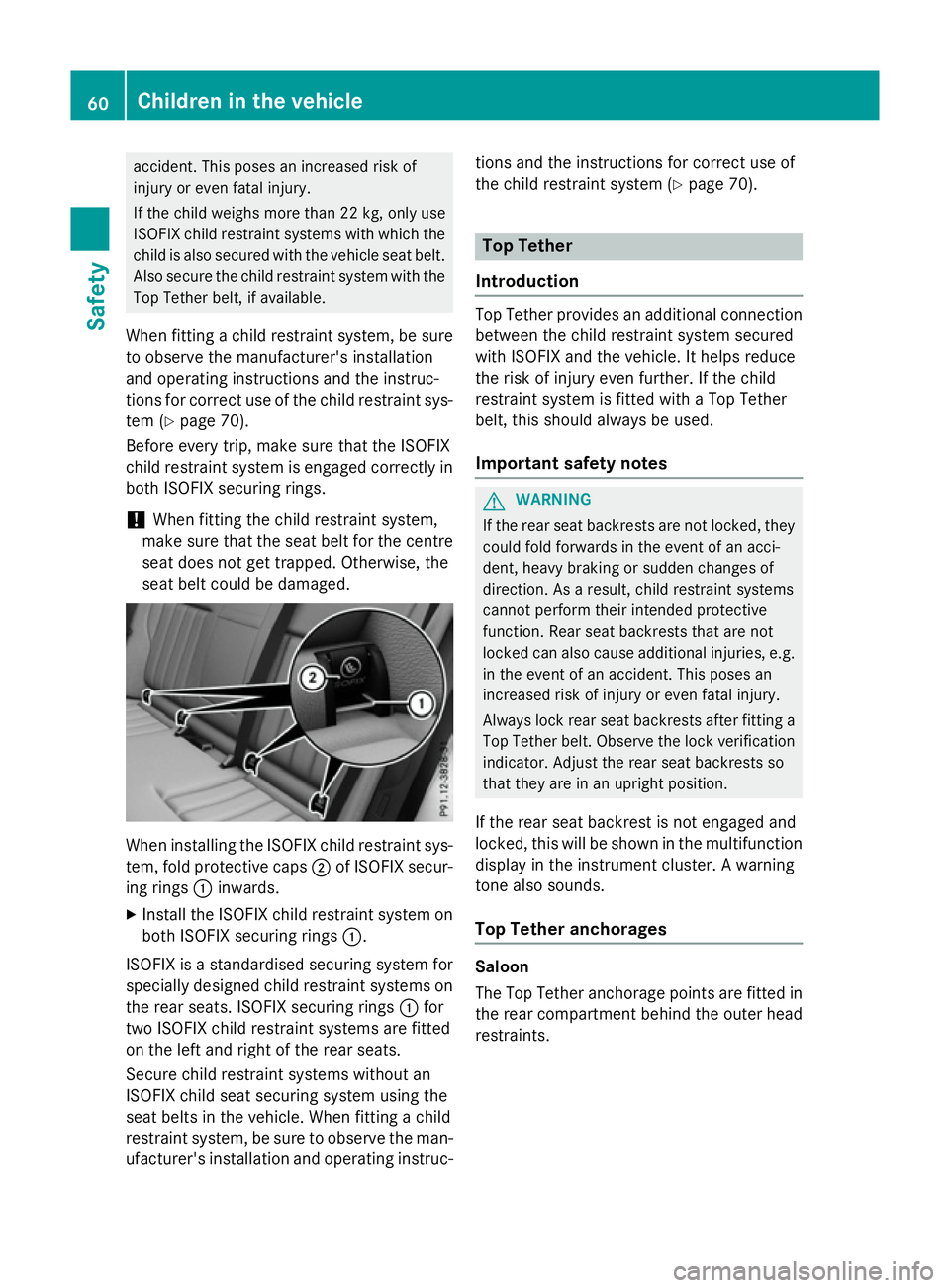
seat belt coul dbedamaged. When installing th
eISOFI Xchild restraint sys-
tem, fold protective caps ;of ISOFIX secur-
ing rings :inwards.
X Install th eISOFI Xchild restraint system on
bot hISOFI Xsecurin grings :.
ISOFIX is astandardised securin gsystem for
specially designed child restraint systems on
th er ear seats. ISOFIX securin grings :for
two ISOFIX child restraint systems are fitted
on th eleft and righ toftherear seats.
Secure child restraint systems without an
ISOFIX child seat securin gsystem usin gthe
seat belt sinthevehicle .When fittin gachild
restraint system, be sure to observ ethe man-
ufacturer' sinstallation and operatin ginstruc- tions and th
einstruction sfor correc tuse of
th ec hild restraint system (Y page 70). Top Tether
Introduction Top Tether provides an additional connection
between th echild restraint system secured
with ISOFIX and th evehicle .Ithelps reduce
th er isk of injury even further. If th echild
restraint system is fitte dwithaTop Tether
belt ,thiss houl dalways be used.
Important safety notes G
WARNING
If th erear seat backrests are no tlocked, they
coul dfold forwards in th eeven tofana cci-
dent, heav ybraking or sudden changes of
direction .Asaresult, child restraint systems
canno tperform their intended protective
function .Rear seat backrests that are not
locke dcan also caus eadditional injuries ,e.g.
in th eeven tofana ccident. This pose san
increased risk of injury or even fatal injury.
Always loc krear seat backrests after fittin ga
Top Tether belt .Observ ethe lockverification
indicator. Adjust th erear seat backrests so
that they are in an upright position.
If th erear seat backres tisnotengaged and
locked, this will be show ninthemultifunction
display in th einstrumen tcluster. Awarning
tone also sounds.
Top Tether anchorages Saloon
The Top Tether anchorage points are fitte
din
th er ear compartmen tbehin dthe outer head
restraints. 60
Children in th
evehicleSafety
Page 68 of 497
X
Pull both parts of the belt tight .Make sure
that the seat belt is not twisted.
X Adjust the head restraint if necessary
(Y page 126).
Side head restraints for the integrated
child seat G
WARNING
If the side head restraint has been fitted incor-
rectly, it cannot perform its intended protec-
tive function. Achild's head therefore cannot
be supported in the event of an accident,
heavy braking or asudden change of direc-
tion. In addition, the side head restraint could become loose and be thrown around, endan-
gering vehicle occupants. This poses an
increased risk of injury or even fatal injury.
Only fasten the side head restraint to the spe-
cially designed securing points on the rear
head restraint. For safety reasons, only use
side head restraints that have been tested
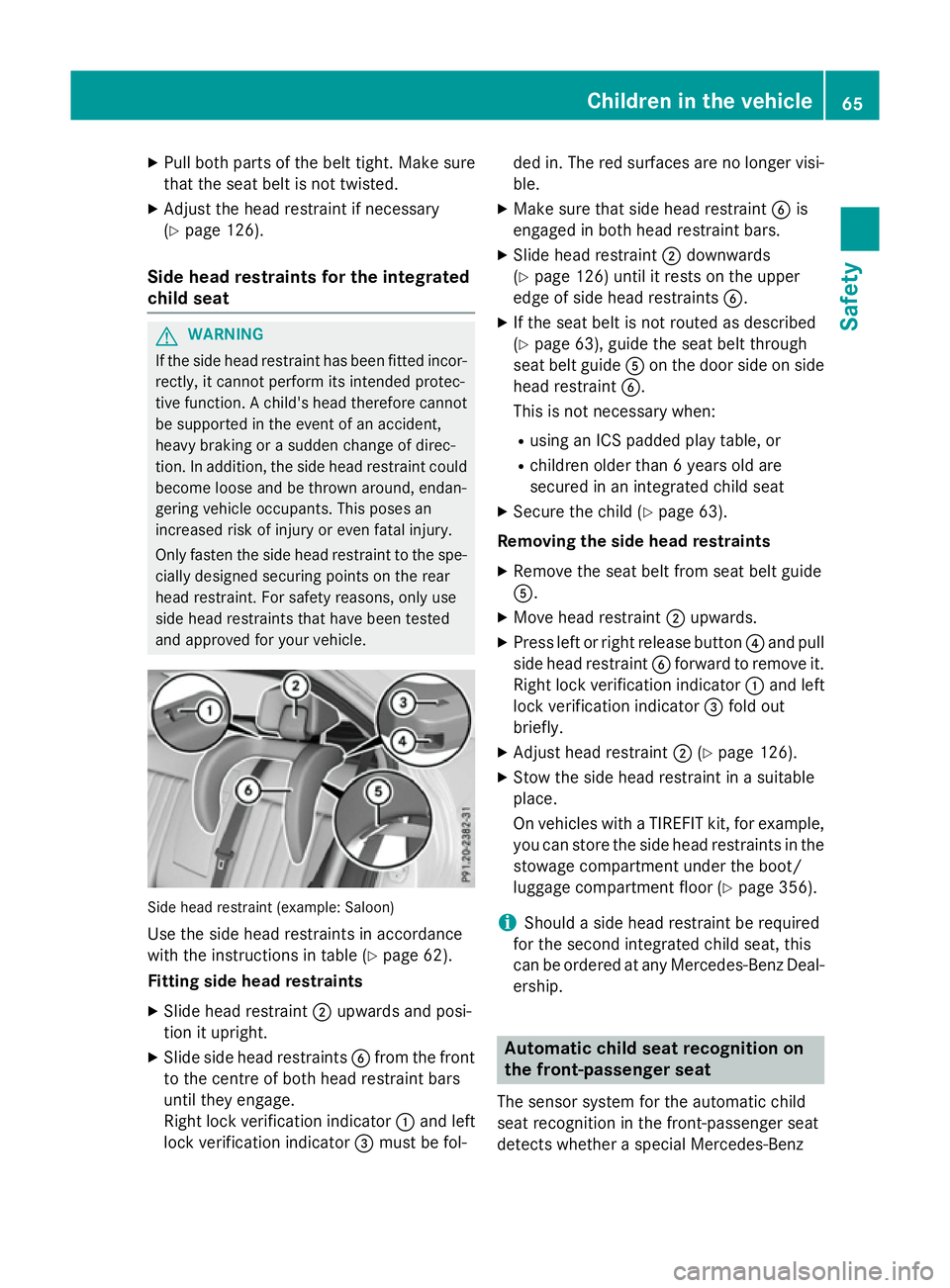
and approved for your vehicle. Side head restraint (example: Saloon)
Use the side head restraints in accordance
with the instruction sintable (Y page 62).
Fitting side head restraints
X Slide head restraint ;upwards and posi-
tion it upright.
X Slide side head restraints Bfrom the front
to the centre of both head restraint bars
until they engage.
Right lock verification indicator :and left
lock verification indicator =must be fol- ded in. The red surfaces are no longer visi-
ble.
X Make sure that side head restraint Bis
engaged in both head restraint bars.
X Slide head restraint ;downwards
(Y page 126) until it rests on the upper
edge of side head restraints B.
X If the seat belt is not routed as described
(Y page 63), guide the seat belt through
seat belt guide Aon the door side on side
head restraint B.
This is not necessary when:
R using an ICS padded play table, or
R children older than 6years old are
secured in an integrated child seat
X Secure the child (Y page 63).
Removing the side head restraints X Remove the seat belt from seat belt guide
A.
X Move head restraint ;upwards.
X Press left or right release button ?and pull
side head restraint Bforward to remove it.
Right lock verification indicator :and left
lock verification indicator =fold out
briefly.
X Adjust head restraint ;(Ypage 126).
X Stow the side head restraint in asuitable
place.
On vehicles with aTIREFI Tkit, for example,
you can store the side head restraints in the stowage compartment under the boot/
luggage compartment floor (Y page 356).
i Should
aside head restraint be required
for the secon dintegrated child seat, this
can be ordered at any Mercedes-Benz Deal- ership. Automatic child seat recognition on
the front-passenger seat
The sensor system for the automatic child
seat recognition in the front-passenger seat
detect swhether aspecial Mercedes-Benz Children in the vehicle
65Safety Z
Page 70 of 497
PASSENGERA
IR BAG OFF indicator lamp :
shows you whether the front-passenger front airbag is disabled.
X Turn the key to position 1or 2in the ignition
lock or, on vehicles with KEYLESS-GO,
press the Start/Stop button once or twice. The system carries out aself-diagnosis.
The PASSENGERA IR BAG OFF indicator lamp
must light up for approximately six seconds.
If, after the system self-test, the
PASSENGER AIR BAG OFF indicator lamp:
R lights up ,the front-passenger fronta irbag
is disabled. It will then not be deployed in
the event of an accident.
R is not lit,t he sensor system did not detect
ac hild restraint system with transponder
for automatic child seat recognition. If, in
the case of an accident ,all deployment cri-
teria are met, the front-passenger fronta ir-
bag is deployed. G
WARNING
Electronic devices on the front-passenger
seat can affect the function of the automatic
child seat recognition, for example:
R laptop
R mobile phone
R transponder cards such as ski passes or
access passes
The front-passenger fronta irbag could deploy
unintentionally or not function as intended
during an accident .This poses an increased
risk of injury or even fatal injury.
Do not place any of the devices mentioned
above or similar devices on the front-
passenger seat. Be aware of the status of the front-passenger fronta irbag both before and
during the journey. Child restraint system on the front-
passenger seat
General notes Accident statistics show that children
secured in the rear seats are safer than chil-
dren secured in the front-passenger seat. For
this reason, Mercedes-Benz strongly advises
that you install achild restraint system on a
rear seat.
Vehicles with automatic child seat recogni-
tion on the front-passenger seat: if it is abso- lutely necessary to fit achild restraint system
to the front-passenger seat, alway sobserve
the information on "Automatic child seat rec-
ognition on the front-passenger seat"
(Y page 65).
You can thus avoid the risks that could arise
as aresult of:
R ac hild restraint system that is not detected
by the automatic child seat recognition
sensor system
R the unintentional disabling of the front-
passenger fronta irbag
R the unsuitable positionin gofthe child
restraint system, e.g. too close to the dash-
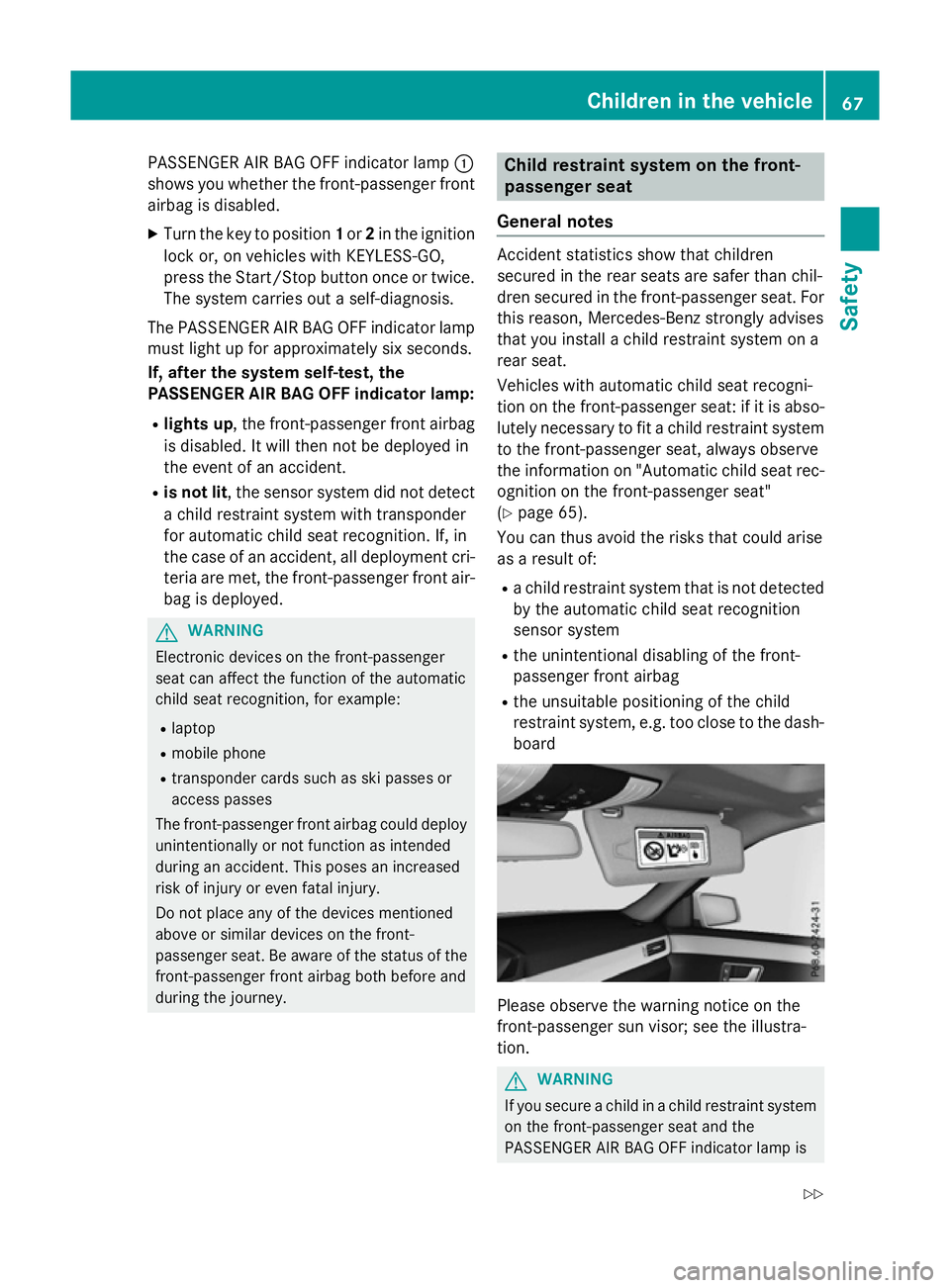
board Please observe the warning notice on the
front-passenger sun visor; see the illustra-
tion.
G
WARNING
If you secure achild in achild restraint system
on the front-passenger seat and the
PASSENGER AIR BAG OFF indicator lamp is Children in the vehicle
67Safety
Z
Page 71 of 497
off, the front-passenger front airbag can
deploy in the event of an accident .The child
could be struck by the airbag. This poses an
increased risk of injury or even fatal injury.
Make sure that the front-passenger front air-
bag has been disabled. The PASSENGER AIR- BAG OFF indicator lamp must be lit.
NEVERu searearward facing child restraint
on aseat protected by an ACTIVE AIRBAGin
front of it; DEATH or SERIOUS INJURY to the
CHILD can occur.
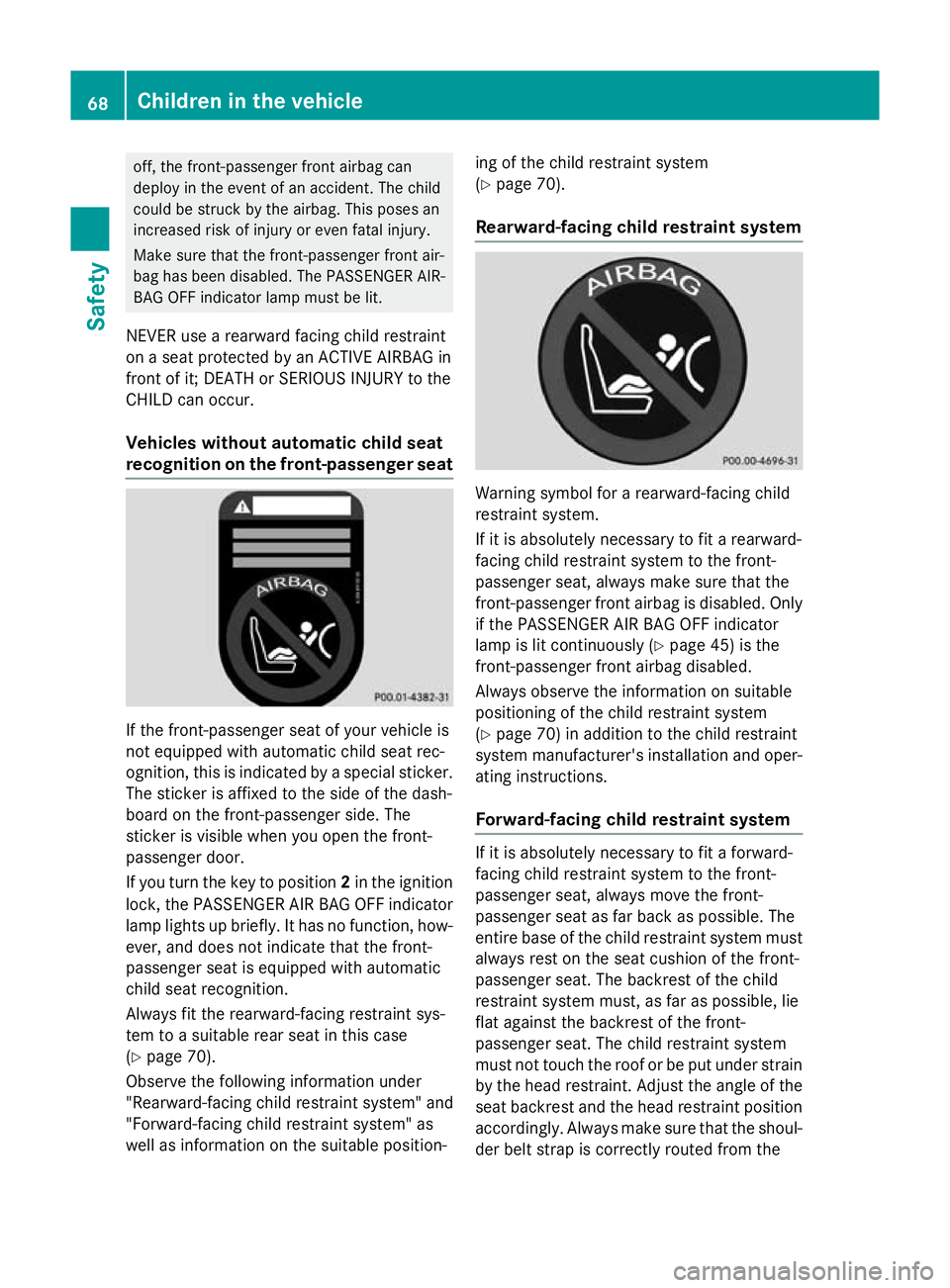
Vehicles without automatic child seat
recognition on the front-passenger seat If the front-passenger seat of your vehicle is
not equipped with automatic child seat rec-
ognition
,this is indicated by aspecial sticker.
The sticker is affixed to the side of the dash-
board on the front-passenger side. The
sticker is visible when you open the front-
passenger door.
If you turn the key to position 2in the ignition
lock, the PASSENGER AIR BAG OFF indicator lamp lights up briefly. It has no function, how-ever, and does not indicate that the front-
passenger seat is equipped with automatic
child seat recognition.
Always fit the rearward-facing restraint sys-
tem to asuitable rear seat in this case
(Y page 70).
Observe the following information under
"Rearward-facing child restraint system" and
"Forward-facing child restraint system" as
well as information on the suitable position- ing of the child restraint system
(Y
page 70).
Rearward-facing child restraint system Warning symbol for
arearward-facing child
restraint system.
If it is absolutely necessary to fit arearward-
facing child restraint system to the front-
passenger seat, always make sure that the
front-passenger front airbag is disabled. Only if the PASSENGER AIR BAG OFF indicator
lamp is lit continuously (Y page 45) is the
front-passenger front airbag disabled.
Always observe the information on suitable
positioning of the child restraint system
(Y page 70) in addition to the child restraint
system manufacturer' sinstallation and oper-
ating instructions.
Forward-facing child restraint system If it is absolutely necessary to fit
aforward-
facing child restraint system to the front-
passenger seat, always move the front-
passenger seat as far back as possible. The
entire base of the child restraint system must
always rest on the seat cushion of the front-
passenger seat. The backrest of the child
restraint system must, as far as possible, lie
flat against the backrest of the front-
passenger seat. The child restraint system
must not touch the roof or be put under strain by the head restraint .Adjust the angle of the
seat backrest and the head restraint position accordingly. Always make sure that the shoul-
der belt strap is correctly routed from the 68
Children in the vehicleSafety