2015 MERCEDES-BENZ B-CLASS SPORTS glove box
[x] Cancel search: glove boxPage 12 of 346
Fog lampsSwitching on/off .......................... .105
Folding table ...................................... 251
Front fog lamps
Display message ............................ 220
Switching on/off ........................... 105
Front-passenger seat
Folding the backrest forward/
back ............................................... 251
Fuel
Additives ........................................ 337
Consumption information .............. 337
Consumption statistics .................. 196
Displaying the current consump-
tion ................................................ 196
Displaying the range ..................... .196
Driving tips ................................... .156
E10 ................................................ 336
Fuel gauge ....................................... 29
Grade (gasoline) ............................ 336
Important safety notes .................. 335
Problem (malfunction) ................... 152
Refueling ........................................ 150
Tank content/reserve fuel ............. 336
Fuel filler flap
Opening ......................................... 151
Fuel level
Calling up the range (on-board
computer) ...................................... 196
Fuel tank
Capacity ........................................ 336
Problem (malfunction) ................... 152
Fuses
Allocation chart ............................ .300
Before changing ............................ .299
Fuse box in the engine compart-
ment .............................................. 299
Fuse box in the front-passenger
footwell .......................................... 300
Important safety notes .................. 298
G
Garage door opener
Clearing the memory ..................... 266
General notes ................................ 263
Important safety notes .................. 264
Opening/closing the garage door .. 266 Programming (button in the rear-
view mirror) ................................... 264
Synchronizing the rolling code ....... 264
Gasoline ............................................. 336
Genuine parts ...................................... 20
Glove box .......................................... .249
H
Hazard warning lamps
Display message ............................ 233
Switching on/off ........................... 107
Head restraints
Adjusting ......................................... 94
Adjusting (manually) ........................ 95
Adjusting (rear) ................................ 95
Headlamps
Fogging up ..................................... 108
see Automatic headlamp mode
Heating
see Climate control
High beam flasher .............................107
High-beam headlamps
Adaptive Highbeam Assist ............. 107
Changing bulbs .............................. 111
Display message ............................ 220
Switching on/off ........................... 106
Hill start assist .................................. 138
HOLD function
Activating ....................................... 171
Deactivating ................................... 171
Display message ............................ 225
Function/notes ............................ .170
Hood
Closing .......................................... .271
Display message ............................ 232
Important safety notes .................. 270
Opening ......................................... 270
Horn ...................................................... 28
Hydroplaning ..................................... 160
I
Ignition lock
see Key positions
Immobilizer .......................................... 67
10Index
Page 18 of 346
Switching on/off........................... 106
Start/Stop button
Removing ....................................... 136
Starting the engine ........................ 138
Start/stop function
see ECO start/stop function
Starting (engine) ................................ 137
Status overview (on-board com- puter) .................................................. 201
STEER CONTROL .................................. 66
Steering (display message) .............. 233
Steering assistant STEER CON- TROL
see STEER CONTROL
Steering wheel
Adjusting (manually) ........................ 97
Button overview ............................... 31
Buttons (on-board computer) ......... 193
Cleaning ......................................... 280
Important safety notes .................... 97
Paddle shifters ............................... 147
Steering wheel paddle shifters ........ 147
Stowage compartments
Armrest (front) ............................... 250
Armrest (under) ............................. 250
Center console .............................. 249
Center console (rear) ..................... 250
Cup holders ................................... 259
Eyeglasses compartment ............... 249
Glove box ....................................... 249
Important safety information ......... 249
Map pockets .................................. 251
Stowage net ................................... 251
Under driver's seat/front-
passenger sea t.............................. 250
Stowage net ....................................... 251
Summer tires ..................................... 304
Sun visor ............................................ 261
Switching air-recirculation mode
on/off ................................................. 130
T
Tachometer ........................................ 193
Tail lamps
Display message ............................ 220
see Lights Tailgate
Display message ............................ 232
Emergency unlocking ....................... 80
Important safety notes .................... 79
Opening dimensions ...................... 341
Opening/closing (from outside) ....... 80
Tank content
Fuel gauge ....................................... 29
Technical data
Capacities ...................................... 335
Emergency spare wheel ................. 331
Information .................................... 334
Tires/wheels ................................. 326
Vehicle data ................................... 341
Telephone
Accepting a call (multifunction
steering wheel) .............................. 200
Display message ............................ 233
Introduction ................................... 200
Menu (on-board computer) ............ 200
Number from the phone book ........ 200
Redialing ........................................ 201
Rejecting/ending a call ................. 200
Temperature
Coolant .......................................... 192
Outside temperature ...................... 193
Setting (climate control )................ 126
Through-loading feature ................... 252
Tire pressure
Checking manually ........................ 309
Display message ............................ 229
Maximum ....................................... 308
Not reached (TIREFIT) .................... 288Note s............................................. 307
Reached (TIREFIT) .......................... 288
Recommended ............................... 305
Tire pressure loss warning system
General notes ................................ 309
Important safety notes .................. 309
Restarting ...................................... 309
TIREFIT kit .......................................... 286
Tires
Aspect ratio (definition) ................. 321
Average weight of the vehicle
occupants (definition) .................... 320
Bar (definition) ............................... 319
Changing a whee l.......................... 322
Characteristics .............................. 319
16Index
Page 47 of 346
ROnly secure a child in a rearward-facing
child restraint system on the front-
passenger seat when the front-passenger
front air bag is deactivated. If the
PASSENGER AIR BAG OFF indicator lamp is
permanently lit, the front-passenger front
air bag is deactivated ( Ypage 39).
R Always observe the instructions and safety
notes on the "Occupant Classification Sys- tem (OCS)" ( Ypage 47) and on "Children
in the vehicle" ( Ypage 54) in addition to
the child restraint system manufacturer's
installation instructions.
Objects in the vehicle interior may pre-
vent an air bag from functioning correctly. Before starting your journey and to avoid risks
resulting from the speed of the air bag as it
deploys, make sure that:
R there are no people, animals or objects
between the vehicle occupants and an airbag.
R there are no objects between the seat, door
and B-pillar.
R no hard objects, e.g. coat hangers, hang on
the grab handles or coat hooks.
R no accessories, such as cup holders, are
attached to the vehicle within the deploy-
ment area of an air bag, e.g. to doors, side
windows, rear side trim or side walls.
R no heavy, sharp-edged or fragile objects
are in the pockets of your clothing. Store
such objects in a suitable place.
GWARNING
If you modify the air bag cover or affix objects
such as stickers to it, the air bag can no longer
function correctly. There is an increased risk
of injury.
Never modify an air bag cover or affix objectsto it.
GWARNING
Sensors to control the air bags are located in the doors. Modifications or work not per-
formed correctly to the doors or door panel-
ing, as well as damaged doors, can lead to the
function of the sensors being impaired. The airbags might therefore not function properly
any more. Consequently, the air bags cannot
protect vehicle occupants as they are
designed to do. There is an increased risk ofinjury.
Never modify the doors or parts of the doors.
Always have work on the doors or door pan-
eling carried out at a qualified specialist work- shop.
Front air bags
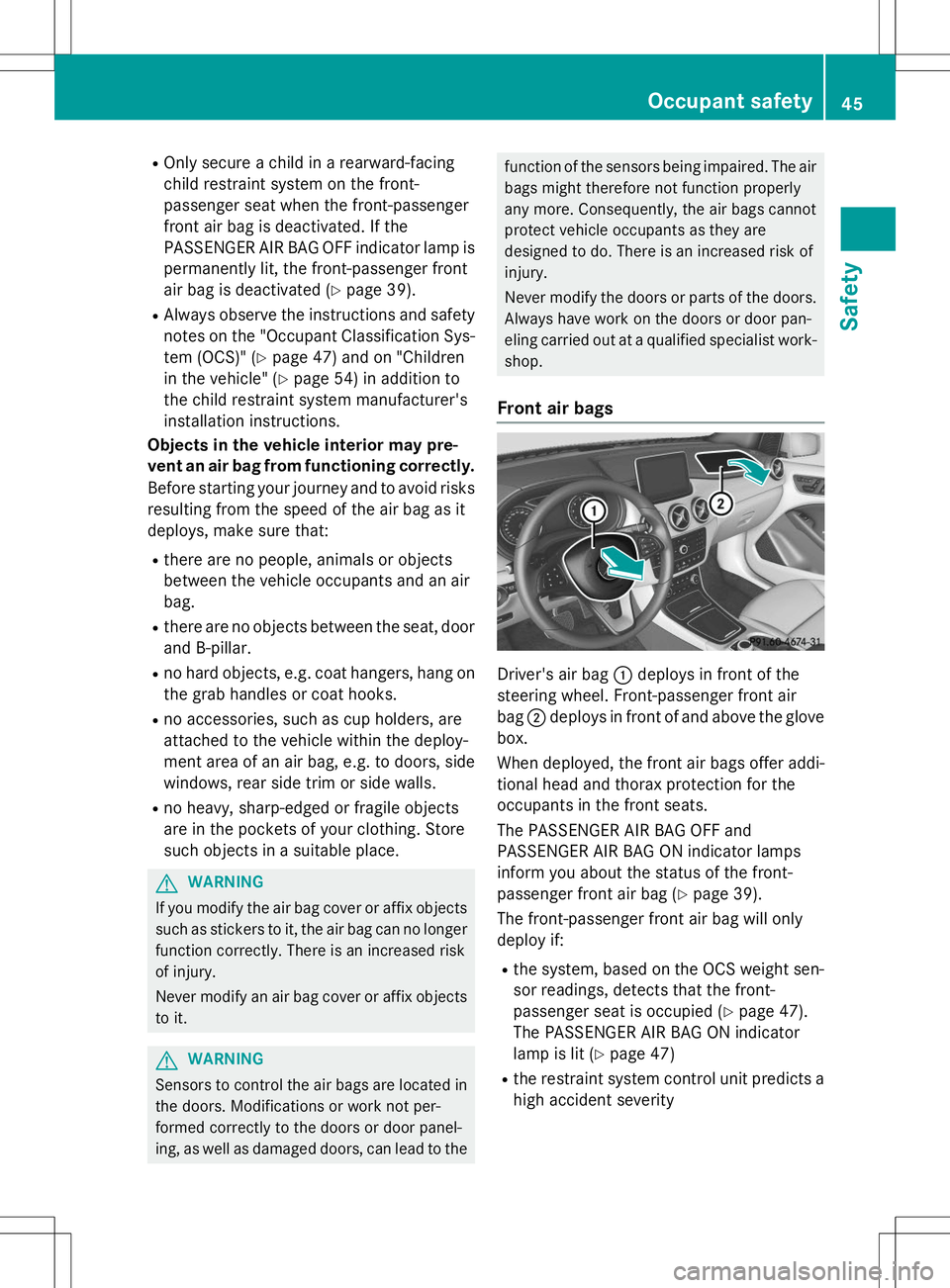
Driver's air bag :deploys in front of the
steering wheel. Front-passenger front air bag ;deploys in front of and above the glove
box.
When deployed, the front air bags offer addi- tional head and thorax protection for the
occupants in the front seats.
The PASSENGER AIR BAG OFF and
PASSENGER AIR BAG ON indicator lamps
inform you about the status of the front-
passenger front air bag ( Ypage 39).
The front-passenger front air bag will only
deploy if:
R the system, based on the OCS weight sen-
sor readings, detects that the front-
passenger seat is occupied ( Ypage 47).
The PASSENGER AIR BAG ON indicator
lamp is lit ( Ypage 47)
R the restraint system control unit predicts a
high accident severity
Occupant safety45
Safety
Z
Page 161 of 346
Have brake pads installed and brake fluid
replaced at a qualified specialist workshop.
If the brake system has only been subject to
moderate loads, you should test the function-ality of your brakes at regular intervals.
You can find a description of Brake Assist
(BAS) on ( Ypage 61).
Mercedes-Benz recommends that you only
have brake pads/linings installed on your
vehicle which have been approved for
Mercedes-Benz vehicles or which correspond to an equivalent quality standard. Brake
pads/linings which have not been approved
for Mercedes-Benz vehicles or which are not
of an equivalent quality could affect your vehi-
cle's operating safety.
Mercedes-Benz recommends that you only
use brake fluid that has been specially
approved for your vehicle by Mercedes-Benz,
or which corresponds to an equivalent quality standard. Brake fluid which has not been
approved for Mercedes-Benz vehicles or
which is not of an equivalent quality could
affect your vehicle's operating safety.
Checking brake lining thickness
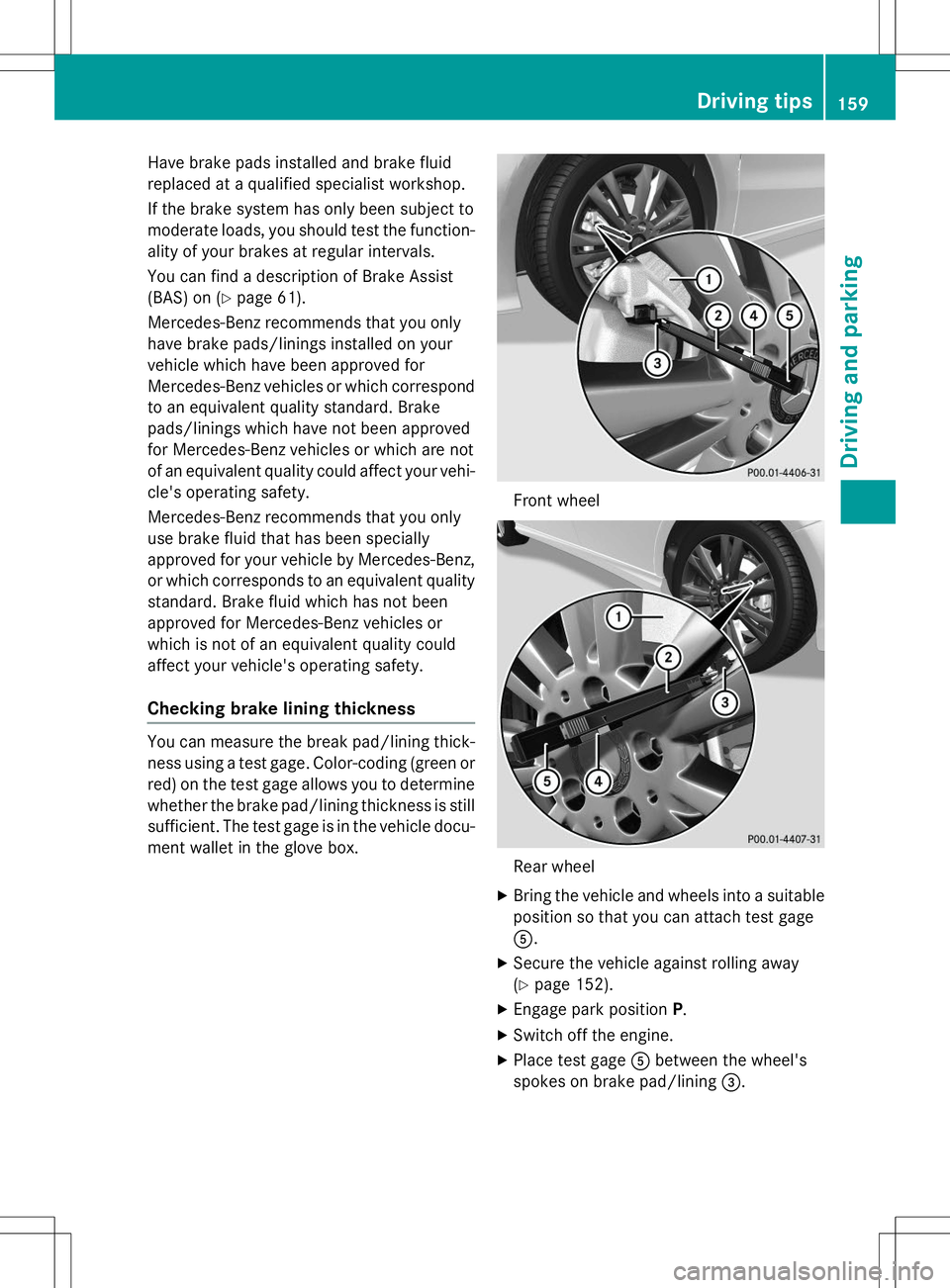
You can measure the break pad/lining thick- ness using a test gage. Color-coding (green or
red) on the test gage allows you to determine whether the brake pad/lining thickness is still
sufficient. The test gage is in the vehicle docu-
ment wallet in the glove box.
Front wheel
Rear wheel
X Bring the vehicle and wheels into a suitable
position so that you can attach test gageA .
X Secure the vehicle against rolling away(Y page 152).
X Engage park position P.
X Switch off the engine.
X Place test gage Abetween the wheel's
spokes on brake pad/lining =.
Driving tips159
Driving and parking
Z
Page 251 of 346
board under the load if necessary. Please
note that the load on the cargo compart-
ment floor will be increased when the load
is lashed down.
Stowage areas
Stowage spaces
Important safety notes
GWARNING
If objects in the passenger compartment are
stowed incorrectly, they can slide or be
thrown around and hit vehicle occupants.
There is a risk of injury, particularly in the
event of sudden braking or a sudden change
in direction. R Always stow objects so that they cannot be
thrown around in such situations.
R Always make sure that objects do not pro-
trude from stowage spaces, parcel nets or
stowage nets.
R Close the lockable stowage spaces while
driving.
R Stow and secure objects that are heavy,
hard, pointy, sharp-edged, fragile or too
large in the cargo compartment.
Observe the loading guidelines ( Ypage 248).
Stowage compartments in the front
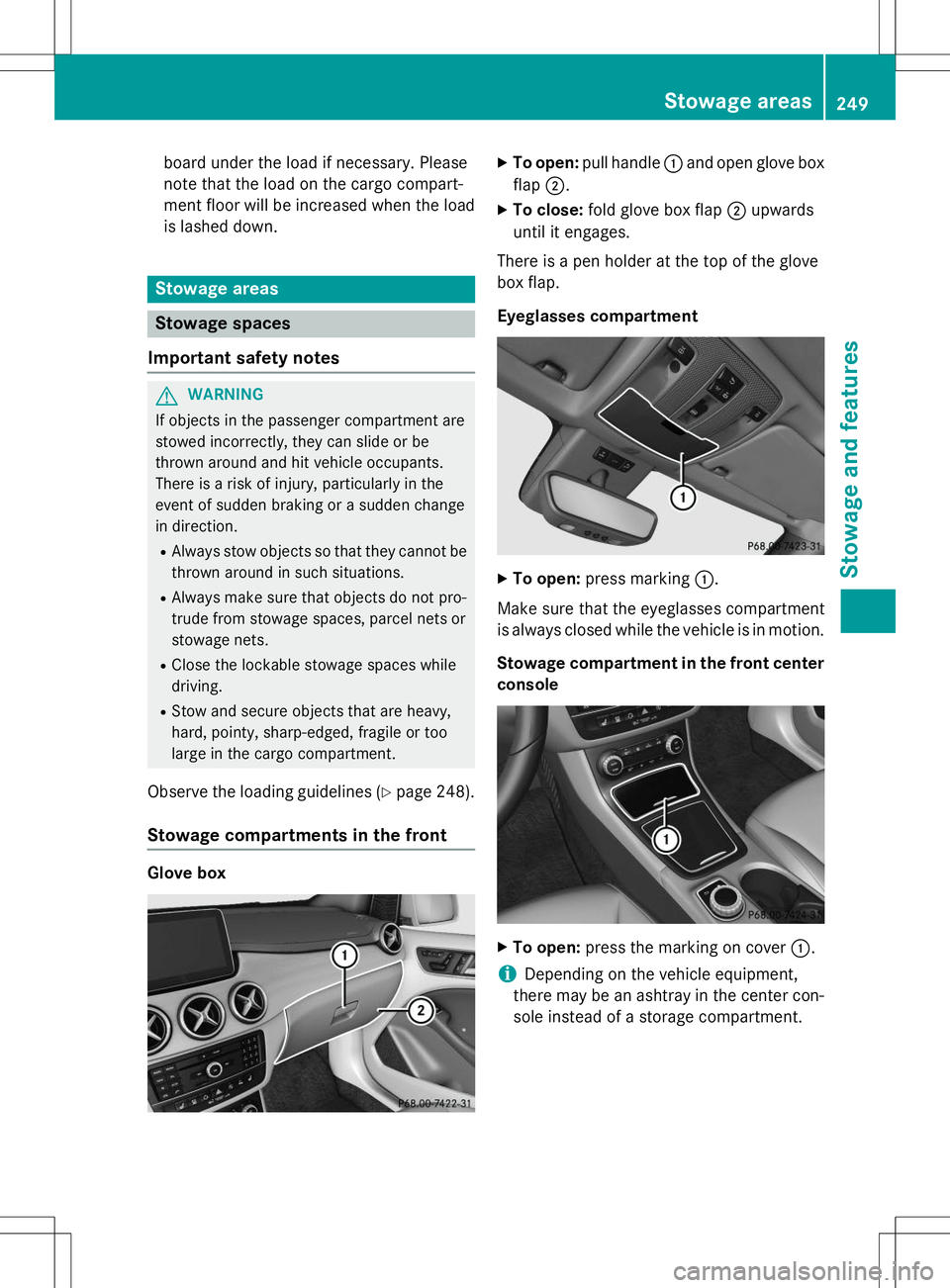
Glove box
X
To open: pull handle :and open glove box
flap ;.
X To close: fold glove box flap ;upwards
until it engages.
There is a pen holder at the top of the glove
box flap.
Eyeglasses compartment
X To open: press marking :.
Make sure that the eyeglasses compartment
is always closed while the vehicle is in motion.
Stowage compartment in the front center console
X To open: press the marking on cover :.
iDepending on the vehicle equipment,
there may be an ashtray in the center con-
sole instead of a storage compartment.
Stowage areas249
Stowage and features
Z