Page 742 of 878

5
When trouble arises
7415-2. Steps to take in an emergency
CAUTION■
Maintenance of the tires
Each tire, including the spare (if provided ), should be checked monthly when cold
and inflated to the inflation pressure re commended by the vehicle manufacturer on
the vehicle placard or tire inflation pressure label (tire and load information label).
(If your vehicle has tires of a different size than the size indicated on the vehicle
placard or tire inflation pressure label [t ire and load information label], you should
determine the proper tire inflation pressure for those tires.)
As an added safety feature, your vehicl e has been equipped with a tire pressure
monitoring system (TPMS-tire pressure wa rning system) that illuminates a low tire
pressure telltale (tire pressure warning light) when one or more of your tires is sig-
nificantly under-inflated. Accordingly, when the low tire pressure telltale (tire pres-
sure warning light) illuminates, you should stop and check your tires as soon as
possible, and inflate them to the proper pressure. Driving on a significantly under-
inflated tire causes the tire to overheat an d can lead to tire failure. Under-inflation
also reduces fuel efficiency and tire tread life, and may affect the vehicle's handling
and stopping ability.
Please note that the TPMS (tire pressure warning system) is not a substitute for
proper tire maintenance, and it is the driver's responsibility to maintain correct tire
pressure, even if under-inflation has not reached the level to trigger illumination of
the TPMS low tire pressure telltale (tire pressure warning light).
Your vehicle has also been equipped with a TPMS (tire pressure warning system)
malfunction indicator to indicate when th e system is not operating properly. The
TPMS (tire pressure warning system) malf unction indicator is combined with the
low tire pressure telltale (tire pressure warning light). When the system detects a
malfunction, the telltale will flash for approximately one minute and then remain
continuously illuminated. This sequence will continue upon subsequent vehicle
start-ups as long as the malfunction exists . When the malfunction indicator is illumi-
nated, the system may not be able to detect or signal low tire pressure as intended.
TPMS (tire pressure warning system) malfunctions may occur for a variety of rea-
sons, including the installation of replacem ent or alternate tires or wheels on the
vehicle that prevent the TPMS (tire pressure warning system) from functioning
properly. Always check the TPMS (tire pressure warning system) malfunction tell-
tale after replacing one or more tires or wheels on your vehicle to ensure that the
replacement or alternate tires and wheels allow the TPMS (tire pressure warning
system) to continue to function properly.
Page 766 of 878
5
When trouble arises
7655-2. Steps to take in an emergency
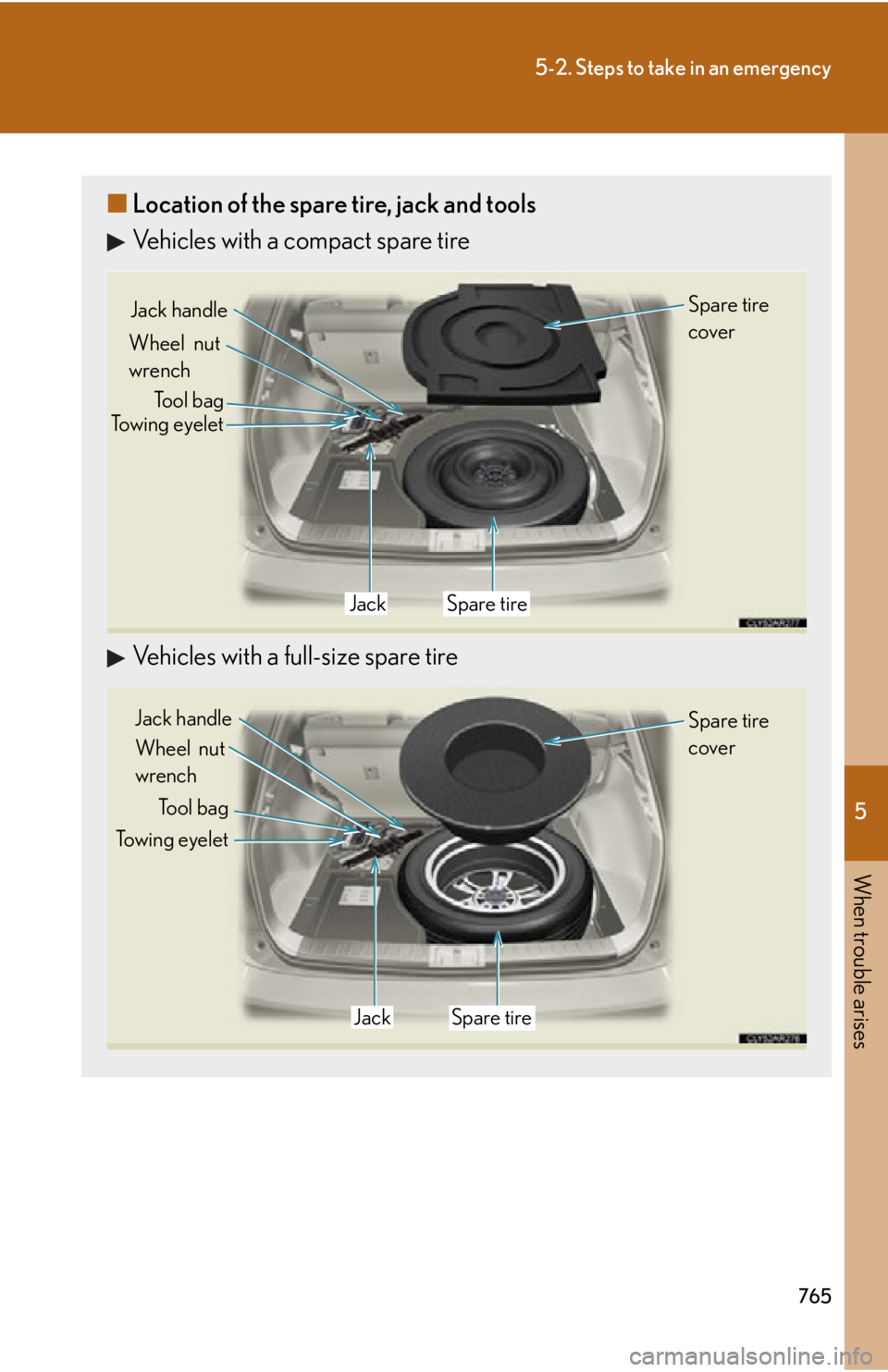
■ Location of the spare tire, jack and tools
Vehicles with a compact spare tire
Vehicles with a full-size spare tire Towing eyelet Tool bagJack handle
Jack Spare tireWheel nut
wrench Spare tire
cover
Towing eyelet To o l b a gJack handle
Jack Spare tireWheel nut
wrench Spare tire
cover
Page 768 of 878
5
When trouble arises
7675-2. Steps to take in an emergency
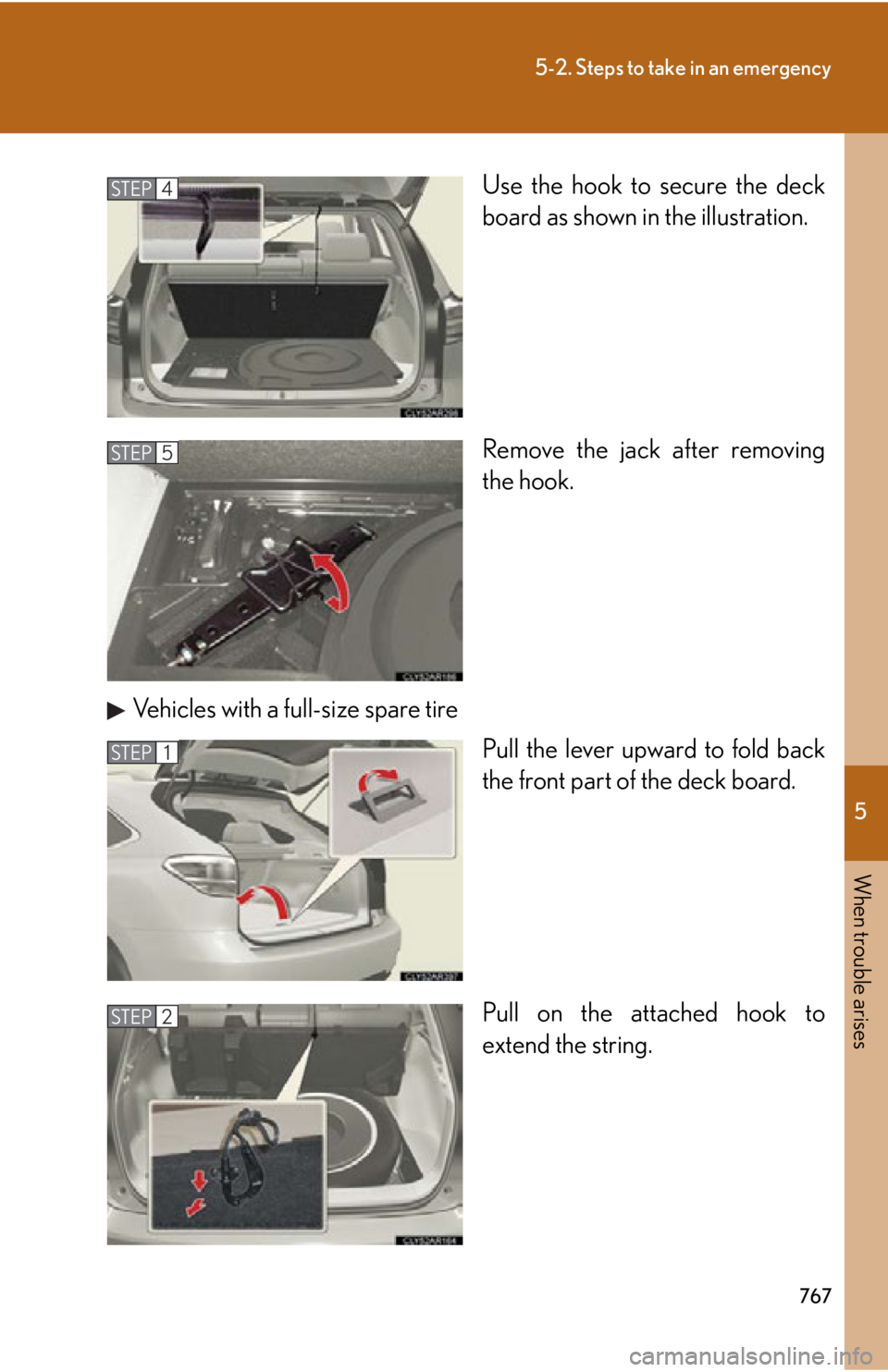
Use the hook to secure the deck
board as shown in the illustration.
Remove the jack after removing
the hook.
Vehicles with a full-size spare tire
Pull the lever upward to fold back
the front part of the deck board.
Pull on the attached hook to
extend the string.STEP 4
STEP 5
STEP 1
STEP 2
Page 770 of 878
5
When trouble arises
7695-2. Steps to take in an emergency
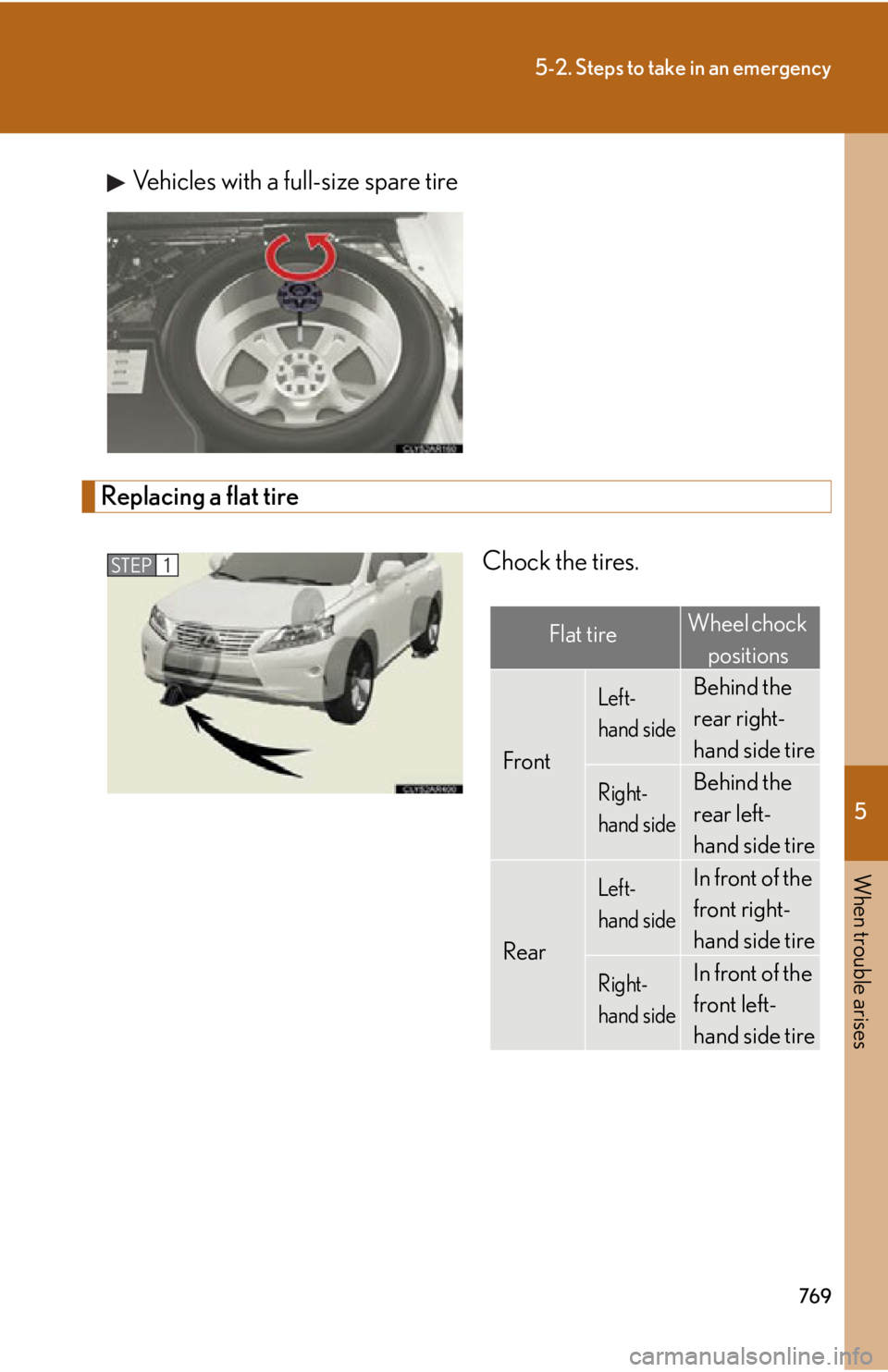
Vehicles with a full-size spare tire
Replacing a flat tire
Chock the tires.STEP 1
Flat tire Wheel chock
positions
Front Left-
hand side Behind the
rear right-
hand side tire
Right-
hand side Behind the
rear left-
hand side tire
Rear Left-
hand side In front of the
front right-
hand side tire
Right-
hand side In front of the
front left-
hand side tire
Page 772 of 878
5
When trouble arises
7715-2. Steps to take in an emergency
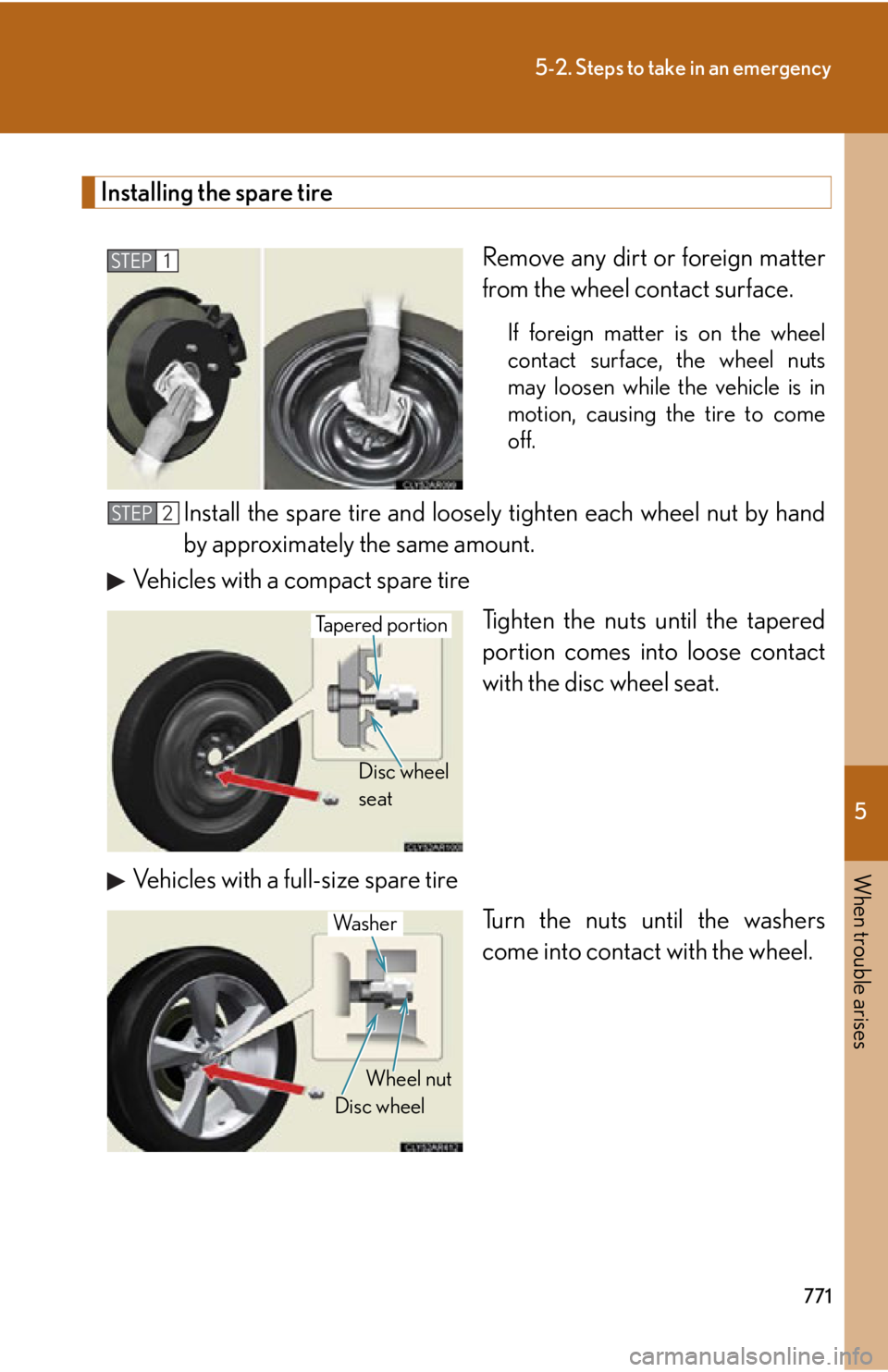
Installing the spare tire
Remove any dirt or foreign matter
from the wheel contact surface. If foreign matter is on the wheel
contact surface, the wheel nuts
may loosen while the vehicle is in
motion, causing the tire to come
off.
Install the spare tire and loosel y tighten each wheel nut by hand
by approximately the same amount.
Vehicles with a compact spare tire
Tighten the nuts until the tapered
portion comes into loose contact
with the disc wheel seat.
Vehicles with a full-size spare tire
Turn the nuts until the washers
come into contact with the wheel.STEP 1
STEP 2
Disc wheel
seatTapered portion
Wheel nut
Disc wheelWa s h e r
Page 808 of 878
8076-1. Specifications
6
Vehicle specifications Tires and wheels
Type A
Type BTi r e s i z e P235/60R18 102V, T165/90D18 107M (spare)
Tire inflation pressure
(recommended cold tire
inflation pressure) Front: 33 psi (230 kPa, 2.3 kgf/cm 2
or bar)
Rear: 33 psi (230 kPa, 2.3 kgf/cm 2
or bar)
Spare: 60 psi (420 kPa, 4.2 kgf/cm 2
or bar)
Wheel size 18 7 1 /2J, 18 4T (spare)
Wheel nut torque 76 ft•lbf (103 N•m, 10.5 kgf•m)
Ti r e s i z e P235/60R18 102V
Tire inflation pressure
(recommended cold tire
inflation pressure) Front: 33 psi (230 kPa, 2.3 kgf/cm 2
or bar)
Rear: 33 psi (230 kPa, 2.3 kgf/cm 2
or bar)
Spare: 33 psi (230 kPa, 2.3 kgf/cm 2
or bar)
Wheel size 18 7 1 /2J
Wheel nut torque 76 ft•lbf (103 N•m, 10.5 kgf•m)
Page 809 of 878

8086-1. Specifications
Ty p e C
Ty p e DTi r e s i z e P235/55R19 101V, T165/90D18 107M (spare)
Tire inflation pressure
(recommended cold tire
inflation pressure) Driving under normal conditions
Front: 33 psi (230 kPa, 2.3 kgf/cm 2
or bar)*
Rear: 33 psi (230 kPa, 2.3 kgf/cm 2
or bar)*
Spare: 60 psi (420 kPa, 4.2 kgf/cm 2
or bar)*: When driving at high speeds above 100 mph (160
km/h), in countries where such speeds are permitted by
law, add 3 psi (20 kPa, 0.2 kgf/cm 2
or bar) to the tires.
Never exceed the maximum cold tire inflation pressure
indicated on the tire sidewall.
Wheel size 19 7 1 /2J, 18 4T (spare)
Wheel nut torque 76 ft•lbf (103 N•m, 10.5 kgf•m)
Ti r e s i z e P235/55R19 101V
Tire inflation pressure
(recommended cold tire
inflation pressure) Driving under normal conditions
Front: 33 psi (230 kPa, 2.3 kgf/cm 2
or bar)
Rear: 33 psi (230 kPa, 2.3 kgf/cm 2
or bar)
Spare: 33 psi (230 kPa, 2.3 kgf/cm 2
or bar)
When driving at high speeds above 100 mph (160 km/h),
in countries where such speeds are permitted by law,
add 3 psi (20 kPa, 0.2 kgf/cm 2
or bar) to the front tires
and rear tires. Never exceed the maximum cold tire
inflation pressure indicated on the tire sidewall.
Wheel size 19 7 1 /2J
Wheel nut torque 76 ft•lbf (103 N•m, 10.5 kgf•m)
Page 815 of 878
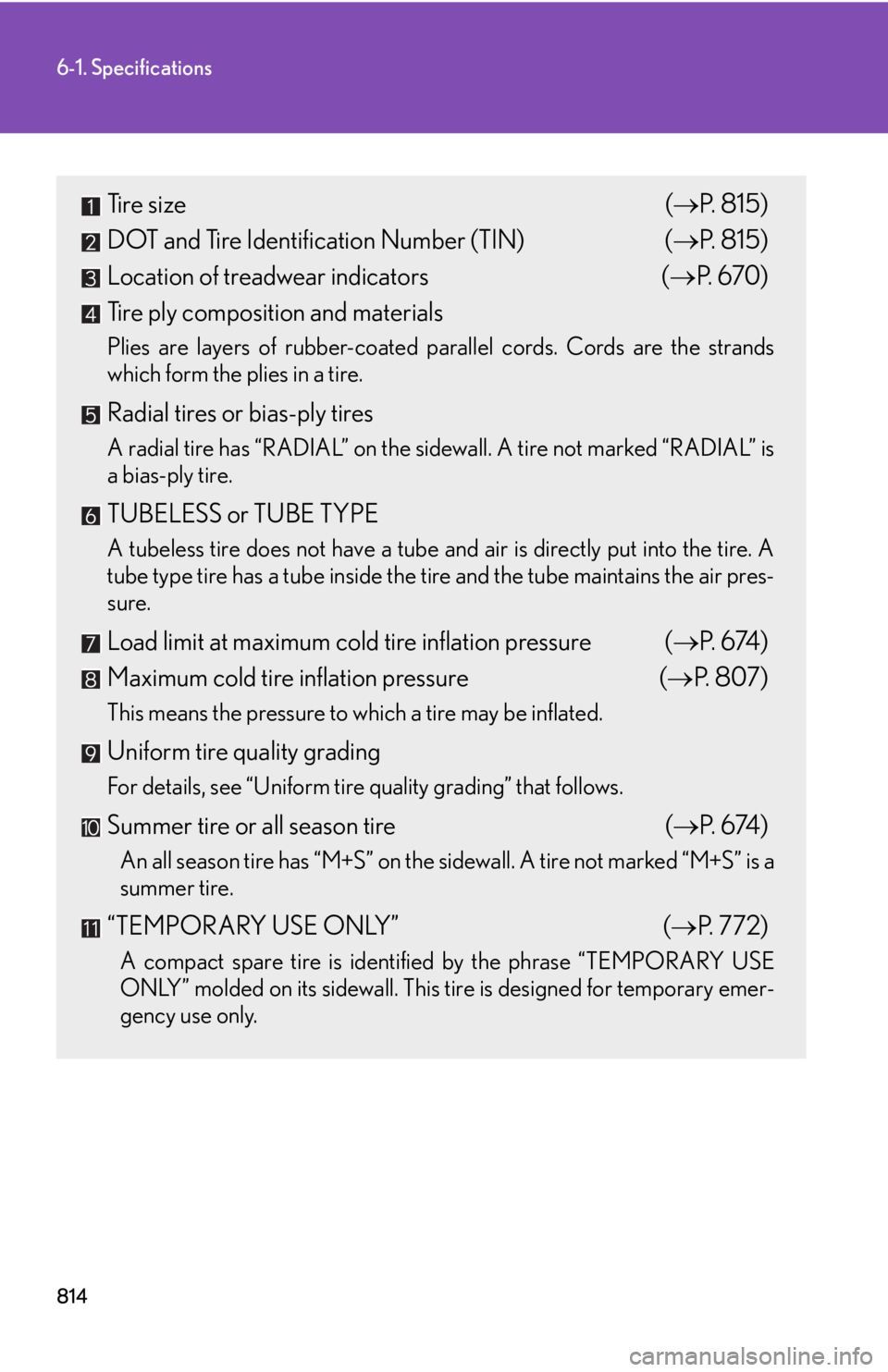
8146-1. Specifications
Tire size ( P. 815)
DOT and Tire Identification Number (TIN) ( P. 815)
Location of treadwear indicators ( P. 670)
Tire ply composition and materials Plies are layers of rubber-coated parallel cords. Cords are the strands
which form the plies in a tire.
Radial tires or bias-ply tires A radial tire has “RADIAL” on the sidewall. A tire not marked “RADIAL” is
a bias-ply tire.
TUBELESS or TUBE TYPE A tubeless tire does not have a tube and air is directly put into the tire. A
tube type tire has a tube inside the ti re and the tube maintains the air pres-
sure.
Load limit at maximum cold tire inflation pressure ( P. 6 74 )
Maximum cold tire inflation pressure ( P. 8 0 7 )This means the pressure to which a tire may be inflated.
Uniform tire quality grading For details, see “Uniform tire quality grading” that follows.
Summer tire or all season tire ( P. 6 74 )An all season tire has “M+S” on the sidewall. A tire not marked “M+S” is a
summer tire.
“TEMPORARY USE ONLY” ( P. 772)A compact spare tire is identified by the phrase “TEMPORARY USE
ONLY” molded on its sidewall. This ti re is designed for temporary emer-
gency use only.