2015 LEXUS RX350 ESP
[x] Cancel search: ESPPage 655 of 886

6554-1. Maintenance and care
4
Maintenance and care NOTICE■
Cleaning detergents ●
Do not use the following types of detergent, as they may discolor the vehicle inte-
rior or cause streaks or damage to painted surfaces:
• Non-seat portions: Organic substances such as benzene or gasoline, alkaline
or acidic solutions, dye, or bleach
• Seats: Acidic solutions, such as thinner, benzene, or alcohol●
Do not use polish wax or polish cleaner. The instrument panel's or other interior
part’s painted surface may be damaged.■
Preventing damage to leather surfaces
Observe the following precautions to avoid damage to and deterioration of leather
surfaces: ●
Remove any dust or dirt from leather surfaces immediately.●
Do not expose the vehicle to direct sunlight for extended pe riods of time. Park
the vehicle in the shade, especially during summer.●
Do not place items made of vinyl, plastic, or that contain wax on the upholstery, as
they may stick to the leather surface if th e vehicle interior heats up significantly.■
Water on the floor
Do not wash the vehicle floor with water.
Vehicle systems such as the audio syst em may be damaged if water comes into
contact with electrical components under the floor of vehicle. Water may also
cause the body to rust.■
Cleaning the inside of the rear window ●
Do not use glass cleaner to clean the re ar window, as this may cause damage to
the rear window defogger heater wires or antenna. Use a cloth dampened with
lukewarm water to gently wipe the window clean. Wipe the window in strokes
running parallel to the heater wires or antenna.
●
Be careful not to scratch or damage the heater wires or antenna.
Page 656 of 886
6564-2. Maintenance
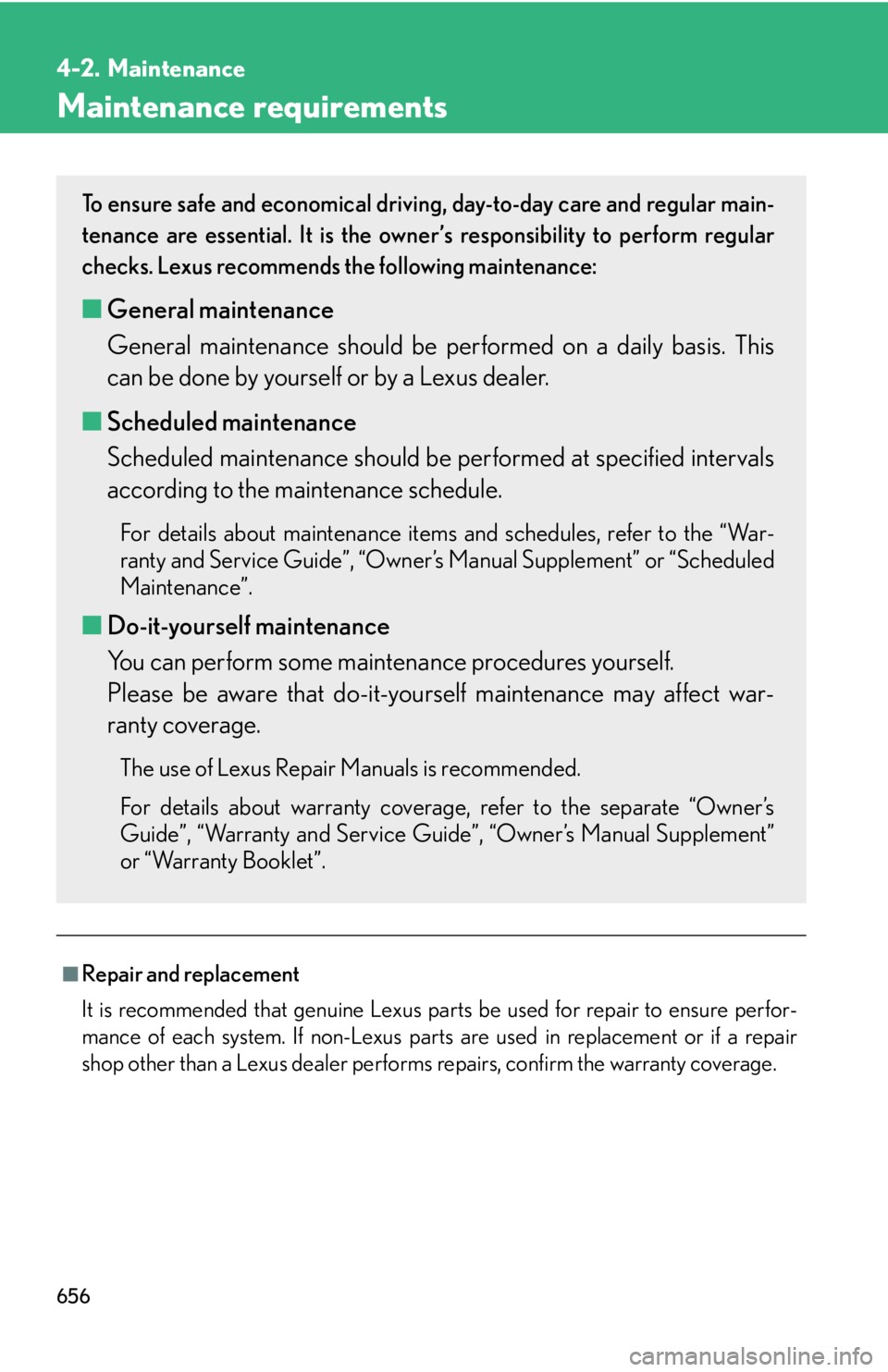
Maintenance requirements
■
Repair and replacement
It is recommended that genuine Lexus parts be used for repair to ensure perfor-
mance of each system. If non-Lexus parts are used in replacement or if a repair
shop other than a Lexus dealer performs repairs, confirm the warranty coverage.To ensure safe and economical drivin g, day-to-day care and regular main-
tenance are essential. It is the owne r’s responsibility to perform regular
checks. Lexus recommends the following maintenance:
■ General maintenance
General maintenance should be performed on a daily basis. This
can be done by yourself or by a Lexus dealer.
■ Scheduled maintenance
Scheduled maintenance should be performed at specified intervals
according to the maintenance schedule. For details about maintenance items and schedules, refer to the “War-
ranty and Service Guide”, “Owner’s Manual Supplement” or “Scheduled
Maintenance”.
■ Do-it-yourself maintenance
You can perform some maintenance procedures yourself.
Please be aware that do-it-your self maintenance may affect war-
ranty coverage. The use of Lexus Repair Manuals is recommended.
For details about warranty coverage, refer to the separate “Owner’s
Guide”, “Warranty and Service Guide”, “Owner’s Manual Supplement”
or “Warranty Booklet”.
Page 690 of 886

6904-3. Do-it-yourself maintenance
■
Certification for tire pressure warning system
TPMS Transmitter FCC ID: PAXPMV107J
For vehicles sold in the U.S.A.
NOTE:
This device complies with part 15 of the FCC Rules. Operation is subject to the fol-
lowing two conditions: (1) This device may not cause harmful interference, and (2)
this device must accept any interference received, including interference that may
cause undesired operation.
FCC WARNING:
Changes or modifications not expressly approved by the party responsible for
compliance could void the user’s authority to operate the equipment.
For vehicles sold in Canada
NOTE:
Operation is subject to the following two conditions: (1) this device may not cause
interference, and (2) this device must a ccept any interference, including interfer-
ence that may cause undesired operation of the device.
L’utilisation de ce dispositif est autori sée seulement aux deux conditions suivantes:
(1) il ne doit pas produire de brouillage, et (2) l’utilisateur du dispositif doit être prêt
à accepter tout brouillage radioélectrique reçu, même si ce brouillage est
susceptible de compromettre le fonctionnement du dispositif.
TPMS Receiver FCC ID: HYQ13BCX
NOTE:
This device complies with part 15 of the FCC Rules. Operation is subject to the fol-
lowing two conditions: (1) This device may not cause harmful interference, and (2)
this device must accept any interference received, including interference that may
cause undesired operation.
FCC WARNING:
Changes or modifications not expressly approved by the party responsible for
compliance could void the user’s authority to operate the equipment.
Page 752 of 886

7525-2. Steps to take in an emergency
CAUTION■
Maintenance of the tires
Each tire, including the spare (if provided ), should be checked monthly when cold
and inflated to the inflation pressure re commended by the vehicle manufacturer on
the vehicle placard or tire inflation pressu re label (tire and load information label).
(If your vehicle has tires of a different size than the size indicated on the vehicle
placard or tire inflation pressure label [t ire and load information label], you should
determine the proper tire inflation pressure for those tires.)
As an added safety feature, your vehicl e has been equipped with a tire pressure
monitoring system (TPMS-tire pressure wa rning system) that illuminates a low tire
pressure telltale (tire pressure warning light) when one or more of your tires is sig-
nificantly under-inflated. Accordingly, when the low tire pressure telltale (tire pres-
sure warning light) illuminates, you should stop and check your tires as soon as
possible, and inflate them to the proper pressure. Driving on a significantly under-
inflated tire causes the tire to overheat and can lead to tire failure. Under-inflation
also reduces fuel efficiency and tire tread life, and may affect the vehicle's handling
and stopping ability.
Please note that the TPMS (tire pressure warning system) is not a substitute for
proper tire maintenance, and it is the driv er's responsibility to maintain correct tire
pressure, even if under-inflation has not reached the level to trigger illumination of
the TPMS low tire pressure telltale (tire pressure warning light).
Your vehicle has also been equipped with a TPMS (tire pressure warning system)
malfunction indicator to indicate when th e system is not operating properly. The
TPMS (tire pressure warning system) malfunction indicator is combined with the
low tire pressure telltale (tire pressure warning light). When the system detects a
malfunction, the telltale will flash for approximately one minute and then remain
continuously illuminated. This sequence will continue upon subsequent vehicle
start-ups as long as the malfunction exists . When the malfunction indicator is illumi-
nated, the system may not be able to detect or signal low tire pressure as intended.
TPMS (tire pressure warning system) malfunctions may occur for a variety of rea-
sons, including the installation of replacem ent or alternate tires or wheels on the
vehicle that prevent the TPMS (tire pres sure warning system) from functioning
properly. Always check the TPMS (tire pressure warning system) malfunction tell-
tale after replacing one or more tires or wheels on your vehicle to ensure that the
replacement or alternate tires and wheels allow the TPMS (tire pressure warning
system) to continue to function properly.
Page 761 of 886
5
When trouble arises
7615-2. Steps to take in an emergency
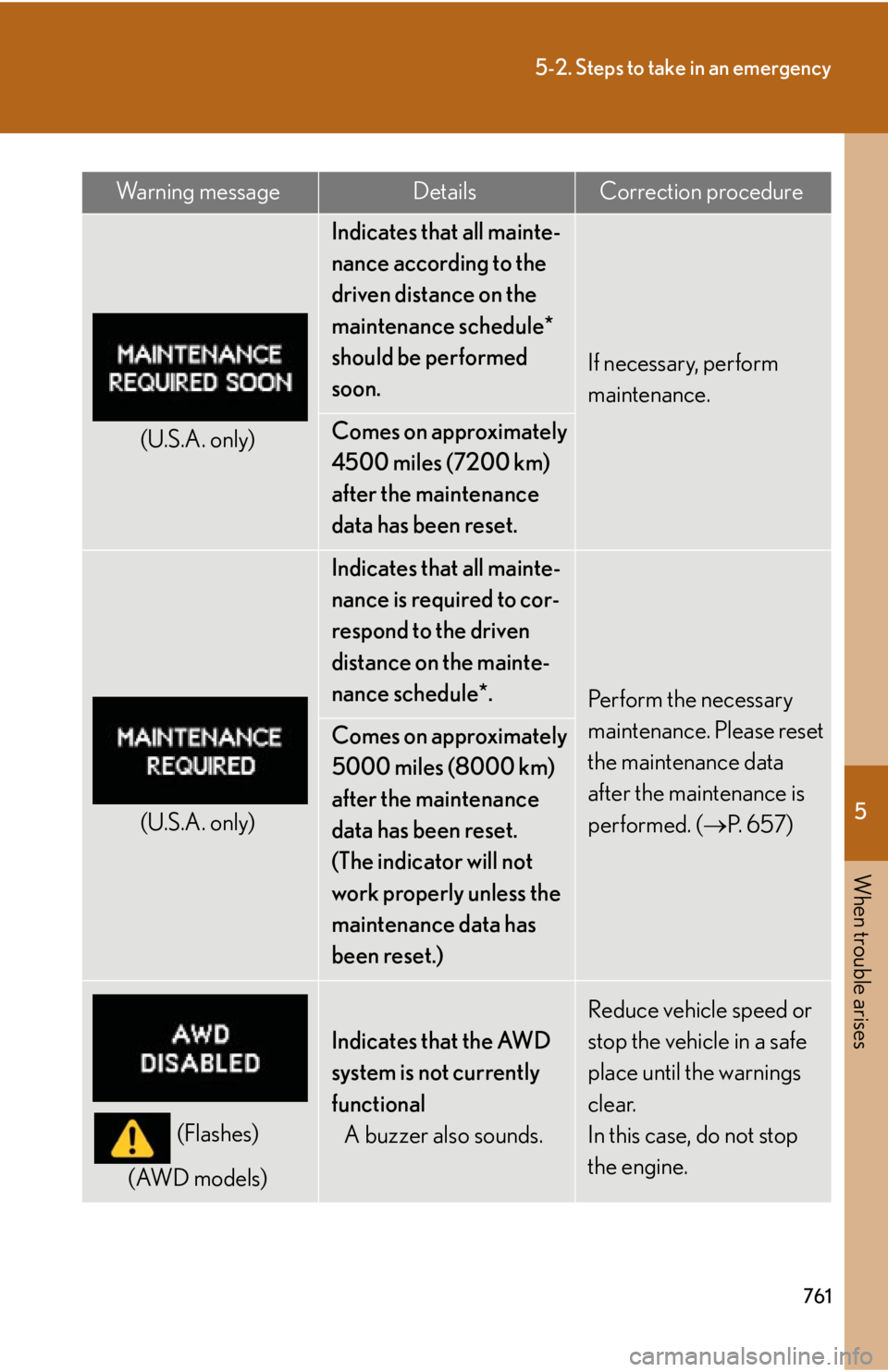
(U.S.A. only) Indicates that all mainte-
nance according to the
driven distance on the
maintenance schedule*
should be performed
soon. If necessary, perform
maintenance.
Comes on approximately
4500 miles (7200 km)
after the maintenance
data has been reset.
(U.S.A. only) Indicates that all mainte-
nance is required to cor-
respond to the driven
distance on the mainte-
nance schedule*.
Perform the necessary
maintenance. Please reset
the maintenance data
after the maintenance is
performed. ( P. 6 5 7 )Comes on approximately
5000 miles (8000 km)
after the maintenance
data has been reset.
(The indicator will not
work properly unless the
maintenance data has
been reset.)
(Flashes)
(AWD models) Indicates that the AWD
system is not currently
functional
A buzzer also sounds. Reduce vehicle speed or
stop the vehicle in a safe
place until the warnings
clear.
In this case, do not stop
the engine.Wa r n i n g m e s s a g e Details Correction procedure
Page 800 of 886

8005-2. Steps to take in an emergency
Add coolant if necessary.
(
P. 6 7 1 )
Water can be used in an emer-
gency if coolant is unavailable.
Start the engine and turn the air conditioning system on to check
that the radiator cooling fans op erate and to check for coolant
leaks from the radiator or hoses. The fans operate when the air conditio ning system is turned on immedi-
ately after a cold start. Confirm that the fans are operating by checking
the fan sound and air flow. If it is diff icult to check these, turn the air con-
ditioning system on and off repeatedly.
(The fans may not operate in freezing temperatures.)
If the fans are not operating:
Stop the engine immediately and contact your Lexus dealer.
If the fans are operating:
Have the vehicle inspected at the nearest Lexus dealer.STEP 5
CAUTION■
To prevent an accident or injury when in specting under the hood of your vehicle●
If steam is seen coming from under the hood, do not open the hood until the
steam has subsided. The engine compartm ent may be very hot, causing serious
injuries such as burns.●
Keep hands and clothing (especially a tie, a scarf or a muffler) away from the fans
and belts. Failure to do so may cause the hands or clothing to be caught, resulting
in serious injury.
●
Do not loosen the radiator cap while the engine and radiator are hot.
Serious injury, such as burns, may resu lt from hot coolant and steam released
under pressure.STEP 6
STEP 7
Page 829 of 886

8276-1. Specifications
6
Vehicle specifications ■ Temperature A, B, C
The temperature grades are A (the hi ghest), B, and C, representing
the tire's resistance to the generation of heat and its ability to dissipate
heat when tested under controlled conditions on a specified indoor
laboratory test wheel. Sustained high temperature can cause the material of the tire to degenerate
and reduce tire life, and excessive temperature can lead to sudden tire fail-
ure.
The grade C corresponds to a level of performance which all passenger car
tires must meet under the Federal Mo tor Vehicle Safety Standard No. 109.
Grades B and A represent higher levels of performance on the laboratory
test wheel than the minimum required by law.
Warning: The temperature grades for this tire are established for a tire that
is properly inflated and not overloaded.
Excessive speed, underinflation, or excess ive loading, either separately or in
combination, can cause heat build up and possible tire failure.
Page 832 of 886
8306-1. Specifications
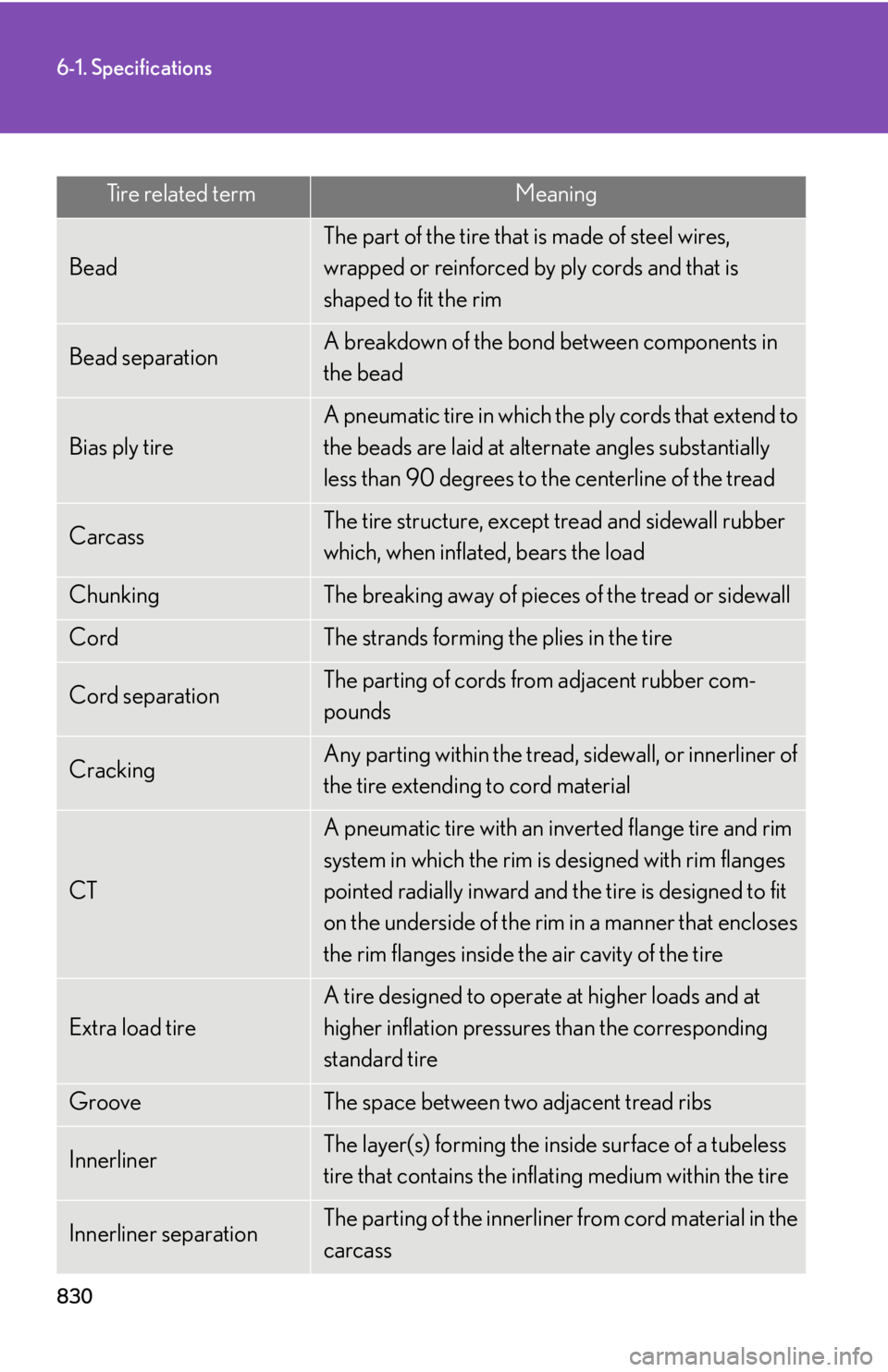
Tire related term Meaning
Bead The part of the tire that is made of steel wires,
wrapped or reinforced by ply cords and that is
shaped to fit the rim
Bead separation A breakdown of the bond between components in
the bead
Bias ply tire A pneumatic tire in which the ply cords that extend to
the beads are laid at alternate angles substantially
less than 90 degrees to the centerline of the tread
Carcass The tire structure, except tread and sidewall rubber
which, when inflated, bears the load
Chunking The breaking away of pieces of the tread or sidewall
Cord The strands forming the plies in the tire
Cord separation The parting of cords from adjacent rubber com-
pounds
Cracking Any parting within the tread, sidewall, or innerliner of
the tire extending to cord material
CT A pneumatic tire with an inverted flange tire and rim
system in which the rim is designed with rim flanges
pointed radially inward and the tire is designed to fit
on the underside of the rim in a manner that encloses
the rim flanges inside the air cavity of the tire
Extra load tire A tire designed to operate at higher loads and at
higher inflation pressures than the corresponding
standard tire
Groove The space between two adjacent tread ribs
Innerliner The layer(s) forming the inside surface of a tubeless
tire that contains the inflating medium within the tire
Innerliner separation The parting of the innerliner from cord material in the
carcass