2015 LEXUS RX350 ESP
[x] Cancel search: ESPPage 92 of 886

921-3. Adjustable components (seats, mirrors, steering wheel)
Anti-glare inside rear view mirror Adjusting the height of rear view mirror
Adjust the height of the rear view
mirror by moving it up and down.
Automatic anti-glare function
Responding to the level of brightness of the headlights of vehicles behind,
the reflected light is automatically reduced.
Type A
Changing automatic anti-glare
function mode
ON/OFF
When the automatic anti-glare
function is in ON mode, the indica-
tor illuminates.
The function will set to ON mode
each time the “ENGINE START
STOP” switch is turned to IGNI-
TION ON mode.
Pressing the button turns the func-
tion to OFF mode. (The indicator
also turns off.)The rear view mirror’s position can be adjusted to enable sufficient confir-
mation of the rear view in accordance with the driver's seating posture.
Indicator
Page 100 of 886
1001-4. Opening and closing the windows and moon roof
■
Door lock linked window operation ●
The power windows can be opened and closed using the mechanical key.
( P. 7 9 3 )●
The power windows can be opened using the wireless remote control.
( P. 4 9 )■
When the battery is disconnected
The window lock switch is disabled. If necessary, press the window lock switch after
reconnecting the battery.■
Customization
Settings (e.g. linked door lock operation) can be changed.
(Customizable features P. 8 3 4 )
CAUTION■
Closing the windows
Observe the following precautions.
Failing to do so may result in death or serious injury. ●
Check to make sure that all passengers do not have any part of their body in a
position where it could be caught when a window is being operated.●
Do not allow children to operate the power windows.
Closing a power window on someone can cause death or serious injury.
The driver is responsible for instructin g children not to operate the power win-
dows.■
Jam protection function ●
Never use any part of your body to intent ionally activate the jam protection func-
tion.●
The jam protection function may not work if something gets caught just before
the window fully closes. Also, the jam protection does not operate when the
power window switch is pulled up continually to close the windows.
Page 104 of 886
1041-4. Opening and closing the windows and moon roof
CAUTION■
Opening the moon roof
Observe the following precautions.
Failing to do so may cause death or serious injury. ●
Do not allow any passengers to put their hands or heads outside the vehicle while
it is moving.●
Do not sit on top of the moon roof.■
Closing the moon roof
Observe the following precautions.
Failing to do so may result in death or serious injury. ●
Check to make sure that all passengers do not have any part of their body in a
position where it could be caught when the moon roof is being operated. ●
Do not allow children to operate the moon roof.
Closing the moon roof on someone can cause death or serious injury. The driver
is responsible for instructing childr en not to operate the moon roof.■
Jam protection function
Observe the following precautions.
Failing to do so may result in death or serious injury. ●
Never use any part of your body to intent ionally activate the jam protection func-
tion.●
The jam protection function may not work if something gets caught just before
the moon roof fully closes. Be careful not to catch fingers or anything else.
Page 111 of 886
1111-6. Theft deterrent system
1
Before driving ■
System maintenance
The vehicle has a maintenance-free type engine immobilizer system.■
Conditions that may cause the system to malfunction ●
If the grip portion of the key is in contact with a metallic object●
If the key is in close proximity to or touching a key to the security system (key
with a built-in transponder chip) of another vehicle■
Certifications for the engine immobilizer system
This system meets the certification requirements of Radio Law.
For vehicles sold in the U.S.A.
FCC ID: NI4TMIMB-1
This device complies with part 15 of the FCC Rules. Operation is subject to the fol-
lowing two conditions: (1) This device may not cause harmful interference, and (2)
this device must accept any interference received, including interference that may
cause undesired operation.
For vehicles sold in Canada
This device complies with Industry Cana da licence-exempt RSS standard(s). Oper-
ation is subject to the following two conditions: (1) this device may not cause inter-
ference, and (2) this device must accept any interference, including interference
that may cause undesired operation of the device.
CAUTION■
Certifications for the immobilizer system
Changes or modifications not expressly approved by the party responsible for
compliance could void the user’s authority to operate the equipment.
NOTICE
■
To ensure the system operates correctly
Do not modify or remove the system. If mo dified or removed, the proper operation
of the system cannot be guaranteed.
Page 122 of 886

1221-7. Safety information
Your vehicle is equipped with AD VANCED AIRBAGS designed based
on the US motor vehicl e safety standards (FMV SS208). The airbag sen-
sor assembly (ECU) controls airbag deployment based on information
obtained from the sensors etc. show n in the system components diagram
above. This information includes cras h severity and occupant informa-
tion. As the airbags deploy, a chemica l reaction in the infla tors quic kly fills
the airbags with non-toxi c gas to help restrain th e motion of the occu-
pants.■
If the SRS airbags deploy (inflate) ●
Bruising and slight abrasion s may result from contact with a deploying (inflating)
SRS airbag.●
A loud noise and white powder will be emitted.●
Parts of the airbag module (steering wheel hub, airbag cover and inflator) as
well as the seats, parts of the front and rear pillars, and roof side rails, may be hot
for several minutes. The airbag itself may also be hot.●
The windshield may crack.●
For Safety Connect subscribers, if the SR S airbags deploy or in the event of a
severe rear-end collision, the system is designed to send an emergency call to
the response center, notifying them of the vehicle’s location (without needing to
push the “SOS” button) and an agent will attempt to speak with the occupants
to ascertain the level of emergency and assistance required. If the occupants
are unable to communicate, the agent automatically treats the call as an emer-
gency and helps to dispatch the necessary emergency services. ( P. 6 4 2 )■
SRS airbag deployment conditions (SRS front airbags) ●
The SRS front airbags will deploy in the event of an impact that exceeds the
set threshold level (the level of force corresponding to an approximately 12 -
18 mph [20 - 30 km/h] frontal collision with a fixed wall that does not move or
deform).
However, this threshold velocity will be considerably higher in the following situa-
tions:
• If the vehicle strikes an object, such as a parked vehicle or sign pole, which
can move or deform on impact
• If the vehicle is involved in an underride collision, such as a collision in which
the front of the vehicle “underrides”, or goes under, the bed of a truck
Page 123 of 886
1231-7. Safety information
1
Before driving ●
Depending on the type of collision, it is possible that only the seat belt preten-
sioners will activate.●
The SRS front airbags for the front passenger will not activate if there is no pas-
senger sitting in the front passenger seat . However, the SRS front airbags for the
front passenger may deploy if luggage is put in the seat, even if the seat is unoc-
cupied. ( P. 1 3 2 )■
SRS airbag deployment conditions (SRS side airbags and curtain shield airbags)
The SRS side airbags and SRS curtain shield airbags will deploy in the event of an
impact that exceeds the set threshold level (the level of force corresponding to the
impact force produced by an approximately 3300 lb. [1500 kg] vehicle colliding
with the vehicle cabin from a direction perp endicular to the vehicle orientation at an
approximate speed of 12 - 18 mph [20 - 30 km/h]).
The SRS curtain shield airbags will deploy in the event of vehicle rollover.■
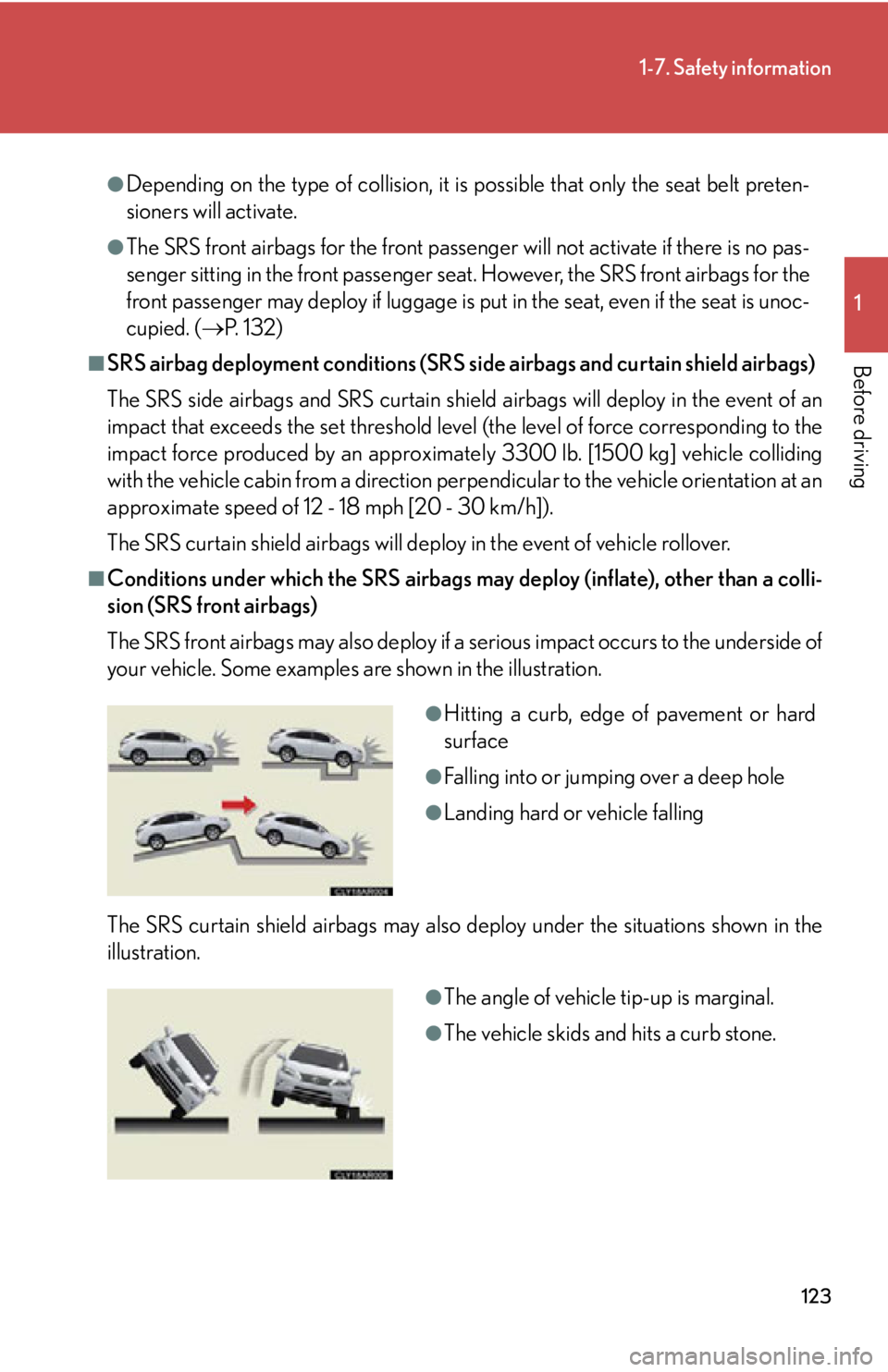
Conditions under which the SRS airbags may deploy (inflate), other than a colli-
sion (SRS front airbags)
The SRS front airbags may also deploy if a serious impact occurs to the underside of
your vehicle. Some examples are shown in the illustration.
The SRS curtain shield airbags may also deploy under the situations shown in the
illustration. ●
Hitting a curb, edge of pavement or hard
surface ●
Falling into or jumping over a deep hole ●
Landing hard or vehicle falling
●
The angle of vehicle tip-up is marginal.
●
The vehicle skids and hits a curb stone.
Page 127 of 886

1271-7. Safety information
1
Before driving CAUTION■
SRS airbag precautions
Observe the following precautions regarding the SRS airbags.
Failure to do so may cause death or serious injury. ●
The driver and all passengers in the vehi cle must wear their seat belts properly.
The SRS airbags are supplemental devices to be used with the seat belts.●
The SRS driver airbag deploys with considerable force, and can cause death or
serious injury especially if the driver is very close to the airbag. The National
Highway Traffic Safety Administration (“NHTSA”) advises:
Since the risk zone for driver’s airbag is the first 2 - 3 in. (50 - 75 mm) of inflation,
placing yourself 10 in. (250 mm) from your driver airbag provides you with a
clear margin of safety. This distance is measured from the center of the steering
wheel to your breastbone. If you sit less than 10 in. (250 mm) away now, you can
change your driving position in several ways:
• Move your seat to the rear as far as you can while still reaching the pedals
comfortably.
• Slightly recline the back of the seat.
Although vehicle designs vary, many dr ivers can achieve the 10 in. (250 mm)
distance, even with the driver seat all the way forward, simply by reclining the
back of the seat somewhat. If reclining the back of your seat makes it hard to
see the road, raise yourself by using a firm, non-slippery cushion, or raise the
seat if your vehicle has that feature.
• If your steering wheel is adjustable, ti lt it downward. This points the airbag
toward your chest instead of your head and neck.
The seat should be adjusted as recommended by NHTSA above, while still main-
taining control of the foot pedals, steering wheel, and your view of the instrument
panel controls.
Page 128 of 886

1281-7. Safety information
CAUTION■
SRS airbag precautions
●
The SRS front passenger airbag also depl oys with considerable force, and can
cause death or serious injury especially if the front passenger is very close to the
airbag. The front passenger seat should be as far from the airbag as possible with
the seatback adjusted, so the front passenger sits upright.●
Improperly seated and/or restrained infants and children can be killed or seri-
ously injured by a deploying airbag. An infant or child who is too small to use a
seat belt should be properly secured us ing a child restraint system. Lexus strongly
recommends that all infants and children be placed in the rear seats of the vehicle
and properly restrained. The rear seats ar e safer for infants and children than the
front passenger seat. ( P. 1 3 7 ) ●
If the seat belt extender has been con-
nected to the front seat belt buckles but the
seat belt extender has not also been fas-
tened to the latch plate of the seat belt, the
SRS front airbags will judge that the driver
and front passenger are wearing the seat
belt even though the seat belt has not been
connected. In this case, the SRS front air-
bags may not activate correctly in a colli-
sion, resulting in death or serious injury in
the event of a collision. Be sure to wear the
seat belt with the seat belt extender.