Page 164 of 886
1642-1. Driving procedures
NOTICE■
When encountering flooded roads
Do not drive on a road that has flooded after heavy rain etc. Doing so may cause the
following serious damage to the vehicle: ●
Engine stalling●
Short in electrical components●
Engine damage caused by water immersion
In the event that you drive on a flooded road and the vehicle is flooded, be sure to
have your Lexus dealer check the following:●
Brake function●
Changes in quantity and quality of oil and fluid used for th e engine, transaxle,
transfer (AWD models), differential, etc.●
Lubricant condition for the propeller shaf t (AWD models), bearings and suspen-
sion joints (where possible), and the function of all joints, bearings, etc.
Page 302 of 886

3022-5. Driving information
Winter driving tips Carry out the necessary preparations and inspections before driving the
vehicle in winter. Always drive the ve hicle in a manner appropriate to the
prevailing weather conditions.
■ Pre-winter preparations
● Use fluids that are appropria te to the prevailing outside tempera-
tures.
• Engine oil
• Engine coolant
• Washer fluid
● Have a service technician inspec t the condition of the battery.
● Have the vehicle fitted with four snow tires or purchase a set of
tire chains for the front tires. Ensure that all tires are the same size and brand, and that chains match
the size of the tires.
■ Before driving the vehicle
Perform the following accord ing to the driving conditions:
● Do not try to forcibly open a w indow or move a wiper that is fro-
zen. Pour warm water over the frozen area to melt the ice. Wipe
away the water immediately to prevent it from freezing.
● To ensure proper operation of the climate control system fan,
remove any snow that has accumu lated on the air inlet vents in
front of the windshield.
● Check for and remove any exce ss ice or snow that may have
accumulated on the exterior lights, vehicle's roof, chassis, around
the tires or on the brakes.
● Remove any snow or mud from the bottom of your shoes before
getting in the vehicle.
Page 659 of 886
6594-2. Maintenance
4
Maintenance and care General maintenance
Engine compartment Items Check points
Battery Check the connections.
( P. 6 8 1 )
Brake fluid Is the brake fluid at the correct level?
( P. 6 7 9 )
Engine coolant Is the coolant at the correct level?
( P. 6 7 7 )
Engine oil Is the engine oil at the correct level?
( P. 6 74 )
Exhaust system There should not be any fumes or
strange sounds.
Radiator/condenser/hoses The radiator and condenser should
be free from foreign objects.
( P. 6 7 8 )
Wa s h e r f l u i d Is there sufficient washer fluid?
( P. 6 8 3 )Listed below are the general maintenance items that should be performed
at the intervals specified in the “Warranty and Service Guide” or “Owner’s
Manual Supplement”. It is recomme nded that any problem you notice
should be brought to the attention of your Lexus dealer or qualified service
shop for advice.
Page 664 of 886
6644-3. Do-it-yourself maintenance
Do-it-yourself service precautions If you perform maintenance by yourself, be sure to follow the correct pro-
cedures as given in these sections.
Items Pa r t s a n d t o o l s
Battery condition ( P. 6 8 1
) •Warm water
• Baking soda
•Grease
• Conventional wrench
(for terminal clamp bolts)
Brake fluid level ( P. 6 7 9 ) • FMVSS No.116 DOT 3 or SAE
J1703 brake fluid
•Rag or paper towel
• Funnel (used only for adding brake
fluid)
Engine coolant level ( P. 6 7 7 ) • “Toyota Super Long Life Coolant”
or a similar high quality ethylene
glycol-based non-silicate, non-
amine, non-nitrite and non-borate
coolant with long-life hybrid
organic acid technology.
For the U.S.A.:
“Toyota Super Long Life Coolant”
is pre-mixed with 50% coolant and
50% deionized water.
For Canada:
“Toyota Super Long Life Coolant”
is pre-mixed with 55% coolant and
45% deionized water.
• Funnel (used only for adding
engine coolant)
Page 670 of 886
6704-3. Do-it-yourself maintenance
Engine compartment
Engine oil filler cap
( P. 675)
Engine oil level dipstick
( P. 6 74 )
Battery ( P. 6 8 1 )
Brake fluid reservoir
( P. 6 7 9 )
Fuse box ( P. 703) Engine coolant reservoir
( P. 677)
Condenser ( P. 6 7 8 )
Radiator ( P. 6 7 8 )
Electric cooling fans
Washer fluid tank ( P. 683)
Page 679 of 886
6794-3. Do-it-yourself maintenance
4
Maintenance and care Brake fluid
■ Checking fluid level
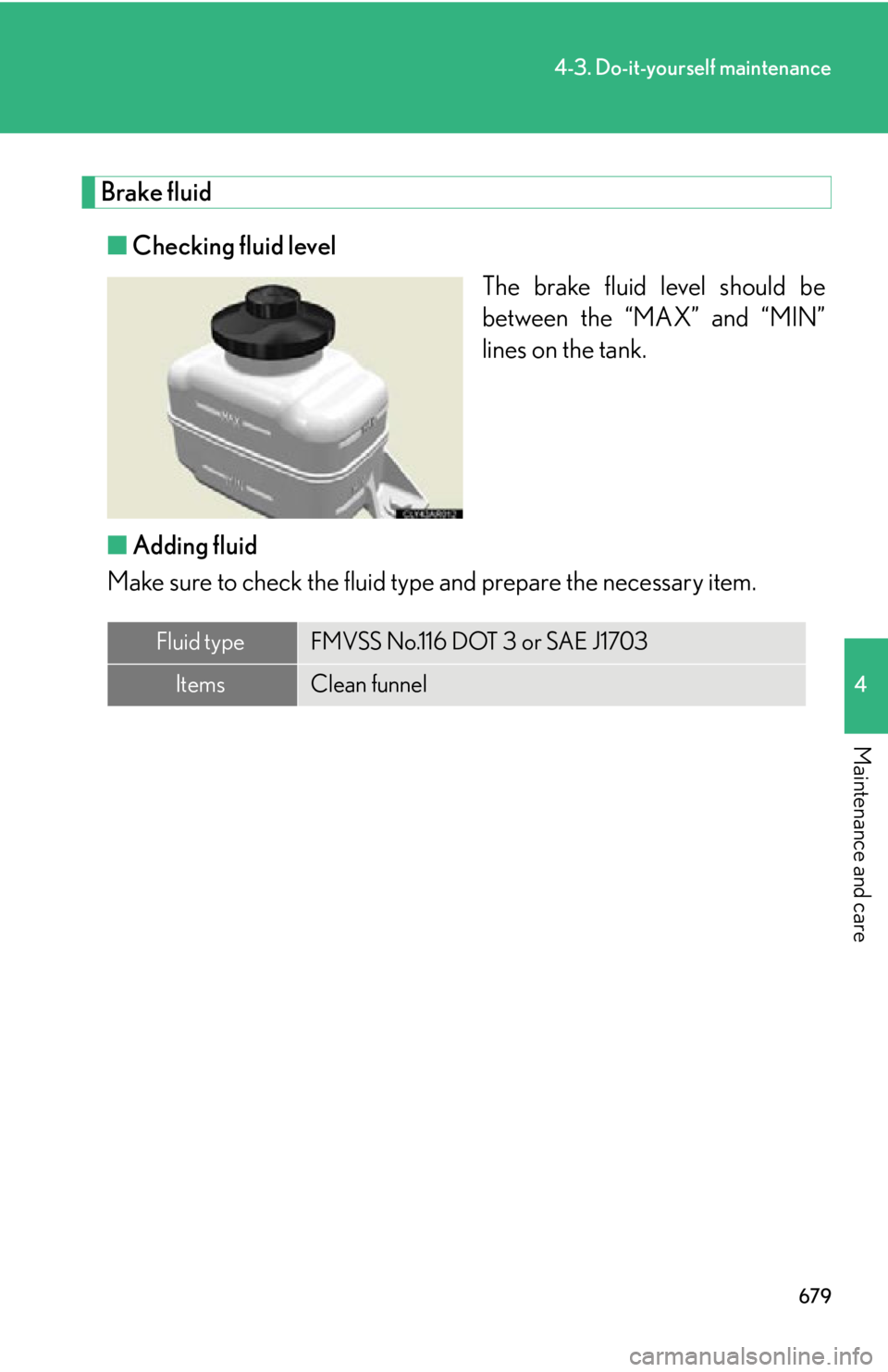
The brake fluid level should be
between the “MAX” and “MIN”
lines on the tank.
■ Adding fluid
Make sure to check the fluid type and prepare the necessary item. Fluid type FMVSS No.116 DOT 3 or SAE J1703
Items Clean funnel
Page 680 of 886
6804-3. Do-it-yourself maintenance
■
Brake fluid can absorb moisture from the air
Excess moisture in the brake fluid can cause a dangerous loss of braking efficiency.
Use only newly opened brake fluid.
CAUTION■
When filling the reservoir
Take care because brake fluid can harm your hands or eyes and damage painted
surfaces.
If fluid gets on your hands or in your eyes, flush the affected area with clean water
immediately.
If you still experience discomfort, see a doctor.
NOTICE■
If the fluid level is low or high
It is normal for the brake fluid level to go down slightly as the brake pads wear out or
when the fluid level in the accumulator is high.
If the reservoir needs frequent re filling, may be a serious problem.
Page 742 of 886
7425-1. Essential information
If you think something is wrong If you notice any of the following symptoms, your vehicle probably needs
adjustment or repair. Contact your Lexus dealer as soon as possible.
■ Visible symptoms
● Fluid leaks under the vehicle.
(Water dripping from the air conditioning after use is normal.)
● Flat-looking tires or uneven tire wear
● Engine coolant temper ature gauge needle continually points
higher than normal.
■ Audible symptoms
● Changes in exhaust sound
● Excessive tire squeal when cornering
● Strange noises related to the suspension system
● Pinging or other noises related to the engine
■ Operational symptoms
● Engine missing, stumbling or running rough
● Appreciable loss of power
● Vehicle pulls heavily to one side when braking.
● Vehicle pulls heavily to one side when driving on a level road.
● Loss of brake effectiveness, sp ongy feeling, pedal almost touches
the floor