2015 LEXUS LS600H brakes
[x] Cancel search: brakesPage 299 of 620

2974-5. Using the driving support systems
4
Driving
LS600hL_U(OM50E41U)
◆Pre-collision braking
When there is a high possibility of a frontal collision, the system warns
the driver using a warning light, war ning display and buzzer. If the sys-
tem determines that a collision is unavoidable, the brakes are automati-
cally applied to help avoid a collision or to reduce the collision speed.
When the vehicle is being stopped by pre-collision braking, the brake
will be engaged for a maximum of 2 seconds and then released auto-
matically. This pre-collisio n braking can be canceled by depressing the
accelerator pedal or brake pedal.
Pre-collision braking can be disabled us ing the pre-collision braking off switch.
◆Suspension control
When there is a high possibility of a frontal collision, the operation of
suspension control helps prevent the front of the vehicle from dropping
when the brakes are applied suddenly.
◆Steering gear control (VGRS) (vehicles with camera sensors)
When the system determines that a collision is unavoidable, the steer-
ing gear ratio is changed to help improve the response to steering
input.
◆Driver monitor system (if equipped)
When the system determines that there is a possibility of a collision, and
either the driver is not facing forwar d or the driver’s eyes are closed,
pre-collision warnings are given in advance to warn the driver. If the
system determines that the conditions to operate pre-collision alert
braking have been met even when th e possibility of a collision increases
further, pre-collision alert braking will operate.
Pre-collision alert braking can be disabled using the pre-collision braking off
switch.
Page 304 of 620

3024-5. Using the driving support systems
LS600hL_U(OM50E41U)
■Conditions that may trigger the system even if there is no danger of a collision
●When there is an object by the roadside at the entrance to a curve
●When passing an oncoming vehicle on a curve
●When driving over a narrow iron bridge
●When there is a metal object on the road surface
●When driving on an uneven road surface
●When passing an oncoming vehicle on a left-turn
●When your vehicle rapidly closes on the vehicle in front
●When a grade separation/interchange, sign , billboard, or other structure appears
to be directly in the vehicle’s line of travel
●When there is a metal plate in the road in front of the vehicle on a downhill slope
●When climbing a steep hill causes an overhead billboard or other metallic structure
to appear directly in the vehicle’s line of travel
●When driving under an overpass
●When an extreme change in vehicle height occurs
●When passing through certain toll gates
●When driving through a lump of steam or smoke
●When the radar sensor moves off position due to its surrounding area being sub-
jected to a strong impact
When the system is activated in the situations described above, there is also a possi-
bility that the seat belts will retract quickly and the brakes will be applied with a force
greater than normal. When the seat belt is locked in the retracted position, stop the
vehicle in a safe place, release the seat belt and refasten it.
■Obstacles not detected
The radar sensor cannot detect plastic obstacles such as traffic cones. There may
also be occasions when the sensor cannot detect pedestrians, animals, bicycles,
motorcycles, trees, or snowdrifts.
■A camera sensor cannot detect obstacles in the following situations:
●A camera sensor is directly receiving intense light, such as sunlight.
●Visibility is poor because of bad weather or other reasons.
●The sensor temperature is extremely high.
●The headlights are not turned on in dark ness such as at night or in a tunnel.
Page 325 of 620

323
4
Driving
LS600hL_U(OM50E41U)
4-6. Driving tips
■Using Eco drive mode
When using Eco drive mode, the torque corresponding to the acceler-
ator pedal depression amount can be generated more smoothly than it
is in normal conditions. In addition, the operatio n of the air conditioning
system (heating/cooling) will be mini mized, improving the fuel econ-
omy. ( P. 283)
■Use of Hybrid System Indicator
The Eco-friendly driving is possible by keeping the indicate of Hybrid
System Indicator within Eco area. ( P. 103)
■When braking the vehicle
Make sure to operate the brakes gently and in good time. A greater
amount of electrical energy can be retained when slowing down.
■Delays
Repeated acceleration and decelerati on, as well as long waits at traffic
lights, will lead to bad fuel consumption. Check traffic reports before
leaving and avoid delays as much as possible. When encountering a
delay, gently release the brake pedal to allow the vehicle to move for-
ward slightly while avoiding overuse of the accelerator pedal. Doing so
can help control excessive gasoline consumption.
■Highway driving
Control your speed and keep at a constant speed. Also, before stop-
ping at a toll booth or similar, allow plenty of time to release the acceler-
ator and gently apply the brakes. A greater amount of electrical energy
can be retained when slowing down.
Hybrid vehicle driving tips
For economical and ecological drivin g, pay attention to the following
points:
Page 328 of 620

3264-6. Driving tips
LS600hL_U(OM50E41U)
Perform the following according to the driving conditions:
●Do not try to forcibly open a window or move a wiper that is frozen.
Pour warm water over the frozen area to melt the ice. Wipe away the
water immediately to prevent it from freezing.
●To ensure proper operation of the climate control system fan, remove
any snow that has accumulated on the air inlet vents in front of the wind-
shield.
●Check for and remove any excess ice or snow that may have accumu-
lated on the exterior lights, vehicle’s roof, chassis, around the tires or on
the brakes.
●Remove any snow or mud from the bo ttom of your shoes before getting
in the vehicle.
Accelerate the vehicle slowly, keep a safe distance between you and the
vehicle ahead, and drive at a reduced speed suitable to road conditions.
Park the vehicle and move the shift lever to P without setting the parking
brake. The parking brake may freeze up, preventing it from being
released. If necessary, block the wheels to prevent inadvertent sliding or
creeping.
Before driving the vehicle
When driving the vehicle
When parking the vehicle
Page 423 of 620

4216-1. Maintenance and care
6
Maintenance and care
LS600hL_U(OM50E41U)
NOTICE
■To prevent paint deterioration and corrosion on the body and components (alu-
minum wheels etc.)
●Wash the vehicle immediately in the following cases:
• After driving near the sea coast
• After driving on salted roads
• If coal tar or tree sap is present on the paint surface
• If dead insects, insect droppings or bird droppings are present on the paintsurface
• After driving in an area contaminated with soot, oily smoke, mine dust, iron
powder or chemical substances
• If the vehicle becomes heavily soiled with dust or mud
• If liquids such as benzene and gasoline are spilled on the paint surface
●If the paint is chipped or scratched, have it repaired immediately.
●To prevent the wheels from corroding, remove any dirt and store in a place with
low humidity when storing the wheels.
■Cleaning the exterior lights
●Wash carefully. Do not use organic subs tances or scrub with a hard brush.
This may damage the surfaces of the lights.
●Do not apply wax to the surfaces of the lights.
Wax may cause damage to the lenses.
■When using an automatic car wash
Set the wiper switch to the off position.
If the wiper switch is in “AUTO”, the wipers may operate and the wiper blades may
be damaged.
■When using a high pressure car wash
●When washing the vehicle, do not spray the camera or its surrounding area
directly with a high pressure washer. Shock applied from high pressure water may
cause the device to not operate normally.
●Do not bring the nozzle tip close to joinin g parts, boots (rubber or plastic covers),
or connectors of the following as they may be damaged if they come into contact
with high pressure water.
•Drivetrain
•Steering •Suspension
•Brakes
Page 431 of 620
4296-2. Maintenance
6
Maintenance and care
LS600hL_U(OM50E41U)
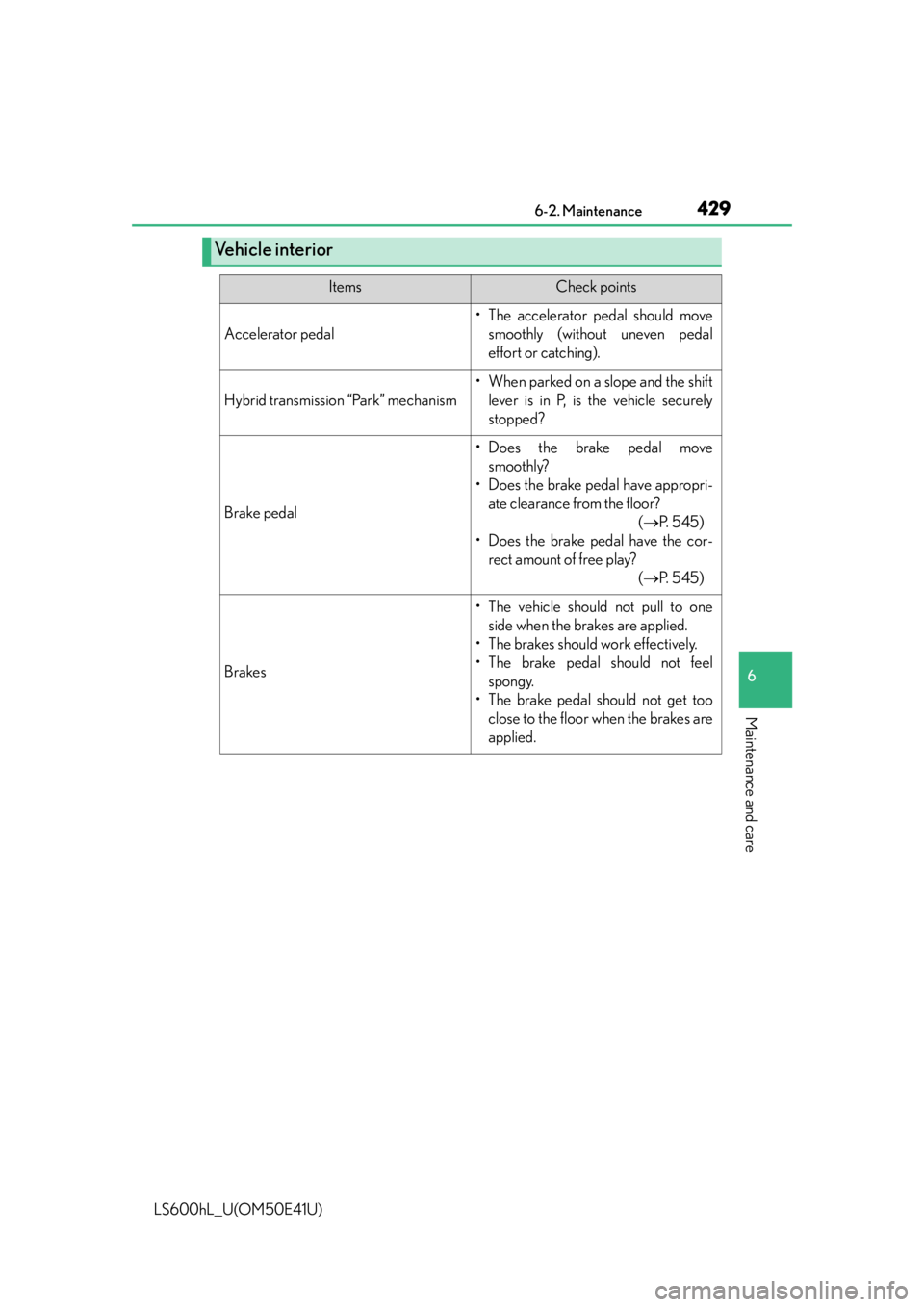
Ve h i c l e i n t e r i o r
ItemsCheck points
Accelerator pedal
• The accelerator pedal should movesmoothly (without uneven pedal
effort or catching).
Hybrid transmission “Park” mechanism
• When parked on a slope and the shiftlever is in P, is the vehicle securely
stopped?
Brake pedal
• Does the brake pedal movesmoothly?
• Does the brake pedal have appropri- ate clearance from the floor? ( P. 545)
• Does the brake pedal have the cor- rect amount of free play? ( P. 545)
Brakes
• The vehicle should not pull to one
side when the brakes are applied.
• The brakes should work effectively.
• The brake pedal should not feel spongy.
• The brake pedal should not get too close to the floor when the brakes are
applied.
Page 490 of 620
4887-2. Steps to take in an emergency
LS600hL_U(OM50E41U)
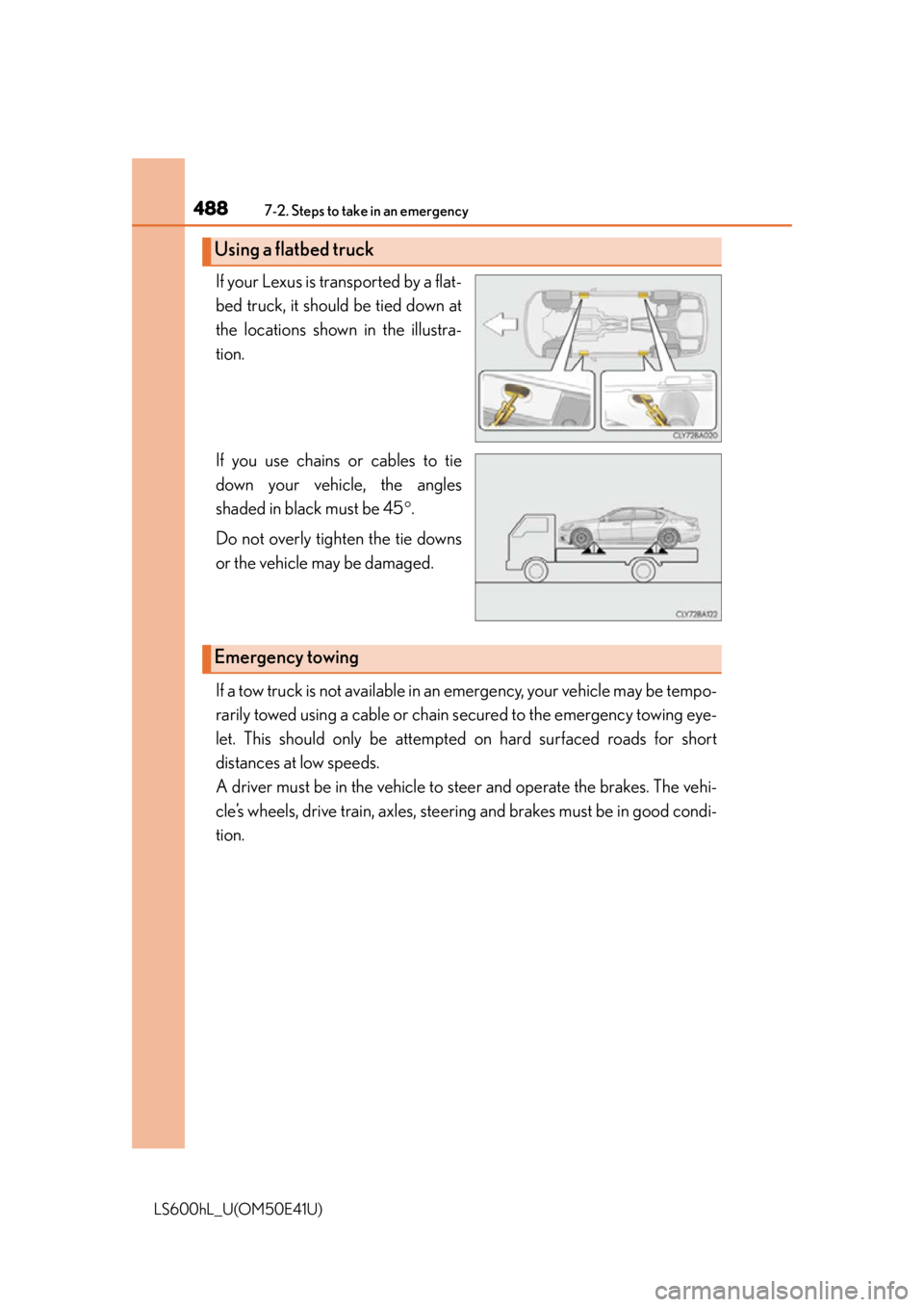
If your Lexus is transported by a flat-
bed truck, it should be tied down at
the locations shown in the illustra-
tion.
If you use chains or cables to tie
down your vehicle, the angles
shaded in black must be 45.
Do not overly tighten the tie downs
or the vehicle may be damaged.
If a tow truck is not available in an emergency, y our vehicle may be tempo-
rarily towed using a cable or chain secured to the emergency towing eye-
let. This should only be attempted on hard surfaced roads for short
distances at low speeds.
A driver must be in the vehicle to steer and operate the brakes. The vehi-
cle’s wheels, drive train, axles, steeri ng and brakes must be in good condi-
tion.
Using a flatbed truck
Emergency towing
Page 492 of 620
4907-2. Steps to take in an emergency
LS600hL_U(OM50E41U)
■While towing
If the hybrid system is off, the power assist for the brakes and steering will not func-
tion, making steering and braking more difficult.
■Wheel nut wrench
Wheel nut wrench is installed in trunk. (P. 5 0 7 , 5 1 6 )
CAUTION
Observe the following precautions.
Failure to do so may result in death or serious injury.
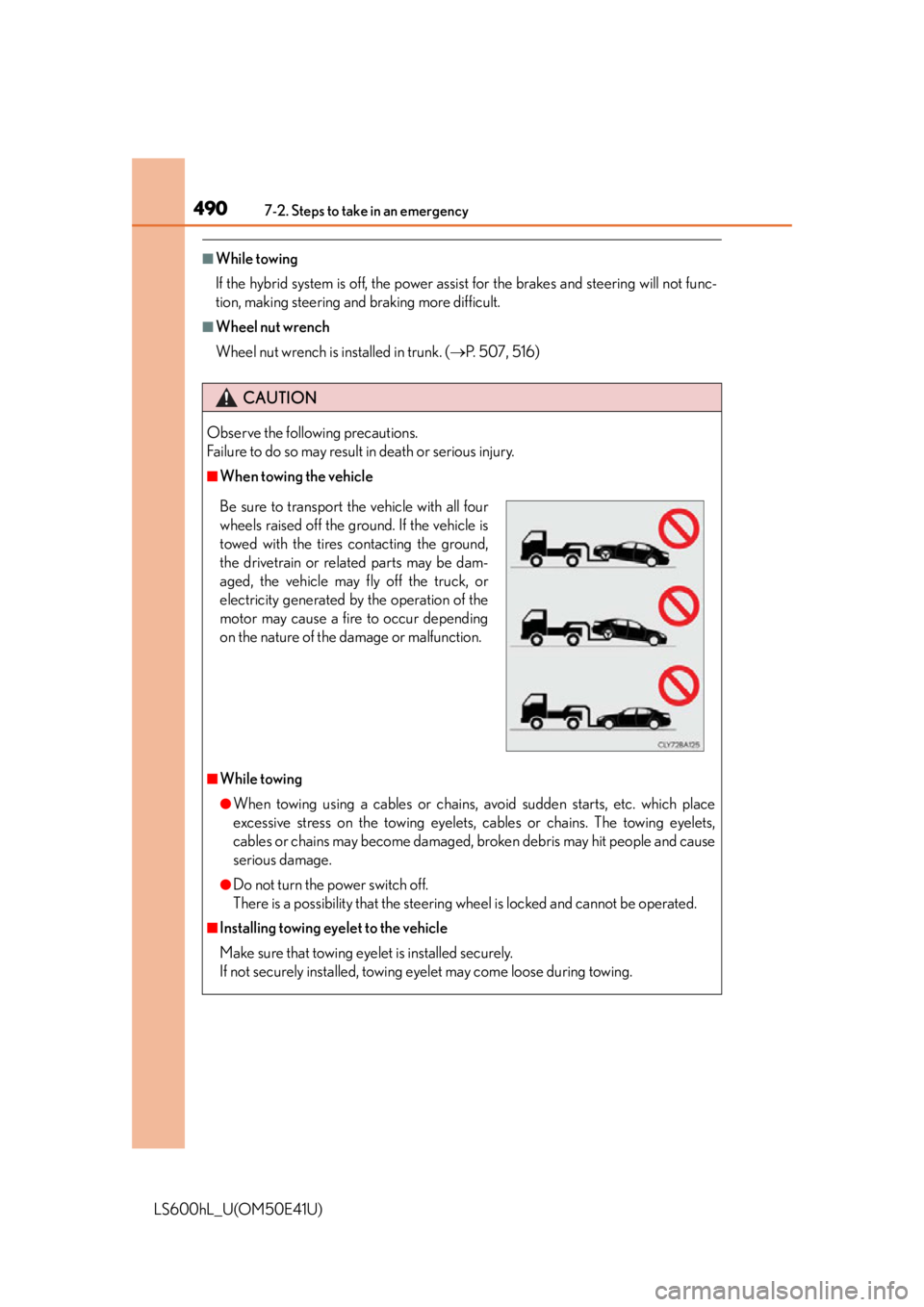
■When towing the vehicle
■While towing
●When towing using a cables or chains, avoid sudden starts, etc. which place
excessive stress on the towing eyelets, cables or chains. The towing eyelets,
cables or chains may become damaged, broken debris may hit people and cause
serious damage.
●Do not turn the power switch off.
There is a possibility that the steering wheel is locked and cannot be operated.
■Installing towing eyelet to the vehicle
Make sure that towing eyel et is installed securely.
If not securely installed, towing eyelet may come loose during towing.
Be sure to transport the vehicle with all four
wheels raised off the ground. If the vehicle is
towed with the tires contacting the ground,
the drivetrain or related parts may be dam-
aged, the vehicle may fly off the truck, or
electricity generated by the operation of the
motor may cause a fire to occur depending
on the nature of the damage or malfunction.