2015 KIA PICANTO ESP
[x] Cancel search: ESPPage 335 of 846
73
Maintenance
MAINTENANCE SERVICES
You should exercise the utmost care to
prevent damage to your vehicle and injury
to yourself whenever performing any
maintenance or inspection procedures.
Inadequate, incomplete or insufficient
servicing may result in operational prob-
lems with your vehicle that could lead to
vehicle damage, an accident, or person-
al injury.
Owner’s responsibility
✽✽ NOTICE
Maintenance Service and Record
Retention are the owner's responsibility.
We recommend in general that you have
your vehicle serviced by an authorized
Kia dealer.
You should retain documents that show
proper maintenance has been performed
on your vehicle in accordance with the
scheduled maintenance service charts
shown on the following pages. You need
this information to establish your compli-
ance with the servicing and maintenance
requirements of your vehicle warranties.
Detailed warranty information is provided
in your Service Passport. Repairs and adjustments required as a
result of improper maintenance or a lack
of required maintenance are not covered
when your vehicle is covered by warranty.
Owner maintenance precautions
Improper or incomplete service may
result in problems. This section gives
instructions only for the maintenance
items that are easy to perform.
✽✽
NOTICE
Improper owner maintenance during
the warranty period may affect warran-
ty coverage. For details, read the sepa-
rate Warranty & Maintenance book
provided with the vehicle. If you're
unsure about any servicing or mainte-
nance procedure, we recommend that
the system be serviced by an authorized
Kia dealer.
CAUTION
Do not put heavy objects or apply excessive force on top of the
engine cover (if equipped) or fuel related parts.
When you inspect the fuel system (fuel lines and fuel injection
devices), we recommend that youcontact an authorized Kia dealer.
Do not drive long time with the engine cover (if equipped) removed.
do not go near fire.
Fuel, washer fluid, etc. are flam-mable oils that may cause fire.
Before touching the battery, igni- tion cables and electrical wiring,you should disconnect the battery
"-" terminal. You may get an elec-tric shock from the electric current.
When you remove the interior trim cover with a flat bed (-) driver, becareful not to damage the cover.
Be careful when you replace and clean bulbs to avoid burns orelectrical shock.
Page 336 of 846

Maintenance
4
7
OWNER MAINTENANCE
The following lists are vehicle checks and
inspections that should be performed atthe frequencies indicated to help ensure
safe, dependable operation of your vehi-
cle.
If you have any question, we recommend
that you consult an authorized Kia dealer.
These Owner Maintenance Checks are
generally not covered by warranties and
you may be charged for labor, parts and
lubricants used. Owner maintenance schedule
When you stop for fuel:
• Check the engine oil level.
Check coolant level in coolant reser-
voir.
Check the windshield washer fluid level.
Look for low or under-inflated tires.
Check the radiator and condenser. Check if the front of the radiator and
condenser are clean and not blocked
with leaves, dirt or insects etc.
If any of the above parts are extremely
dirty or you are not sure of their condi-
tion, we recommend that you contact
an authorized Kia dealer.
WARNING - Maintenance
work
Performing maintenance work on a vehicle can be dangerous. You
can be seriously injured while
performing some maintenance
procedures. If you lack sufficient
knowledge and experience or the
proper tools and equipment to do
the work, we recommend that the
system be serviced by an author-
ized Kia dealer.
Working under the hood with the engine running is dangerous. It
becomes even more dangerous
when you wear jewelry or loose
clothing. These can become
entangled in moving parts and
result in injury. Therefore, if you
must run the engine while work-
ing under the hood, make certain
that you remove all jewelry (espe-
cially rings, bracelets, watches,
and necklaces) and all neckties,
scarves, and similar loose cloth-
ing before getting near theengine or cooling fans.
WARNING
Be careful when checking your
engine coolant level when the
engine is hot. Scalding hot coolant
and steam may blow out under
pressure. This could cause burns
or other serious injury.
Page 378 of 846
Maintenance
46
7
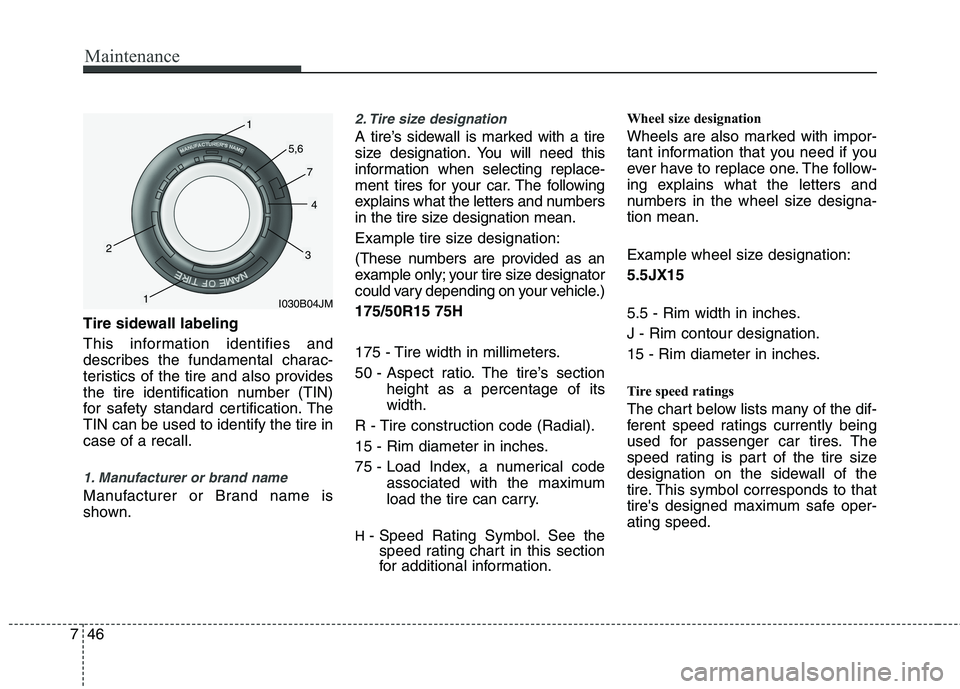
Tire sidewall labeling
This information identifies and
describes the fundamental charac-
teristics of the tire and also provides
the tire identification number (TIN)
for safety standard certification. TheTIN can be used to identify the tire incase of a recall.
1. Manufacturer or brand name
Manufacturer or Brand name is
shown.
2. Tire size designation
A tire’s sidewall is marked with a tire
size designation. You will need this
information when selecting replace-
ment tires for your car. The following
explains what the letters and numbers
in the tire size designation mean.
Example tire size designation:
(These numbers are provided as an
example only; your tire size designator
could vary depending on your vehicle.) 175/50R15 75H
175 - Tire width in millimeters.
50 - Aspect ratio. The tire’s section
height as a percentage of its width.
R - Tire construction code (Radial).
15 - Rim diameter in inches.
75 - Load Index, a numerical code associated with the maximum
load the tire can carry.
H - Speed Rating Symbol. See the
speed rating chart in this section
for additional information. Wheel size designation
Wheels are also marked with impor-
tant information that you need if you
ever have to replace one. The follow-
ing explains what the letters and
numbers in the wheel size designa-tion mean.
Example wheel size designation: 5.5JX15
5.5 - Rim width in inches. J - Rim contour designation.
15 - Rim diameter in inches.
Tire speed ratings
The chart below lists many of the dif-
ferent speed ratings currently being
used for passenger car tires. The
speed rating is part of the tire size
designation on the sidewall of the
tire. This symbol corresponds to that
tire's designed maximum safe oper-ating speed.
I030B04JM
1
1
23
4
5,6
7
Page 380 of 846
Maintenance
48
7
7. Uniform tire quality grading
Quality grades can be found where
applicable on the tire sidewall
between tread shoulder and maxi-
mum section width.
For example:
TREADWEAR 400
TRACTION A
TEMPERATURE A
Tread wear
The tread wear grade is a compara-
tive rating based on the wear rate ofthe tire when tested under controlled
conditions on a specified govern-
ment test course. For example, a tire
graded 150 would wear one-and-a-
half times (1½) as well on the gov-
ernment course as a tire graded 100.
The relative performance of tires depends upon the actual conditions
of their use, however, and may
depart significantly from the norm
due to variations in driving habits,
service practices and differences in
road characteristics and climate. These grades are molded on the
side-walls of passenger vehicle tires.
The tires available as standard or
optional equipment on your vehicle
may vary with respect to grade.
Traction - AA, A, B & C
The traction grades, from highest to
lowest, are AA, A, B and C. Those
grades represent the tire’s ability to
stop on wet pavement as measuredunder controlled conditions on speci-
fied government test surfaces of
asphalt and concrete. A tire marked C
may have poor traction performance.
Temperature - A, B & C
The temperature grades are A (the
highest), B, and C, representing the
tire’s resistance to the generation ofheat and its ability to dissipate heatwhen tested under controlled condi-
tions on a specified indoor laboratorytest wheel.
Sustained high temperature can
cause the material of the tire to
degenerate and reduce tire life, and
excessive temperature can lead to
sudden tire failure. Grades B and A
represent higher levels of perform-
ance on the laboratory test wheel
than the minimum required by law.
WARNING
The traction grade assigned to this tire is based on straight-ahead braking traction tests,
and does not include accelera-
tion, cornering, hydroplaning,
or peak traction characteristics.WARNING - Tire
temperature
The temperature grade for this
tire is established for a tire that is
properly inflated and not over-
loaded. Excessive speed, under-
inflation, or excessive loading,
either separately or in combina-
tion, can cause heat build-up and
possible sudden tire failure. This
can cause loss of vehicle control
and serious injury or death.
Page 393 of 846

761
Maintenance
LIGHT BULBS
Use only the bulbs of the specifiedwattage.
✽✽ NOTICE
After, driving in heavy rain or washing
the vehicle, headlight and taillight lenses
could appear frosty. This condition is
caused by the temperature difference
between the lamp inside and outside.
This is similar to the condensation on
your windows inside your vehicle during
the rain and doesn’t indicate a problem
with your vehicle. If the water leaks into
the lamp bulb circuitry, we recommend
that the system be checked by an
authorized Kia dealer.WARNING - Working on
the lights
Prior to working on the light, firmly
apply the parking brake, ensure
that the ignition switch is turned tothe LOCK position and turn off the
lights to avoid sudden movement
of the vehicle and burning your fin-
gers or receiving an electric shock.
CAUTION
Be sure to replace the burned-out bulb with one of the same wattagerating. Otherwise, it may causedamage to the fuse or electricwiring system.
CAUTION
If you do not have necessary tools, the correct bulbs and the
expertise, we recommend that youconsult an authorized Kia dealer.
In many cases, it is difficult toreplace vehicle light bulbs because
other parts of the vehicle must be removed before you can get to thebulb. This is especially true if you have to remove the headlight
assembly to get to the bulb(s).
Removing/installing the headlightassembly can result in damage tothe vehicle.
Do not install additional bulb or LED. If you install that, the lamp
may not be operated properly andfuse box or electric wiring system may have problem.
Page 401 of 846
769
Maintenance
Exterior care
Exterior general caution
It is very important to follow the label
directions when using any chemical
cleaner or polish. Read all warning andcaution statements that appear on thelabel.
Finish maintenance
Washing
To help protect your vehicle’s finish from
rust and deterioration, wash it thoroughlyand frequently at least once a month with
lukewarm or cold water.
If you use your vehicle for off-road driv-
ing, you should wash it after each off-
road trip. Pay special attention to the
removal of any accumulation of salt, dirt,
mud, and other foreign materials. Make
sure the drain holes in the lower edges of
the doors and rocker panels are keptclear and clean.
Insects, tar, tree sap, bird droppings,
industrial pollution and similar deposits
can damage your vehicle’s finish if not
removed immediately.
Even prompt washing with plain water
may not completely remove all these
deposits. A mild soap, safe for use on
painted surfaces, may be used.
After washing, rinse the vehicle thor-
oughly with lukewarm or cold water. Do
not allow soap to dry on the finish.
APPEARANCE CARECAUTION
Do not use strong soap, chemical
detergents or hot water, and do
not wash the vehicle in direct sunlight or when the body of thevehicle is warm.
Be careful when washing the side windows of your vehicle.Especially, with high-pressurewater, water may leak through the windows and wet the interior.
To prevent damage to the plastic parts and lamps, do not cleanwith chemical solvents or strongdetergents.
WARNING - Wet brakes
After washing the vehicle, test the
brakes while driving slowly to see if
they have been affected by water. If
braking performance is impaired,
dry the brakes by applying them
lightly while maintaining a slow for-
ward speed.
Page 414 of 846

Recommended SAE viscosity
number Engine oil viscosity (thickness) has an
effect on fuel economy and cold weather
operating (engine start and engine oil
flowability). Lower viscosity engine oils can
provide better fuel economy and cold
weather performance, however, higher vis-
cosity engine oils are required for satisfac-
tory lubrication in hot weather. Using oils of
any viscosity other than those recom-
mended could result in engine damage.When choosing an oil, consider the range
of temperature your vehicle will be oper-
ated in before the next oil change.Proceed to select the recommended oil
viscosity from the chart.
CAUTION
Always be sure to clean the area
around any filler plug, drain plug, ordipstick before checking or drain-ing any lubricant. This is especially
important in dusty or sandy areasand when the vehicle is used onunpaved roads. Cleaning the plugand dipstick areas will prevent dirt
and grit from entering the engine and other mechanisms that couldbe damaged.
Temperature Range for SAE Viscosity Numbers
Temperature
Gasoline
Engine Oil * 1°C
(°F)-30 -20 -10 0 10 20 30 40 50 -10 0 20 40 60 80 100 120
*1
: For better fuel economy, it is recommended to use the engine oil of a viscosity grade SAE
5W-20* 2
(API SM / ILSAC GF-4). However, if the engine oil is not available in your country,
select the proper engine oil using the engine oil viscosity chart.
* 2
: In Middle East, do not use the engine oil of viscosity grade SAE 5W-20.
20W-50
10W-30
15W-40
5W-20* 2
, 5W-30
85
Specifications & Consumer information
Page 419 of 846

Index
2
I
Air bags..........................................................................3-39
Air bag warning label ..............................................3-61
Air bag warning light ..............................................3-42
Curtain air bag..........................................................3-52
Driver's and passenger's front air bag ......................3-46
Side air bag ..............................................................3-51
Air cleaner ....................................................................7-30
Air conditioner compressor label ....................................8-7
Antenna ........................................................................4-109
Anti-lock brake system (ABS) ......................................5-29
Appearance care ............................................................7-69 Exterior care ............................................................7-69
Interior care ..............................................................7-74
Ashtray ........................................................................4-103
Audio system ..............................................................4-109 Antenna ..................................................................4-109
Aux, USB and iPod................................................4-111
Steering wheel audio control ................................4-110
Automatic climate control system ................................4-92 Air conditioning ......................................................4-97
Automatic heating and air conditioning ..................4-93
Manual heating and air conditioning ......................4-94
Automatic transaxle ......................................................5-20 Shift lock system ......................................................5-23 Base curb weight ..........................................................5-56
Battery............................................................................7-36
Battery saver function ....................................................4-69
Before driving ..................................................................5-3
Bottle holders, see cup holders ....................................4-104
Brake system..................................................................5-26
Anti-lock brake system (ABS) ................................5-29
Electronic stability program (ESP) ..........................5-31
Hill-start assist control (HAC) ................................5-35
Emergency Stop Signal (ESS) ................................5-36
Parking brake ..........................................................5-27
Power brakes ............................................................5-26
Vehicle stability management (VSM) ......................5-35
Brake fluid ....................................................................7-26
Bulb replacement ..........................................................7-61
Bulb wattage ....................................................................8-2
Button start/stop, see engine start/stop button ................5-6
Capacities (Lubricants) ....................................................8-4 Care Exterior care ..............................................................7-69
Interior care ..............................................................7-74
Tire care ....................................................................7-40
AB
C