2015 KIA PICANTO ESP
[x] Cancel search: ESPPage 814 of 846
761
Maintenance
LIGHT BULBS
Use only the bulbs of the specifiedwattage.
✽✽ NOTICE
After, driving in heavy rain or washing
the vehicle, headlight and taillight lenses
could appear frosty. This condition is
caused by the temperature difference
between the lamp inside and outside.
This is similar to the condensation on
your windows inside your vehicle during
the rain and doesn’t indicate a problem
with your vehicle. If the water leaks into
the lamp bulb circuitry, have the vehicle
checked by an authorised Kia dealer.
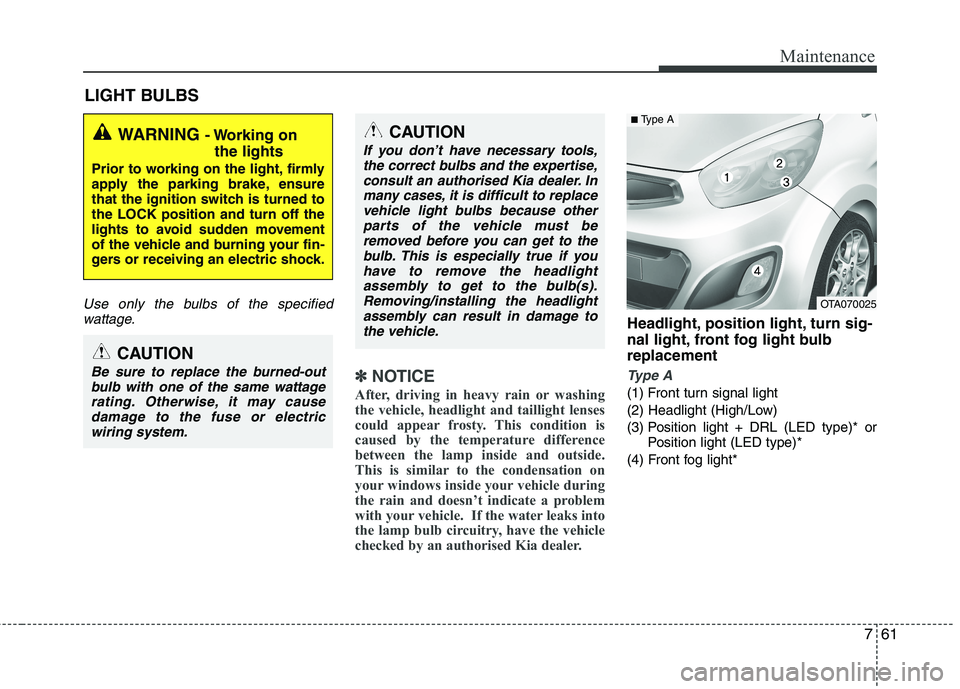
Headlight, position light, turn sig-
nal light, front fog light bulbreplacement
Type A
(1) Front turn signal light
(2) Headlight (High/Low)
(3) Position light + DRL (LED type)* or Position light (LED type)*
(4) Front fog light*
WARNING - Working on
the lights
Prior to working on the light, firmly
apply the parking brake, ensure
that the ignition switch is turned tothe LOCK position and turn off the
lights to avoid sudden movement
of the vehicle and burning your fin-
gers or receiving an electric shock.
CAUTION
Be sure to replace the burned-out bulb with one of the same wattagerating. Otherwise, it may causedamage to the fuse or electricwiring system.
CAUTION
If you don’t have necessary tools,the correct bulbs and the expertise,
consult an authorised Kia dealer. Inmany cases, it is difficult to replacevehicle light bulbs because other parts of the vehicle must be
removed before you can get to thebulb. This is especially true if youhave to remove the headlight
assembly to get to the bulb(s).Removing/installing the headlightassembly can result in damage tothe vehicle.
OTA070025
■ Type A
Page 822 of 846
769
Maintenance
Exterior care
Exterior general caution
It is very important to follow the label
directions when using any chemical
cleaner or polish. Read all warning andcaution statements that appear on thelabel.
Finish maintenance
Washing
To help protect your vehicle’s finish from
rust and deterioration, wash it thoroughlyand frequently at least once a month with
lukewarm or cold water.
If you use your vehicle for off-road driv-
ing, you should wash it after each off-
road trip. Pay special attention to the
removal of any accumulation of salt, dirt,
mud, and other foreign materials. Make
sure the drain holes in the lower edges of
the doors and rocker panels are keptclear and clean.
Insects, tar, tree sap, bird droppings,
industrial pollution and similar deposits
can damage your vehicle’s finish if not
removed immediately.
Even prompt washing with plain water
may not completely remove all these
deposits. A mild soap, safe for use on
painted surfaces, may be used.
After washing, rinse the vehicle thor-
oughly with lukewarm or cold water. Do
not allow soap to dry on the finish.
APPEARANCE CARECAUTION
Do not use strong soap, chemical
detergents or hot water, and do
not wash the vehicle in direct sunlight or when the body of thevehicle is warm.
Be careful when washing the side windows of your vehicle.Especially, with high-pressurewater, water may leak through the windows and wet the interior.
To prevent damage to the plastic parts and lamps, do not cleanwith chemical solvents or strongdetergents.
WARNING - Wet brakes
After washing the vehicle, test the
brakes whilst driving slowly to see
if they have been affected by water.
If braking performance is impaired,
dry the brakes by applying them
lightly whilst maintaining a slow
forward speed.
Page 835 of 846

Recommended SAE viscosity
number Engine oil viscosity (thickness) has an
effect on fuel economy and cold weather
operating (engine start and engine oil
flowability). Lower viscosity engine oils
can provide better fuel economy and cold
weather performance, however, higher
viscosity engine oils are required for sat-
isfactory lubrication in hot weather. Using
oils of any viscosity other than those rec-ommended could result in engine dam-
age.When choosing an oil, consider the range
of temperature your vehicle will be oper-
ated in before the next oil change.Proceed to select the recommended oil
viscosity from the chart.
CAUTION
Always be sure to clean the area
around any filler plug, drain plug, ordipstick before checking or drain-ing any lubricant. This is especially
important in dusty or sandy areasand when the vehicle is used onunpaved roads. Cleaning the plugand dipstick areas will prevent dirt
and grit from entering the engine and other mechanisms that couldbe damaged.
Temperature Range for SAE Viscosity Numbers
Temperature
Petrol
Engine Oil * 1°C
(°F)-30 -20 -10 0 10 20 30 40 50 -10 0 20 40 60 80 100 120
*1
: For better fuel economy, it is recommended to use the engine oil of a viscosity grade SAE
5W-20* 2
(API SM / ILSAC GF-4). However, if the engine oil is not available in your country,
select the proper engine oil using the engine oil viscosity chart.
* 2
: In Middle East, do not use the engine oil of viscosity grade SAE 5W-20.
20W-50
10W-30
15W-40
5W-20* 2
, 5W-30
85
Specifications & Consumer information
Page 841 of 846

Index
4
I
Economical operation ....................................................5-37
Electric power steering ..................................................4-34
Electronic stability program (ESP) ................................5-30
Emergency starting ..........................................................6-5
Jump starting ..............................................................6-5
Push starting ................................................................6-6
Emergency stop signal (ESS) ........................................5-35
Emergency towing ..........................................................6-28
Emergency whilst driving ................................................6-3
Emergency commodity ..................................................6-31
Emission control system ................................................7-75 Crankcase emission control system ..........................7-75
Evaporative emission control system ........................7-75
Exhaust emission control system ..............................7-76
Engine compartment..................................................2-4, 7-2
Engine coolant ................................................................7-23
Engine number ..................................................................8-7
Engine oil ........................................................................7-21
Engine overheats ..............................................................6-7
Engine start/stop button ....................................................5-6
Engine will not start..........................................................6-4
Evaporative emission control system..............................7-75
Exhaust emission control system ....................................7-76
Explanation of scheduled maintenance items ................7-18
Exterior care....................................................................7-69 Flat tyre ............................................................................6-8
Changing tyres ............................................................6-9
Jack and tools ..............................................................6-8
Removing and storing the spare tyre ..........................6-9
Fluid Automatic transaxle fluid ..........................................7-27
Washer fluid ..............................................................7-29
Brake fluid ................................................................7-26
Folding the rear seat........................................................3-10
Front seat adjustment - manual ........................................3-4
Fuel filler lid ..................................................................4-27
Fuel gauge ......................................................................4-42
Fuel requirements ............................................................1-2
Fuses ..............................................................................7-50 Fuse/relay panel description......................................7-54
Instrument panel fuse ................................................7-51
Multi fuse ..................................................................7-53
Memory fuse ............................................................7-52
Gauge Fuel gauge ................................................................4-42
Glassroof, see sunroof ....................................................4-30
Glove box ......................................................................4-100
F
G
E