Page 221 of 678

This function allows you to define two separate trips
called “Trip A” and “Trip B” where the car’s#complete
trips#are monitored in an independent manner.
Both trips can be reset (reset - start of a new trip). To
perform a reset, push and hold the OK button on the
steering wheel controls.
“Trip A” is used to display the figures relating to:
•Distance Travelled
•Average Consumption
•Travel Time (driving time)
Quantities Displayed
Distance Travelled
Indicates the distance travelled by the start of the new trip.
Average Consumption
Represents the average fuel consumption since the start
of the new trip.
Travel Time
Elapsed time since the start of the new trip.
OK Button
Short Push Of The Button: display of various param-
eters.
Long Push Of The Button: reset quantities and begin a
new trip.
New trip
Starts after reset:
•#Manual#by pressing theOKbutton.
•#Automatic#when the#distance#reaches the value is
62140 (99999.9 km) or when the#time travel#reaches
the value of 999.59 (999 hours and 59 minutes).
•After each disconnection and reconnection of the bat-
tery.
5
GETTING TO KNOW YOUR INSTRUMENT PANEL 219
Page 237 of 678
ESC Operation Modes
To disable ESC and other safety systems, follow the
instruction below.
There are three modes of active safety systems present on
the vehicle:
•ESC On
•Partial Off
•Full Off
ESC On
All active safety systems are enabled when operating the
vehicle in four-wheel drive.
This mode should be used for most driving situations.
The system will be in#ESC On#each time the engine is
started.
NOTE:It is recommended to select the mode#Partial Off#
or#Full Off#only for specific reasons.
Partial Off
By pushing the traction control button for less than five
seconds, while driving the vehicle, you can disable the
Traction Control System (TCS) and limit the intervention
of the TCS system only. Other systems remain enabled.
The activation of the mode is indicated by the illumina-
tion of the light, on the instrument panel.6
SAFETY 235
Page 239 of 678

NOTE:When driving on snow, with snow chains, it may
be useful to switch to the mode to#Partial Off#, starting in
this mode will allow greater traction.
Full Off
By pushing the button for more than five seconds, the
ESC system is switched off completely , in addition to
systems TSC, ERM, and the ESC system will be limited to
the single braking action on the individual drive wheels.
Other systems remain enabled.
The activation of the mode is highlighted from the
warning on the instrument panel.
WARNING!
In the ESC “Full Off” mode, the engine torque
reduction and stability features are disabled. There-
fore, enhanced vehicle stability offered by the ESC
(Continued)
WARNING!(Continued)
system is unavailable. In an emergency evasive ma-
neuver, the ESC system will not engage to assist in
maintaining stability. “ESC Off” mode is intended
for off-highway or off-road use only.
NOTE:Driving the vehicle above the speed of 40 mph
(65 km/h), the systems will behave as described for the
mode#Partial Off.”
To return to “ESC On” of operation, push the button
again.
Each time the ignition is turned ON, the ESC system will
be ON even if it was turned off previously.
6
SAFETY 237
Page 271 of 678
How To Disengage The Automatic Locking Mode
Unbuckle the combination lap/shoulder belt and allow it
to retract completely to disengage the Automatic Locking
Mode and activate the vehicle sensitive (emergency)
locking mode.
WARNING!
•The seat belt assembly must be replaced if the
switchable Automatic Locking Retractor (ALR) fea-
ture or any other seat belt function is not working
properly when checked according to the proce-
dures in the Service Manual.
•Failure to replace the seat belt assembly could
increase the risk of injury in collisions.
(Continued)
WARNING!(Continued)
•Do not use the Automatic Locking Mode to restrain
occupants who are wearing the seat belt or children
who are using booster seats. The locked mode is
only used to install rear-facing or forward-facing
child restraints that have a harness for restraining
the child.
Supplemental Restraint System (SRS)
Air Bag System Components
Your vehicle may be equipped with the following air bag
system components:
•Occupant Restraint Controller (ORC)
•Air Bag Warning Light
•Steering Wheel and Column
•Instrument Panel
6
SAFETY 269
Page 272 of 678
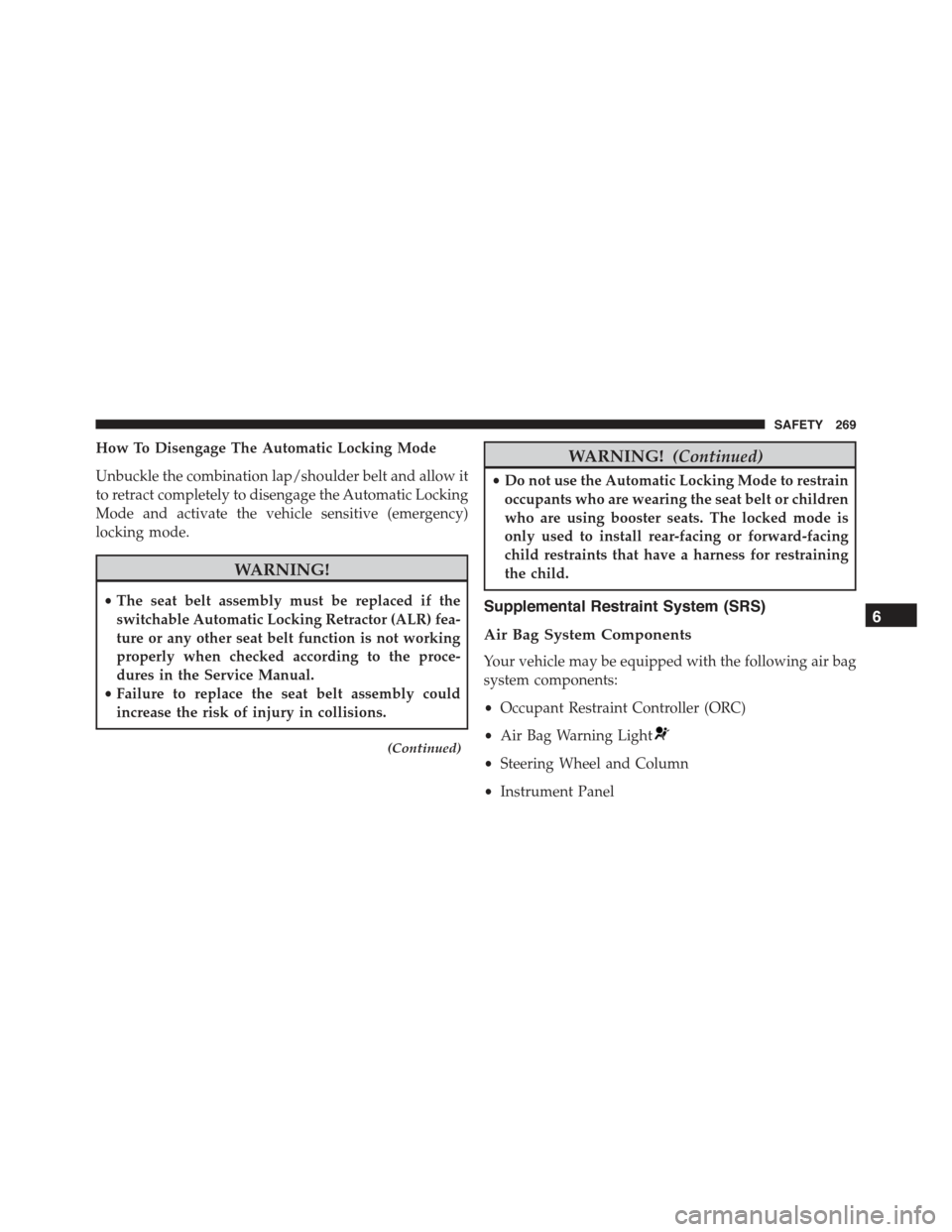
•Knee Impact Bolsters
•Advanced Front Air Bags
•Supplemental Side Air Bags
•Supplemental Knee Air Bags
•Front and Side Impact Sensors
•Seat Belt Pretenioners
•Seat Belt Buckle Switch
•Seat Track Position Sensors
Advanced Front Air Bags
This vehicle has Advanced Front Air Bags for both the
driver and front passenger as a supplement to the seat
belt restraint systems. The driver ’s Advanced Front Air
Bag is mounted in the center of the steering wheel. The
passenger ’s Advanced Front Air Bag is mounted in the
instrument panel, above the glove compartment. The
words “SRS AIRBAG” or “AIRBAG” are embossed on
the air bag covers.
Passenger Advanced Front Air Bag
270 SAFETY
Page 273 of 678
WARNING!
•Being too close to the steering wheel or instrument
panel during Advanced Front Air Bag deployment
could cause serious injury, including death. Air
bags need room to inflate. Sit back, comfortably
extending your arms to reach the steering wheel or
instrument panel.
•Never place a rear-facing child restraint in front of
an air bag. A deploying Passenger Advanced Front
Air Bag can cause death or serious injury to a child
12 years or younger, including a child in a rear-
facing child restraint.
•Only use a rear-facing child restraint in a vehicle
with a rear seat.Supplemental Driver Knee Air Bag/Driver Knee Impact
Bolster
6
SAFETY 271
Page 274 of 678

Advanced Front Air Bag Features
The Advanced Front Air Bag system has multistage
driver and front passenger air bags. This system provides
output appropriate to the severity and type of collision as
determined by the Occupant Restraint Controller (ORC),
which may receive information from the front impact
sensors or other system components.
The first stage inflator is triggered immediately during an
impact that requires air bag deployment. A low energy
output is used in less severe collisions. A higher energy
output is used for more severe collisions.
This vehicle may be equipped with driver and/or front
passenger seat track position sensors that may adjust the
inflation rate of the Advanced Front Air Bags based upon
seat position.
This vehicle may be equipped with a driver and/or front
passenger seat belt buckle switch that detects whether
the driver or front passenger seat belt is buckled. The seat
belt buckle switch may adjust the inflation rate of the
Advanced Front Air Bags.
WARNING!
•No objects should be placed over or near the air
bag on the instrument panel or steering wheel,
because any such objects could cause harm if the
vehicle is in a collision severe enough to cause the
air bags to inflate.
•Do not put anything on or around the air bag
covers or attempt to open them manually. You may
damage the air bags and you could be injured
because the air bags may no longer be functional.
The protective covers for the air bag cushions are
designed to open only when the air bags are
inflating.
(Continued)
272 SAFETY
Page 275 of 678

WARNING!(Continued)
•Relying on the air bags alone could lead to more
severe injuries in a collision. The air bags work
with your seat belt to restrain you properly. In
some collisions, air bags won’t deploy at all. Al-
ways wear your seat belts even though you have air
bags.
Advanced Front Air Bag Operation
Advanced Front Air Bags are designed to provide addi-
tional protection by supplementing the seat belts. Ad-
vanced Front Air Bags are not expected to reduce the risk
of injury in rear, side, or rollover collisions. The Ad-
vanced Front Air Bags will not deploy in all frontal
collisions, including some that may produce substantial
vehicle damage — for example, some pole collisions,
truck underrides, and angle offset collisions.
On the other hand, depending on the type and location of
impact, Advanced Front Air Bags may deploy in crashes
with little vehicle front-end damage but that produce a
severe initial deceleration.
Because air bag sensors measure vehicle deceleration
over time, vehicle speed and damage by themselves are
not good indicators of whether or not an air bag should
have deployed.
Seat belts are necessary for your protection in all colli-
sions, and also are needed to help keep you in position,
away from an inflating air bag.
When the ORC detects a collision requiring the Ad-
vanced Front Air Bags, it signals the inflator units. A large
quantity of non-toxic gas is generated to inflate the
Advanced Front Air Bags.
The steering wheel hub trim cover and the upper right
side of the instrument panel separate and fold out of the
6
SAFETY 273