Page 407 of 678

Before climbing a steep hill,shift the transmission to a
lower gear and shift the 4WD System to 4WD LOW. Use
first gear and 4WD LOW for very steep hills.
If you stall or begin to lose headwaywhile climbing a
steep hill, allow your vehicle to come to a stop and
immediately apply the brakes. Restart the engine and
shift to REVERSE. Back slowly down the hill allowing the
compression braking of the engine to help regulate your
speed. If the brakes are required to control vehicle speed,
apply them lightly and avoid locking or skidding the
tires.
WARNING!
If the engine stalls or you lose headway or cannot
make it to the top of a steep hill or grade, never
attempt to turn around. To do so may result in
tipping and rolling the vehicle. Always back straight
(Continued)
WARNING!(Continued)
down a hill in REVERSE gear carefully. Never back
down a hill in NEUTRAL using only the brake.
NOTE:Remember, never drive diagonally across a hill -
drive straight up or down.
If the wheels start to slip as you approach the crest of a
hill, ease off the accelerator and maintain headway by
turning the front wheels slowly left and right. This may
provide a fresh “bite” into the surface and will usually
provide traction to complete the climb.
Traction Downhill
Shift the transmission into a low gear and the 4WD
System to 4WD LOW range or Select Hill Descent
Control if equipped (refer to#Electronic Brake Control
System#in this section for further information). Let the
vehicle go slowly down the hill with all four wheels
7
STARTING AND OPERATING 405
Page 424 of 678
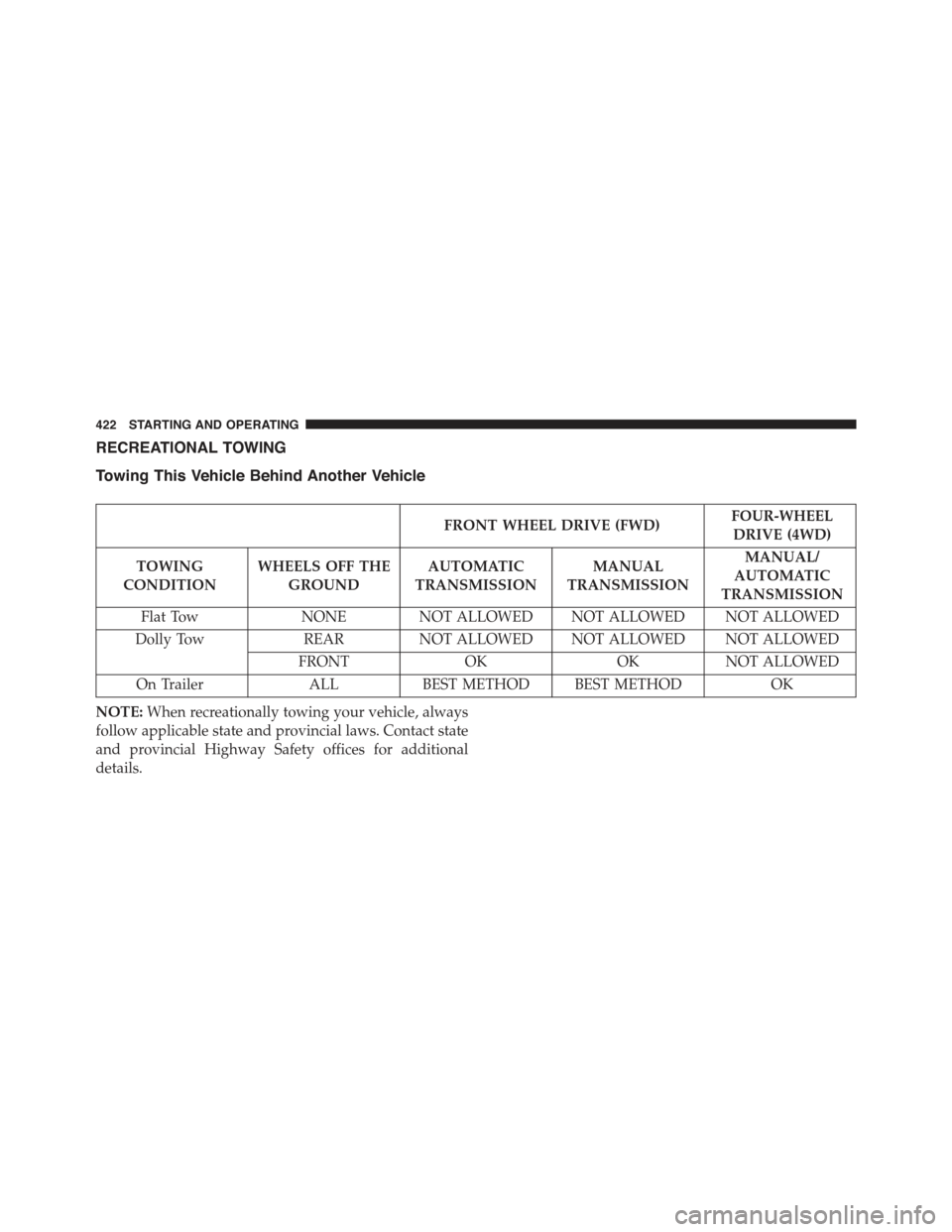
RECREATIONAL TOWING
Towing This Vehicle Behind Another Vehicle
FRONT WHEEL DRIVE (FWD)FOUR-WHEEL
DRIVE (4WD)
TOWING
CONDITION
WHEELS OFF THE
GROUND
AUTOMATIC
TRANSMISSION
MANUAL
TRANSMISSION
MANUAL/
AUTOMATIC
TRANSMISSION
Flat TowNONE NOT ALLOWED NOT ALLOWED NOT ALLOWED
Dolly TowREARNOT ALLOWED NOT ALLOWED NOT ALLOWED
FRONTOKOKNOT ALLOWED
On TrailerALLBEST METHOD BEST METHODOK
NOTE:When recreationally towing your vehicle, always
follow applicable state and provincial laws. Contact state
and provincial Highway Safety offices for additional
details.
422 STARTING AND OPERATING
Page 426 of 678
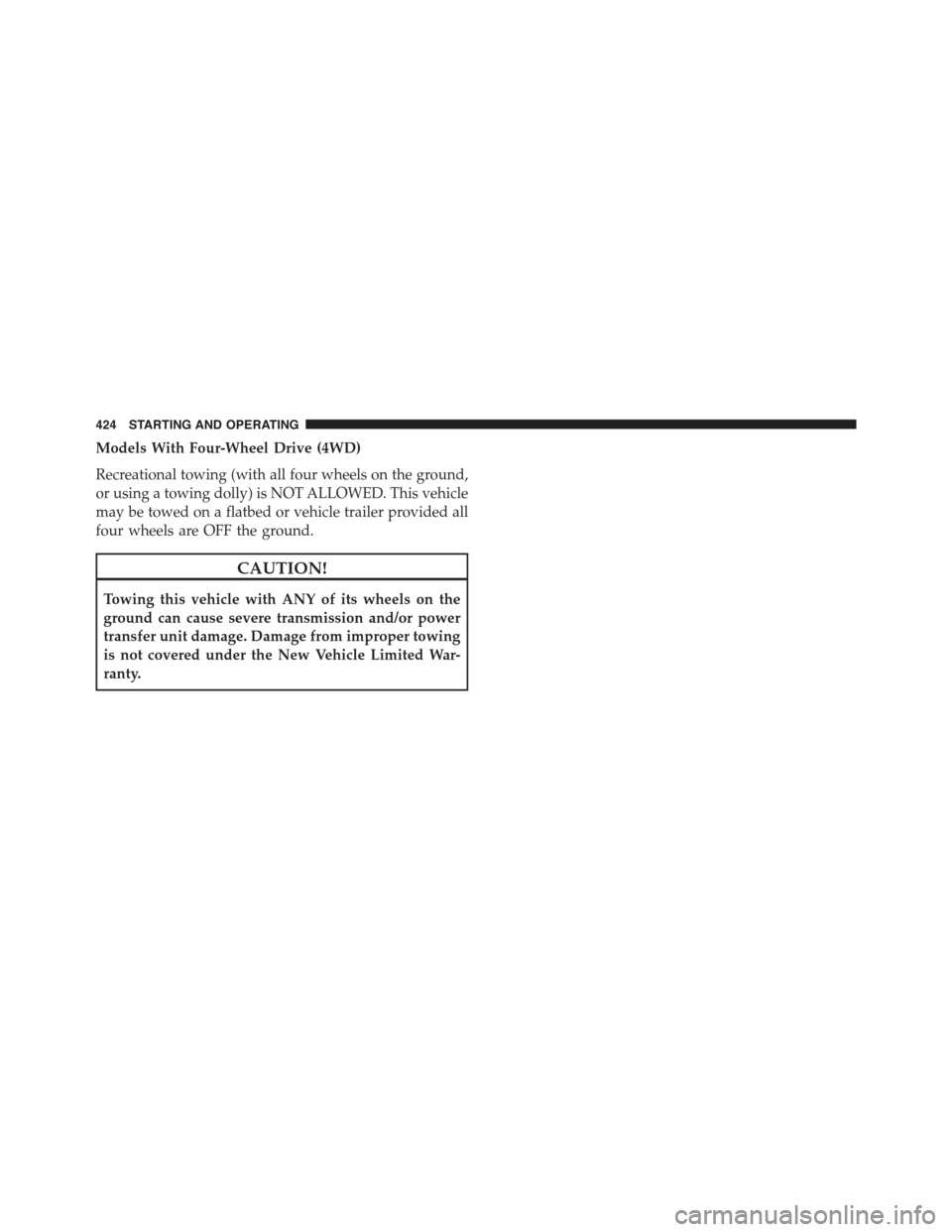
Models With Four-Wheel Drive (4WD)
Recreational towing (with all four wheels on the ground,
or using a towing dolly) is NOT ALLOWED. This vehicle
may be towed on a flatbed or vehicle trailer provided all
four wheels are OFF the ground.
CAUTION!
Towing this vehicle with ANY of its wheels on the
ground can cause severe transmission and/or power
transfer unit damage. Damage from improper towing
is not covered under the New Vehicle Limited War-
ranty.
424 STARTING AND OPERATING
Page 428 of 678
▫Road Tire Installation...................486
!TIRE SERVICE KIT STORAGE..............487
▫Tire Service Kit.......................488
!JUMP-STARTING PROCEDURES...........492
▫Preparations For Jump-Start..............492
▫Jump-Starting Procedure................494
!ENHANCED ACCIDENT RESPONSE SYSTEM . .496
!SUPPLY OF EMERGENCY................497
!IF YOUR ENGINE OVERHEATS............498
!SHIFT LEVER OVERRIDE................499
!IGNITION KEY REMOVAL OVERRIDE.......501
!FREEING A STUCK VEHICLE.............503
!TOWING A DISABLED VEHICLE...........505
▫Front Wheel Drive (FWD)................506
▫Four-Wheel Drive (4WD)................507
!EMERGENCY TOW HOOKS — IF EQUIPPED . .507
426 IN CASE OF EMERGENCY
Page 509 of 678

CAUTION!
Towing this vehicle in violation of the above require-
ments can cause severe transmission damage. Dam-
age from improper towing is not covered under the
New Vehicle Limited Warranty.
Four-Wheel Drive (4WD)
The manufacturer requires towing with all four wheels
OFF the ground. Acceptable methods are to tow the
vehicle on a flatbed, or with one end of the vehicle raised
and the opposite end on a towing dolly.
CAUTION!
•DO NOT tow this vehicle with ANY of its wheels
on the ground. Damage to the drivetrain will result.
(Continued)
CAUTION!(Continued)
•Front or rear wheel lifts must not be used. Internal
damage to the transmission or power transfer unit
will occur if a front or rear wheel lift is used when
towing.
•Towing this vehicle in violation of the above re-
quirements can cause severe transmission and/or
power transfer unit damage. Damage from im-
proper towing is not covered under the New Ve-
hicle Limited Warranty.
EMERGENCY TOW HOOKS — IF EQUIPPED
If your vehicle is equipped with tow hooks, there will be
one in the rear and two mounted on the front of the
vehicle. The rear hook will be located on the driver’s side
of the vehicle.
8
IN CASE OF EMERGENCY 507
Page 586 of 678

Four Wheel Drive (4WD) Non-Trailhawk Models with-
out a Two-Speed Power Takeoff Unit
•Original equipment 215/60R17 and 225/55R18 tire
sizes are not chainable.
•The use of 9mm snow chains is permitted with the use
of 215/60R16 tires.
Four Wheel Drive (4WD) Non-Trailhawk Models with a
Two-Speed Power Takeoff Unit
•The use of 7mm snow chains is permitted with the use
of 215/60R17 and 225/55R18 tires.
Four Wheel Drive (4WD) Trailhawk Models
•The use of 9mm snow chains is permitted with the use
of 215/60R17 tires.
CAUTION!
•Use on Front Tires Only
•Damage to Front Wheel Drive (FWD) Models may
result if tire chains or traction devices are used with
original equipment size tires.
•Damage to Four Wheel Drive (4WD) Models with-
out a Two-Speed Power Takeoff Unit may result if
tire chains or traction devices are used with origi-
nal equipment size tires.
•Damage to Four Wheel Drive (4WD) Trailhawk
Models may result if tire chains or traction devices
are used with original equipment size tires.
WARNING!
Using tires of different size and type (M+S, Snow)
between front and rear axles can cause unpredictable
handling. You could lose control and have a collision.
584 MAINTAINING AND CARING FOR YOUR VEHICLE
Page 588 of 678
type tires. Rotation will increase tread life, help to main-
tain mud, snow, and wet traction levels, and contribute to
a smooth, quiet ride.
Refer to the “Maintenance Schedule” for the proper
maintenance intervals. The reasons for any rapid or
unusual wear should be corrected prior to rotation being
performed.
The suggested Front Wheel Drive (FWD) rotation
method is the “rearward cross” shown in the following
diagram. This rotation pattern does not apply to some
directional tires that must not be reversed.
The suggested Four Wheel Drive (4WD) Tire rotation
method is the “forward-cross” shown in the following
diagram.
Front Wheel Drive (FWD) Tire Rotation
586 MAINTAINING AND CARING FOR YOUR VEHICLE
Page 589 of 678
CAUTION!
Proper operation of four-wheel drive vehicles de-
pends on tires of equal size, type and circumference
on each wheel. Any difference in tire size can cause
(Continued)
CAUTION!(Continued)
damage to the power transfer unit. Tire rotation
schedule should be followed to balance tire wear.
VEHICLE STORAGE
If the vehicle should remain stationary for more than a
month, observe the following precautions:
•Park your vehicle in a covered, dry and possibly airy
location the windows open slightly;
•Check that the Electric Park Brake is not engaged.
•Disconnect the negative (-) terminal from the battery
post and be sure that the battery is fully charged.
During storage check battery charge quarterly.
•If you do not disconnect the battery from the electrical
system, check the battery charge every thirty days.
Four Wheel Drive (4WD) Tire Rotation
9
MAINTAINING AND CARING FOR YOUR VEHICLE 587
Page:
< prev 1-8 9-16 17-24