2015 HYUNDAI TUCSON air condition
[x] Cancel search: air conditionPage 483 of 653
5-37
Driving your vehicle
5
✽✽NOTICE
Turning the ESC OFF does not
affect ABS or standard brake sys-
tem operation.Vehicle Stability Management (VSM)
Vehicle Stability Management (VSM)
helps ensure the vehicle stays stable
when accelerating or braking sud-
denly on wet, slippery and rough
roads where traction over the four
tires can suddenly become uneven.
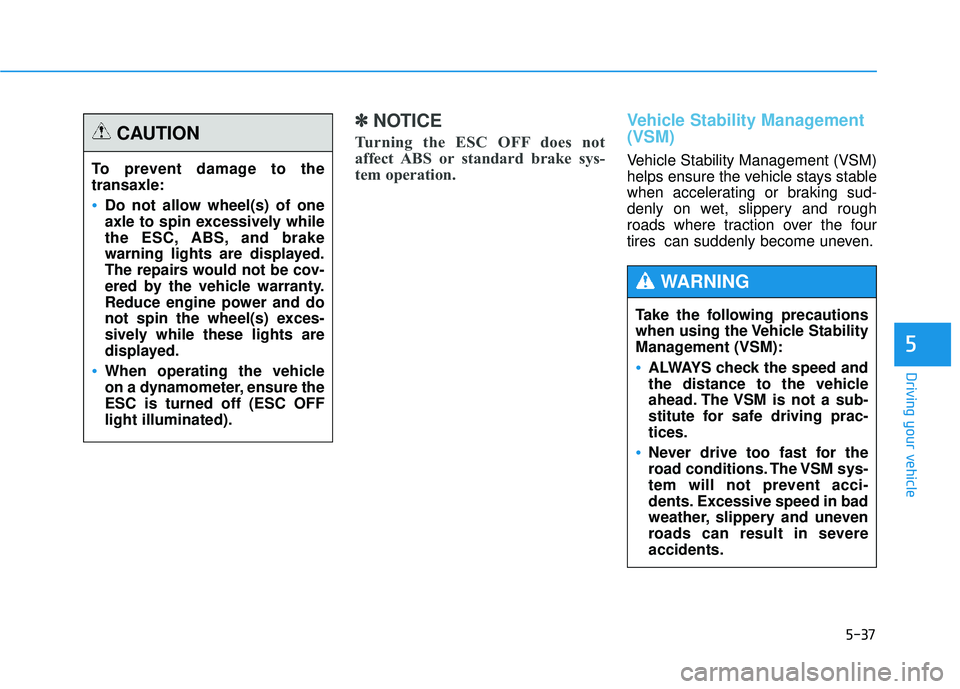
To prevent damage to thetransaxle:
Do not allow wheel(s) of one
axle to spin excessively while
the ESC, ABS, and brake
warning lights are displayed.
The repairs would not be cov-
ered by the vehicle warranty.
Reduce engine power and do
not spin the wheel(s) exces-
sively while these lights are
displayed.
When operating the vehicle
on a dynamometer, ensure theESC is turned off (ESC OFFlight illuminated).
CAUTION
Take the following precautions
when using the Vehicle Stability
Management (VSM):
ALWAYS check the speed and
the distance to the vehicle
ahead. The VSM is not a sub-
stitute for safe driving prac-tices.
Never drive too fast for the
road conditions. The VSM sys-
tem will not prevent acci-
dents. Excessive speed in bad
weather, slippery and uneven
roads can result in severeaccidents.
WARNING
Page 489 of 653
5-43
Driving your vehicle
5
DDRRIIVV IINN GG AA SSSS IISS TT SS YY SSTT EEMM
Active ECO system
Active ECO operation
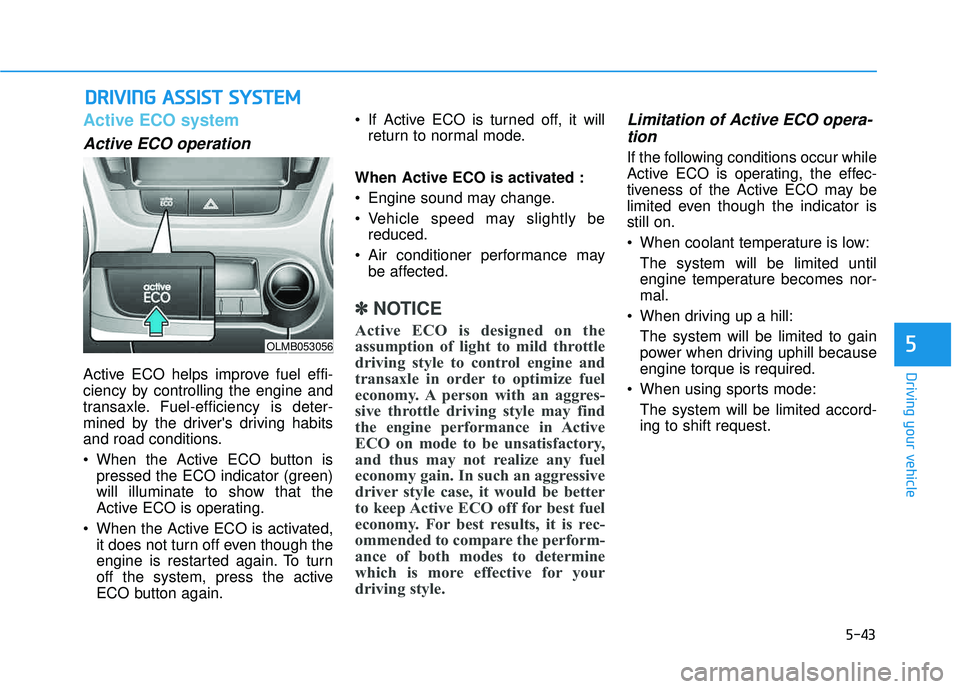
Active ECO helps improve fuel effi-
ciency by controlling the engine and
transaxle. Fuel-efficiency is deter-
mined by the driver's driving habits
and road conditions.
When the Active ECO button is
pressed the ECO indicator (green)
will illuminate to show that the
Active ECO is operating.
When the Active ECO is activated, it does not turn off even though the
engine is restarted again. To turn
off the system, press the active
ECO button again. If Active ECO is turned off, it will
return to normal mode.
When Active ECO is activated :
Engine sound may change.
Vehicle speed may slightly be reduced.
Air conditioner performance may be affected.
✽✽ NOTICE
Active ECO is designed on the
assumption of light to mild throttle
driving style to control engine and
transaxle in order to optimize fuel
economy. A person with an aggres-
sive throttle driving style may find
the engine performance in Active
ECO on mode to be unsatisfactory,
and thus may not realize any fuel
economy gain. In such an aggressive
driver style case, it would be better
to keep Active ECO off for best fuel
economy. For best results, it is rec-
ommended to compare the perform-
ance of both modes to determine
which is more effective for your
driving style.
Limitation of Active ECO opera- tion
If the following conditions occur while
Active ECO is operating, the effec-
tiveness of the Active ECO may be
limited even though the indicator isstill on.
When coolant temperature is low:
The system will be limited until
engine temperature becomes nor-mal.
When driving up a hill: The system will be limited to gain
power when driving uphill becauseengine torque is required.
When using sports mode:
The system will be limited accord-ing to shift request.
OLMB053056
Page 522 of 653
6-6
What to do in an emergency
✽✽NOTICE
An inappropriately disposedbattery can be harmful to
the environment and human
health. Dispose the battery
according to your local
law(s) or regulation.Jump starting procedure
1.Position the vehicles close enough that the jumper cables will reach,
but do not allow the vehicles totouch.
2.Avoid fans or any moving parts in the engine compartment at all
times, even when the vehicles are
turned off.
3.Turn off all electrical devices such as radios, lights, air conditioning,
etc. Put the vehicles in P (Park)
and set the parking brakes. Turn
both vehicles OFF.(Continued)
NEVER attempt to recharge
the battery when the vehicle’s
battery cables are connected
to the battery.
The electrical ignition system
works with high voltage.
NEVER touch these compo-nents with the engine running
or when the ignition switch isin the ON position.
To prevent damage to your vehi-
cle:
Only use a 12-volt power sup-
ply (battery or jumper system)
to jump start your vehicle.
Do not attempt to jump start
your vehicle by push-starting.
CAUTION
Pb
Page 524 of 653
6-8
If your temperature gauge indicates
overheating, you experience a loss
of power, or hear loud pinging or
knocking, the engine may be over-
heating. If this happens, you should:
1.Pull off the road and stop as soonas it is safe to do so.
2.Place the shift lever in P (Park) and set the parking brake. If the air con-
ditioning is ON, turn it OFF.
3.If engine coolant is running out under the vehicle or steam is com-ing out from the hood, stop the
engine. Do not open the hood until
the coolant has stopped running or
the steaming has stopped. If there
is no visible loss of engine coolant
and no steam, leave the engine
running and check to be sure the
engine cooling fan is operating. If
the fan is not running, turn the
engine off. 4.Check for coolant leaking from the
radiator, hoses or under the vehi-
cle. (If the air conditioning had
been in use, it is normal for cold
water to be draining from it when
you stop.)
5.If engine coolant is leaking out, stop the engine immediately and
call the nearest authorized
HYUNDAI dealer for assistance.
IIFF TT HH EE EE NN GGIINN EE OO VVEERR HH EEAA TTSS
What to do in an emergency
While the engine is
running, keep hands,
clothing and tools
away from the mov-
ing parts such as thecooling fan and drive
belt to prevent seri-
ous injury.
WARNING
NEVER remove the radiator cap or thedrain plug while theengine and radiator
are hot. Hot coolant
and steam may blow out under
pressure, causing serious
injury.
Turn the engine off and wait
until the engine cools down.
Use extreme care when remov-
ing the radiator cap. Wrap a
thick towel around it, and turn it
counterclockwise slowly to the
first stop. Step back while the
pressure is released from the
cooling system. When you aresure all the pressure has been
released, press down on the
cap, using a thick towel, and
continue turning counterclock-
wise to remove it.
WARNING
Page 529 of 653
6-13
What to do in an emergency
✽✽NOTICE
The TPMS Malfunction Indicator
may illuminate after blinking for
one minute if the vehicle is near elec-
tric power supply cables or radio
transmitters such as police stations,
government and public offices,
broadcasting stations, military
installations, airports, transmitting
towers, etc. Additionally, the TPMS
Malfunction indicator may illumi-
nate if snow chains are used or elec-
tronic devices such as computers,
chargers, remote starters, naviga-
tion, etc. This may interfere with
normal operation of the TPMS.This device complies with Part 15 of the FCC rules.
Operation is subject to the following
two conditions:
1. This device may not cause harm- ful interference, and
2. This device must accept any inter- ference received, including inter-
ference that may cause undesired
Changes or modifications not
expressly approved by the party
responsible for compliance could
void the user's authority to operatethe equipment.
Tampering with, modifying, or dis-
abling the TPMS components may
interfere with the system’s ability to
function and may void the warranty
for that portion of the vehicle.Changing a Tire with TPMS
If you have a flat tire, the Low Tire
Pressure Telltale will illuminate. If you
believe you have a flat tire or feel any
vehicle instability, take your foot off
the accelerator pedal and let the
vehicle slow down while driving
straight ahead. Do not apply the
brakes immediately or attempt to pull
off the road as this may cause a lossof control resulting in an accident.
When the vehicle has slowed to such
a speed that it is safe to do so, brake
carefully and pull off the road. Drive
off the road as far as possible and
park on firm, level ground. If you are
on a divided highway, do not park in
the median area between the two
traffic lanes. Replace the flat tire with
the compact spare tire.
6
Page 536 of 653

6-20
What to do in an emergency
✽✽NOTICE
When the original tire and wheel are
repaired and reinstalled on the vehi-
cle, the lug nut torque must be set
correctly to prevent wheel vibration.
The correct lug nut tightening
torque is 65-79 lb.ft (9-11 kg.m).
To prevent damaging the com-
pact spare tire and your vehicle:
Drive slowly enough for the
road conditions to avoid all
hazards, such as a potholesor debris.
Avoid driving over obstacles. The compact spare tire diame-ter is smaller than the diame-
ter of a conventional tire and
reduces the ground clearance
approximately 1 in (25 mm).
Do not use tire chains on the
compact spare tire. Because
of the smaller size, a tire chain
will not fit properly.
Do not use the compact spare
tire on any other wheels, nor
should standard tires, snow
tires, wheel covers or trimrings be used with the com-pact spare wheel.
CAUTION
Page 542 of 653
7
Maintenance
7
Maintenance
ENGINE COMPARTMENT .....................................7-3
MAINTENANCE SERVICES .....................................7-4
Owner's responsibility ...................................................7-4
Owner maintenance precautions ..................................7-4
OWNER MAINTENANCE .......................................7-6
Owner maintenance schedule ........................................7-7
SCHEDULED MAINTENANCE SERVICES ..............7-8
Normal maintenance schedule .......................................7-9
Maintenance under severe usage conditions ..........7-22
EXPLANATION OF SCHEDULED MAINTENANCE ITEMS .....................................7-24
ENGINE OIL ...........................................................7-27
Checking the engine oil level .......................................7-27
Checking the engine oil and filter ..............................7-28
ENGINE COOLANT ................................................7-29
Checking the engine coolant level..............................7-29
Changing engine coolant .............................................7-31
BRAKE FLUID ........................................................7-32
Checking the brake fluid level .....................................7-32
WASHER FLUID.....................................................7-34
Checking the washer fluid level .............................7-34
PARKING BRAKE...................................................7-35
Checking the parking brake .........................................7-35
AIR CLEANER .......................................................7-36
Filter replacement ........................................................7-36
CLIMATE CONTROL AIR CLEANER ....................7-38
Filter inspection ...............................................................7-38
WIPER BLADES.....................................................7-40
Blade inspection ..............................................................7-40
Blade replacement .......................................................7-40
BATTERY ...............................................................7-43
For best battery service................................................7-44
Battery recharging .........................................................7-44
Reset features .................................................................7-46
TIRES AND WHEELS ............................................7-47
Tire care ............................................................................7-47
Recommended cold tire inflation pressures.............7-48
Check tire inflation pressure........................................7-49
Tire rotation .....................................................................7-50
Wheel alignment and tire balance ..............................7-51
Tire replacement .............................................................7-51
Wheel replacement .........................................................7-52
Tire traction ......................................................................7-52
Tire maintenance ............................................................7-53
Tire sidewall labeling ......................................................7-53
Tire terminology and definitions.................................7-57
All season tires ................................................................7-60
Summer tires ....................................................................7-60
7
Page 548 of 653
7-7
7
Maintenance
Owner maintenance schedule
When you stop for fuel:
Check the engine oil level.
Check coolant level in the enginecoolant reservoir.
Check the windshield washer fluid level.
Check for low or under-inflated tires
While operating your vehicle:
Note any changes in the sound ofthe exhaust or any smell of
exhaust fumes in the vehicle.
Check for vibrations in the steering wheel. Notice if there is any
increased steering effort or loose-
ness in the steering wheel, or
change in its straight-ahead posi-tion.
Notice if your vehicle constantly turns slightly or “pulls” to one side
when traveling on smooth, levelroad.
When stopping, listen and check for unusual sounds, pulling to one
side, increased brake pedal travel
or “hard-to-push” brake pedal.
If any slipping or changes in the operation of your transaxle occurs,
check the transaxle fluid level.
Check the automatic transaxle P (Park) function.
Check the parking brake.
Check for fluid leaks under your vehicle (water dripping from the air
conditioning system during or after
use is normal).
At least monthly:
Check coolant level in the enginecoolant reservoir.
Check the operation of all exterior lights, including the stoplights, turn
signals and hazard warning flash-
ers.
Check the inflation pressures of all tires including the spare for tires
that are worn, show uneven wear,or are damaged.
Check for loose wheel lug nuts.
Be careful when checking your
engine coolant level when the
engine is hot. This may result in
coolant being blown out of theopening and cause serious
burns and other injuries.
WARNING