2015 FORD TRANSIT page 42
[x] Cancel search: page 42Page 91 of 461

Starting System
Description and Action
Message
Press the brake pedal before you start the engine.
Press brake to start
Indicates that the engine has failed to start.
Cranking time exceeded
Tire Pressure Monitoring System Description and Action
Message
The tire pressure is low in one or more tires, check the tire
pressures. See Tire Pressure Monitoring System (page
251).
Low Tire Pressure
The system has detected a fault that requires service.
Tire Pressure Monitor
Fault
The system has detected a fault that requires service or the
spare tire is in use. See
Tire Pressure Monitoring System
(page 251).
Tire Pressure Sensor
Fault
Water in Fuel Description and Action
Message
Drain off the water immediately. See Draining the Fuel
Filter Water Trap (page 210).
Water detected in fuel
Service required
88Transit (TTH) Canada/United States of America, enUSA, Edition date: 03/2014 Information Displays
Page 100 of 461

MANUAL SEATS
Moving the Seat Backward or
Forward
WARNINGS
Do not place cargo or any objects
behind the seat backrest before
returning it to the original position.
Pull on the seat backrest to make sure that
it has fully latched after returning the seat
backrest to its original position. An
unlatched seat may become dangerous if
you stop suddenly or have a crash. Do not adjust the driver seat when
your vehicle is moving. This may
result in sudden seat movement,
causing the loss of control of your vehicle. Make sure the driver seat fully locks
into place by rocking it backward and
forward.
1. Lift the handle.
2. Move the seat backward or forward to
attain the desired position.
3. Release the handle. Note:
The driver seat has removable stop
bolts on the track to enable access to the
vehicle battery. See Changing the 12V
Battery (page 213).
Adjusting the Lumbar Support 1.
Rotate the handle clockwise or counter
clockwise to attain the desired lumbar
support.
Recline Adjustment WARNINGS
Do not adjust the driver seat backrest
when your vehicle is moving. This
may result in sudden seat
movement, causing the loss of control of
your vehicle. Do not adjust the recliner from inside
your vehicle if the seat is unoccupied.
The seat back may move suddenly
and cause personal injury. 97
Transit (TTH) Canada/United States of America, enUSA, Edition date: 03/2014 SeatsE177638 E146386
Page 101 of 461
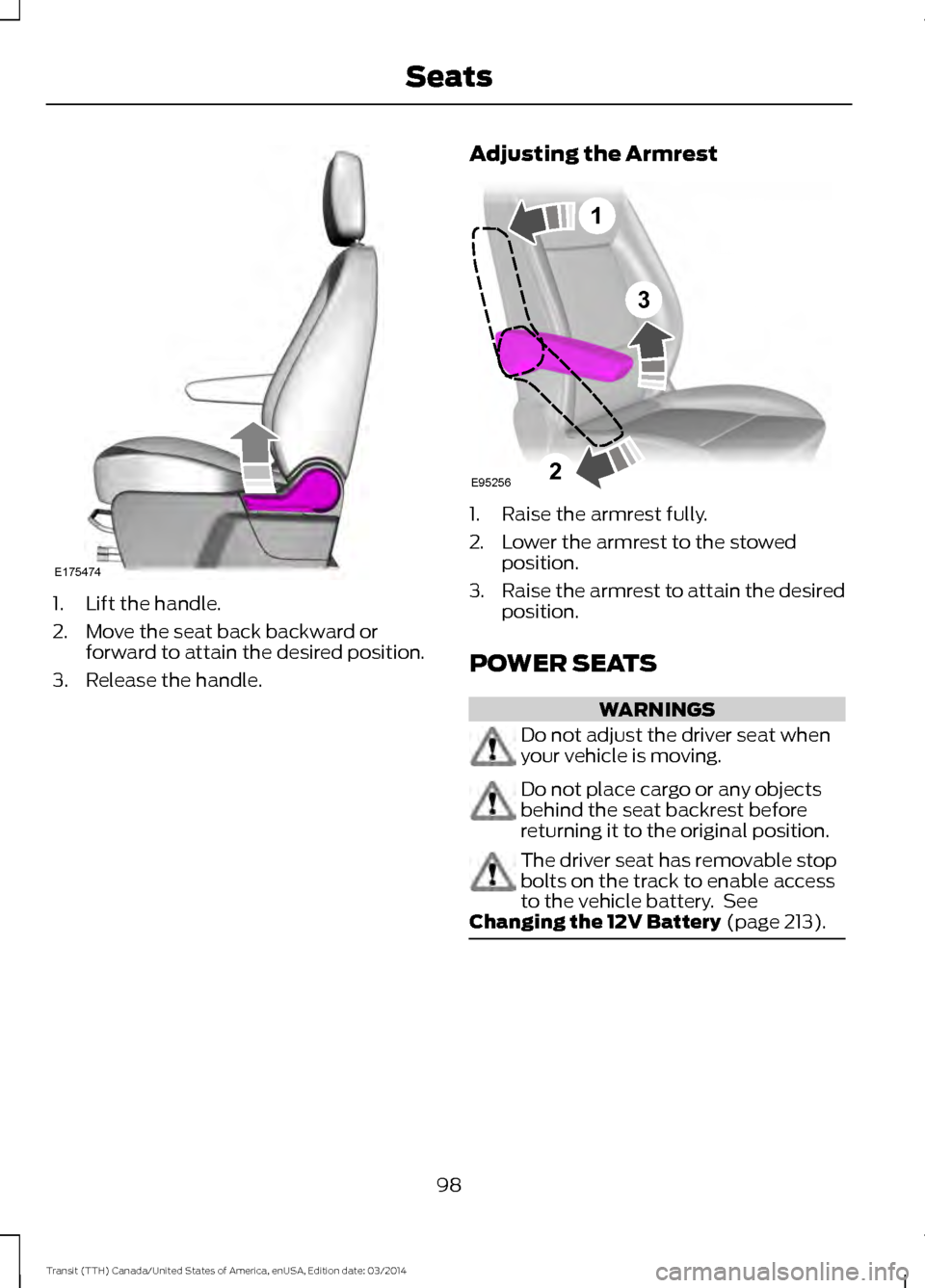
1. Lift the handle.
2. Move the seat back backward or
forward to attain the desired position.
3. Release the handle. Adjusting the Armrest 1. Raise the armrest fully.
2. Lower the armrest to the stowed
position.
3. Raise the armrest to attain the desired
position.
POWER SEATS WARNINGS
Do not adjust the driver seat when
your vehicle is moving.
Do not place cargo or any objects
behind the seat backrest before
returning it to the original position.
The driver seat has removable stop
bolts on the track to enable access
to the vehicle battery. See
Changing the 12V Battery (page 213). 98
Transit (TTH) Canada/United States of America, enUSA, Edition date: 03/2014 SeatsE175474 3
E95256
1
2
Page 111 of 461

and the environmental temperature sensor
will determine how long the glow plugs
stay energized. The required time for the
glow plugs to remain energized will
decrease as the engine coolant
temperature, barometric pressure and the
environmental temperature increases.
When you switch the ignition on, the glow
plug indicator lamp will illuminate if glow
plug heat is necessary as a starting aid.
Wait until the glow plug indicator lamp
turns off before starting the engine. The
lamp should always momentarily
illuminate when the engine is cold and you
switch the ignition on.
Cold Weather Operation
In cold weather below 32°F (0°C), the
engine may slowly increase to a higher idle
speed if left idling in park (P). As the engine
warms-up, the engine sound level
decreases due to the activation of
powertrain control module controlled
sound reduction features.
It is recommended that the engine block
heater be used for starting when the
temperature is -9°F (-23°C) or colder. See
Engine Bl
ock Heater (page 109).
Note: Idling in cold weather does not heat
the engine to its normal operating
temperature. Long periods of idling,
especially in cold weather, can cause a
buildup of deposits which can cause engine
damage.
Starting a Cold or Hot Engine
Note: Do not press the accelerator pedal.
1. Fully depress the brake pedal.
2. Turn the ignition key to position
II and
wait until the glow plug indicator lamp
turns off.
Note: Do not press the accelerator pedal.
3. Turn the ignition key to position III until
the engine starts. 4. Release the key.
Note:
You may need to crank the engine for
up to 10 seconds when the outside air
temperature is
5°F (-15°C) or below.
Note: Engine power may be reduced for 15
seconds when the engine oil temperature
is
-9°F (-23°C) or below. This is to allow
the turbocharger to be lubricated.
Note: If the engine fails to start after a
number of attempts, the system will not
allow you to operate the starter for a short
period of time, for example 30 minutes.
Failure to Start
If the engine does not crank with the
ignition key turned to position III while the
brake pedal is fully depressed, do the
following:
1. Switch the ignition off.
2. Release the brake pedal.
Note: Make sure the parking brake is fully
applied.
3. Fully depress the brake pedal.
4. Turn the ignition key to position
II and
wait until the glow plug indicator lamp
turns off.
Note: Do not press the accelerator pedal.
5. Turn the ignition key to position III until
the engine starts.
6. Release the key.
DIESEL PARTICULATE FILTER
The filter forms part of the emissions
reduction system on your vehicle. It filters
harmful diesel particulates (soot) from the
exhaust gas.
108 Transit (TTH) Canada/United States of America, enUSA, Edition date: 03/2014Starting and Stopping the Engine
Page 117 of 461

exported to non ultra-low sulfur diesel fuel
markets will need to be retrofitted (at the
customer
’s expense using Ford authorized
dealer service parts) in order to be reliably
operated on non ultra-low sulfur diesel
fuel.
Biodiesel
You may operate your vehicle on diesel
fuels containing up to 20% biodiesel, also
known as B20.
Biodiesel fuel is a chemically converted
product from renewable fuel sources, such
as vegetable oils, animal fats and waste
cooking greases. To help achieve acceptable engine
performance and durability when using
biodiesel in your vehicle:
•
Confirm the biodiesel content of the
fuel to be B20 (20% biodiesel) or less
by checking the label on the fuel pump.
• Only use biodiesel fuel of good quality
that complies with applicable industry
standards ASTM D975 for diesel and
ASTM D7467 for B6-B20 blends.
• Follow the recommended service
maintenance intervals. See Normal
Scheduled Maintenance (page 436).
• Do not store biodiesel fuel in the fuel
tank for more than one month.
• Do not use raw oils, fats or waste
cooking greases.
System Messages Action and Description
Message
Consider changing brands or reducing biodiesel content if
you have cold temperature fuel gelling issues or this message
frequently appears.
LOW FUEL PRESSURE
Use of biodiesel in concentrations greater
than 20% may cause damage to your
vehicle, including engine and/or exhaust
after-treatment hardware (exhaust
catalyst and particulate filter) failures.
When using biodiesel in concentrations
greater than 20%, this can also cause fuel
filter restrictions that may result in a lack
of power or damage to fuel system
components, including fuel pump and fuel
injector failures. See
Special Operating
Conditions Scheduled Maintenance
(page 438). .
Look for a label on the fuel pump to
confirm the amount of biodiesel contained
in a diesel fuel. Biodiesel fuel blends with
greater than 5% must be labeled. Biodiesel content is often indicated with
the letter B followed by the percent of
biodiesel in the fuel. For example, B20
indicates a fuel containing 20% biodiesel.
Ask the service station attendant to
confirm the biodiesel content of a diesel
fuel if you do not see a label on the fuel
pump.
Biodiesel fuels degrade more easily than
diesel fuels not containing biodiesel and
should not be stored in the fuel tank for
more than one month. If you plan to park
or store your vehicle for more than one
month, then you should empty your vehicle
fuel tank of biodiesel fuel. You should fill
the tank with a pure petroleum-based
diesel fuel and run your vehicle for a
minimum of 30 minutes.
114 Transit (TTH) Canada/United States of America, enUSA, Edition date: 03/2014 Fuel and Refueling
Page 119 of 461

WARNINGS
Do not dispose of fuel in the
household refuse or the public
sewage system. Use an authorized
waste disposal facility. When refueling the vehicle fuel tank from
a fuel container, use the plastic funnel
included with your vehicle.
Note:
The specifically designed plastic
funnel included with your vehicle will work
safely with the fuel system. 1. The plastic funnel is located in the
glove box.
2. Open the fuel filler door fully until it engages and remove the fuel filler cap.
Note: Capless fuel systems do not have a
fuel filler cap.
3. Insert the plastic funnel into the filler neck.
4. Add fuel to your vehicle from the fuel container.
5. Remove the plastic funnel from the filler neck. 6. Replace the fuel filler cap and close
the fuel filler door.
7. Clean the plastic funnel and place it back in your vehicle or correctly dispose
of it. Extra plastic funnels can be
purchased from an authorized dealer
if you choose to dispose of it.
CATALYTIC CONVERTER WARNING
Do not park or idle your vehicle over
dry leaves, dry grass or other
combustible materials. The exhaust
will radiate a considerable amount of heat
during use, and after you have switched
the engine off. This is a potential fire
hazard. Driving with a Catalytic Converter
WARNINGS
Avoid running out of fuel.
Do not crank the engine for long
periods.
Do not run the engine when a spark
plug lead is disconnected.
Do not push-start or tow-start your
vehicle. Use booster cables. See
Jump Starting the Vehicle (page
178). Do not switch the ignition off when
driving.
116
Transit (TTH) Canada/United States of America, enUSA, Edition date: 03/2014 Fuel and RefuelingE156223
Page 120 of 461

SELECTIVE CATALYTIC
REDUCTION SYSTEM
WARNINGS
You must refill the diesel exhaust
fluid tank when it is low. If it is not
refilled, vehicle speed will be limited
to 50 mph (80 km/h). Drive with caution
and refill the fluid tank as soon as possible. If the diesel exhaust fluid becomes
contaminated your vehicle will be
limited to idle speed operation.
Replace the fluid immediately. Tampering with or disabling the
selective catalytic reduction system
will result in severe vehicle
performance limitation. Vehicle speed will
be limited to
6 mph (10 km/h). Your vehicle has a selective catalytic
reduction system to help reduce exhaust
emission levels by injecting diesel exhaust
fluid into the exhaust system.
Diesel Exhaust Fluid Level
For the system to operate correctly, you
must maintain the diesel exhaust fluid
level.
A warning lamp will illuminate
when the diesel exhaust fluid
level is low and needs to be
refilled. See
Warning Lamps and
Indicators (page 75).
The warning lamp will illuminate
approximately
500 mi (800 km) before
the diesel exhaust fluid tank is empty. Refill
the tank as soon as possible.
Note: If the warning lamp illuminates when
your vehicle is moving, and the diesel
exhaust fluid is at a sufficient level, this
indicates a system malfunction. Have your
vehicle checked by an authorized dealer as
soon as possible. Continued driving without refilling the fluid
will result in:
•
Vehicle speed being limited. Prior to
this occurring a message will appear in
the information display.
• Further vehicle operation without
refilling the diesel exhaust fluid will
cause the engine to run at idle speed.
Note: You must add a minimum of
3.2 qt
(3 L) for your vehicle to exit the run at idle
speed mode.
Filling the Diesel Exhaust Fluid Tank WARNINGS
Do not allow diesel exhaust fluid to
come into contact with eyes, skin or
clothing. Should the fluid come into
contact with eyes, flush them with plenty
of water and contact a physician. Clean
affected skin with soap and water. If
swallowed, drink plenty of water and
contact a physician immediately. Refill the diesel exhaust fluid tank in
a well-ventilated area. When
removing the tank cap or a diesel
exhaust fluid container cap, ammonia
vapor may escape. Ammonia vapor is an
irritant to the eyes, skin and mucous
membranes. Inhaling ammonia vapor can
cause burning to the eyes, throat and nose
resulting in watering eyes or severe
coughing. Do not put diesel exhaust fluid in the
fuel tank. This can cause engine
damage not covered by the vehicle
warranty. 117
Transit (TTH) Canada/United States of America, enUSA, Edition date: 03/2014 Fuel and RefuelingE163176
Page 126 of 461

WARNINGS
An incorrectly operating or damaged
exhaust system may result in entry
of harmful and potentially lethal
fumes into the passenger compartment.
If you smell exhaust fumes inside your
vehicle, have an authorized dealer inspect
your vehicle immediately. Do not drive if
you smell exhaust fumes. Your vehicle has various emission control
components and a catalytic converter that
will enable your vehicle to comply with
applicable exhaust emission standards.
To make sure that the catalytic converter
and other emission control components
continue to work correctly:
•
Use only the specified fuel listed.
• Avoid running out of fuel.
• Do not switch the ignition off when your
vehicle is moving, especially at high
speeds.
• Have the items listed in scheduled
maintenance information carried out
according to the specified schedule.
The scheduled maintenance items listed
in scheduled maintenance information are
essential to the life and performance of
your vehicle and to its emissions system.
If you use parts other than Ford, Motorcraft
or Ford-authorized parts for maintenance
replacements, or for service of
components affecting emission control,
such non-Ford parts should be the
equivalent to genuine Ford Motor Company
parts in performance and durability.
Illumination of any of the following warning
lamps, indicators or vehicle symptoms
could indicate that the emission control
system is not working correctly.
• Coolant temperature warning lamp.
• Charging system warning lamp.
• Service engine soon indicator. •
Fluid leaks.
• Strange odors.
• Excessive exhaust smoke.
• Loss of engine power.
Do not make any unauthorized changes to
your vehicle or engine. By law, vehicle
owners and anyone who manufactures,
repairs, services, sells, leases, trades
vehicles, or supervises a fleet of vehicles
are not permitted to intentionally remove
an emission control device or prevent it
from working. Information about your
vehicle ’s emission system is on the Vehicle
Emission Control Information Decal
located on or near the engine. This decal
also lists engine displacement.
Please see your warranty information for
complete details.
On-Board Diagnostics (OBD-II)
Your vehicle has an on-board diagnostics
system (OBD-II) that monitors the engine ’s
emission control system. This system
protects the environment by making sure
that your vehicle continues to meet
government emission standards. The
OBD-II system also assists an authorized
dealer in correctly servicing your vehicle. When the service engine soon
indicator illuminates, the OBD-II
system has detected a
malfunction. Temporary malfunctions may
cause the service engine soon indicator to
illuminate.
Examples of temporary malfunctions are:
• The vehicle has run out of fuel.
• Poor fuel quality or water in the fuel.
• The engine may misfire or run rough.
• The fuel filler door may not have been
closed correctly. See Refueling (page
120).
• Driving through deep water. The
electrical system may be wet.
123 Transit (TTH) Canada/United States of America, enUSA, Edition date: 03/2014 Fuel and Refueling