2015 FORD TRANSIT weight
[x] Cancel search: weightPage 204 of 461
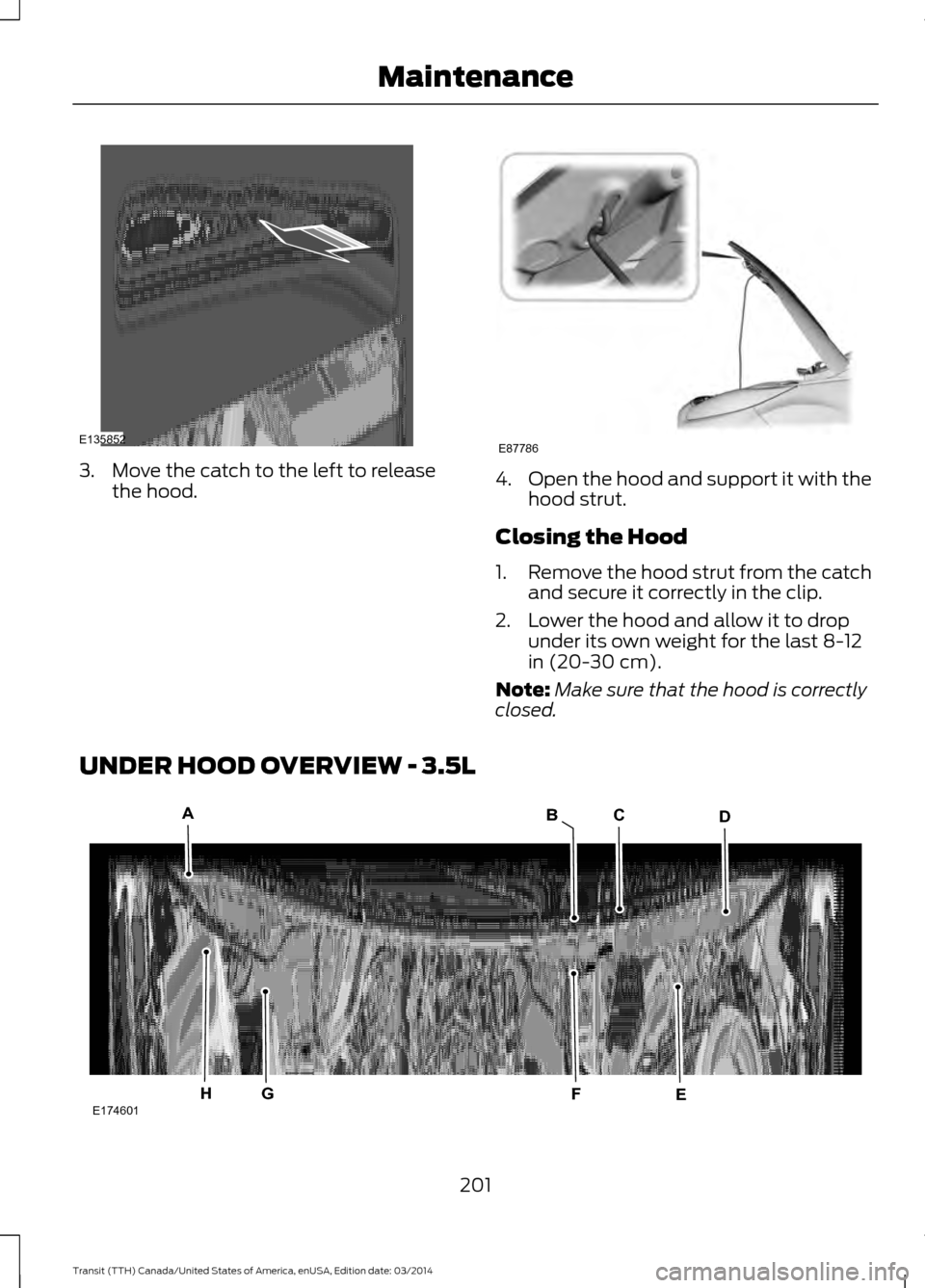
3. Move the catch to the left to release
the hood. 4.
Open the hood and support it with the
hood strut.
Closing the Hood
1. Remove the hood strut from the catch
and secure it correctly in the clip.
2. Lower the hood and allow it to drop under its own weight for the last 8-12
in (20-30 cm).
Note: Make sure that the hood is correctly
closed.
UNDER HOOD OVERVIEW - 3.5L 201
Transit (TTH) Canada/United States of America, enUSA, Edition date: 03/2014 MaintenanceE135852 E87786 E174601
ACD
EGH
B
F
Page 209 of 461

•
Sustained high-speed driving at Gross
Vehicle Weight Rating (maximum
loaded weight for vehicle operation).
• Sustained use of diesel fuel other than
ultra-low sulfur diesel (ULSD). Resetting the Oil Life Monitoring
System The indicator lamp will
illuminate when the engine oil
and oil filter requires changing.
To reset the Oil Life Monitoring System, switch the ignition on, do not start the
engine and scroll to: Action and Description
Message
Fully press the accelerator and brake pedals. Keep both
pedals fully pressed.
Oil change required
The information display will show this message after a short
period of time.
Oil reset in prog.
The information display will show this message after a short
period of time.
Oil reset complete
Release the accelerator and brake pedals and switch the
ignition off.
ENGINE COOLANT CHECK
Checking the Engine Coolant
When the engine is cold, check the
concentration and level of the engine
coolant at the intervals listed in the
scheduled maintenance information. See
Scheduled Maintenance (page 433).
Note: Make sure that the level is between
the MIN and MAX marks on the coolant
reservoir.
Note: Coolant expands when it is hot. The
level may extend beyond the MAX mark.
Note: If the level is at the MIN mark, below
the MIN mark, or empty, add coolant
immediately. See
Adding Engine Coolant
in this chapter.
The coolant concentration should be
maintained within 48% to 50%, which
equates to a freeze point between -29.2°F
(-34°C)
and -34.5°F (-37°C). Note:
For best results, coolant
concentration should be tested with a
refractometer, for example Robinair®
coolant and battery refractometer 75240.
We do not recommend the use of
hydrometers or coolant test strips for
measuring coolant concentrations.
Note: Automotive fluids are not
interchangeable. Do not use engine coolant,
antifreeze or windshield washer fluid outside
of its specified function and vehicle location.
Adding Engine Coolant WARNINGS
Do not add engine coolant when the
engine is hot. Steam and scalding
liquids released from a hot cooling
system can burn you badly. Also, spilling
coolant on hot engine parts can burn you. Do not put engine coolant in the
windshield washer fluid reservoir. If
sprayed on the windshield, engine
coolant could make it difficult to see
through the windshield.
206 Transit (TTH) Canada/United States of America, enUSA, Edition date: 03/2014 Maintenance
Page 238 of 461

graded 100. The relative
performance of tires depends
upon the actual conditions of their
use, however, and may depart
significantly from the norm due to
variations in driving habits, service
practices, and differences in road
characteristics and climate.
Traction AA A B C
WARNING
The traction grade assigned
to this tire is based on
straight-ahead braking traction
tests, and does not include
acceleration, cornering,
hydroplaning or peak traction
characteristics. The traction grades, from highest
to lowest are AA, A, B, and C. The
grades represent the tire
’s ability
to stop on wet pavement as
measured under controlled
conditions on specified
government test surfaces of
asphalt and concrete. A tire
marked C may have poor traction
performance.
Temperature A B C WARNING
The temperature grade for
this tire is established for a
tire that is correctly inflated and
not overloaded. Excessive speed,
under-inflation, or excessive
loading, either separately or in
combination, can cause heat
buildup and possible tire failure. The temperature grades are A
(the highest), B and C,
representing the tire
’s resistance
to the generation of heat and its
ability to dissipate heat when
tested under controlled conditions
on a specified indoor laboratory
test wheel. Sustained high
temperature can cause the
material of the tire to degenerate
and reduce tire life, and excessive
temperature can lead to sudden
tire failure. The grade C
corresponds to a level of
performance which all passenger
car tires must meet under the
Federal Motor Vehicle Safety
Standard No. 139. Grades B and A
represent higher levels of
performance on the laboratory
test wheel than the minimum
required by law.
Glossary of Tire Terminology
• Tire label: A label showing the
OE (Original Equipment) tire
sizes, recommended inflation
pressure and the maximum
weight the vehicle can carry.
• Tire Identification Number
(TIN): A number on the
sidewall of each tire providing
information about the tire
brand and manufacturing
plant, tire size and date of
manufacture. Also referred to
as DOT code.
• Inflation pressure: A measure
of the amount of air in a tir
e.
235 Transit (TTH) Canada/United States of America, enUSA, Edition date: 03/2014 Wheels and Tires
Page 241 of 461

15: Indicates the wheel or
rim diameter in inches. If
you change the wheel
size, you will have to
purchase new tires to
match the new wheel
diameter.
E
95:
Indicates the tire's
load index. It is an index
that relates to how much
weight a tire can carry.
You may find this
information in the Owner ’s
Guide. If not, contact a
local tire dealer.
F
H: Indicates the tire's
speed rating. The speed
rating denotes the speed
at which a tire is designed
to be driven for extended
periods of time under a
G
standard condition of load
and inflation pressure.
The tires on your vehicle
may operate at different
conditions for load and
inflation pressure. These
speed ratings may need
to be adjusted for the
difference in conditions.
The ratings range from 81
mph (130 kph) to 186 mph
(299 kph). These ratings
are listed in the following
chart. United States of
America DOT Tire
Identification Number
(TIN):
This begins with
the letters DOT and
indicates that the tire
H
meets all federal
standards. The next two
numbers or letters are the
plant code designating
where it was
manufactured, the next
two are the tire size code
and the last four numbers
represent the week and
year the tire was built. For
example, the numbers 317
mean the 31st week of
1997. After 2000 the
numbers go to four digits.
For example, 2501 means
the 25th week of 2001.
The numbers in between
are identification codes
used for traceability. This
information is used to
contact customers if a tire
defect requires a recall.
M+S or M/S: Mud and
Snow, AT: All Terrain, AS:
All Season.
I
Tire Ply Composition
and Material Used:
Indicates the number of
plies or the number of
layers of rubber-coated
fabric in the tire tread and
J
sidewall. Tire
238 Transit (TTH) Canada/United States of America, enUSA, Edition date: 03/2014 Wheels and Tires
Page 263 of 461

3. Rotate the cable through 90 degrees.
Slide the cable through the slot to
release the spare wheel bracket from
the winch. 4. Remove the retaining nut to release
the spare wheel bracket. Vehicle Jack WARNINGS
When one of the front wheels is off
the ground, the transmission alone
will not prevent the vehicle from
moving or slipping off the jack. To help prevent the vehicle from
moving when you change a tire, be
sure to place the transmission in park
(P), set the parking brake and block (in
both directions) the wheel that is
diagonally opposite (other side and end of
the vehicle) to the tire being changed. Never get underneath a vehicle that
is supported only by a jack. If the
vehicle slips off the jack, you or
someone else could be seriously injured. Do not attempt to change a tire on
the side of the vehicle close to
moving traffic. Pull far enough off the
road to avoid the danger of being hit when
operating the jack or changing the wheel. Always use the jack provided as
original equipment with your vehicle.
If using a jack other than the one
provided as original equipment with your
vehicle, make sure the jack capacity is
adequate for the vehicle weight, including
any vehicle cargo or modifications. Disable the power running boards
before jacking, lifting, or placing any
object under the vehicle. Never place
your hand between the power running
board and the vehicle as extended power
running boards will retract when the doors
are closed. Failure to follow these
instructions may result in personal injury. Note:
Passengers should not remain in the
vehicle when the vehicle is being jacked.
Note: Vehicles with a Temporary Mobility
Kit do not have a vehicle jack or a lug
wrench.
260 Transit (TTH) Canada/United States of America, enUSA, Edition date: 03/2014 Wheels and TiresE146812
12 E146813
Page 273 of 461

VEHICLE IDENTIFICATION
NUMBER
The vehicle identification number is
located on the left-hand side of the
instrument panel.
Please note that in the graphic, XXXX is
representative of your vehicle identification
number.
The Vehicle Identification Number contains
the following information:
World manufacturer identifier
A
Brake system, Gross Vehicle
Weight Rating, Restraint Devices
and their locations
B Make, vehicle line, series, body
type
C
Engine type
D
Check digit
E
Model year
F
Assembly plant
G
Production sequence number
H
VEHICLE CERTIFICATION
LABEL The National Highway Traffic Safety
Administration Regulations require that a
Safety Compliance Certification Label be
affixed to a vehicle and prescribe where
the Safety Compliance Certification Label
may be located. The Safety Compliance
Certification Label shall be affixed to either
the door hinge pillar, the door latch post,
or the edge of the door near the door latch,
next to the driver's seating position.
270 Transit (TTH) Canada/United States of America, enUSA, Edition date: 03/2014Capacities and SpecificationsE142476 E142477 E167469
Page 417 of 461

For a complete listing of the accessories
that are available for your vehicle, contact
an authorized dealer or visit our online
store at www.accessories.ford.com
(United States only).
Ford Motor Company will repair or replace
any properly authorized dealer-installed
Ford Genuine Accessory found to be
defective in factory-supplied materials or
workmanship during the warranty period,
as well as any component damaged by the
defective accessories. Ford Motor
Company will warrant your accessory
through the warranty that provides the
greatest benefit:
•
24 months, unlimited miles
• The remainder of your new vehicle
limited warranty
Contact an authorized dealer for details
and a copy of the warranty.
Exterior Style
• Side window deflectors
• Splash guards
• Wheels
Interior Style
• All-weather floor mats
• Interior ambient lighting
• Cargo organizers
• Rear seat entertainment*
• Premium carpeted floor mats
Lifestyle
• Ash cup and smokers packages
• Roof racks and carriers*
• Hitch and towing accessories
Peace of Mind
• Remote start
• Vehicle security system •
Wheel locks
• Bumper-mounted parking sensor*
• Keyless entry keypad
*The Ford Licensed Accessory
manufacturer designs, develops and
therefore warrants Ford Licensed
Accessories, and does not design or test
these accessories to Ford Motor Company
engineering requirements. Contact an
authorized Ford dealer for the
manufacturer's limited warranty details,
and request a copy of the Ford Licensed
Accessories product limited warranty from
the accessory manufacturer.
For maximum vehicle performance, keep
the following information in mind when
adding accessories or equipment to your
vehicle:
• When adding accessories, equipment,
passengers and luggage to your
vehicle, do not exceed the total weight
capacity of the vehicle or of the front
or rear axle (GVWR or GAWR as
indicated on the Safety Compliance
Certification label). Ask an authorized
dealer for specific weight information.
• The Federal Communications
Commission (FCC) and Canadian
Radio Telecommunications
Commission (CRTC) regulate the use
of mobile communications systems
that are equipped with radio
transmitters, for example, two-way
radios, telephones and theft alarms.
Any such equipment installed in your
vehicle should comply with Federal
Communications Commission (FCC)
and Canadian Radio
Telecommunications Commission
(CRTC) regulations and should be
installed only by an authorized dealer.
414 Transit (TTH) Canada/United States of America, enUSA, Edition date: 03/2014 Accessories
Page 458 of 461

Phone...............................................................387
Making C alls........................................................ 389
Pairing Subsequent Cell Phones.................389
Pairing Your Cell Phone for the First Time.................................................................. 388
Phone Menu Options....................................... 390
Phone Settings................................................... 393
Phone Voice Commands................................ 394
Receiving Calls................................................... 390
Text Messaging.................................................... 391
Post-Crash Alert System
...........................180
Power Door Locks See: Locking and Unlocking............................. 54
Power Seats.....................................................98 P
ower Lumbar...................................................... 99
Power Steering Fluid Check.....................210 Adding Power Steering Fluid.......................... 210
Power Windows..............................................70 Accessory Delay.................................................... 70
Bounce-Back......................................................... 70
Driver Side One-Touch Down.......................... 70
Driver Side One-Touch Up................................ 70
R
Rear Passenger Climate Controls............93
Rear Quarter Windows
.................................72
Closing the Rear Windows................................ 72
Opening the Rear Windows.............................. 72
Rear Seats........................................................
99
Installing the Seats............................................. 101
Recline Adjustment........................................... 100
Removing Seats, 12 & 15 Passenger Vehicles............................................................. 100
Rear View Camera.......................................
144
Switching the Rear View Camera Off.........146
Switching the Rear View Camera On..........145
Using the Display................................................ 145
Vehicles with Parking Aid................................ 146
Rear View Camera See: Rear View Camera.................................... 144
Recommended Towing Weights............162 Calculating the Maximum Loaded Trailer
Weight for Your Vehicle............................... 164
Reduced Engine Performance.................173
Refueling..........................................................120 Remote Control..............................................44
C
ar Finder................................................................ 45
Integrated Key head Transmitter...................44
Programming a New Remote Control..........45
Replacing the Battery......................................... 45
Sounding a Panic Alarm.................................... 46
Removing a Headlamp...............................216
Repairing Minor Paint Damage..............230
Replacement Parts Recommendation........................................10
Collision Repairs..................................................... 11
Scheduled Maintenance and Mechanical Repairs................................................................... 11
Warranty on Replacement Parts...................... 11
Replacing a Lost Key or Remote Control............................................................46
Reporting Safety Defects (Canada Only)..............................................................186
Reporting Safety Defects (U.S. Only)...............................................................185
Roadside Assistance...................................
176
Vehicles Sold in Canada: Getting Roadside
Assistance.........................................................176
Vehicles Sold in Canada: Using Roadside Assistance.........................................................176
Vehicles Sold in the United States: Getting Roadside Assistance.................................... 176
Vehicles Sold in the United States: Using Roadside Assistance.................................... 176
Roadside Emergencies...............................176
Running-In See: Breaking-In................................................... 173
Running Out of Fuel......................................115 Adding Fuel From a Portable Fuel
Container........................................................... 115
Filling a Portable Fuel Container................... 115
S
Safety Belt Height Adjustment................30
Safety Belt Minder..........................................31 Belt-Minder®.......................................................... 31
Safety Belts.......................................................27 Principle of Operation......................................... 27
Safety Belt Warning Lamp and Indicator Chime..............................................................30
Conditions of operation...................................... 31
Safety Canopy ™.............................................
41
455 Transit (TTH) Canada/United States of America, enUSA, Edition date: 03/2014 Index