2015 FORD TRANSIT light
[x] Cancel search: lightPage 106 of 461

WARNINGS
Do not use the power points for
operating a cigar lighter element.
Do not insert objects other than an
accessory plug into the power points.
Run the engine for full capacity use of the
power points.
Note:
Do not use the power points over the
vehicle capacity of 12 volt DC 180 watt or a
fuse may blow.
Note: Do not hang any accessory from the
accessory plug.
Note: Always keep the power point caps
closed when not in use.
Note: Incorrect use of the power points can
cause damage not covered by the vehicle
warranty.
To prevent the battery from running out of
charge:
• Do not use the power points for longer
than necessary when the engine is not
running.
• Do not leave devices plugged in
overnight or when your vehicle is in park
(P) for extended periods of time.
Note: The power point turns off after 30
minutes if you switched the ignition on
without the engine running. Auxiliary Power Point Locations Auxiliary Power Point locations may be:
•
On the instrument panel.
• Inside the floor console storage
compartment.
• Inside the cargo area.
Note: Do not keep electrical devices or
adaptors plugged in to the auxiliary power
point when not in use.
AC Power Point WARNING
Do not use any extension cord with
the AC power point, since it will
defeat the safety protection design
provided by the cap and twist tab. Doing
so may cause the power point to overload
due to powering multiple devices that can
reach beyond the 150 watt load limit and
could result in fire or personal injury. 103
Transit (TTH) Canada/United States of America, enUSA, Edition date: 03/2014 Auxiliary Power PointsE185878
Page 107 of 461

Use the AC power point for powering
electrical devices that require up to 150
watts. You can find it under the parking
brake lever.
Note:
Do not keep electrical devices or
adaptors plugged in to the AC power point
when not in use.
When the green indicator light, located on
the AC power point, is:
• On — AC power point is ready to supply
power.
• Off — AC power point is not ready to
supply power or you ignition is not
switched on.
• Flashing — AC power point is in fault
mode.
If you exceed the 150 watts limit, then the
AC power point temporarily turns off.
The indicator light flashes if the power
point detects overloading, overheating, or
shorting conditions. For overloaded or
shorted conditions, unplug your device and
switch the ignition off then back on. For an
overheated condition, let the system cool
down and switch the ignition off then back
on.
The AC power point is not suitable for use
with all electrical devices, for example:
• Tube type televisions.
• Vacuum cleaners.
• Power tools. •
Compressor-driven refrigerators.
• Medical or measuring equipment that
must process precise data.
• Appliances requiring an extremely
stable power supply, for example:
•Microcomputer-controlled electric
blankets.
• Touch-sensor lamps.
CIGAR LIGHTER Press the element in to use the cigar
lighter. It will pop out automatically.
Note:
Do not press and hold the cigar lighter
element.
104 Transit (TTH) Canada/United States of America, enUSA, Edition date: 03/2014 Auxiliary Power PointsE143941 E103382
Page 115 of 461

FUEL QUALITY - GASOLINE
Note:
Use of any fuel other than
recommended fuel can cause powertrain
damage, impair the emission control system
or cause loss of vehicle performance. Any
damage to vehicle that is caused by use of
fuel not recommended will not be covered
under warranty.
Choosing the Right Fuel Without
a Flex Fuel Vehicle (If Equipped)
Use only UNLEADED gasoline or
UNLEADED gasoline blended with a
maximum of 85% ethanol (E-85) in your
Flex Fuel Vehicle (FFV). If your vehicle is
flex fuel capable, the fuel fill inlet will have
a yellow housing.
Do not use:
• Fuel containing more than 15% ethanol
or E-85 fuel.
• Fuel with methanol.
• Fuels containing metallic based
additives, including manganese-based
compounds.
• Fuels containing the octane booster
additive, methylcyclopentadienyl
manganese tricarbonyl (MMT)
• Leaded fuel (The use of leaded fuel is
prohibited by law).
Choosing the Right Fuel With a
Flex Fuel Vehicle (If Equipped)
Use only UNLEADED gasoline or
UNLEADED gasoline blended with a
maximum of 85% ethanol (E-85) in your
Flex Fuel Vehicle (FFV). If your vehicle is
flex fuel capable, it will have a yellow bezel
placed over the fuel fill inlet.
Do not use:
• Fuels containing more than 85%
ethanol or E-100 fuel.
• Fuel with methanol. •
Fuels containing metallic based
additives, including manganese-based
compounds.
• Fuels containing the octane booster
additive, methylcyclopentadienyl
manganese tricarbonyl (MMT)
• Leaded fuel (The use of leaded fuel is
prohibited by law).
Octane Recommendations Do not be concerned if your engine
sometimes knocks lightly. However, if it
knocks heavily under most driving
conditions while you are using fuel with the
recommended octane rating, see your
authorized dealer to prevent any engine
damage.
3.5L V6 EcoBoost
We recommend regular unleaded gasoline
with a pump (R+M)/2 octane rating of 87.
Some stations offer fuels posted as regular
with an octane rating below 87, particularly
in high altitude areas. We do not
recommend fuels with an octane rating
below 87. To provide improved
performance, we recommend premium
fuel for severe duty usage, such as trailer
tow.
112 Transit (TTH) Canada/United States of America, enUSA, Edition date: 03/2014 Fuel and RefuelingE161513
Page 121 of 461

The diesel exhaust fluid tank filler neck is
located below the fuel filler neck and has
a blue cap. Fill the tank using a fluid pump
at a diesel exhaust fluid filling station or a
diesel exhaust fluid container. We
recommend Motorcraft® diesel exhaust
fluid, the containers are spill proof and stop
the flow of fluid when the tank is full. The
capacity of the diesel exhaust fluid tank is
21 liters.
You must only use diesel exhaust fluid that
is certified by the American Petroleum
Institute (API).
Note:
You must open the fuel filler door
before you can open the diesel exhaust fluid
filler door. Note:
Immediately wash off any diesel
exhaust fluid that has spilled on to a painted
surface with soapy water.
Filling the Diesel Exhaust Fluid Tank
Using a Fuel Station Pump
Filling the diesel exhaust fluid tank using
a pump is similar to a refuelling your
vehicle. The diesel exhaust fluid pump
nozzle will shut off automatically when the
tank is full.
Note: Some filling stations utilize a
magnetic mechanism in the pump nozzle
that may prevent refilling the diesel exhaust
fluid tank. To overcome this issue you will
need to locate another filling station or use
a refill container.
Filling the Diesel Exhaust Fluid Tank
Using a Container
The following procedure applies to
Motorcraft diesel exhaust fluid or similar
fluid containers. Always follow the
manufacturer's instructions.
1. Remove the diesel exhaust fluid container cap. Place the spout on to
the container and tighten it until you
feel a strong resistance.
2. Remove the diesel exhaust fluid tank filler cap.
3. Insert the spout in to the filler neck until
the seal on the spout seats on to the
filler neck. Pour the fluid in to the tank.
When the tank is full the fluid will stop
flowing automatically.
4. Return the container to the vertical position slightly below the diesel
exhaust fluid filler neck. Allow any fluid
remaining in the spout to drain back in
to the container.
5. Remove the spout from the diesel exhaust fluid filler neck. Replace the
diesel exhaust fluid tank cap.
118 Transit (TTH) Canada/United States of America, enUSA, Edition date: 03/2014 Fuel and RefuelingE172245 E163354)E163354
Page 122 of 461

6. Remove the spout from the diesel
exhaust fluid container and replace the
cap.
Note: If there is diesel exhaust fluid left in
the container retain it for later use. The
spout is re-useable. Wash the spout with
clean water prior to storage. Do not use the
diesel exhaust fluid spout with any other
fluid.
Filling the Diesel Exhaust Fluid Tank in
Cold Climates
Diesel exhaust fluid may freeze if the
ambient temperature is below 12°F (-11°C).
Your vehicle has a preheating system
which allows diesel exhaust fluid to
operate below 12°F (-11°C). If you do not
use your vehicle for an extended period
when the ambient temperature is below
12°F (-11°C)
, the fluid in the tank may
freeze. If the tank is overfilled and the fluid
freezes it may damage the tank. This is not
covered by the vehicle warranty.
Contaminated Diesel Exhaust
Fluid or Inoperative Selective
Catalytic Reduction System If the system becomes
contaminated or inoperative, the
diesel exhaust fluid warning
lamp will illuminate and a message will
appear in the information display.
Continued driving without replacing the
fluid or not having the system repaired will
result in:
• Vehicle speed being limited. Prior to
this occurring a message will appear in
the information display.
• Further vehicle operation without
replacing contaminated diesel exhaust
fluid will cause the engine to run at idle
speed. Note:
If the vehicle speed becomes limited
or the engine will only run at idle speed,
normal vehicle operation will not resume
until you have the system repaired. To
service a contaminated or inoperative
system, see an authorized dealer.
Note: You must add a minimum of 3.2 qt
(3 L) for your vehicle to exit the run at idle
speed mode.
Diesel Exhaust Fluid Guidelines
• Do not put diesel exhaust fluid in the
vehicle fuel tank.
• Do not overfill the diesel exhaust fluid
tank.
• Do not dilute diesel exhaust fluid with
water or any other liquid.
• Do not re-use a diesel exhaust fluid
container.
• Do not store in direct sunlight.
• Store at temperatures between 23°F
(-5°C) and 68°F (20°C).
• Do not store a diesel exhaust fluid
container in your vehicle.
• Diesel exhaust fluid is non-flammable,
non-toxic, colorless and water-soluble.
Approximate Diesel Exhaust Fluid
Usage
The chart below illustrates the
approximate diesel exhaust fluid usage for
the given distances traveled under various
driving conditions. Usage may vary
depending on:
• Driving style.
• Towing a trailer.
• Vehicle load.
• Engine idling time.
119 Transit (TTH) Canada/United States of America, enUSA, Edition date: 03/2014 Fuel and RefuelingE163176
Page 124 of 461
Note:
When you insert the correct size fuel
pump nozzle into a capless fuel system, a
spring loaded inhibitor will open. This helps
to avoid refueling with the incorrect fuel.
Note: The capless fuel system
accommodates standard non-commercial
fuel pump nozzle sizes up to 1 in (25 mm)
diameter.
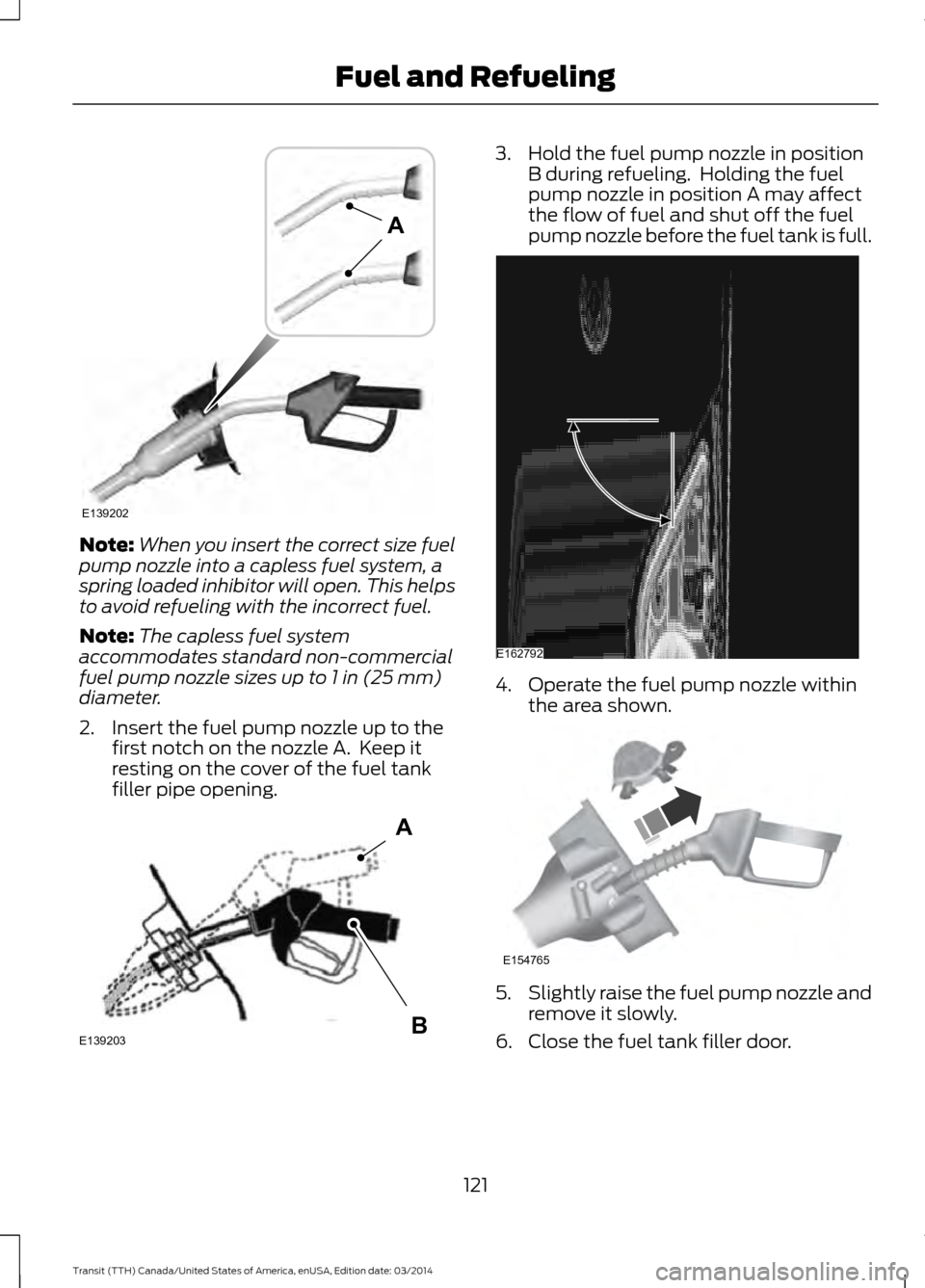
2. Insert the fuel pump nozzle up to the first notch on the nozzle A. Keep it
resting on the cover of the fuel tank
filler pipe opening. 3. Hold the fuel pump nozzle in position
B during refueling. Holding the fuel
pump nozzle in position A may affect
the flow of fuel and shut off the fuel
pump nozzle before the fuel tank is full. 4. Operate the fuel pump nozzle within
the area shown. 5.
Slightly raise the fuel pump nozzle and
remove it slowly.
6. Close the fuel tank filler door.
121 Transit (TTH) Canada/United States of America, enUSA, Edition date: 03/2014 Fuel and RefuelingE139202
A E139203
A
B E162792 E154765
Page 130 of 461

System Message
Action and Description
Message
You must maintain the diesel particulate filter for it to
continue to function correctly. Do not disregard a system
maintenance message. The Ford Warranty may not cover
damage caused to your vehicle as a result of disregarding
this message.
Exhaust filter overloaded
Drive to clean
Operator Commanded Regeneration
Precautions and Safe Exhaust Position WARNING
Failure to comply with the following
instructions for operator
commanded regeneration may result
in fire, serious injury, death or property
damage. Before you start operator commanded
regeneration, do the following:
•
You must park your vehicle outside of
any structure.
• Move the gearshift lever to park (P)
with the parking brake set on stable,
level ground.
• Your vehicle must be
9.8 ft (3 m) -
16.4 ft (5 m) away from any
obstructions and must be away from
materials that can easily combust or
melt, for example, paper, leaves,
petroleum products, fuels, plastics and
other dry organic material.
• Make sure there is a minimum of 2.6 gal
(12 L)
of fuel in the fuel tank.
• Make sure all fluids are at the correct
levels.
• Make sure that the louvers located at
the tip of the exhaust are clear of any
obstructions as they are used to
introduce fresh air into the tailpipe to
cool the exhaust gas as it leaves. How to Start Operator Commanded
Regeneration WARNING
Stay clear of exhaust tip during
regeneration. You or others can be
burned.
Note:
You cannot use the operator
commanded regeneration until the diesel
particulate filter load percentage has
reached 100 percent. The diesel particulate
filter load percentage will fluctuate up and
down when driving your vehicle due to active
and passive regenerations.
Note: During the use of operator
commanded regeneration, you may observe
a light amount of white smoke. This is
normal. You cannot use the operator
commanded regeneration if the
service engine soon light is
illuminated.
Using the Information Display
You can start operator commanded
regeneration using the information display.
See General Information
(page 79).
127 Transit (TTH) Canada/United States of America, enUSA, Edition date: 03/2014 Fuel and Refueling
Page 132 of 461

the vehicle over materials that could burn
until the exhaust system has had sufficient
time to cool. Depending on the amount of
soot collected by the diesel particulate
filter, ambient temperature, and altitude,
operator commanded regeneration may
last up to 30 minutes. When the system is at the point
of over saturation, the service
engine soon light will illuminate
and the following message will appear.
System Message Action and Description
Message
You will not be able to allow cleaning. You must have your
vehicle serviced by an authorized dealer.
Exhaust filter over limit
Service now
Operator Commanded Regeneration
with Automatic Regeneration Control
(If Equipped)
If your vehicle is operated with significant
stationary operation, low speed drive
cycles less than 25 mph (40 km/h), short
drive cycles, drive time less than 15 minutes
or the vehicle does not fully warm up,
passive and active regeneration may not sufficiently clean the diesel particulate
filter system. You can switch off automatic
regeneration until better driving conditions
are available, for example steady high
driving. You can then switch automatic
regeneration back on to clean the diesel
particulate filter.
Switching the Automatic Regeneration Control On and Off
To switch the automatic regeneration control on and off, scroll to: Action and Description
Message
Press the
OK button.
Information
Press the
OK button.
Driver Assist
Uncheck the box to switch automatic regeneration off.
Auto Exh.Clean
Check the box to switch automatic regeneration on.
When you switch automatic regeneration off, one of the following warning
messages may be displayed. The diesel particulate filter is full and you should switch the
automatic regeneration control on as soon as possible.
Exhaust Filter Full Clean
Soon
The diesel particulate filter is overloaded you must switch
the automatic regeneration control on as soon as possible.
Exhaust Filter Over-
loaded Clean Now
You must clean the diesel particulate filter immediately.
Failing to do so would cause the diesel particulate filter to
become blocked.
Exhaust filter at limit
Clean now
129Transit (TTH) Canada/United States of America, enUSA, Edition date: 03/2014 Fuel and Refueling