2015 FORD SUPER DUTY weight
[x] Cancel search: weightPage 30 of 84
Contaminated Diesel Exhaust Fluid
(DEF) or inoperative Selective
Catalytic Reduction system
Selective catalytic reduction
systems are sensitive to
contamination of the Diesel
Exhaust Fluid (DEF). USE ONLY API or ISO
22241 CERTIFIED DIESEL EXHAUST FLUID
(DEF). If the selective catalytic reduction
system becomes contaminated or
inoperative, the Diesel Exhaust Fluid (DEF)
light will illuminate and exhaust fluid
system fault messages will appear in the
information display.
Continued driving without replacing DEF
or having the selective catalytic reduction
system repaired will result in the following
actions as required by the California Air
Resources Board (CARB) and U.S.
Environmental Protection Agency (EPA):
• Within a certain number of miles
(kilometers) to empty, speed will be
limited upon restart. Prior to this
occurring a message will appear in the
information display.
• Further vehicle operation without
replacing contaminated DEF will cause
the engine to enter an idle-only
condition. This will only occur upon
vehicle refueling, vehicle idling in park
for 1 hour, or engine shutdown for 10
minutes or more and will be indicated
by a message in the information display
indicating required actions to resume
normal operation.
For either vehicle speed limiting or idle-only
condition, normal vehicle operation will
resume when you repair the contaminated
system. To service a contaminated or
inoperative system, see an authorized
dealer. Diesel Exhaust Fluid (DEF) guidelines
and information
•
Use only Diesel Exhaust Fluid that
carries the trademark: American
Petroleum Institute (API) certified DEF
or ISO 22241.
• Do not put DEF in the diesel fuel tank.
• Do not overfill the DEF tank.
• Do not re-use the DEF container once
it is emptied.
• Avoid spilling DEF on painted surfaces,
carpeting or plastic components.
Immediately wipe away any DEF that
has spilled with a damp cloth and
water. If it has already crystallized, use
warm water and a sponge.
• Store DEF out of direct sunlight and in
temperatures between 23°F (-5°C) —
68°F (20°C).
• DEF will freeze below 12°F (-11°C).
• Do not store the DEF bottle in your
vehicle. If it leaks it could cause
damage to interior components or
release an ammonia odor inside your
vehicle.
• DEF is non-flammable, non-toxic,
colorless and water-soluble liquid.
• Do not dilute DEF with water or any
other liquid.
• An ammonia odor may be smelled
when the cap is removed or during
refill. Refill DEF in a well ventilated
area.
Typical Diesel Exhaust Fluid (DEF)
Usage
The charts below illustrate approximate
Diesel Exhaust Fluid (DEF) usage for the
given distances traveled under various
driving conditions and when using the
power take off. Your usage may vary
depending on: driving style, trailer towing,
loaded vehicle weight, weather, idle time,
PTO usage.
27
Super Duty (TFA) , enUSA Fuel and RefuelingE163176
Page 39 of 84
Noise Emissions Warranty, Prohibited
Tampering Acts and Maintenance
On January 1, 1978, Federal regulation
became effective governing the noise
emission on trucks over 10,000 lbs. (4,536
kg) GVWR (Gross Vehicle Weight Rating).
The preceding statements concerning
prohibited tampering acts and
maintenance, and the noise warranty
found in the Warranty Guide, are
applicable to complete chassis cabs over
10,000 lbs. (4,536 kg) GVWR.
FUEL TANK SELECTOR
SWITCH
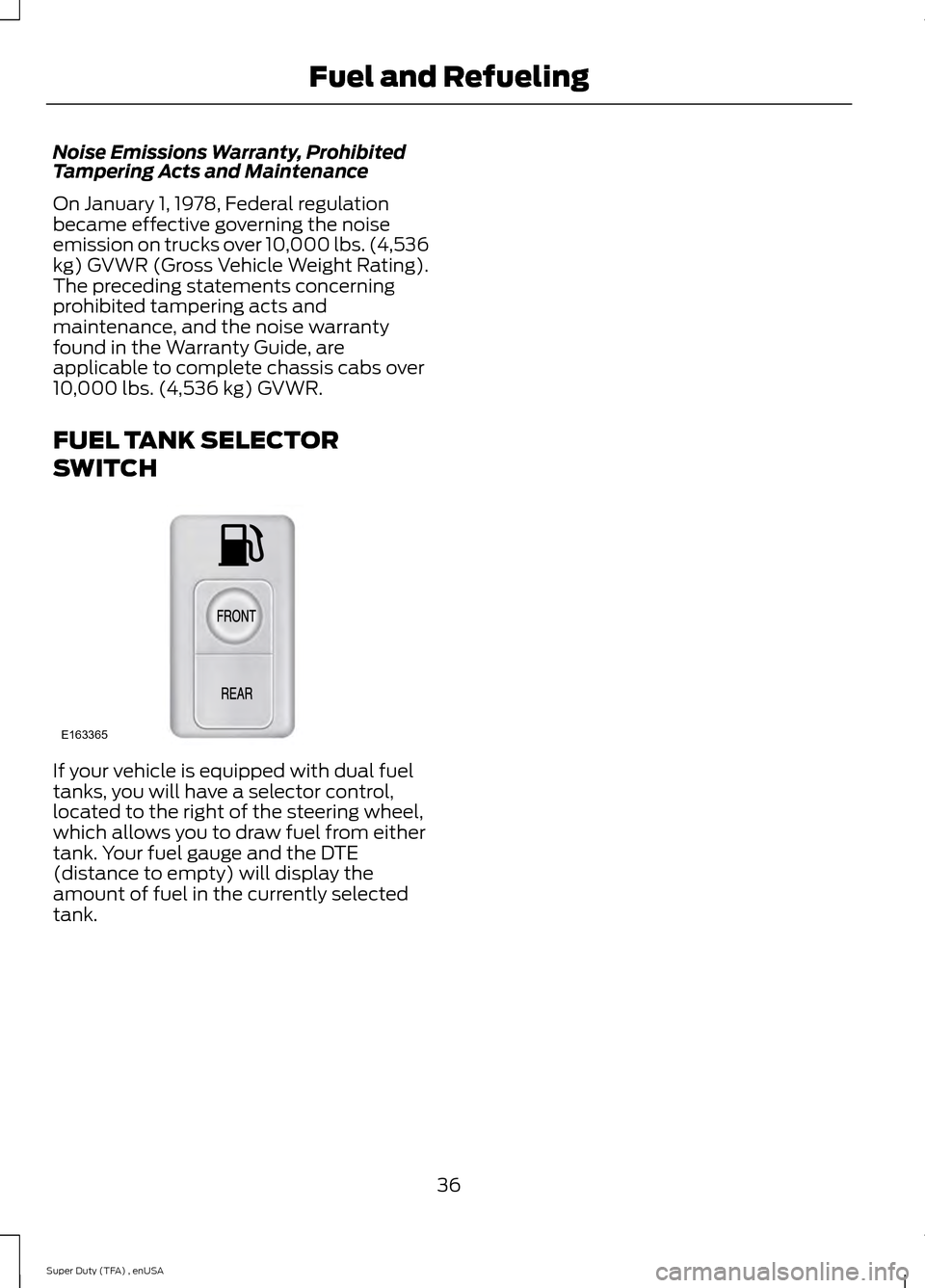
If your vehicle is equipped with dual fuel
tanks, you will have a selector control,
located to the right of the steering wheel,
which allows you to draw fuel from either
tank. Your fuel gauge and the DTE
(distance to empty) will display the
amount of fuel in the currently selected
tank.
36
Super Duty (TFA) , enUSA Fuel and RefuelingE163365
Page 48 of 84
5.
Reset the Intelligent Oil Life Monitor™.
See the Information Displays chapter
in the Owner's Manual for more
information.
Engine lubrication for severe service
operation
The following conditions define severe
operation for which engine operation with
SAE 5W-40 API CJ-4 is recommended. Oil
and oil filter change intervals will be
determined by the Intelligent Oil Life
Monitor™ as noted previously.
• Frequent or extended idling (over 10
minutes per hour of normal driving)
• Low-speed operation/stationary use
• If vehicle is operated in sustained
ambient temperatures below -10°F
(-23°C) or above 100°F (38°C)
• Frequent low-speed operation,
consistent heavy traffic less than 25
mph (40 km/h)
• Operating in severe dust conditions
• Operating the vehicle off road
• Towing a trailer over 1,000 miles (1,600
km)
• Sustained, high-speed driving at Gross
Vehicle Weight Rating (maximum
loaded weight for vehicle operation)
• Use of fuels with sulfur content other
than ultra-low sulfur diesel (ULSD)
• Use of high-sulfur diesel fuel
ENGINE COOLANT CHECK
Checking the Engine Coolant
When the engine is cold, check the
concentration and level of engine coolant
at the intervals listed in the scheduled
maintenance chapter. See Scheduled
Maintenance (page 59). Note:
Make sure that the level is between
the MIN and MAX marks on the coolant
reservoirs.
Note: Coolant expands when it is hot. The
level may extend beyond the MAX mark
Note: If the level is at the MIN mark, below
the MIN mark, or empty, add coolant
immediately. See
Adding Engine Coolant
in this chapter.
Note: The coolant concentration should be
maintained within 48% to 50%, which
equates to a freeze point between -30 °F
(-34 °C) and -34 °F (-37 °C).
Note: For best results, the coolant
concentration should be tested with a
refractometer such as Rotunda tool
300-ROB75240 available from your dealer.
Ford does not recommend the use of
hydrometers or coolant test strips for
measuring coolant concentrations.
Note: Automotive fluids are not
interchangeable. Do not use engine coolant
or antifreeze or windshield washer fluid
outside of its specified function and vehicle
location.
Adding Engine Coolant WARNINGS
Do not add engine coolant when the
engine is hot. Steam and scalding
liquids released from a hot cooling
system can burn you badly. Also, you can
be burned if you spill coolant on hot engine
parts. Do not put engine coolant in the
windshield washer fluid container. If
sprayed on the windshield, engine
coolant could make it difficult to see
through the windshield.
45
Super Duty (TFA) , enUSA Maintenance
Page 70 of 84
Frequent low-speed operation, consistent heavy traffic under 25 mph (40 km/h) or long
rush-hour traffic
Change the transfer case fluid. (Four-wheel drive vehicles)
Every 60000 miles (96000
km)
Flush and refill the engine coolant. Do not add engine
coolant additive.
Every 60000 miles (96000
km) or 2400 engine hours
Note: When adding coolant additive, do not exceed the specified maximum of 48 fluid
ounces (1.4 liters). Operating the engine with excessive coolant additive may cause
overheating which could lead to severe, permanent engine damage.
Note: After the initial coolant flush and fill at 60000 miles (96000 kilometers) or 2400
engine hours, flush and fill every 45000 miles (72000 kilometers) or 1800 engine hours
thereafter. Sustained high-speed driving at gross vehicle weight rating (maximum loaded weight
for vehicle operation)
Change the engine oil and filter as indicated by the
information display, and perform the services listed in the
scheduled maintenance chart.
As required
Replace the engine-mounted and frame-mounted fuel
filters.
Every 15000 miles (24000
km), six months, 600 engine
hours, or as indicated by the
information display
Inspect the coolant concentration (freeze-point protec-
tion) and additive (corrosion inhibitor) strength. Add
engine coolant additive if necessary.
Every 15000 miles (24000
km) or 600 engine hours
Replace the wheel bearing grease and grease seals if using
non-sealed bearings. (Two-wheel drive vehicles)
Every 30000 miles (48000
km)
Change the rear axle fluid (Dana rear axles only - some F-
350s; all F-450s and F-550s).
Every 50000 miles (80000
km)
Change the transfer case fluid. (Four-wheel drive vehicles)
Flush and refill the engine coolant. Do not add engine
coolant additive.
Every 60000 miles (96000
km) or 2400 engine hours
Note: When adding coolant additive, do not exceed the specified maximum of 48 fluid
ounces (1.4 liters). Operating the engine with excessive coolant additive may cause
overheating which could lead to severe, permanent engine damage.
Note: After the initial coolant flush and fill at 60000 miles (96000 kilometers) or 2400
engine hours, flush and fill every 45000 miles (72000 kilometers) or 1800 engine hours
thereafter.
67
Super Duty (TFA) , enUSA Scheduled Maintenance
Page 73 of 84
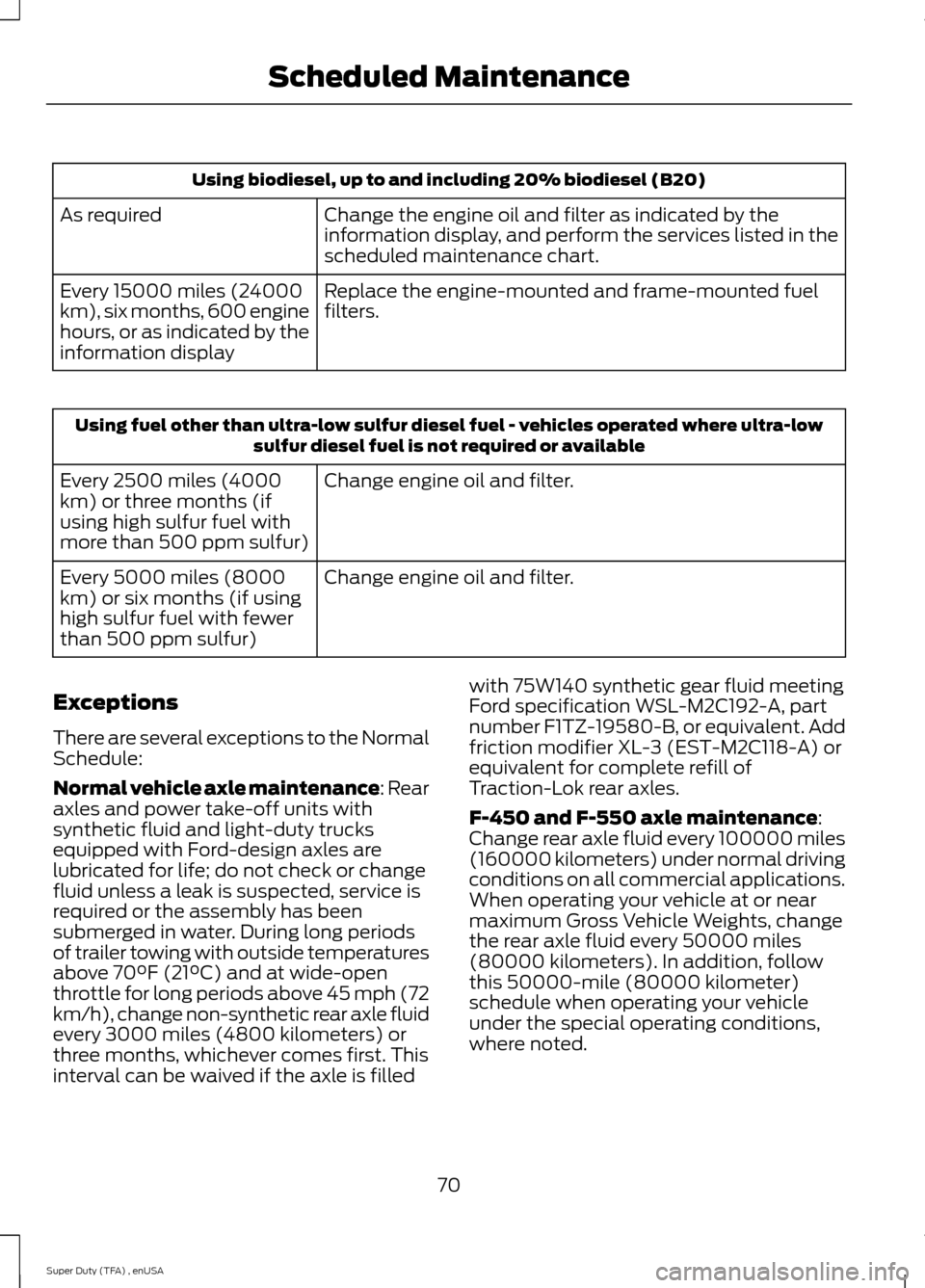
Using biodiesel, up to and including 20% biodiesel (B20)
Change the engine oil and filter as indicated by the
information display, and perform the services listed in the
scheduled maintenance chart.
As required
Replace the engine-mounted and frame-mounted fuel
filters.
Every 15000 miles (24000
km), six months, 600 engine
hours, or as indicated by the
information display Using fuel other than ultra-low sulfur diesel fuel - vehicles operated where ultra-low
sulfur diesel fuel is not required or available
Change engine oil and filter.
Every 2500 miles (4000
km) or three months (if
using high sulfur fuel with
more than 500 ppm sulfur)
Change engine oil and filter.
Every 5000 miles (8000
km) or six months (if using
high sulfur fuel with fewer
than 500 ppm sulfur)
Exceptions
There are several exceptions to the Normal
Schedule:
Normal vehicle axle maintenance: Rear
axles and power take-off units with
synthetic fluid and light-duty trucks
equipped with Ford-design axles are
lubricated for life; do not check or change
fluid unless a leak is suspected, service is
required or the assembly has been
submerged in water. During long periods
of trailer towing with outside temperatures
above 70°F (21°C) and at wide-open
throttle for long periods above 45 mph (72
km/h), change non-synthetic rear axle fluid
every 3000 miles (4800 kilometers) or
three months, whichever comes first. This
interval can be waived if the axle is filled with 75W140 synthetic gear fluid meeting
Ford specification WSL-M2C192-A, part
number F1TZ-19580-B, or equivalent. Add
friction modifier XL-3 (EST-M2C118-A) or
equivalent for complete refill of
Traction-Lok rear axles.
F-450 and F-550 axle maintenance:
Change rear axle fluid every 100000 miles
(160000 kilometers) under normal driving
conditions on all commercial applications.
When operating your vehicle at or near
maximum Gross Vehicle Weights, change
the rear axle fluid every 50000 miles
(80000 kilometers). In addition, follow
this 50000-mile (80000 kilometer)
schedule when operating your vehicle
under the special operating conditions,
where noted.
70
Super Duty (TFA) , enUSA Scheduled Maintenance