2015 FORD SUPER DUTY fuel additives
[x] Cancel search: fuel additivesPage 6 of 84
ABOUT THIS SUPPLEMENT
This supplement will acquaint you with the
Power Stroke diesel engine. It provides
recommendations on engine care and
operating procedures. For complete vehicle
information, also refer to your Owner
’s
Manual included with the vehicle. It also
describes equipment and gives
specifications for equipment that was in
effect when this guide was approved for
printing, and should be considered a
permanent part of the vehicle.
Note: Your vehicle ’s powertrain control
systems can detect and store information
about vehicle modifications that increase
horsepower and torque output such as
whether or not performance-enhancing
powertrain components commonly referred
to as performance chips have been used.
This information will stay in the system ’s
memory cannot be erased even if the
modification is removed. Ford Motor
Company, Ford of Canada, Ford of Mexico
and service or repair facilities can retrieve
this information when servicing your vehicle.
Ford Motor Company may use this
information to determine if your warranty
covers any needed repairs.
Note: Some aftermarket products may
cause severe engine/transmission and/or
exhaust system damage; refer to your
warranty information for more information.
Your new diesel engine will feel, drive and
function somewhat differently than a
gasoline engine. Therefore it is very
important that you read and thoroughly
familiarize yourself and others operating
the vehicle with this guide. A special
procedure for turning off the diesel engine
is in the Starting and Stopping the Engine
chapter, See Starting a Diesel Engine
(page 10). It is important to read and
understand this material in order to
maintain the best service life for your
engine. Ford may discontinue models or change
specifications without any notice and
without incurring obligations.
Warnings WARNING
Throughout this guide, you will find
warnings identified by the warning
symbol. Warnings remind you to be
especially careful to reduce the risk of
personal injury. Breaking-In Your Vehicle
Your vehicle does not need an extensive
break-in. Try not to drive continuously at
the same speed for the first 1000 miles
(1600 kilometers) of new vehicle
operation. Vary your speed to allow parts
to adjust themselves to other parts.
Drive your new vehicle at least 500 miles
(800 kilometers) before towing a trailer.
Make sure you use the specified engine oil.
See Technical Specifications (page 57).
Do not add friction modifier compounds
or special break-in oils during the first few
thousand miles (kilometers) of operation,
since these additives may prevent piston
ring seating. See Engine Oil Check (page
43
).
Diesel Engine Information
The diesel engine fuel system is a
pressurized two-stage filtration system
and consists of:
• A frame-mounted Fuel and Water
Separator primary filter with an electric
fuel pump and water drain
• An engine-mounted secondary fuel
filter
• A fuel injector for each cylinder (8
total)
• A high-pressure fuel pump
3
Super Duty (TFA) , enUSA Introduction
Page 8 of 84
The powertrain and glow plug control
modules electronically control the glow
plug system. After you switch the ignition
on the glow plug control module
immediately energizes the glow plugs. The
glow plug control module using the engine
coolant temperature, barometric pressure
sensor and environmental temperature
sensor will determine how long the glow
plugs stay energized. The required time for
the glow plugs to be energized decreases
as the coolant temperature, barometric
pressure and environmental temperature
increase.
Glow Plug
Engine and secondary cooling system
The cooling system contains a primary
cooling loop to cool the engine and a
secondary cooling loop to cool the
transmission, charge air, and fuel. The
coolant serves three primary purposes: to
provide heat transfer, freeze point
protection, and corrosion protection using
additives.
Vehicles with diesel engines typically are
used to carry heavy loads and accumulate
mileage rapidly. These two factors may
cause the additives in the coolant to wear
out in a shorter time. For more information
about coolant additives and coolant
change intervals See Engine Coolant
Check (page 45). . Operating the engine
with insufficient coolant or coolant additive
can cause severe engine damage
Diesel Particulate Filter system
Your vehicle is equipped with a diesel
particulate filter in the exhaust system. The
diesel particulate filter reduces carbon
emissions by trapping exhaust particulates
(soot) before they reach the tailpipe. You
must properly maintain your diesel
particulate filter in order for it to function properly. Regeneration of the diesel
particulate filter occurs automatically
during operation above 30 mph (48 km/h)
and requires no actions from the driver. If
you do a lot of idling or stop and go driving,
pay attention to maintenance messages
that alert you when you need to drive to
clean the diesel particulate filter, or
perform operator commanded
regeneration. See
Emission Control
System (page 30).
Selective catalytic reduction system
Your vehicle is equipped with a selective
catalytic reduction system designed to
reduce emission levels of nitrogen oxides
from the exhaust of your diesel engine. This
system relies on the use of Diesel Exhaust
Fluid (DEF) that you must replenish at
certain intervals. Failure to maintain proper
DEF levels or if the DEF becomes
contaminated will result in vehicle speed
limitations or result in your vehicle entering
an idle-only mode. See
Selective
Catalytic Reduction System (page 21).
Speed control
If your vehicle speed goes outside a
predetermined range from the set speed,
the RSM (Resume) function will not reset
your vehicle speed. You will need to reset
your vehicle speed with the SET+ or SET-
button after reaching the desired speed
using the accelerator pedal.
Minor Troubleshooting Guide
If the engine won ’t crank WARNING
Battery posts, terminals and related
accessories contain lead and lead
compounds. Wash hands after
handling. 5
Super Duty (TFA) , enUSA Introduction
Page 14 of 84
2.
When the glow plug pre-heat indicator
turns off, turn the key to start and
release the key as soon as the engine
starts. After starting the engine, the
glow plugs may remain on for a period.
If you do not start the engine before
the glow plug activation time ends, you
will need to reset the glow plugs by
turning the key to off.
3. After the engine starts, allow it to idle for about 15 seconds. This is to protect
the engine. Do not increase engine
speed until the oil pressure gauge
indicates normal pressure.
Cold Weather Operation
Note: Idling in cold weather does not heat
the engine to its normal operating
temperature. Long periods of idling,
especially in cold weather, can cause a
buildup of deposits which can cause engine
damage.
Changing to a lighter grade engine oil also
makes starting easier under these
conditions. Refer to Engine oil
specifications. See Technical
Specifications (page 57).
Diesel fuel is adjusted seasonally for cold
temperatures. Diesel fuel which has not
been properly formulated for the ambient
conditions may gel which can clog the fuel
filters. One indication that the fuel filter(s)
may be clogged is if the engine starts, stalls
after a short time, and then does not
restart. If you have been using biodiesel,
you may need to use a fuel with lower
biodiesel content, try another brand, or
discontinue using biodiesel. Do not use
alcohol based additives to correct fuel
gelling. This may result in damage to the
fuel injectors and system. Use the proper
anti-gel and performance improvement
product. See
Technical Specifications
(page 57). Your vehicle is equipped with a fuel and
water separator that recirculates fuel from
the engine to help prevent fuel filter
clogging. To avoid engine fuel starvation
during cold weather operation of 32°F
(0°C) or below, we recommended that
the fuel level in your tank should not drop
below 1⁄4 full. This helps prevent air from
entering the fuel system and stalling the
engine.
Your vehicle is equipped with a selective
catalyst reduction system that uses Diesel
Exhaust Fluid (DEF) to operate properly.
You need to replenish your vehicle
’s DEF
at certain intervals. When filling your
vehicle ’s DEF tank in cold weather, you
must take special care to prevent damage
to the tank. See
Selective Catalytic
Reduction System (page 21).
In cold weather below 32°F (0°C), the
engine may slowly increase to a higher idle
speed if left idling in P (Park). As the engine
warms-up, the engine sound level
decreases due to the activation of
PCM-controlled sound reduction features.
If you operate your vehicle in a heavy
snowstorm or blowing snow conditions,
snow and ice can clog the engine air
induction. If this occurs, the engine may
experience a significant reduction in power
output. At the earliest opportunity, clear
all the snow and/or ice away from inside
the air filter assembly. Remove the air
cleaner cover and the pleated paper filter,
leaving the foam filter in and remove any
snow or ice. Make sure you install the foam
filter correctly in place. Remove any debris,
snow or ice on the foam filter by brushing
the surface with soft brush. Once you have
cleared all of the debris, reinstall the air
filter and assembly.
Do not use water, solvents, or a hard brush
for cleaning the foam filter.
11
Super Duty (TFA) , enUSA Starting and Stopping the Engine
Page 20 of 84
Look for a label on the fuel pump to
confirm the amount of biodiesel contained
in a diesel fuel. Biodiesel content is often
indicated with the letter B followed by the
percent of biodiesel in the fuel. For
example, B20 indicates a fuel containing
20% biodiesel. Ask the service station
attendant to confirm the biodiesel content
of a diesel fuel if you do not see a label on
the fuel pump.
Biodiesel fuels degrade more easily than
diesel fuels not containing biodiesel and
should not be stored in the fuel tank for
more than 1 month. If you plan to park or
store your vehicle for more than 1 month,
then you should empty your vehicle fuel
tank of biodiesel fuel. You should fill the
tank with a pure petroleum-based diesel
fuel and run your vehicle for a minimum of
30 minutes.
Note:
Degraded or oxidized biodiesel can
damage fuel system seals and plastics and
corrode steel parts.
During cold weather, if you have problems
operating on biodiesel, you may need to
use a diesel fuel with lower biodiesel
content, try another brand, or discontinue
the use of biodiesel.
Diesel Fuel Additives
It should not be necessary to add any
aftermarket additives to your fuel if you
use a high quality diesel fuel that conforms
to ASTM industry specifications.
Aftermarket additives can damage the fuel
injector system or engine.
Use Motorcraft® cetane booster or an
equivalent cetane booster additive if you
suspect fuel has low cetane. Use
Motorcraft® anti-gel & performance
improver or an equivalent additive if there
is fuel gelling. Do not use alcohol-based additives to
improve cetane quality, to prevent fuel
gelling or any other use. The use of alcohol
additives may result in damage to the fuel
injectors and system. See Technical
Specifications (page 57).
Your warranty may not cover repairs
needed to correct the effects of using an
aftermarket product that does not meet
Ford specifications in your fuel.
Note: Ultra Low Sulfur Diesel fuel is
designed to meet the emissions standards
for the 6.7L engine and is backward
compatible as well (for example, it can be
used in the 7.3L, 6.9L, 6.4L and 6.0L diesel
engines in Ford vehicles.
Fuel And Water Separator
Your vehicle is equipped with a diesel fuel
conditioner module located on the
frame-rail under the driver-side floorboard
near the transmission. You should drain water from the
module assembly whenever the
warning light comes on and the
message center directs you to drain the
water separator. This will occur when
approximately 0.32 pints (150 ml) of water
accumulates in the module. If you allow
the water level to exceed this level, the
water may pass through to the engine and
may cause fuel injection equipment
damage.
Draining the Diesel Fuel Conditioner
Module (DFCM) WARNING
Your vehicle must be stopped with
the engine off when draining the
Diesel Fuel Conditioner Module. Fuel
may ignite if the separator is drained while
the engine is running or vehicle is moving. 17
Super Duty (TFA) , enUSA Fuel and Refueling
Page 21 of 84
Note:
If you drain the diesel fuel conditioner
module while the system is running air will
enter into the fuel system. The engine will
not operate properly if air enters the system.
Note: With fuel tank levels above 3⁄4 tank
it may be necessary to loosen the bowl 3
turns before opening the drain. This will
actuate an anti-siphon valve at the fuel and
water separator inlet and prevent the fuel
from siphoning out of the tank.
Note: A loose drain valve can allow air to
enter the fuel system and cause drivetrain
issues. The engine will not operate properly.
Be sure that you fully tighten the drain valve.
1. Stop your vehicle and shut off the engine.
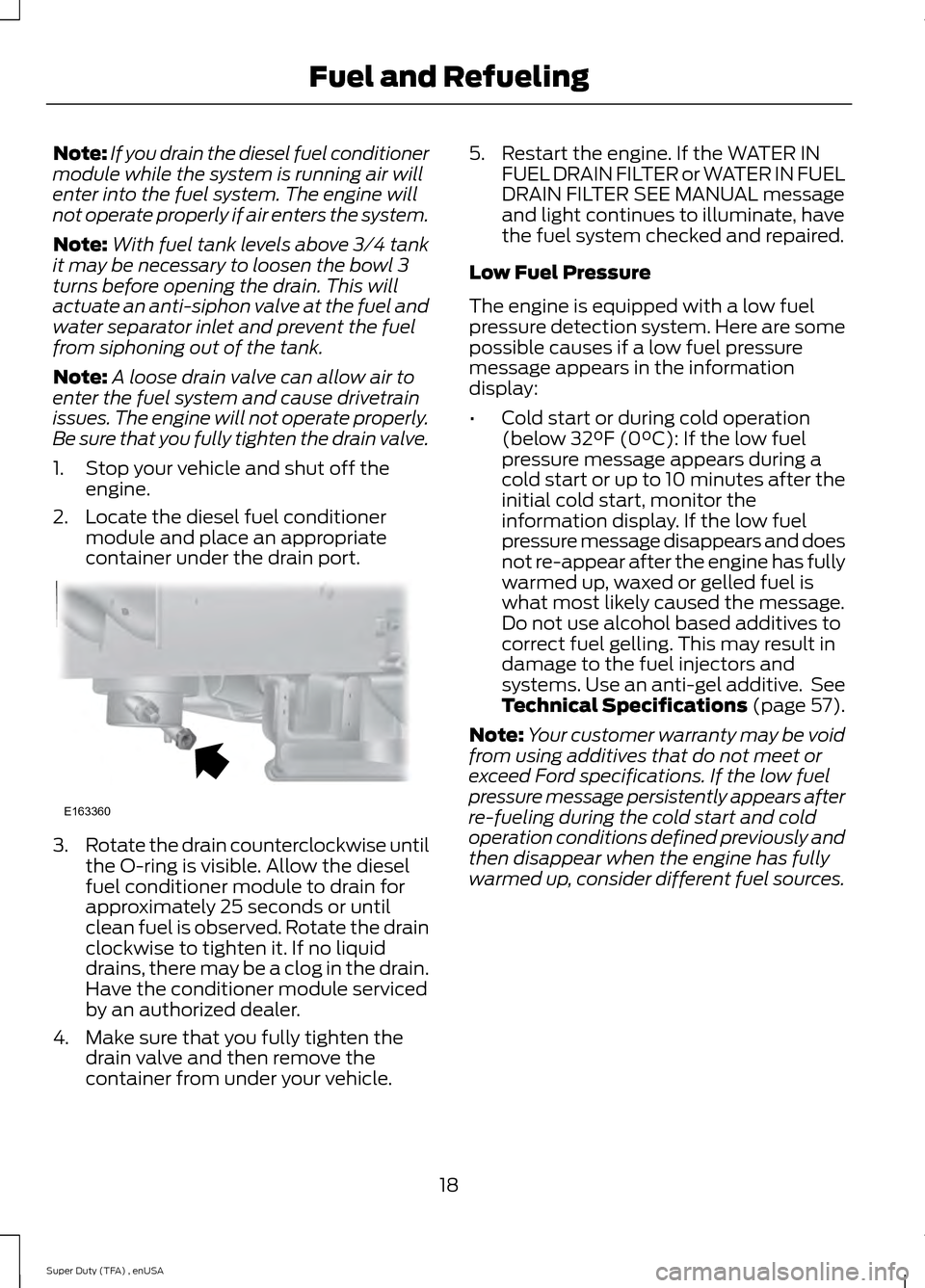
2. Locate the diesel fuel conditioner module and place an appropriate
container under the drain port. 3.
Rotate the drain counterclockwise until
the O-ring is visible. Allow the diesel
fuel conditioner module to drain for
approximately 25 seconds or until
clean fuel is observed. Rotate the drain
clockwise to tighten it. If no liquid
drains, there may be a clog in the drain.
Have the conditioner module serviced
by an authorized dealer.
4. Make sure that you fully tighten the drain valve and then remove the
container from under your vehicle. 5. Restart the engine. If the WATER IN
FUEL DRAIN FILTER or WATER IN FUEL
DRAIN FILTER SEE MANUAL message
and light continues to illuminate, have
the fuel system checked and repaired.
Low Fuel Pressure
The engine is equipped with a low fuel
pressure detection system. Here are some
possible causes if a low fuel pressure
message appears in the information
display:
• Cold start or during cold operation
(below 32°F (0°C): If the low fuel
pressure message appears during a
cold start or up to 10 minutes after the
initial cold start, monitor the
information display. If the low fuel
pressure message disappears and does
not re-appear after the engine has fully
warmed up, waxed or gelled fuel is
what most likely caused the message.
Do not use alcohol based additives to
correct fuel gelling. This may result in
damage to the fuel injectors and
systems. Use an anti-gel additive. See
Technical Specifications (page 57).
Note: Your customer warranty may be void
from using additives that do not meet or
exceed Ford specifications. If the low fuel
pressure message persistently appears after
re-fueling during the cold start and cold
operation conditions defined previously and
then disappear when the engine has fully
warmed up, consider different fuel sources.
18
Super Duty (TFA) , enUSA Fuel and RefuelingE163360
Page 63 of 84
Ford Motor Company has recommended
maintenance intervals for various parts
and component systems based upon
engineering testing. Ford Motor Company
relies upon this testing to determine the
most appropriate mileage for replacement
of oils and fluids to protect your vehicle at
the lowest overall cost to you and
recommends against maintenance
schedules that deviate from the scheduled
maintenance information.
We strongly recommend the use of only
genuine Ford, Motorcraft or
Ford-authorized re-manufactured
replacement parts engineered for your
vehicle.
Additives and Chemicals
This owner's manual and the Ford
Workshop Manual list the recommended
additives and chemicals for your vehicle.
We do not recommend using chemicals or
additives not approved by us as part of
your vehicle
’s normal maintenance. Please
consult your warranty information. Oils, Fluids and Flushing
In many cases, fluid discoloration is a
normal operating characteristic and, by
itself, does not necessarily indicate a
concern or that the fluid needs to be
changed. However, a qualified expert, such
as the factory-trained technicians at your
dealership, should inspect discolored fluids
that also show signs of overheating or
foreign material contamination
immediately.
Make sure to change your vehicle
’s oils and
fluids at the specified intervals or in
conjunction with a repair. Flushing is a
viable way to change fluid for many vehicle
sub-systems during scheduled
maintenance. It is critical that systems are
flushed only with new fluid that is the same
as that required to fill and operate the
system or using a Ford-approved flushing
chemical.
Owner Checks and Services
Make sure you perform the following basic
maintenance checks and inspections every
month or at six-month intervals. Check every month
Air filter restriction gauge.
Fuel and water separator. Drain if necessary (or if indicated by the information display). Tires (including spare) for wear and proper pressure.
Holes and slots in the tail pipe to make sure they are functional and clear of debris.
60
Super Duty (TFA) , enUSA Scheduled Maintenance
Page 82 of 84
A
About This Supplement.................................3
Breaking-In Your Vehicle...................................... 3
Diesel Engine Information................................... 3
Minor Troubleshooting Guide............................. 5
Warnings.................................................................... 3
ABS See: Brakes.............................................................. 37
B
Brakes
..................................................................37
General Information............................................ 37
C
Capacities and Specifications
..................55
Technical Specifications.................................... 57
Changing the Engine Air Filter...................50 Air Filter Replacement......................................... 51
Air Filter Restriction Gauge............................... 50
Cleaning the Engine......................................54
Cleaning the Exhaust...................................54
Coolant Check See: Engine Coolant Check.............................. 45
E
Emission Control System
...........................30
Diesel Exhaust System: Oxidation Catalyst
And Diesel Particulate Filter System
........................................................................\
........ 30
Engine Block Heater
.......................................14
Rapid Heat Supplemental Heating
System................................................................. 14
Engine Coolant Check..................................45 Adding Engine Coolant...................................... 45
Checking Coolant Corrosion Inhibitor Additive Strength ........................................... 48
Checking the Engine Coolant.......................... 45
Coolant Change................................................... 50
Engine and Secondary Cooling System Refill Procedure................................................ 47
Engine-driven Cooling Fan (Fan Clutch)................................................................ 50
Recycled Engine Coolant.................................. 48
Severe Climates................................................... 48Engine Idle Shutdown
...................................13
Engine Oil Check.............................................43 Changing the Engine Oil and Oil Filter.........44
Engine Oil Specifications.................................. 43
Engine Specifications
...................................55
Drivebelt Routing.................................................. 55
F
Fuel and Refueling
..........................................15
Fuel Quality.......................................................15
Biodiesel................................................................... 16
Diesel Fuel Additives ........................................... 17
Fuel And Water Separator ................................. 17
Fuel Requirements - Choosing The Right Fuel: Vehicles Operated Where Ultra Low
Sulfur Diesel Fuel Is Not Required ............15
Fuel Requirements - Choosing The Right Fuel: Vehicles Operated Where Ultra Low
Sulfur Diesel Fuel Is Required (United
States/Canada/Puerto Rico/U.S. Virgin
Islands And Other Locales) ......................... 15
Fuel Shutoff.....................................................39 Running Out Of DEF (Diesel Exhaust
Fluid).................................................................... 39
Fuel Tank Selector Switch..........................36
G
Gauges..................................................................8 Engine Boost Gauge.............................................. 8
General Maintenance Information
..........59
Multi-point Inspection......................................... 61
Owner Checks and Services............................ 60
Protecting Your Investment............................. 59
Why Maintain Your Vehicle?............................ 59
Why Maintain Your Vehicle at Your Dealership?....................................................... 59
I
Instrument Cluster...........................................8
Introduction........................................................3
79
Super Duty (TFA) , enUSA Index