2015 FORD SUPER DUTY transmission
[x] Cancel search: transmissionPage 6 of 84
ABOUT THIS SUPPLEMENT
This supplement will acquaint you with the
Power Stroke diesel engine. It provides
recommendations on engine care and
operating procedures. For complete vehicle
information, also refer to your Owner
’s
Manual included with the vehicle. It also
describes equipment and gives
specifications for equipment that was in
effect when this guide was approved for
printing, and should be considered a
permanent part of the vehicle.
Note: Your vehicle ’s powertrain control
systems can detect and store information
about vehicle modifications that increase
horsepower and torque output such as
whether or not performance-enhancing
powertrain components commonly referred
to as performance chips have been used.
This information will stay in the system ’s
memory cannot be erased even if the
modification is removed. Ford Motor
Company, Ford of Canada, Ford of Mexico
and service or repair facilities can retrieve
this information when servicing your vehicle.
Ford Motor Company may use this
information to determine if your warranty
covers any needed repairs.
Note: Some aftermarket products may
cause severe engine/transmission and/or
exhaust system damage; refer to your
warranty information for more information.
Your new diesel engine will feel, drive and
function somewhat differently than a
gasoline engine. Therefore it is very
important that you read and thoroughly
familiarize yourself and others operating
the vehicle with this guide. A special
procedure for turning off the diesel engine
is in the Starting and Stopping the Engine
chapter, See Starting a Diesel Engine
(page 10). It is important to read and
understand this material in order to
maintain the best service life for your
engine. Ford may discontinue models or change
specifications without any notice and
without incurring obligations.
Warnings WARNING
Throughout this guide, you will find
warnings identified by the warning
symbol. Warnings remind you to be
especially careful to reduce the risk of
personal injury. Breaking-In Your Vehicle
Your vehicle does not need an extensive
break-in. Try not to drive continuously at
the same speed for the first 1000 miles
(1600 kilometers) of new vehicle
operation. Vary your speed to allow parts
to adjust themselves to other parts.
Drive your new vehicle at least 500 miles
(800 kilometers) before towing a trailer.
Make sure you use the specified engine oil.
See Technical Specifications (page 57).
Do not add friction modifier compounds
or special break-in oils during the first few
thousand miles (kilometers) of operation,
since these additives may prevent piston
ring seating. See Engine Oil Check (page
43
).
Diesel Engine Information
The diesel engine fuel system is a
pressurized two-stage filtration system
and consists of:
• A frame-mounted Fuel and Water
Separator primary filter with an electric
fuel pump and water drain
• An engine-mounted secondary fuel
filter
• A fuel injector for each cylinder (8
total)
• A high-pressure fuel pump
3
Super Duty (TFA) , enUSA Introduction
Page 8 of 84
The powertrain and glow plug control
modules electronically control the glow
plug system. After you switch the ignition
on the glow plug control module
immediately energizes the glow plugs. The
glow plug control module using the engine
coolant temperature, barometric pressure
sensor and environmental temperature
sensor will determine how long the glow
plugs stay energized. The required time for
the glow plugs to be energized decreases
as the coolant temperature, barometric
pressure and environmental temperature
increase.
Glow Plug
Engine and secondary cooling system
The cooling system contains a primary
cooling loop to cool the engine and a
secondary cooling loop to cool the
transmission, charge air, and fuel. The
coolant serves three primary purposes: to
provide heat transfer, freeze point
protection, and corrosion protection using
additives.
Vehicles with diesel engines typically are
used to carry heavy loads and accumulate
mileage rapidly. These two factors may
cause the additives in the coolant to wear
out in a shorter time. For more information
about coolant additives and coolant
change intervals See Engine Coolant
Check (page 45). . Operating the engine
with insufficient coolant or coolant additive
can cause severe engine damage
Diesel Particulate Filter system
Your vehicle is equipped with a diesel
particulate filter in the exhaust system. The
diesel particulate filter reduces carbon
emissions by trapping exhaust particulates
(soot) before they reach the tailpipe. You
must properly maintain your diesel
particulate filter in order for it to function properly. Regeneration of the diesel
particulate filter occurs automatically
during operation above 30 mph (48 km/h)
and requires no actions from the driver. If
you do a lot of idling or stop and go driving,
pay attention to maintenance messages
that alert you when you need to drive to
clean the diesel particulate filter, or
perform operator commanded
regeneration. See
Emission Control
System (page 30).
Selective catalytic reduction system
Your vehicle is equipped with a selective
catalytic reduction system designed to
reduce emission levels of nitrogen oxides
from the exhaust of your diesel engine. This
system relies on the use of Diesel Exhaust
Fluid (DEF) that you must replenish at
certain intervals. Failure to maintain proper
DEF levels or if the DEF becomes
contaminated will result in vehicle speed
limitations or result in your vehicle entering
an idle-only mode. See
Selective
Catalytic Reduction System (page 21).
Speed control
If your vehicle speed goes outside a
predetermined range from the set speed,
the RSM (Resume) function will not reset
your vehicle speed. You will need to reset
your vehicle speed with the SET+ or SET-
button after reaching the desired speed
using the accelerator pedal.
Minor Troubleshooting Guide
If the engine won ’t crank WARNING
Battery posts, terminals and related
accessories contain lead and lead
compounds. Wash hands after
handling. 5
Super Duty (TFA) , enUSA Introduction
Page 20 of 84
Look for a label on the fuel pump to
confirm the amount of biodiesel contained
in a diesel fuel. Biodiesel content is often
indicated with the letter B followed by the
percent of biodiesel in the fuel. For
example, B20 indicates a fuel containing
20% biodiesel. Ask the service station
attendant to confirm the biodiesel content
of a diesel fuel if you do not see a label on
the fuel pump.
Biodiesel fuels degrade more easily than
diesel fuels not containing biodiesel and
should not be stored in the fuel tank for
more than 1 month. If you plan to park or
store your vehicle for more than 1 month,
then you should empty your vehicle fuel
tank of biodiesel fuel. You should fill the
tank with a pure petroleum-based diesel
fuel and run your vehicle for a minimum of
30 minutes.
Note:
Degraded or oxidized biodiesel can
damage fuel system seals and plastics and
corrode steel parts.
During cold weather, if you have problems
operating on biodiesel, you may need to
use a diesel fuel with lower biodiesel
content, try another brand, or discontinue
the use of biodiesel.
Diesel Fuel Additives
It should not be necessary to add any
aftermarket additives to your fuel if you
use a high quality diesel fuel that conforms
to ASTM industry specifications.
Aftermarket additives can damage the fuel
injector system or engine.
Use Motorcraft® cetane booster or an
equivalent cetane booster additive if you
suspect fuel has low cetane. Use
Motorcraft® anti-gel & performance
improver or an equivalent additive if there
is fuel gelling. Do not use alcohol-based additives to
improve cetane quality, to prevent fuel
gelling or any other use. The use of alcohol
additives may result in damage to the fuel
injectors and system. See Technical
Specifications (page 57).
Your warranty may not cover repairs
needed to correct the effects of using an
aftermarket product that does not meet
Ford specifications in your fuel.
Note: Ultra Low Sulfur Diesel fuel is
designed to meet the emissions standards
for the 6.7L engine and is backward
compatible as well (for example, it can be
used in the 7.3L, 6.9L, 6.4L and 6.0L diesel
engines in Ford vehicles.
Fuel And Water Separator
Your vehicle is equipped with a diesel fuel
conditioner module located on the
frame-rail under the driver-side floorboard
near the transmission. You should drain water from the
module assembly whenever the
warning light comes on and the
message center directs you to drain the
water separator. This will occur when
approximately 0.32 pints (150 ml) of water
accumulates in the module. If you allow
the water level to exceed this level, the
water may pass through to the engine and
may cause fuel injection equipment
damage.
Draining the Diesel Fuel Conditioner
Module (DFCM) WARNING
Your vehicle must be stopped with
the engine off when draining the
Diesel Fuel Conditioner Module. Fuel
may ignite if the separator is drained while
the engine is running or vehicle is moving. 17
Super Duty (TFA) , enUSA Fuel and Refueling
Page 22 of 84
•
Low fuel operation: If the low fuel
pressure message appears when your
vehicle is warm and during low fuel
tank level operation (near empty),
refuel your vehicle. If the message
reappears after fueling, see below. If
the message does not come back, the
low fuel pressure condition was due to
low fuel levels in the fuel tank.
• Normal operation: If the low fuel
pressure message appears during
normal operation when the engine is
fully warm, and fuel level is not low,
you must change the fuel filters
regardless of the maintenance
schedule interval.
• If replacement of the fuel filter does
not remedy the low fuel pressure
message during normal operation as
defined above, take the vehicle to an
authorized dealer.
Changing the Engine-Mounted and
Diesel Fuel Conditioner Module Fuel
Filters
Your vehicle is equipped with two fuel
filters. The first filter mounts on top of the
engine on the driver ’s side. The second
filter, inside the diesel fuel conditioner
module, is mounted on the frame rail under
the driver ’s side floorboard near the
transmission. You should replace both
filters at the same time. Regular fuel filter
changes are an important part of engine
maintenance; failing to keep with the
scheduled maintenance could lead to
engine performance issues and fuel
injection system damage. Refer to the
scheduled maintenance information of this
supplement for more information. See
General Maintenance Information
(page 59). Refer to Motorcraft part numbers in the
Capacities and Specifications chapter for
the fuel filter replacement part number.
See Motorcraft Parts (page 55). This part
number includes filters and seals for both
the engine-mounted and frame-mounted
filters.
Removal - Diesel Fuel Conditioner
Module filter
The diesel fuel conditioner module filter is
located in the lower portion of the housing.
1. Drain the diesel fuel conditioner
module. See Draining the Fuel and
Water Separator earlier in this chapter.
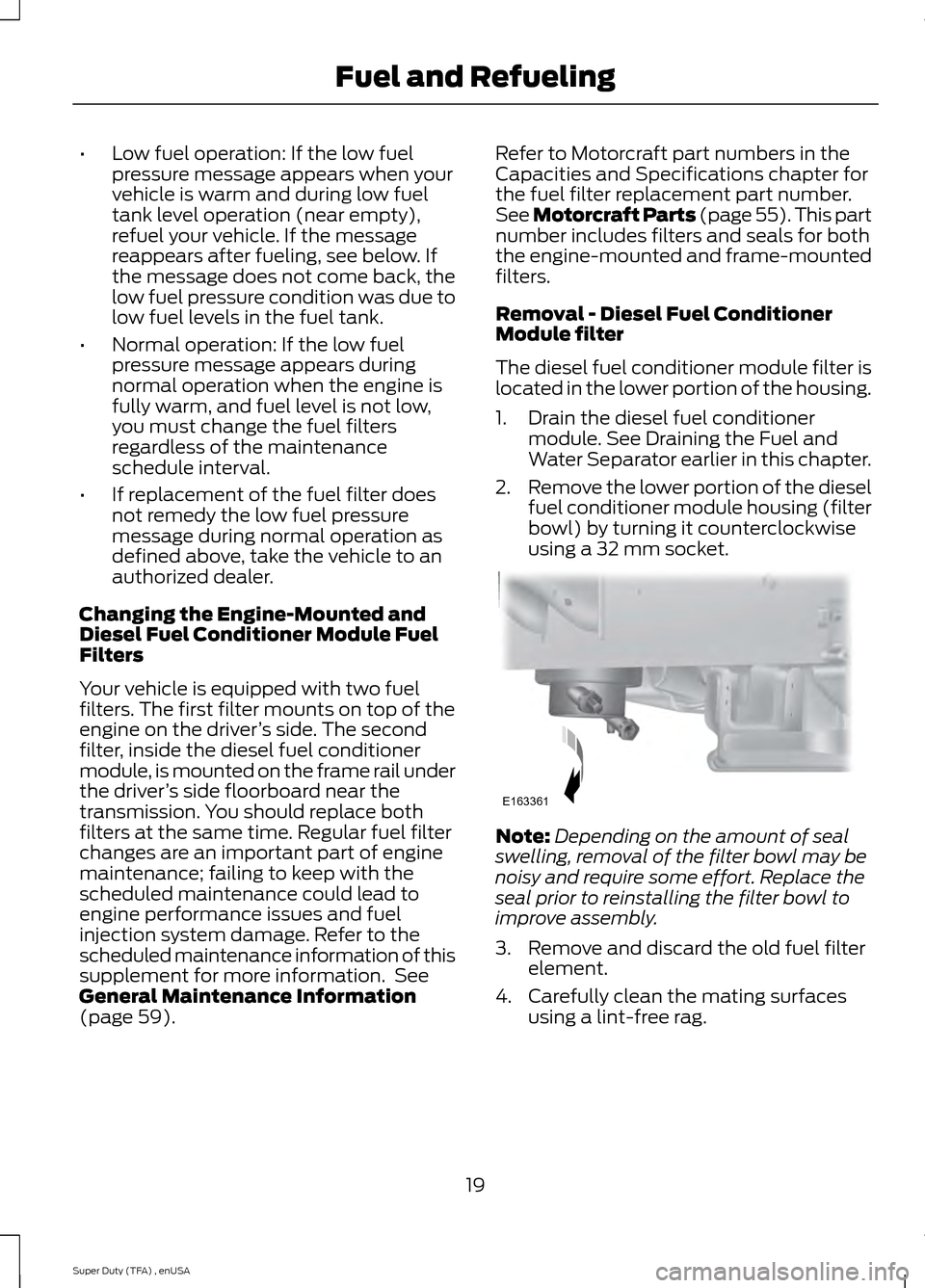
2. Remove the lower portion of the diesel
fuel conditioner module housing (filter
bowl) by turning it counterclockwise
using a 32 mm socket. Note:
Depending on the amount of seal
swelling, removal of the filter bowl may be
noisy and require some effort. Replace the
seal prior to reinstalling the filter bowl to
improve assembly.
3. Remove and discard the old fuel filter element.
4. Carefully clean the mating surfaces using a lint-free rag.
19
Super Duty (TFA) , enUSA Fuel and RefuelingE163361
Page 40 of 84
GENERAL INFORMATION
Diesel Engine Braking
This feature increases engine braking at
higher engine speeds to provide better
grade descent control with less brake and
transmission wear and tear.
Press the button located on the
switch bank next to the audio
unit to switch the system on or
off.
A light will illuminate in the instrument
cluster when this feature is switched on.
You can use this feature with tow/haul to
provide further increased engine braking.
For more information on tow/haul, see
Automatic Transmission operation in your
Owner's Manual.
37
Super Duty (TFA) , enUSA BrakesE171217
Page 42 of 84
FUEL SHUTOFF
In the event of a moderate to severe
collision, this vehicle is equipped with a
fuel pump shut-off feature that stops the
flow of fuel to the engine. Not every impact
will cause a shut-off.
After an accident, if the engine cranks but
does not start, this switch may have been
activated.
This switch is located on the passenger
’s
side of the instrument panel. Open the
front passenger door and remove the small
access panel The switch has a red button on top of it.
To reset the switch:
1. Turn the ignition off.
2. Check the fuel system for leaks. 3. If no leaks are apparent, reset the
switch by pushing in on the reset
button.
4. Turn the ignition on.
5. Wait a few seconds and return the key
to off.
6. Make another check for leaks.
Running Out Of DEF (Diesel
Exhaust Fluid)
If your vehicle runs out of DEF, it will enter
into a speed limited mode and can also
enter into an idle-only mode. Normal
vehicle operation will not resume until DEF
is refilled. See Selective Catalytic
Reduction System (page 21).
Contact roadside assistance for help in
finding a retailer that sells DEF. See the
Customer Assistance chapter in the
Owner ’s Manual for more information.
JUMP STARTING THE VEHICLE WARNINGS
The gases around the battery can
explode if exposed to flames, sparks,
or lit cigarettes. An explosion could
result in personal injury or vehicle damage. Batteries contain sulfuric acid which
can burn skin, eyes and clothing, if
contacted.
Use only an adequate-sized cable
with insulated clamps.
Preparing Your Vehicle
Note:
Do not attempt to push-start your
automatic transmission vehicle. Automatic
transmissions do not have push-start
capability. Attempting to push-start a
vehicle with an automatic transmission may
cause transmission damage.
39
Super Duty (TFA) , enUSA Roadside EmergenciesE163366 E163367
Page 45 of 84
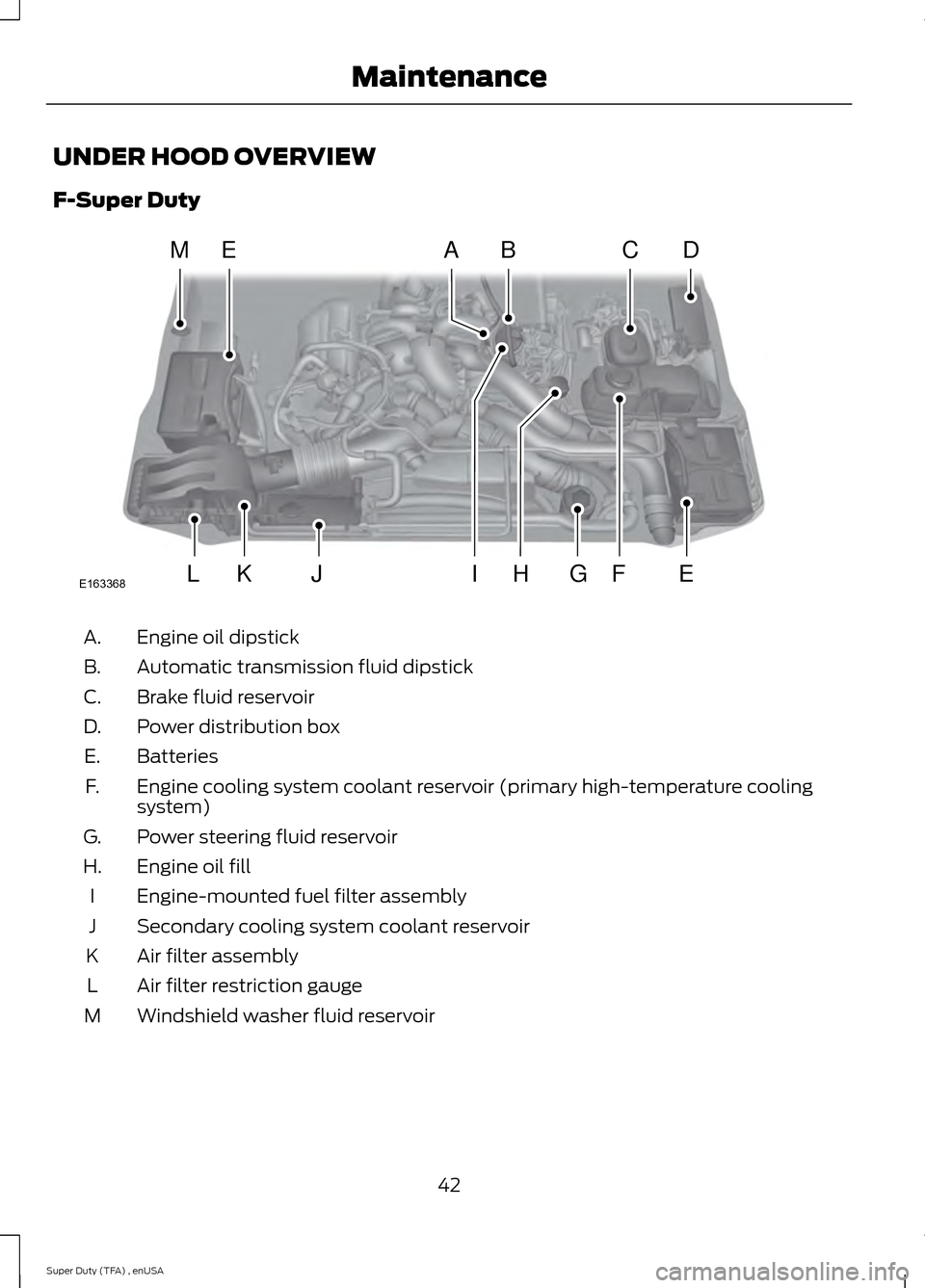
UNDER HOOD OVERVIEW
F-Super Duty
Engine oil dipstick
A.
Automatic transmission fluid dipstick
B.
Brake fluid reservoir
C.
Power distribution box
D.
Batteries
E.
Engine cooling system coolant reservoir (primary high-temperature cooling
system)
F.
Power steering fluid reservoir
G.
Engine oil fill
H.
Engine-mounted fuel filter assembly
I
Secondary cooling system coolant reservoir
J
Air filter assembly
K
Air filter restriction gauge
L
Windshield washer fluid reservoir
M
42
Super Duty (TFA) , enUSA MaintenanceE163368
MEBC
EGJKLF
DA
HI
Page 61 of 84
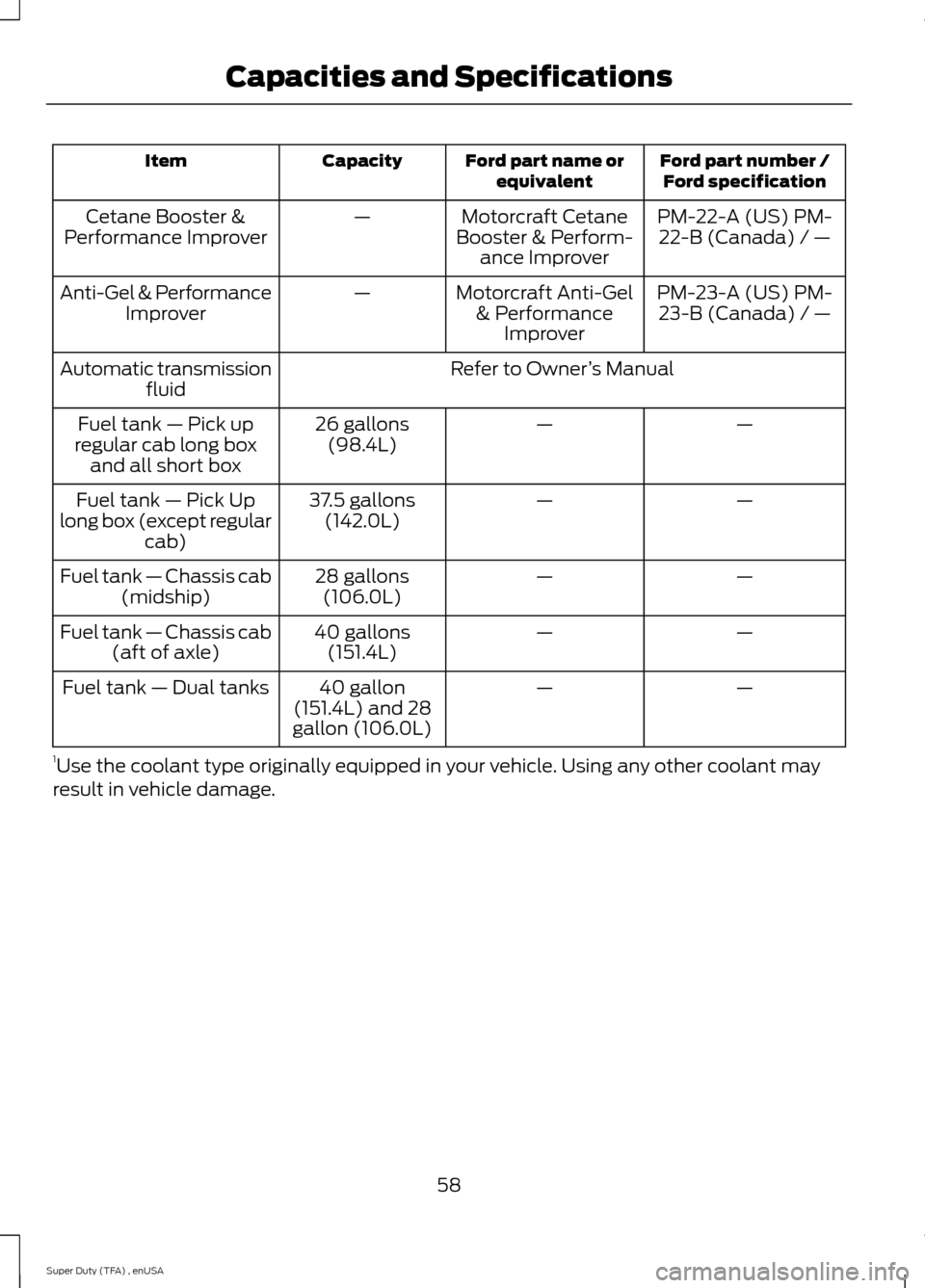
Ford part number /
Ford specification
Ford part name or
equivalent
Capacity
Item
PM-22-A (US) PM-22-B (Canada) / —
Motorcraft Cetane
Booster & Perform- ance Improver
—
Cetane Booster &
Performance Improver
PM-23-A (US) PM-23-B (Canada) / —
Motorcraft Anti-Gel
& Performance Improver
—
Anti-Gel & Performance
Improver
Refer to Owner’s Manual
Automatic transmission
fluid
—
—
26 gallons
(98.4L)
Fuel tank — Pick up
regular cab long box and all short box
—
—
37.5 gallons
(142.0L)
Fuel tank — Pick Up
long box (except regular cab)
—
—
28 gallons
(106.0L)
Fuel tank — Chassis cab
(midship)
—
—
40 gallons
(151.4L)
Fuel tank — Chassis cab
(aft of axle)
—
—
40 gallon
(151.4L) and 28
gallon (106.0L)
Fuel tank — Dual tanks
1 Use the coolant type originally equipped in your vehicle. Using any other coolant may
result in vehicle damage.
58
Super Duty (TFA) , enUSA Capacities and Specifications