2015 FORD SUPER DUTY check engine
[x] Cancel search: check enginePage 24 of 84
Installation – Engine-mounted fuel
filter
1. Install the new filter into the filter
bracket. Turn the filter clockwise to
lock it in place.
2. Reconnect both fuel lines.
Note: Using a fuel that has more than
average impurities may require you to
replace the fuel filter more frequently than
the service interval specifies.
Note: You will need to purge the system of
air after removal or changing of the filter.
See purging air from the fuel system later
in this chapter.
Purging air from the fuel system
Turn the ignition key to on for 30 seconds,
then turn it to off. Do this six times in a row
to purge any trapped air from the fuel
system.
After filter service, a no start or rough
running engine may indicate that air is
entering the system through the filter bowl
seal or drain. Make sure the drain is tight
and you tightened the filter bowl to the
mechanical stop.
SELECTIVE CATALYTIC
REDUCTION SYSTEM
Your vehicle is equipped with a selective
catalytic reduction system to help reduce
emission levels of oxides of nitrogen from
the exhaust of the diesel engine. The
system automatically injects Diesel
Exhaust Fluid (DEF) into the exhaust
system to enable proper selective catalytic
reduction function. Importance of maintaining the
Diesel Exhaust Fluid (DEF) level
In order for the selective catalytic reduction
system to operate properly, the DEF level
must be maintained. Generally, the DEF
tank should be filled during the oil change
service interval. See General
Maintenance Information (page 59).
However, certain conditions or driving
styles, such as trailer towing or fast rates
of acceleration, will require the refilling of
the DEF tank more often.
The engine control unit will monitor the
amount of fluid available in the DEF tank.
Running a system check in the information
display will indicate whether the DEF level
is ok or if it is less than 1/2 full. A message
will display in the information display when
the DEF level is low and needs to be
refilled. When you see this message, you
should refill your tank. See the Information
displays chapter of your Owner ’s Manual
for information display functions. For
instructions on refilling your DEF tank, see
filling the Diesel Exhaust Fluid (DEF) tank
in this supplement.
Diesel Exhaust Fluid (DEF)
warning messages and vehicle
operations WARNINGS
Diesel Exhaust Fluid (DEF) must be
refilled when low or replaced when
contaminated or your vehicle speed
will be speed limited to 50 mph (80 km/h).
In these conditions, drive with caution and
refill DEF immediately. If the DEF becomes
empty or contaminated and fluid is not
replaced, your vehicle will become limited
to idle speed only once stopped. In these
conditions, be cautious where you stop
your vehicle because you may not be able
to drive long distances and will not be able
to maintain highway speeds until you refill
or replace the DEF.
21
Super Duty (TFA) , enUSA Fuel and Refueling
Page 25 of 84
WARNINGS
Tampering or disabling your vehicle
’s
exhaust aftertreatment system will
result in severe vehicle performance
limitation including eventual speed limiting
to 5 mph. Your vehicle
’s information display will
display a series of messages regarding the
amount of DEF available. A systems check
will display messages indicating the
amount of DEF available (OK or under 1⁄2
full) or will produce a warning message
that displays the mileage (kilometers)
remaining as the fluid in the DEF tank nears
empty. For more information on warning
messages, see the Information Displays
chapter of your Owner ’s Manual. As the DEF level nears empty,
the DEF warning symbol will be
displayed and a series of tones
will sound with the messages starting at
500 miles (805 km) remaining before DEF
is depleted. The warning symbol and
messages will continue until you refill the
DEF tank. Continued driving without refilling will
result in the following actions as required
by the California Air Resources Board
(CARB) and the U.S. Environmental
Protection Agency (EPA):
•
Within a certain number of miles
(kilometers) to empty, speed will be
limited upon vehicle restart. Prior to
this occurring a message will appear in
the information display.
• Further vehicle operation without
refilling your DEF tank will cause the
engine to enter an idle-only condition.
This will only occur upon vehicle
refueling or at an extended idle. A
message will indicate the required
actions to resume normal operation. It
is required to add a minimum of 0.5
gallons (1.9L) of DEF to the tank to exit
the idle-only condition, but your vehicle
will still be in the speed-limiting mode
until you refill the tank completely.
For either vehicle speed limiting or idle-only
condition, normal vehicle operation will
resume when you refill the DEF tank.
Note: When filling the DEF tank from
empty, there may be a short delay before
detecting the increased level of fluid. The
increased level detection must occur before
your vehicle returns to full power. Low DEF Warnings and Actions — Instrument Cluster Messages (Optional information
display messages shown, base information display messages similar)
Vehicle Actions
Customer
Requested Actions
Distance/Exhaust
Fluid Level or Action
Cluster Message
None
Drive normally
Full exhaust fluid
tank
Exhaust Fluid Level
OK
None
Drive normally
Exhaust fluid tank
below 1⁄2 full
Exhaust Fluid Under
1⁄2 Full
22
Super Duty (TFA) , enUSA Fuel and RefuelingE163176
Page 34 of 84
Diesel particulate filter maintenance
You must properly maintain your diesel
particulate filter in order for it to function
properly. Do not disregard the EXHAUST
OVERLOADED DRIVE TO CLEAN and
EXHAUST AT LIMIT DRIVE TO CLEAN
NOW
maintenance messages otherwise
system damage could result that your
warranty may not cover.
Failure to perform active or Operator
Commanded Regeneration when
instructed could result in a clogged diesel
particulate filter. If your diesel particulate
filter fills beyond the regeneration
threshold, your vehicle will disable the
ability for active and Operator
Commanded Regeneration. This could
result in irreversible damage to the filter
requiring replacement that your warranty
may not cover. If your vehicle is not
equipped with Operator Commanded
Regeneration, check with your dealer for
availability.
Once the diesel particulate filter is full of
exhaust particles, the engine control
module will command the exhaust system
to clean the filter through a process called
active regeneration. Active regeneration
requires the engine computer to raise the
exhaust temperature to eliminate the
particles. During cleaning, the particles
convert to harmless gasses. Once cleaned
the diesel particulate filter will then be
ready to continue trapping exhaust
particles.
The regeneration process operates more
efficiently when you safely operate your
vehicle at least 30 mph (48 km/h) with a
steady pedal for approximately 20 minutes
to complete the process. The frequency
and duration of regeneration will fluctuate
by how you drive your vehicle, outside air
temperature, and altitude. For most driving,
regeneration frequency will vary from 100 - 500 miles (161 - 805 km) between
occurrences and each occurrence will last
from 9 - 20 minutes. You can usually
reduce the duration of regeneration if you
maintain a constant speed above 30 mph
(48 km/h).
When the engine control module detects
that the diesel particulate filter is nearly
full of particulates and you are not
operating your in a manner to allow
effective automatic cleaning, the
information display will display
EXH
OVERLOADED DRIVE TO CLEAN for
base information display and Exhaust
Overloaded Drive to Clean for the
optional information display. These
messages appear as a reminder for you to
drive in order to clean the diesel particulate
filter. If you operate your vehicle in a
manner to allow effective automatic
cleaning, the information display will
display a cleaning exhaust filter message,
which is the normal regeneration process.
See the Information Displays chapter of
the Owner Guide for more information.
You can also choose Operator
Commanded Regeneration to clean the
exhaust system at this point. See How to
start Operator Commanded Regeneration
later in this chapter.
If you are not able to drive in a manner that
allows effective automatic cleaning (active
regeneration) or you choose to perform
regeneration of the diesel particulate filter
(cleaning) while at idle (stationary), then
Operator Commanded Regeneration
would need to be performed. See Operator
Commanded Regeneration later in this
chapter.
31
Super Duty (TFA) , enUSA Fuel and Refueling
Page 38 of 84
Emission Control System(s) Laws
WARNING
Do not remove or alter the original
equipment floor covering or
insulation between it and the metal
floor of the vehicle. The floor covering and
insulation protect occupants of the vehicle
from the engine and exhaust system heat
and noise. On vehicles with no original
equipment floor covering insulation, do not
carry passengers in a manner that permits
prolonged skin contact with the metal
floor. Provide adequate insulation. Failure
to follow these instructions may result in
fire or personal injury. In the U.S. federal law and certain state
laws prohibit removing or rendering
inoperative emission control system(s).
Similar federal or provincial laws may
apply in Canada. Ford recommends
against any vehicle modification without
determining applicable law.
Tampering with emissions
control systems (including
related sensors and the Diesel
Exhaust Fluid (DEF) injection system) can
result in reduced engine power and the
illumination of the service engine soon
light.
Tampering with a Noise Control
System
Federal law prohibits the following acts or
the causing thereof: (1) The removal or
rendering inoperative by any person other
than for purposes of maintenance, repair
or replacement of any device or element
of design incorporated into any new vehicle
for the purpose of noise control prior to its
sale or delivery to the ultimate purchaser
or while it is in use, or (2) the use of the
vehicle after such device or element of
design has been removed or rendered
inoperative by any person. Among those acts, which the U.S.
Environmental Protection Agency may
presume to constitute tampering are the
acts listed below:
•
Removal of hood blanket, fender apron
absorbers, fender apron barriers,
underbody noise shields or acoustically
absorptive material.
• Tampering or rendering inoperative the
engine speed governor, to allow engine
speed to exceed manufacturer ’s
specifications.
The complexity of the diesel engine makes
it so the owner is discouraged from
attempting to perform maintenance other
than the services described in this
supplement.
If you experience difficult starting the
engine, rough idling, excessive exhaust
smoke, a decrease in engine performance
or excess fuel consumption, perform the
following checks:
• A plugged or disconnected air inlet
system or engine air filter element
• Water in the fuel filter and water
separator
• A clogged fuel filter
• Contaminated fuel
• Air in the fuel system, due to loose
connections
• An open or pinched sensor hose
• Check engine oil level
• Wrong fuel or oil viscosity for climactic
conditions
If these checks do not help you correct the
engine performance problem you are
experiencing, consult an authorized dealer.
35
Super Duty (TFA) , enUSA Fuel and Refueling
Page 42 of 84
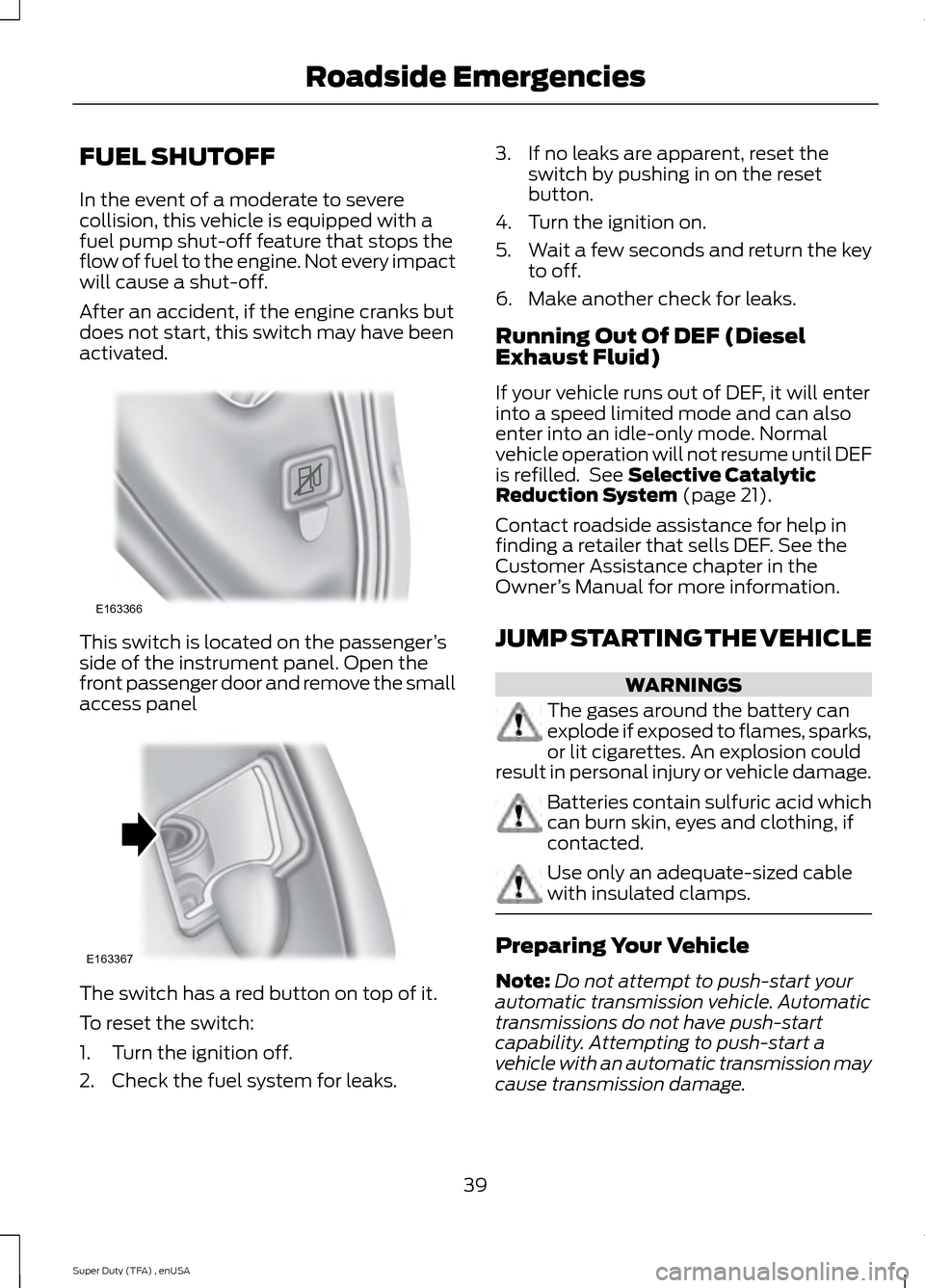
FUEL SHUTOFF
In the event of a moderate to severe
collision, this vehicle is equipped with a
fuel pump shut-off feature that stops the
flow of fuel to the engine. Not every impact
will cause a shut-off.
After an accident, if the engine cranks but
does not start, this switch may have been
activated.
This switch is located on the passenger
’s
side of the instrument panel. Open the
front passenger door and remove the small
access panel The switch has a red button on top of it.
To reset the switch:
1. Turn the ignition off.
2. Check the fuel system for leaks. 3. If no leaks are apparent, reset the
switch by pushing in on the reset
button.
4. Turn the ignition on.
5. Wait a few seconds and return the key
to off.
6. Make another check for leaks.
Running Out Of DEF (Diesel
Exhaust Fluid)
If your vehicle runs out of DEF, it will enter
into a speed limited mode and can also
enter into an idle-only mode. Normal
vehicle operation will not resume until DEF
is refilled. See Selective Catalytic
Reduction System (page 21).
Contact roadside assistance for help in
finding a retailer that sells DEF. See the
Customer Assistance chapter in the
Owner ’s Manual for more information.
JUMP STARTING THE VEHICLE WARNINGS
The gases around the battery can
explode if exposed to flames, sparks,
or lit cigarettes. An explosion could
result in personal injury or vehicle damage. Batteries contain sulfuric acid which
can burn skin, eyes and clothing, if
contacted.
Use only an adequate-sized cable
with insulated clamps.
Preparing Your Vehicle
Note:
Do not attempt to push-start your
automatic transmission vehicle. Automatic
transmissions do not have push-start
capability. Attempting to push-start a
vehicle with an automatic transmission may
cause transmission damage.
39
Super Duty (TFA) , enUSA Roadside EmergenciesE163366 E163367
Page 46 of 84
Scheduled Maintenance
The scheduled maintenance services in
the scheduled maintenance information
of this supplement are required because
they are considered essential to the life
and performance of your vehicle. See
General Maintenance Information
(page 59).
Use only recommended fuel, lubricants,
fluids and service parts conforming to Ford
specifications. Motorcraft® parts are
designed and built for best performance
in your vehicle.
ENGINE OIL CHECK
Because it is normal to add some oil
between oil changes, check your engine oil
level each time you stop for fuel. To check
the engine oil level consistently and
accurately, the following procedure is
recommended:
1. Have engine at normal operating temperature (at least into the NORMAL
range on the engine coolant
temperature gauge).
2. Park the vehicle on a level surface, then
turn off the engine and open the hood.
3. Allow at least 20 minutes after engine
shutdown to ensure that the oil
contained in the upper parts of the
engine has returned to the oil pan.
4. Protecting yourself from engine heat, pull out the dipstick, wipe it clean and
reinsert fully.
5. Read oil level on both sides of dipstick
and use highest level (reading) for the
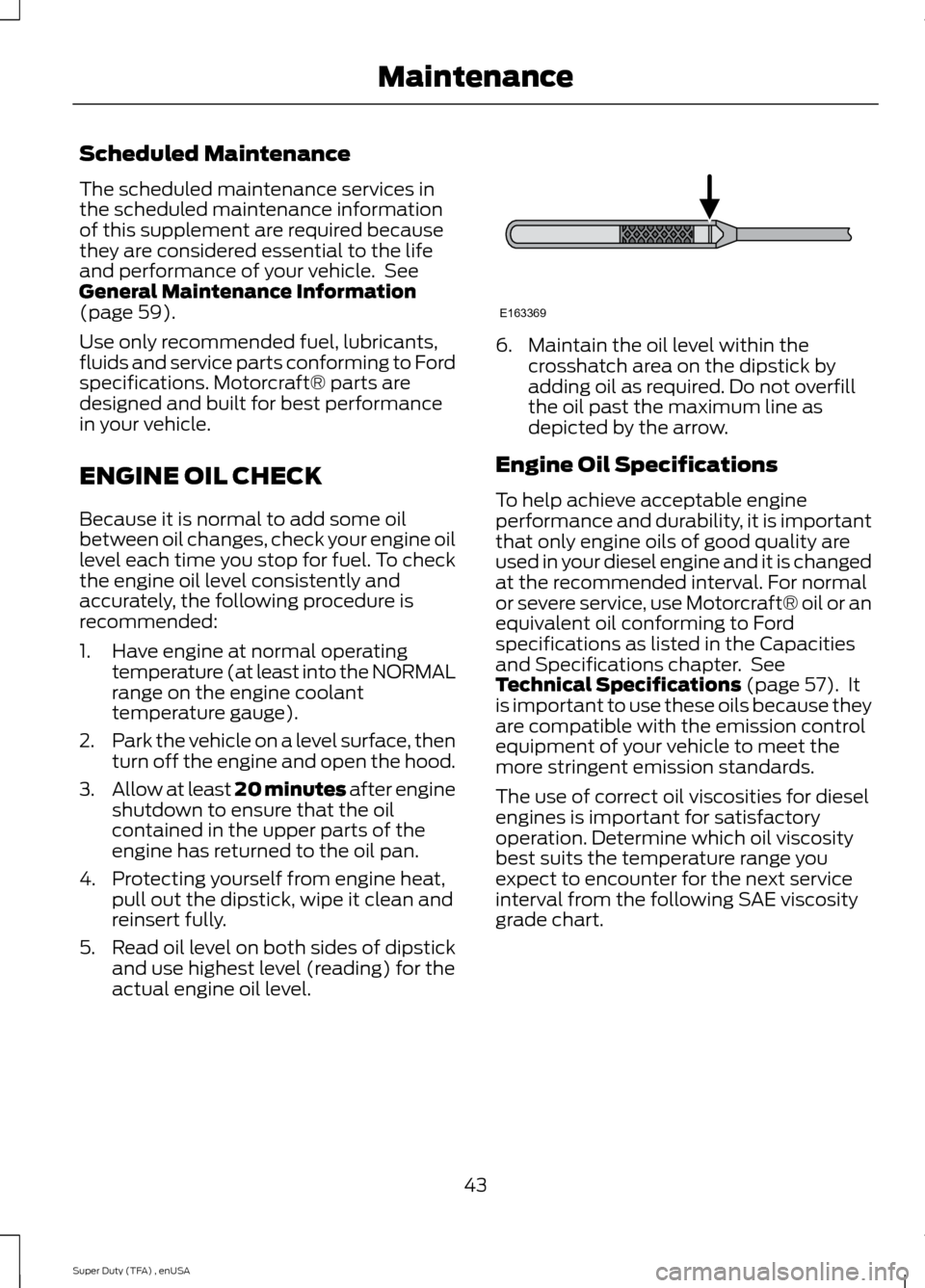
actual engine oil level. 6. Maintain the oil level within the
crosshatch area on the dipstick by
adding oil as required. Do not overfill
the oil past the maximum line as
depicted by the arrow.
Engine Oil Specifications
To help achieve acceptable engine
performance and durability, it is important
that only engine oils of good quality are
used in your diesel engine and it is changed
at the recommended interval. For normal
or severe service, use Motorcraft® oil or an
equivalent oil conforming to Ford
specifications as listed in the Capacities
and Specifications chapter. See
Technical Specifications
(page 57). It
is important to use these oils because they
are compatible with the emission control
equipment of your vehicle to meet the
more stringent emission standards.
The use of correct oil viscosities for diesel
engines is important for satisfactory
operation. Determine which oil viscosity
best suits the temperature range you
expect to encounter for the next service
interval from the following SAE viscosity
grade chart.
43
Super Duty (TFA) , enUSA MaintenanceE163369
Page 48 of 84
5.
Reset the Intelligent Oil Life Monitor™.
See the Information Displays chapter
in the Owner's Manual for more
information.
Engine lubrication for severe service
operation
The following conditions define severe
operation for which engine operation with
SAE 5W-40 API CJ-4 is recommended. Oil
and oil filter change intervals will be
determined by the Intelligent Oil Life
Monitor™ as noted previously.
• Frequent or extended idling (over 10
minutes per hour of normal driving)
• Low-speed operation/stationary use
• If vehicle is operated in sustained
ambient temperatures below -10°F
(-23°C) or above 100°F (38°C)
• Frequent low-speed operation,
consistent heavy traffic less than 25
mph (40 km/h)
• Operating in severe dust conditions
• Operating the vehicle off road
• Towing a trailer over 1,000 miles (1,600
km)
• Sustained, high-speed driving at Gross
Vehicle Weight Rating (maximum
loaded weight for vehicle operation)
• Use of fuels with sulfur content other
than ultra-low sulfur diesel (ULSD)
• Use of high-sulfur diesel fuel
ENGINE COOLANT CHECK
Checking the Engine Coolant
When the engine is cold, check the
concentration and level of engine coolant
at the intervals listed in the scheduled
maintenance chapter. See Scheduled
Maintenance (page 59). Note:
Make sure that the level is between
the MIN and MAX marks on the coolant
reservoirs.
Note: Coolant expands when it is hot. The
level may extend beyond the MAX mark
Note: If the level is at the MIN mark, below
the MIN mark, or empty, add coolant
immediately. See
Adding Engine Coolant
in this chapter.
Note: The coolant concentration should be
maintained within 48% to 50%, which
equates to a freeze point between -30 °F
(-34 °C) and -34 °F (-37 °C).
Note: For best results, the coolant
concentration should be tested with a
refractometer such as Rotunda tool
300-ROB75240 available from your dealer.
Ford does not recommend the use of
hydrometers or coolant test strips for
measuring coolant concentrations.
Note: Automotive fluids are not
interchangeable. Do not use engine coolant
or antifreeze or windshield washer fluid
outside of its specified function and vehicle
location.
Adding Engine Coolant WARNINGS
Do not add engine coolant when the
engine is hot. Steam and scalding
liquids released from a hot cooling
system can burn you badly. Also, you can
be burned if you spill coolant on hot engine
parts. Do not put engine coolant in the
windshield washer fluid container. If
sprayed on the windshield, engine
coolant could make it difficult to see
through the windshield.
45
Super Duty (TFA) , enUSA Maintenance
Page 50 of 84
For vehicles with overflow coolant systems
with a non-pressurized cap on the coolant
recovery system, add coolant to the
coolant recovery reservoir when the engine
is cool. Add prediluted engine coolant
(Motorcraft Orange Antifreeze/Coolant
Prediluted) to the FULL COLD level. For all
other vehicles which have a coolant degas
system with a pressurized cap, or if it is
necessary to remove the coolant pressure
relief cap on the radiator of a vehicle with
an overflow system, follow these steps to
add engine coolant.
1. Turn the engine off and let it cool.
2. When the engine is cool, wrap a thick
cloth around the coolant pressure relief
cap on the coolant reservoir (a
translucent plastic bottle). Slowly turn
cap counterclockwise until pressure
begins to release. When you are sure
that all the pressure has been released,
use the cloth to turn it
counterclockwise and remove the cap.
3. Fill the coolant reservoir slowly with prediluted engine coolant to within the
FULL COLD level, or between the MIN
and MAX marks (within the COLD FILL
RANGE), as listed on the engine
coolant reservoir. If you removed the
radiator cap in an overflow system, fill
the radiator until the coolant is visible
and radiator is almost full. If coolant is
added to bring the level within the
COLD FILL RANGE when the engine is
not cold, the system may remain under
filled.
4. Replace the cap. Turn until tightly installed. Cap must be tightly installed
to prevent coolant loss.
Whenever coolant has been added, the
coolant level in the coolant reservoir
should be checked the next few times you
drive the vehicle. If necessary, add enough
prediluted engine coolant to bring the
coolant level to the proper level. If you have to add more than 1.0 quart (1.0
liter) of engine coolant per month, have
your authorized dealer check the engine
cooling system. Your cooling system may
have a leak. Operating an engine with a
low level of coolant can result in engine
overheating and possible engine damage.
Engine and Secondary Cooling
System Refill Procedure
The following procedure should be used
when refilling the engine or secondary
cooling systems after it has been drained
or become extremely low.
1. Before you remove the cap, turn the
engine off and let it cool.
2. When the engine is cool, wrap a thick cloth around the cap. Slowly turn cap
counterclockwise until pressure begins
to release.
3. Step back while the pressure releases.
4. When you are sure that all the pressure
has been released, use the cloth to turn
it counterclockwise and remove the
cap.
5. Slowly add prediluted engine coolant to the coolant reservoir until the
coolant level is within the COLD FILL
RANGE as listed on the reservoir.
6. Reinstall the pressure relief cap.
7. Start and run the engine at 2000 rpm for 2 minutes.
8. Shut engine off, and remove the pressure relief cap as previously
outlined.
9. If required, add prediluted engine coolant to the coolant reservoir until
the coolant level is within the COLD
FILL RANGE as listed on the reservoir.
47
Super Duty (TFA) , enUSA Maintenance