2015 FORD SUPER DUTY check engine
[x] Cancel search: check enginePage 51 of 84
10.
Engine cooling system: Repeat
Step 5 until the coolant level has
stabilized (is no longer dropping after
each step) AND the upper radiator
hose at the radiator is warm to the
touch (indicating that the engine
thermostat is open and coolant is
flowing through the radiator).
Secondary cooling system: Repeat
Step 5 until the coolant level has
stabilized (is no longer dropping after
each step) AND the lower passenger
side of the secondary radiator is
warm to the touch (indicating
secondary thermostat is open and
coolant is flowing through the entire
system).
11. Reinstall the pressure relief cap. Shut
the engine off and let it cool.
12. Check the coolant level in the reservoir before you drive your vehicle
the next few times (with the engine
cool).
13. If necessary, add prediluted engine coolant to the coolant reservoir until
the coolant level is within the COLD
FILL RANGE as listed on the reservoir.
After any coolant has been added,
check the coolant concentration. See
Adding Engine Coolant
earlier in
the chapter for more information.
Whenever coolant has been added, the
coolant level in the reservoir should be
checked the next few times you drive the
vehicle. If needed, add prediluted engine
coolant to bring the coolant level to the
proper level on the reservoir.
Recycled Engine Coolant
Ford Motor Company does not recommend
the use of recycled engine coolant since a
Ford-approved recycling process is not yet
available. Used engine coolant should be disposed
of in an appropriate manner. Follow your
community
’s regulations and standards
for recycling and disposing of automotive
fluids.
Severe Climates
If you drive in extremely cold climates:
• It may be necessary to have a Ford
authorized dealer increase the coolant
concentration above 50%.
• A coolant concentration of 60% will
provide improved freeze point
protection. Engine coolant
concentrations above 60% will
decrease the overheat protection
characteristics of the engine coolant
and may cause engine damage.
If you drive in extremely hot climates:
• It may be necessary to have a Ford
authorized dealer decrease the coolant
concentration to 40%.
• A coolant concentration of 40% will
provide improved overheat protection.
Engine coolant concentrations below
40% will decrease the corrosion/freeze
protection characteristics of the engine
coolant and may cause engine
damage.
Vehicles driven year-round in non-extreme
climates should use prediluted engine
coolant for optimum cooling system and
engine protection.
Checking Coolant Corrosion
Inhibitor Additive Strength
At specific mileage intervals of 15000
miles (24000 km), as listed in the
scheduled maintenance information
chapter, the coolant corrosion inhibitor
additive should be checked. The optional
information display, if equipped, will also
display the message CHECK COOLANT
ADDITIVE at this time. The purpose of
checking is to verify the correct engine
48
Super Duty (TFA) , enUSA Maintenance
Page 53 of 84
Coolant Change
At specific mileage intervals, as listed in
the scheduled maintenance information,
the coolant should be changed. The
optional information display, if equipped,
will also display the message COOLANT
CHANGE REQUIRED at this time.
See Capacities and Specifications
(page 55). for the proper coolant.
Engine-driven Cooling Fan (Fan
Clutch)
Your vehicle is equipped with an engine
driven cooling fan drive (also called a fan
clutch). This fan drive changes the fan
speed to match the vehicle ’s changing
cooling air flow requirements. Fan speed,
fan noise level and fuel consumption all
will increase based on the driving
conditions that include trailer towing, hill
climbing, heavy loads, high speed and high
ambient temperature, individually or in
combination.
The fan drive is designed to provide the
minimum fan speed (and resulting
minimum fan noise and fuel consumption)
required to meet the ever changing vehicle
cooling air flow requirements. You will hear
the amount of fan noise increasing and
decreasing as the engine power
requirements and vehicle driving conditions
change as you drive. This is to be expected
as being normal to the operation of your
vehicle. High levels of fan noise might also
be heard when your engine is first started,
and should normally decrease after driving
for a short time. CHANGING THE ENGINE AIR
FILTER
Air Filter Restriction Gauge WARNING
To reduce the risk of vehicle damage
and/or personal burn injuries do not
start your engine with the air filter
removed and do not remove it while the
engine is running. Note:
Operating your vehicle in heavy
snowfall or extreme rain conditions may
allow excessive amounts of snow or water
into the air intake system. This could plug
or soak the air filter that could cause the
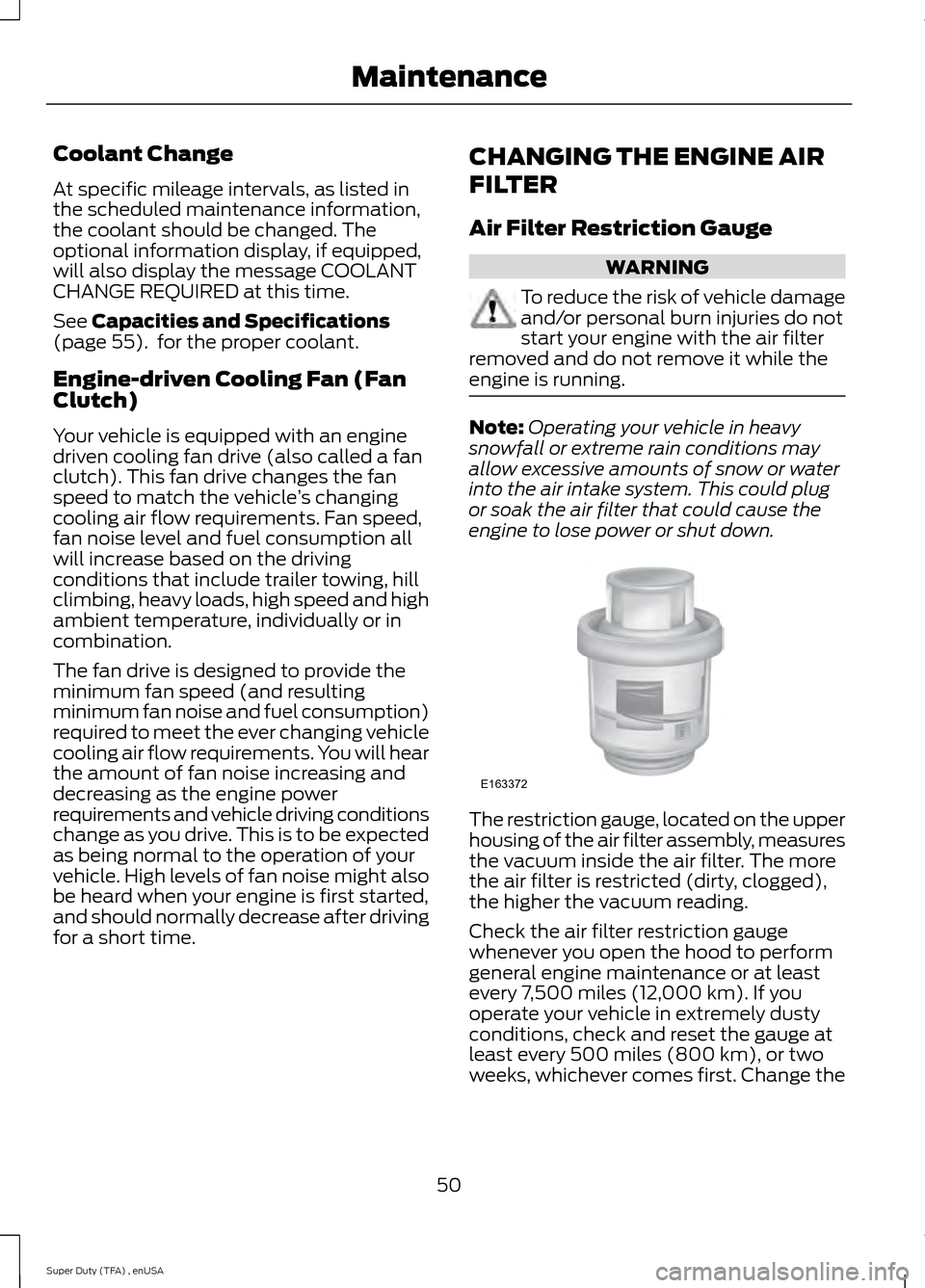
engine to lose power or shut down. The restriction gauge, located on the upper
housing of the air filter assembly, measures
the vacuum inside the air filter. The more
the air filter is restricted (dirty, clogged),
the higher the vacuum reading.
Check the air filter restriction gauge
whenever you open the hood to perform
general engine maintenance or at least
every 7,500 miles (12,000 km). If you
operate your vehicle in extremely dusty
conditions, check and reset the gauge at
least every 500 miles (800 km), or two
weeks, whichever comes first. Change the
50
Super Duty (TFA) , enUSA MaintenanceE163372
Page 63 of 84
Ford Motor Company has recommended
maintenance intervals for various parts
and component systems based upon
engineering testing. Ford Motor Company
relies upon this testing to determine the
most appropriate mileage for replacement
of oils and fluids to protect your vehicle at
the lowest overall cost to you and
recommends against maintenance
schedules that deviate from the scheduled
maintenance information.
We strongly recommend the use of only
genuine Ford, Motorcraft or
Ford-authorized re-manufactured
replacement parts engineered for your
vehicle.
Additives and Chemicals
This owner's manual and the Ford
Workshop Manual list the recommended
additives and chemicals for your vehicle.
We do not recommend using chemicals or
additives not approved by us as part of
your vehicle
’s normal maintenance. Please
consult your warranty information. Oils, Fluids and Flushing
In many cases, fluid discoloration is a
normal operating characteristic and, by
itself, does not necessarily indicate a
concern or that the fluid needs to be
changed. However, a qualified expert, such
as the factory-trained technicians at your
dealership, should inspect discolored fluids
that also show signs of overheating or
foreign material contamination
immediately.
Make sure to change your vehicle
’s oils and
fluids at the specified intervals or in
conjunction with a repair. Flushing is a
viable way to change fluid for many vehicle
sub-systems during scheduled
maintenance. It is critical that systems are
flushed only with new fluid that is the same
as that required to fill and operate the
system or using a Ford-approved flushing
chemical.
Owner Checks and Services
Make sure you perform the following basic
maintenance checks and inspections every
month or at six-month intervals. Check every month
Air filter restriction gauge.
Fuel and water separator. Drain if necessary (or if indicated by the information display). Tires (including spare) for wear and proper pressure.
Holes and slots in the tail pipe to make sure they are functional and clear of debris.
60
Super Duty (TFA) , enUSA Scheduled Maintenance
Page 64 of 84
Tightening lug nuts
Tighten the lug nuts to the specified torque at 500 miles
(800 km) after any wheel disturbance (such as tire rota-
tion, changing a flat tire or wheel removal).
Vehicles with single rear
wheels
Tighten the wheel lug nuts to the specified torque at 100
miles (160 km), and again at 500 miles (800 km) of new vehicle operation and after any wheel disturbance (such as tire rotation, changing a flat tire or wheel removal).
Vehicles with dual rear
wheels
Note: For the proper lug nut torque specification, see Technical specifications in the Wheels
and Tires chapter of your owner's manual.
Multi-point Inspection
In order to keep your vehicle running right,
it is important to have the systems on your
vehicle checked regularly. This can help
identify potential issues and prevent major
problems. We recommend having the
following multi-point inspection performed
at every scheduled maintenance interval
to help make sure your vehicle keeps
running great. Multi-point inspection
Horn operation
Accessory drive belt(s)
Radiator, cooler, heater and A/C hoses
Battery performance
Suspension component for leaks ordamage
Engine air filter
Steering and linkage
Exhaust system
Tires (including spare) for wear and properpressure**
Exterior lamps and hazard warning system
operation
Windshield for cracks, chips or pits
Fluid levels *
; fill if necessary
Washer spray and wiper operation
For oil and fluid leaks
* Brake, coolant recovery reservoir, automatic transmission, power steering and window
washer.
** If your vehicle is equipped with a temporary mobility kit, check the tire sealant expiration
Use By date on the canister. Replace as needed.
61
Super Duty (TFA) , enUSA Scheduled Maintenance
Page 65 of 84
Be sure to ask your dealership service
advisor or technician about the multi-point
vehicle inspection. It is a comprehensive
way to perform a thorough inspection of
your vehicle. Your checklist gives you
immediate feedback on the overall
condition of your vehicle.
NORMAL SCHEDULED
MAINTENANCE
Intelligent Oil-Life Monitor
Your vehicle is equipped with an Intelligent
Oil-Life Monitor that determines when you
should change the engine oil based on how
your vehicle is used. By using several
important factors in its calculations, the
monitor helps reduce the cost of owning
your vehicle and reduces environmental
waste at the same time.
This means you do not have to remember
to change the oil on a mileage-based
schedule. Your vehicle lets you know when
an oil change is due by displaying ENGINE
OIL CHANGE DUE or OIL CHANGE
REQUIRED in the information display.
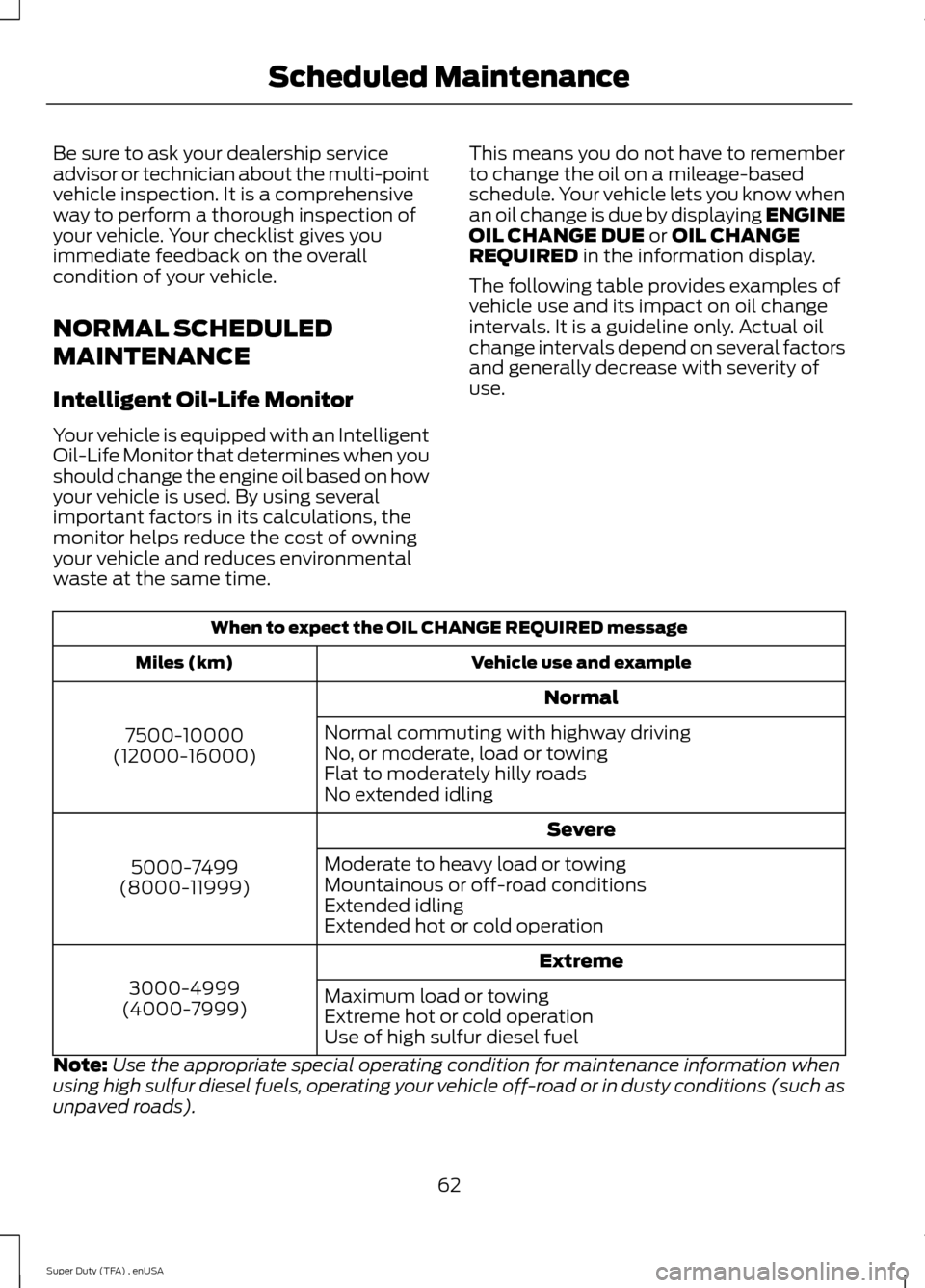
The following table provides examples of
vehicle use and its impact on oil change
intervals. It is a guideline only. Actual oil
change intervals depend on several factors
and generally decrease with severity of
use. When to expect the OIL CHANGE REQUIRED message
Vehicle use and example
Miles (km)
Normal
7500-10000
(12000-16000) Normal commuting with highway driving
No, or moderate, load or towing
Flat to moderately hilly roads
No extended idling
Severe
5000-7499
(8000-11999) Moderate to heavy load or towing
Mountainous or off-road conditions
Extended idling
Extended hot or cold operation
Extreme
3000-4999
(4000-7999) Maximum load or towing
Extreme hot or cold operation
Use of high sulfur diesel fuel
Note: Use the appropriate special operating condition for maintenance information when
using high sulfur diesel fuels, operating your vehicle off-road or in dusty conditions (such as
unpaved roads).
62
Super Duty (TFA) , enUSA Scheduled Maintenance
Page 73 of 84
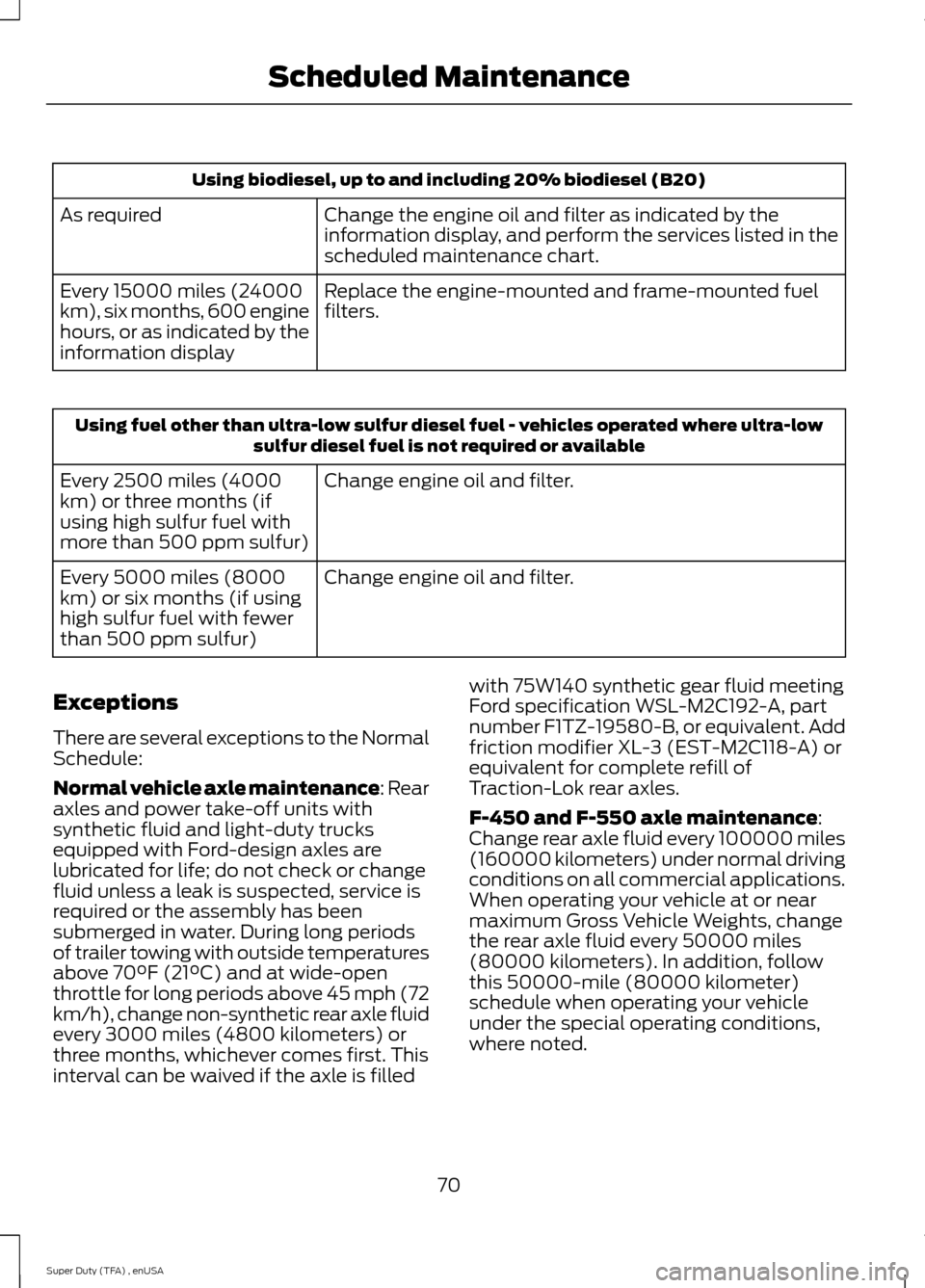
Using biodiesel, up to and including 20% biodiesel (B20)
Change the engine oil and filter as indicated by the
information display, and perform the services listed in the
scheduled maintenance chart.
As required
Replace the engine-mounted and frame-mounted fuel
filters.
Every 15000 miles (24000
km), six months, 600 engine
hours, or as indicated by the
information display Using fuel other than ultra-low sulfur diesel fuel - vehicles operated where ultra-low
sulfur diesel fuel is not required or available
Change engine oil and filter.
Every 2500 miles (4000
km) or three months (if
using high sulfur fuel with
more than 500 ppm sulfur)
Change engine oil and filter.
Every 5000 miles (8000
km) or six months (if using
high sulfur fuel with fewer
than 500 ppm sulfur)
Exceptions
There are several exceptions to the Normal
Schedule:
Normal vehicle axle maintenance: Rear
axles and power take-off units with
synthetic fluid and light-duty trucks
equipped with Ford-design axles are
lubricated for life; do not check or change
fluid unless a leak is suspected, service is
required or the assembly has been
submerged in water. During long periods
of trailer towing with outside temperatures
above 70°F (21°C) and at wide-open
throttle for long periods above 45 mph (72
km/h), change non-synthetic rear axle fluid
every 3000 miles (4800 kilometers) or
three months, whichever comes first. This
interval can be waived if the axle is filled with 75W140 synthetic gear fluid meeting
Ford specification WSL-M2C192-A, part
number F1TZ-19580-B, or equivalent. Add
friction modifier XL-3 (EST-M2C118-A) or
equivalent for complete refill of
Traction-Lok rear axles.
F-450 and F-550 axle maintenance:
Change rear axle fluid every 100000 miles
(160000 kilometers) under normal driving
conditions on all commercial applications.
When operating your vehicle at or near
maximum Gross Vehicle Weights, change
the rear axle fluid every 50000 miles
(80000 kilometers). In addition, follow
this 50000-mile (80000 kilometer)
schedule when operating your vehicle
under the special operating conditions,
where noted.
70
Super Duty (TFA) , enUSA Scheduled Maintenance
Page 82 of 84
A
About This Supplement.................................3
Breaking-In Your Vehicle...................................... 3
Diesel Engine Information................................... 3
Minor Troubleshooting Guide............................. 5
Warnings.................................................................... 3
ABS See: Brakes.............................................................. 37
B
Brakes
..................................................................37
General Information............................................ 37
C
Capacities and Specifications
..................55
Technical Specifications.................................... 57
Changing the Engine Air Filter...................50 Air Filter Replacement......................................... 51
Air Filter Restriction Gauge............................... 50
Cleaning the Engine......................................54
Cleaning the Exhaust...................................54
Coolant Check See: Engine Coolant Check.............................. 45
E
Emission Control System
...........................30
Diesel Exhaust System: Oxidation Catalyst
And Diesel Particulate Filter System
........................................................................\
........ 30
Engine Block Heater
.......................................14
Rapid Heat Supplemental Heating
System................................................................. 14
Engine Coolant Check..................................45 Adding Engine Coolant...................................... 45
Checking Coolant Corrosion Inhibitor Additive Strength ........................................... 48
Checking the Engine Coolant.......................... 45
Coolant Change................................................... 50
Engine and Secondary Cooling System Refill Procedure................................................ 47
Engine-driven Cooling Fan (Fan Clutch)................................................................ 50
Recycled Engine Coolant.................................. 48
Severe Climates................................................... 48Engine Idle Shutdown
...................................13
Engine Oil Check.............................................43 Changing the Engine Oil and Oil Filter.........44
Engine Oil Specifications.................................. 43
Engine Specifications
...................................55
Drivebelt Routing.................................................. 55
F
Fuel and Refueling
..........................................15
Fuel Quality.......................................................15
Biodiesel................................................................... 16
Diesel Fuel Additives ........................................... 17
Fuel And Water Separator ................................. 17
Fuel Requirements - Choosing The Right Fuel: Vehicles Operated Where Ultra Low
Sulfur Diesel Fuel Is Not Required ............15
Fuel Requirements - Choosing The Right Fuel: Vehicles Operated Where Ultra Low
Sulfur Diesel Fuel Is Required (United
States/Canada/Puerto Rico/U.S. Virgin
Islands And Other Locales) ......................... 15
Fuel Shutoff.....................................................39 Running Out Of DEF (Diesel Exhaust
Fluid).................................................................... 39
Fuel Tank Selector Switch..........................36
G
Gauges..................................................................8 Engine Boost Gauge.............................................. 8
General Maintenance Information
..........59
Multi-point Inspection......................................... 61
Owner Checks and Services............................ 60
Protecting Your Investment............................. 59
Why Maintain Your Vehicle?............................ 59
Why Maintain Your Vehicle at Your Dealership?....................................................... 59
I
Instrument Cluster...........................................8
Introduction........................................................3
79
Super Duty (TFA) , enUSA Index
Page 83 of 84
J
Jump Starting the Vehicle...........................39
Connecting the Jumper Cables...................... 40
Jump Starting......................................................... 41
Preparing Your Vehicle....................................... 39
Removing the Jumper Cables........................... 41
M
Maintenance....................................................42
Motorcraft Parts.............................................55
N
Normal Scheduled Maintenance.............62 Intelligent Oil-Life Monitor................................ 62
Normal Maintenance Intervals....................... 63
O
Oil Check See: Engine Oil Check......................................... 43
R
Refueling...........................................................29 Fueling Tips............................................................ 29
Roadside Emergencies
................................39
S
Scheduled Maintenance Record...............71
Scheduled Maintenance.............................59
Selective Catalytic Reduction System..............................................................21
Diesel Exhaust Fluid (DEF) warning messages and vehicle operations..............21
Importance of maintaining the Diesel Exhaust Fluid (DEF) level.............................. 21
Special Operating Conditions Scheduled Maintenance.................................................65
Exceptions.............................................................. 70
Starting a Diesel Engine...............................10 Cold Weather Operation...................................... 11
Cold Weather Starting........................................ 10
Starting and Stopping the Engine............10
Switching Off the Engine..............................13 T
Technical Specifications
See: Capacities and Specifications...............55
Towing a Trailer...............................................38
Towing................................................................38
U
Under Hood Overview..................................42 F-Super Duty.......................................................... 42
Scheduled Maintenance................................... 43
V
Vehicle Care
.....................................................54
W
Warning Lamps and Indicators...................8 Diesel Engine Brake............................................... 8
Diesel Exhaust Fluid (DEF)................................. 9
Glow Plug Pre-Heat............................................... 9
Water In Fuel............................................................ 9
80
Super Duty (TFA) , enUSA Index