Page 148 of 369
BREAKING-IN
You need to break in new tires for
approximately 300 mi (480 km). During
this time, your vehicle may exhibit some
unusual driving characteristics.
Avoid hard accelerations and driving too
fast during the first
1000 mi (1,600 km).
COLD WEATHER
PRECAUTIONS
The functional operation of some
components and systems can be affected
at temperatures below
-13°F (-25°C).
DRIVING THROUGH WATER WARNING
Do not drive through flowing or deep
water as you may lose control of your
vehicle.
Note:
Driving through standing water can
cause vehicle damage.
Note: Engine damage can occur if water
enters the air filter.
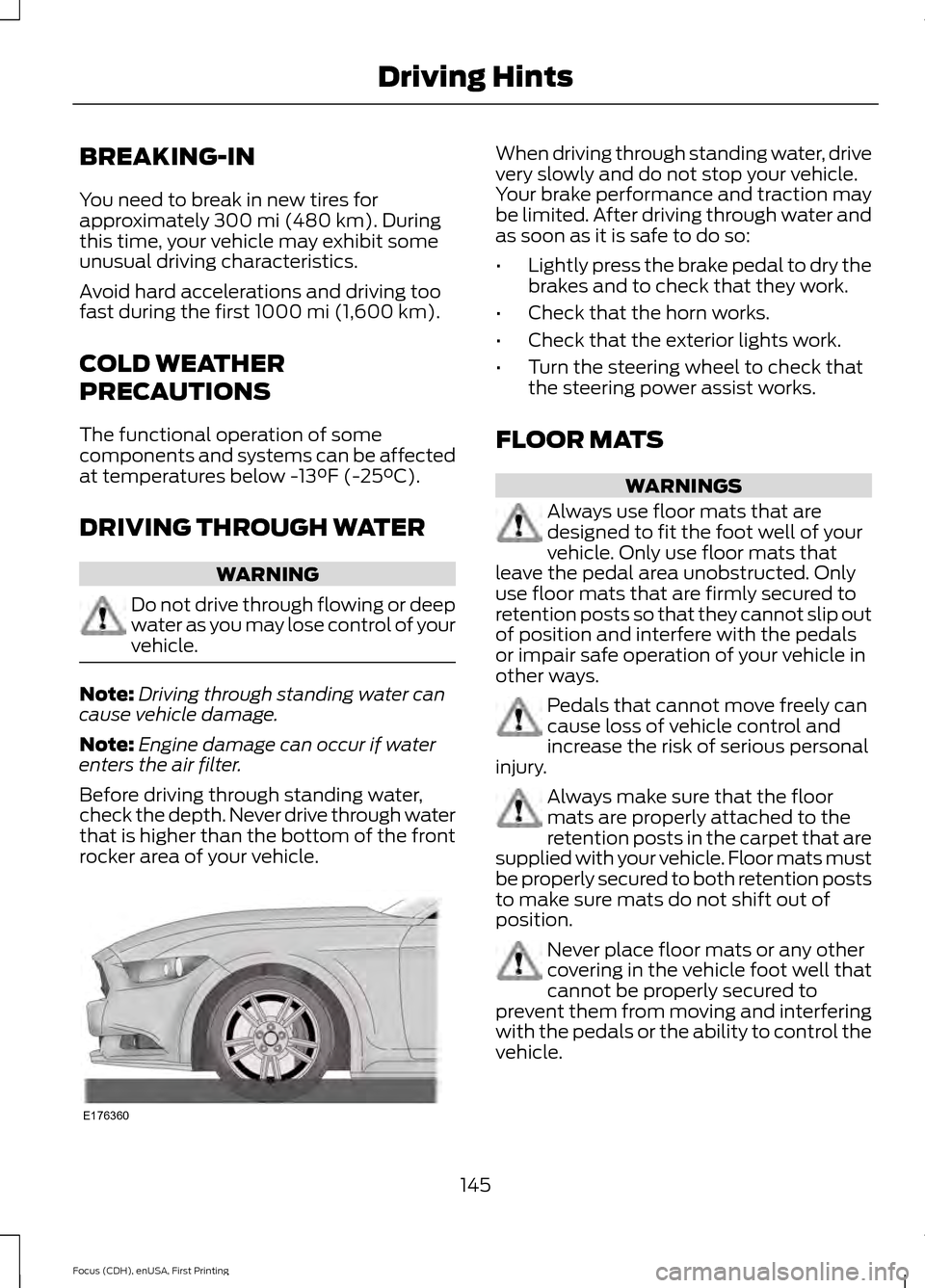
Before driving through standing water,
check the depth. Never drive through water
that is higher than the bottom of the front
rocker area of your vehicle. When driving through standing water, drive
very slowly and do not stop your vehicle.
Your brake performance and traction may
be limited. After driving through water and
as soon as it is safe to do so:
•
Lightly press the brake pedal to dry the
brakes and to check that they work.
• Check that the horn works.
• Check that the exterior lights work.
• Turn the steering wheel to check that
the steering power assist works.
FLOOR MATS WARNINGS
Always use floor mats that are
designed to fit the foot well of your
vehicle. Only use floor mats that
leave the pedal area unobstructed. Only
use floor mats that are firmly secured to
retention posts so that they cannot slip out
of position and interfere with the pedals
or impair safe operation of your vehicle in
other ways. Pedals that cannot move freely can
cause loss of vehicle control and
increase the risk of serious personal
injury. Always make sure that the floor
mats are properly attached to the
retention posts in the carpet that are
supplied with your vehicle. Floor mats must
be properly secured to both retention posts
to make sure mats do not shift out of
position. Never place floor mats or any other
covering in the vehicle foot well that
cannot be properly secured to
prevent them from moving and interfering
with the pedals or the ability to control the
vehicle.
145
Focus (CDH), enUSA, First Printing Driving HintsE176360
Page 154 of 369
•
As with any vehicle fire, do not inhale
smoke, vapors or gas from the vehicle,
as they may be hazardous.
• Remain a safe distance from the
vehicle and try to stay clear of the
smoke.
• Stay out of the roadway and stay out
of the way of any oncoming traffic
while awaiting the arrival of emergency
responders.
Post-Incident
• Do not store a severely damaged
vehicle with a lithium-ion battery inside
a structure or within 50 feet (15
meters) of any structure or vehicle.
• Make sure that passenger and cargo
compartments remain ventilated (i.e.
open window, door or trunk).
• For vehicles in the United States, notify
Ford Motor Company 1-800-392-3673
(then follow the prompts on the voice
response menu), an authorized Ford
dealer or service center as soon as
possible as there may be other steps
to secure and discharge the
high-voltage battery.
• For vehicles in Canada, notify Ford
Motor Company 1-800-565-3673
(then follow the prompts on the voice
response menu), an authorized Ford
dealer or service center as soon as
possible as there may be other steps
to secure and discharge the
high-voltage battery.
• Call 911 if you observe leaking fluids,
sparks, smoke or flames, or hear
gurgling or bubbling from the
high-voltage battery. POST-CRASH ALERT SYSTEM
The system flashes the direction indicators
and sounds the horn (intermittently) in the
event of a serious impact that deploys an
airbag (front, side, side curtain or Safety
Canopy) or the safety belt pretensioners.
The horn and indicators will turn off when:
•
You press the hazard control button.
• You press the panic button on the
remote entry transmitter (if equipped).
• Your vehicle runs out of power.
151
Focus (CDH), enUSA, First Printing Roadside Emergencies
Page 163 of 369
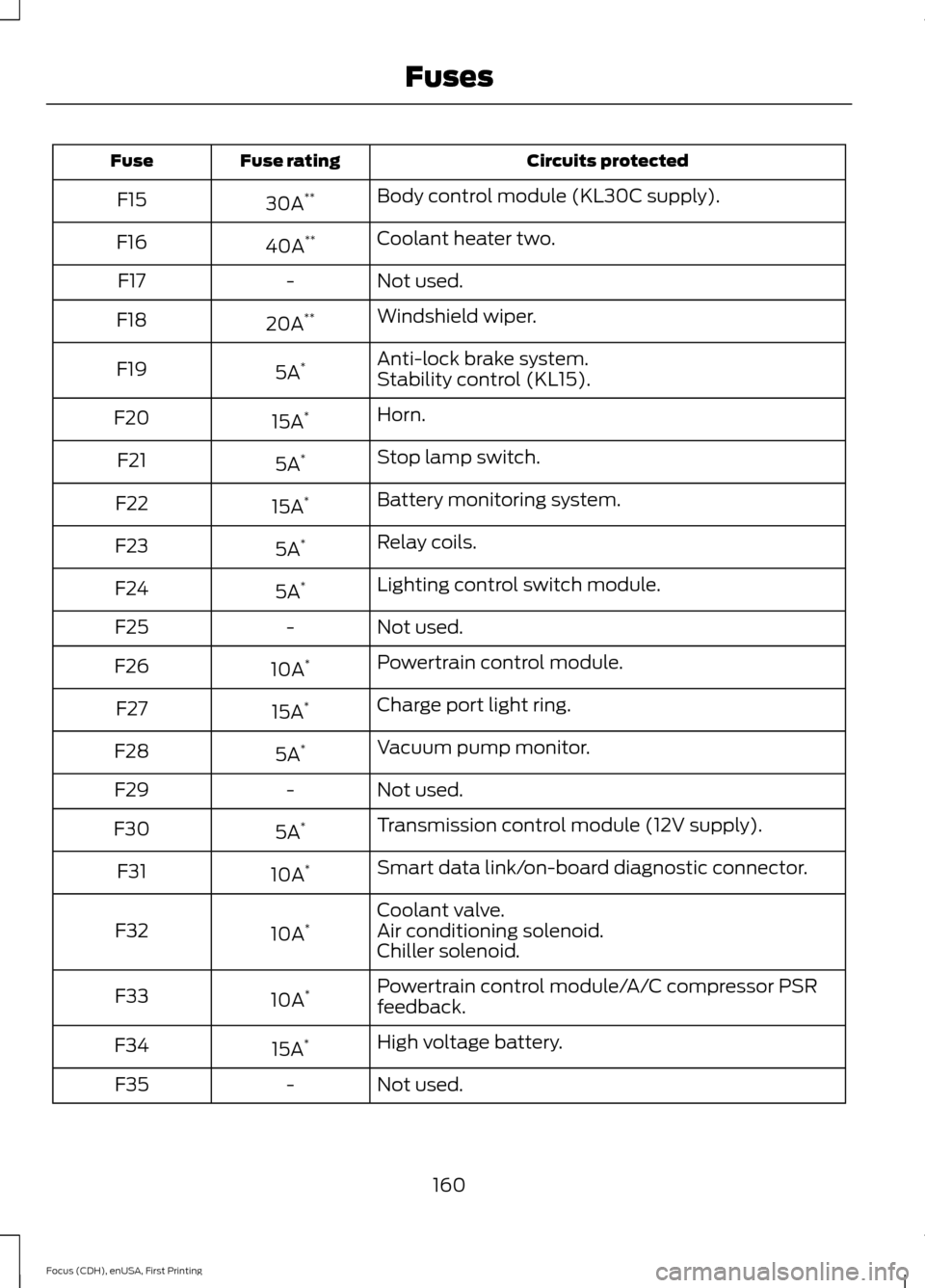
Circuits protected
Fuse rating
Fuse
Body control module (KL30C supply).
30A **
F15
Coolant heater two.
40A **
F16
Not used.
-
F17
Windshield wiper.
20A **
F18
Anti-lock brake system.
5A *
F19
Stability control (KL15).
Horn.
15A *
F20
Stop lamp switch.
5A *
F21
Battery monitoring system.
15A *
F22
Relay coils.
5A *
F23
Lighting control switch module.
5A *
F24
Not used.
-
F25
Powertrain control module.
10A *
F26
Charge port light ring.
15A *
F27
Vacuum pump monitor.
5A *
F28
Not used.
-
F29
Transmission control module (12V supply).
5A *
F30
Smart data link/on-board diagnostic connector.
10A *
F31
Coolant valve.
10A *
F32 Air conditioning solenoid.
Chiller solenoid.
Powertrain control module/A/C compressor PSR
feedback.
10A *
F33
High voltage battery.
15A *
F34
Not used.
-
F35
160
Focus (CDH), enUSA, First Printing Fuses
Page 164 of 369
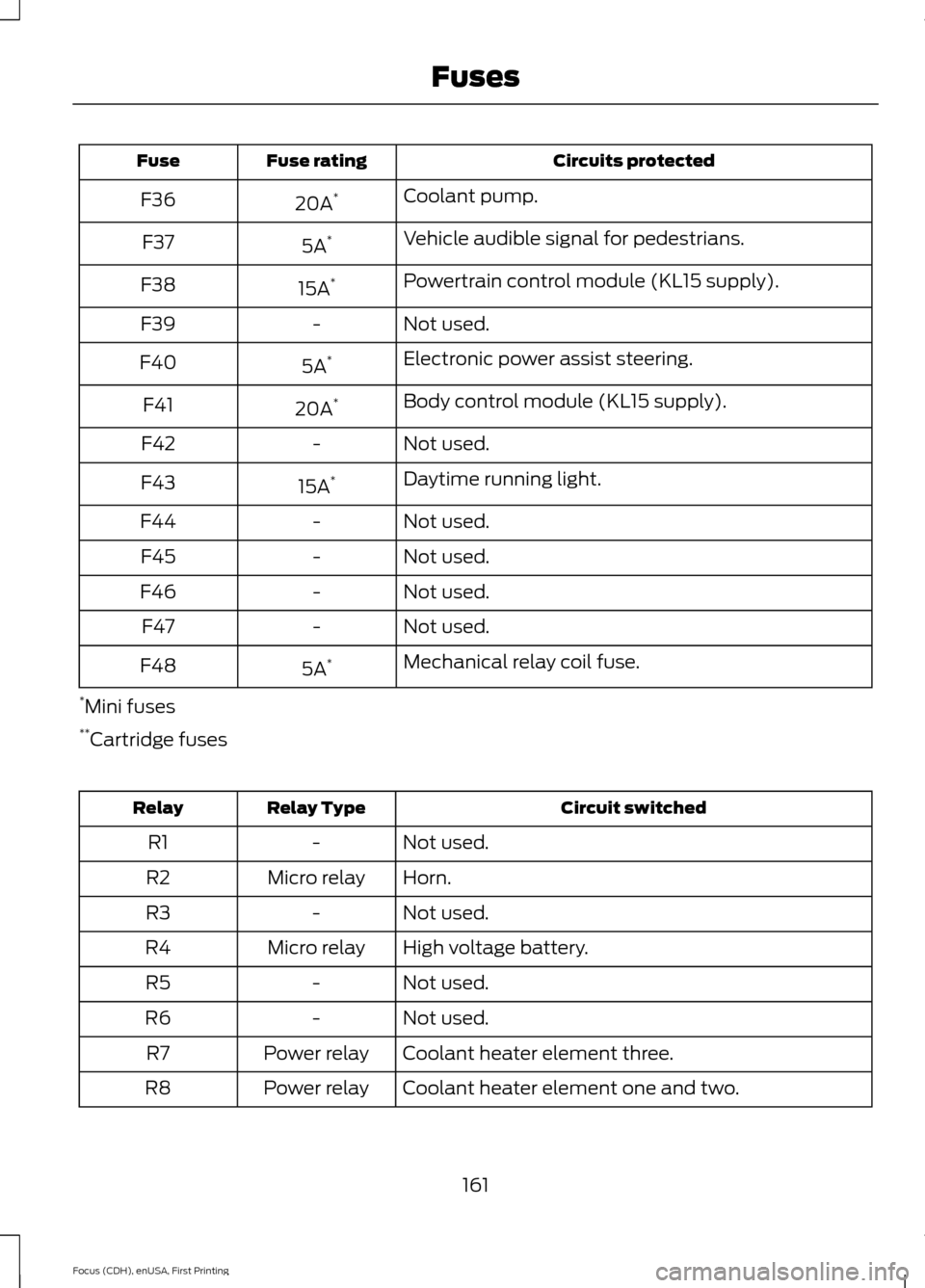
Circuits protected
Fuse rating
Fuse
Coolant pump.
20A *
F36
Vehicle audible signal for pedestrians.
5A *
F37
Powertrain control module (KL15 supply).
15A *
F38
Not used.
-
F39
Electronic power assist steering.
5A *
F40
Body control module (KL15 supply).
20A *
F41
Not used.
-
F42
Daytime running light.
15A *
F43
Not used.
-
F44
Not used.
-
F45
Not used.
-
F46
Not used.
-
F47
Mechanical relay coil fuse.
5A *
F48
* Mini fuses
** Cartridge fuses Circuit switched
Relay Type
Relay
Not used.
-
R1
Horn.
Micro relay
R2
Not used.
-
R3
High voltage battery.
Micro relay
R4
Not used.
-
R5
Not used.
-
R6
Coolant heater element three.
Power relay
R7
Coolant heater element one and two.
Power relay
R8
161
Focus (CDH), enUSA, First Printing Fuses
Page 172 of 369
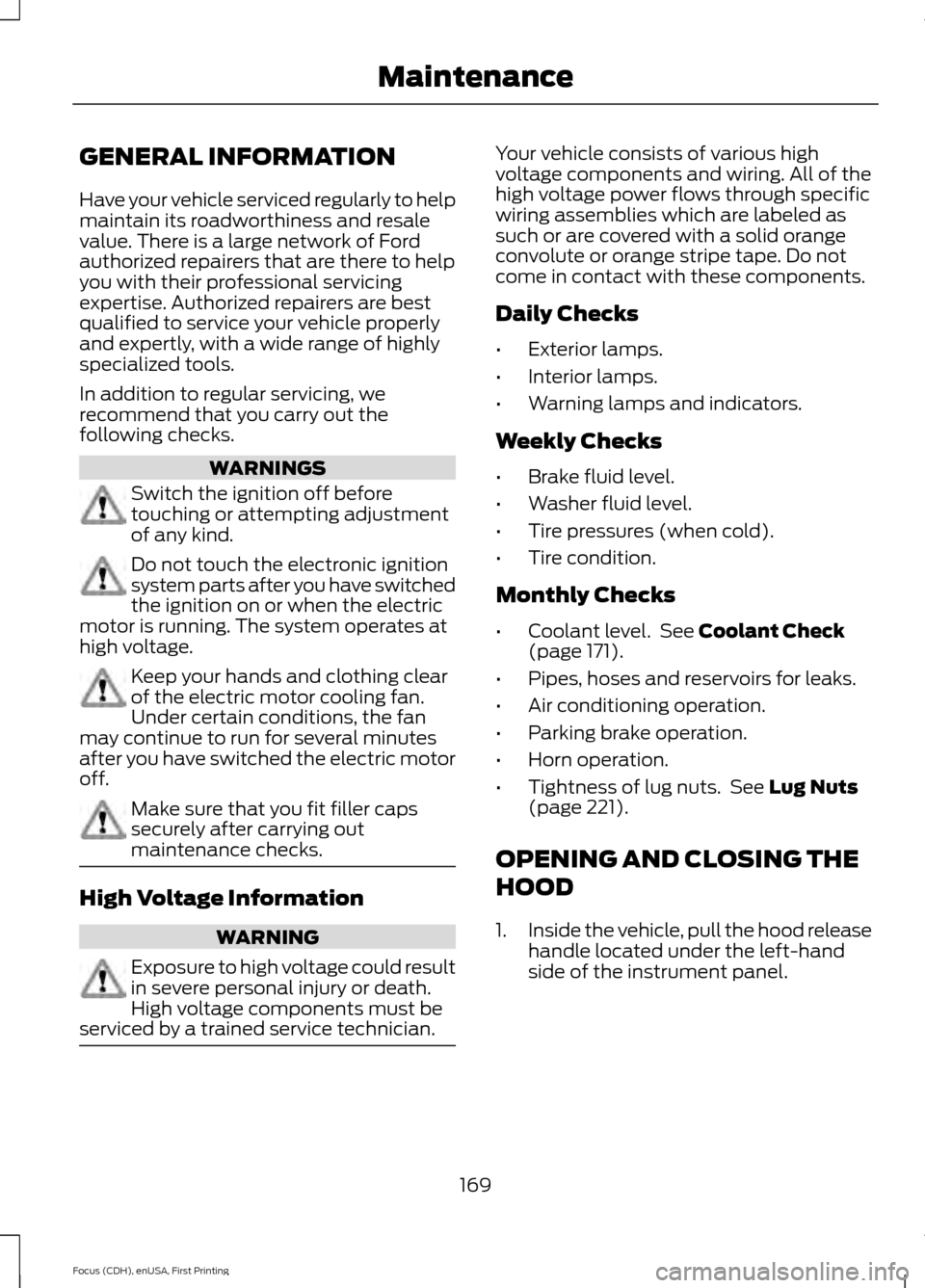
GENERAL INFORMATION
Have your vehicle serviced regularly to help
maintain its roadworthiness and resale
value. There is a large network of Ford
authorized repairers that are there to help
you with their professional servicing
expertise. Authorized repairers are best
qualified to service your vehicle properly
and expertly, with a wide range of highly
specialized tools.
In addition to regular servicing, we
recommend that you carry out the
following checks.
WARNINGS
Switch the ignition off before
touching or attempting adjustment
of any kind.
Do not touch the electronic ignition
system parts after you have switched
the ignition on or when the electric
motor is running. The system operates at
high voltage. Keep your hands and clothing clear
of the electric motor cooling fan.
Under certain conditions, the fan
may continue to run for several minutes
after you have switched the electric motor
off. Make sure that you fit filler caps
securely after carrying out
maintenance checks.
High Voltage Information
WARNING
Exposure to high voltage could result
in severe personal injury or death.
High voltage components must be
serviced by a trained service technician. Your vehicle consists of various high
voltage components and wiring. All of the
high voltage power flows through specific
wiring assemblies which are labeled as
such or are covered with a solid orange
convolute or orange stripe tape. Do not
come in contact with these components.
Daily Checks
•
Exterior lamps.
• Interior lamps.
• Warning lamps and indicators.
Weekly Checks
• Brake fluid level.
• Washer fluid level.
• Tire pressures (when cold).
• Tire condition.
Monthly Checks
• Coolant level. See Coolant Check
(page 171).
• Pipes, hoses and reservoirs for leaks.
• Air conditioning operation.
• Parking brake operation.
• Horn operation.
• Tightness of lug nuts. See
Lug Nuts
(page 221).
OPENING AND CLOSING THE
HOOD
1. Inside the vehicle, pull the hood release
handle located under the left-hand
side of the instrument panel.
169
Focus (CDH), enUSA, First Printing Maintenance
Page 352 of 369
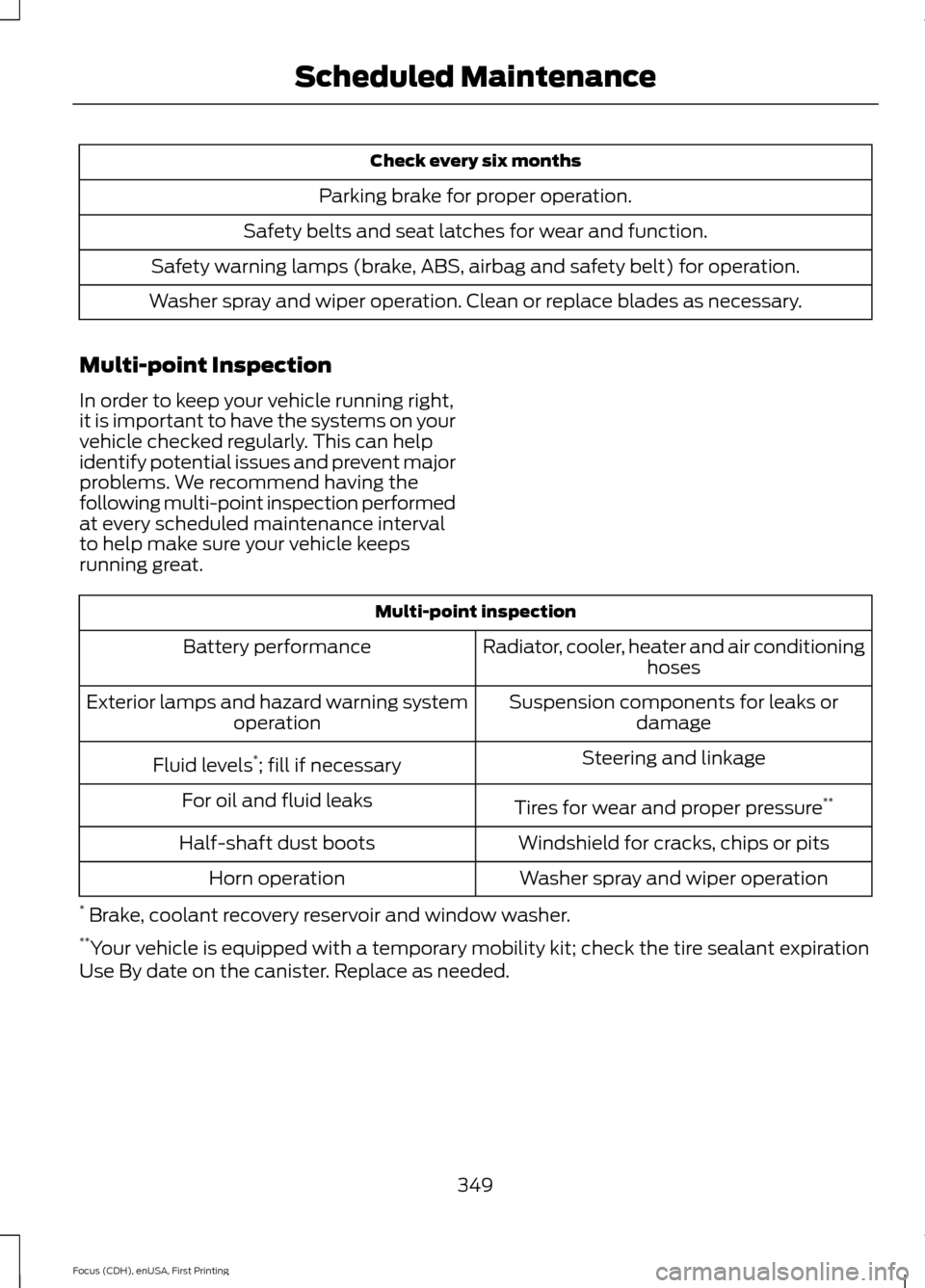
Check every six months
Parking brake for proper operation.
Safety belts and seat latches for wear and function.
Safety warning lamps (brake, ABS, airbag and safety belt) for operation.
Washer spray and wiper operation. Clean or replace blades as necessary.
Multi-point Inspection
In order to keep your vehicle running right,
it is important to have the systems on your
vehicle checked regularly. This can help
identify potential issues and prevent major
problems. We recommend having the
following multi-point inspection performed
at every scheduled maintenance interval
to help make sure your vehicle keeps
running great. Multi-point inspection
Radiator, cooler, heater and air conditioning hoses
Battery performance
Suspension components for leaks ordamage
Exterior lamps and hazard warning system
operation
Steering and linkage
Fluid levels *
; fill if necessary
Tires for wear and proper pressure **
For oil and fluid leaks
Windshield for cracks, chips or pits
Half-shaft dust boots
Washer spray and wiper operation
Horn operation
* Brake, coolant recovery reservoir and window washer.
** Your vehicle is equipped with a temporary mobility kit; check the tire sealant expiration
Use By date on the canister. Replace as needed.
349
Focus (CDH), enUSA, First Printing Scheduled Maintenance