2015 FORD F650 steering
[x] Cancel search: steeringPage 54 of 384
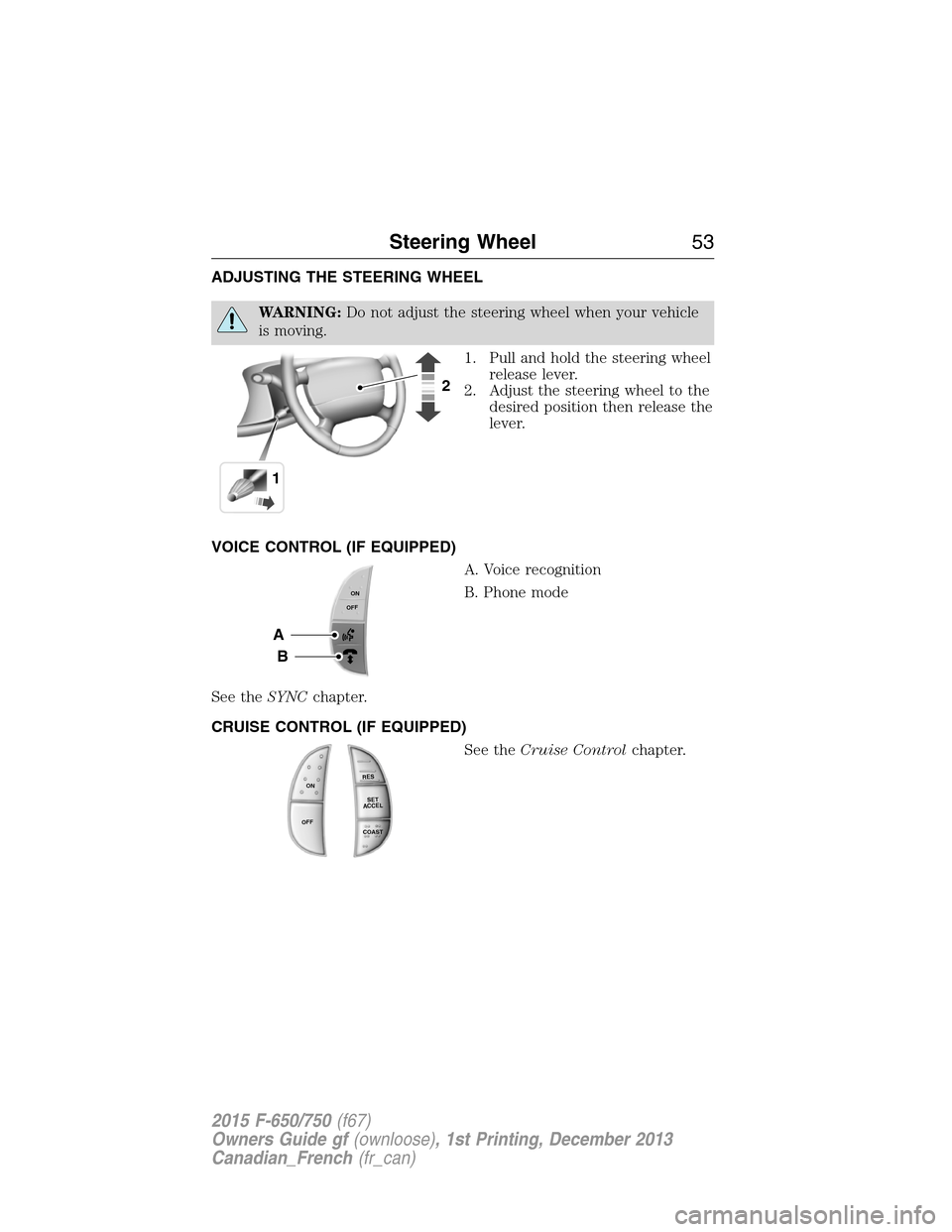
ADJUSTING THE STEERING WHEEL
WARNING:Do not adjust the steering wheel when your vehicle
is moving.
1. Pull and hold the steering wheel
release lever.
2. Adjust the steering wheel to the
desired position then release the
lever.
VOICE CONTROL (IF EQUIPPED)
A. Voice recognition
B. Phone mode
See theSYNCchapter.
CRUISE CONTROL (IF EQUIPPED)
See theCruise Controlchapter.
12
A
B
ONOFF
R
E
S
S
E
T
A
C
C
E
L
C
OA
S
T
ON
OFF
Steering Wheel53
2015 F-650/750(f67)
Owners Guide gf(ownloose), 1st Printing, December 2013
Canadian_French(fr_can)
Page 74 of 384

GENERAL INFORMATION
WARNING:Driving while distracted can result in loss of vehicle
control, crash and injury. We strongly recommend that you use
extreme caution when using any device that may take your focus off
the road. Your primary responsibility is the safe operation of your
vehicle. We recommend against the use of any hand-held device while
driving and encourage the use of voice-operated systems when possible.
Make sure you are aware of all applicable local laws that may affect the
use of electronic devices while driving.
You can control various systems on your vehicle using the information
display controls on the steering wheel. Corresponding information
appears in the information display.
Information Display Controls
•Press the INFO button to scroll
through trip and fuel usage
information.
•Press the SETUP button to
scroll through various vehicle
feature settings.
•Press the RESET button to
choose settings, reset
information and confirm
messages.
Info
Press the INFO button repeatedly to cycle through the following
features:
Note:Some options may appear slightly different or not at all if the
items are optional.
INFO
TRIP A/B
MILES (km) TO E
AVG MPG (L/100 km)
TIMER
BLANK SCREEN
INFOSETUP
RESET
Information Displays73
2015 F-650/750(f67)
Owners Guide gf(ownloose), 1st Printing, December 2013
Canadian_French(fr_can)
Page 80 of 384

SITTING IN THE CORRECT POSITION
WARNING:Do not recline the seat back as this can cause the
occupant to slide under the seat’s safety belt, resulting in severe
personal injury in the event of a crash.
WARNING:Do not place objects higher than the seat backs to
reduce the risk of injury in a crash or during heavy braking or
when stopping suddenly.
When you use them properly, the
seat, head restraint and safety belt
provide optimum protection in the
event of a crash. We recommend
that you follow these guidelines:
•Do not recline the seat back more than 30 degrees from vertical.
•Sit in an upright position with the base of your spine as far back as
possible.
•Adjust the head restraint so that the top of it is level with the top of
your head and as far forward as possible, remaining comfortable.
•Keep sufficient distance between yourself and the steering wheel. We
recommend a minimum of 10 inches (250 millimeters) between your
breastbone and the center of the steering wheel.
•Hold the steering wheel with your arms slightly bent.
•Bend your legs slightly so that you can press the pedals fully.
•Position the shoulder strap of the safety belt over the center of your
shoulder and position the lap strap tightly across your hips.
Make sure that your driving position is comfortable and that you can
maintain full control of your vehicle.
Seats79
2015 F-650/750(f67)
Owners Guide gf(ownloose), 1st Printing, December 2013
Canadian_French(fr_can)
Page 99 of 384

Instrument cluster lamp(s) illuminates or flashes when operator
assistance is required. In addition, engine performance becomes
increasingly limited above Level 1.
At Levels 1 and 2, the operator can take two courses of action to
facilitate filter regeneration:
1. Drive your vehicle on the highway at highway speeds.
2. Perform a parked regeneration by following the steps inParked
regeneration.
At Level 3, performing a parked regeneration is the only available course
of action (short of professional servicing) available to the operator for
regenerating the filter. At Level 4, professional servicing is the only way
to regenerate the filter.
Parked Regeneration
WARNING:When performing the parked regeneration
procedure, make certain the vehicle is safely off the roadway, and
the exhaust system is away from people, or any flammable materials,
vapors, or structures. Engine speed may increase during parked
regeneration.
Note:Parked regeneration is only available when the DPF lamp on the
instrument cluster is illuminated solid or flashing.
1. Bring your vehicle to a complete stop on level ground and safely off
the road with the exhaust system away from people, flammable
materials, vapors or structures. Ford recommends that you perform a
walk-around before beginning a parked regeneration.
2. If your vehicle is equipped with an automatic transmission and a
steering column shift lever, place the transmission in positionP.
Otherwise, place the transmission in positionN.
3. Remove your feet from the accelerator pedal and clutch pedal
(manual transmission).
4. Set the parking brake.
5. Within five seconds of setting the parking brake, remove your foot
from the service brake pedal.
The engine speed may increase slightly. To allow parked regeneration to
continue uninterrupted:
1. The vehicle must remain parked.
2. The transmission must remain in positionPorNas previously
described in Step 2.
98Starting and Stopping the Engine
2015 F-650/750(f67)
Owners Guide gf(ownloose), 1st Printing, December 2013
Canadian_French(fr_can)
Page 129 of 384

If the fuse is not blown and the brake lamps are working properly, the
following procedure allows you to move the gearshift lever from position
P:
1. Apply the parking brake, and
turn the engine off.
2. Remove the lower finish panel
below the steering column.
3. Turn the key to the on position,
but do not start the engine.
4. Pull back on the solenoid, and
at the same time, shift the
transmission into positionN.
5. Start your vehicle.
See an authorized dealer as soon as
possible if this procedure is used.
Six–speed TorqShift® Transmission
WARNING:Always set the parking brake fully and make sure
the gearshift is latched in position P. Turn the ignition to the off
position and remove the key whenever you leave your vehicle.
WARNING:Do not use the tow/haul feature when driving in icy
or slippery conditions as the increased engine braking can cause
the rear wheels to slide and the vehicle to swing around with the
possible loss of vehicle control.
128Transmission
2015 F-650/750(f67)
Owners Guide gf(ownloose), 1st Printing, December 2013
Canadian_French(fr_can)
Page 136 of 384
You can lock and unlock the differential when your vehicle is moving at a
constant speed of less than 25 mph (40 km/h) and while the wheels are
not slipping. Do not lock the differential when your vehicle is traveling
down steep grades and traction is minimal.
The differential lock and differential lock light automatically disengage at
speeds above 25 mph (40 km/h). The differential lock remains off until
either you restart your vehicle or you turn the differential lock switch off
then back on.
Turn the engine off and raise all drive wheels of the locker differential
axle in order to prevent your vehicle from moving when servicing the
wheels, tires or brakes. Axles equipped with a NoSPIN Detroit Locker
differential deliver power to both wheels even when only one wheel is on
the ground.
WARNING:Failure to raise all drive wheels with this type of
differential could cause the vehicle to move unexpectedly,
resulting in property damage, personal injury or death.
Take care to avoid sudden accelerations when both drive wheels are on a
slippery surface.
WARNING:Sudden accelerations on slippery surfaces could
cause the wheels to spin, the vehicle to turn sideways on a
crowned road surface or in a turn, possibly resulting in loss of vehicle
control and personal injury.
Fluid Temperature
Axle operating temperatures normally do not exceed 100°F (38°C). If
the operating temperature exceeds 230°F (110°C), the rate of axle
lubrication oxidation increases and shortens the life of the lubricant and
seals, requiring axle lubrication changes to become more frequent to
preserve the axle. Do not consistently run extreme pressure (EP)
lubricants above 230°F (110°C).
Axle Conversions
WARNING:When operating a loaded vehicle, the driver must
keep all adjustable axles on the ground at all times, supporting
their share of the vehicle’s load. Failure to do so can overload other
axles, tires, wheels, springs, steering components, brakes and frames,
resulting in early component failure, loss of vehicle control, possible
property damage and personal injury.
Transmission135
2015 F-650/750(f67)
Owners Guide gf(ownloose), 1st Printing, December 2013
Canadian_French(fr_can)
Page 139 of 384

GENERAL INFORMATION
All standard equipment brakes self-adjusting. Automatic adjustment,
when required, occurs whenever you apply and release the brakes during
forward or reverse operation.
Note:Occasional brake noise is normal. If a metal-to-metal, continuous
grinding or continuous squeal sound is present, this may indicate worn
brake linings. Have them inspected by an authorized dealer. If your
vehicle has continuous vibration or shudder in the steering wheel while
braking, an authorized dealer should inspect the vehicle.
Know the required stopping distances for all driving conditions you may
encounter. For longer brake lining life, take full advantage of engine
braking power when coming to a stop.
WARNING:Do not drive with your foot resting on the brake
pedal. This results in abnormally high brake temperatures,
excessive lining wear and increased stopping distances.
Before descending a long or steep hill, shift to a lower gear and avoid
continuous application of the brakes. Normally, choose the same gear to
descend the hill that you use to ascend the hill.
WARNING:Continuous application of the brakes causes the
brakes to overheat, resulting in a temporary loss of braking.
See theInstrument Clusterchapter for information on the
brake system warning light.
Wet brakes result in reduced braking efficiency. Gently press the brake
pedal a few times when driving from a car wash or standing water to dry
the brakes.
If Brakes Do Not Grip Well
•If you have been driving through deep water, gently apply the brakes
several times while your vehicle is moving slowly.
•Let the brakes cool if you have been using them excessively, as in
mountain driving or after several fast, high-speed stops.
•Check brake adjustment.
•Check brake linings for excessive wear.
•Check system air pressure on vehicles equipped with air brakes.
138Brakes
2015 F-650/750(f67)
Owners Guide gf(ownloose), 1st Printing, December 2013
Canadian_French(fr_can)
Page 140 of 384

Anti-lock Brake System (ABS)
This system helps you maintain steering control during emergency stops
by keeping the brakes from locking.
The ABS lamp momentarily illuminates when you switch on the
ignition. If the light does not illuminate during start-up, if it
remains on or flashes, the ABS may not be working and
requires servicing.
If the ABS is disabled, normal braking is still effective. If the
brake warning lamp illuminates, have your brake system
serviced immediately.
If you connect a PLC trailer with the ignition on, the trailer
ABS light also illuminates. If the light fails to illuminate, if it
remains on after you start the vehicle or continues to flash,
have the system serviced immediately.
FULL POWER BRAKE SYSTEM
WARNING:If the red BRAKE warning lamp in the instrument
cluster remains illuminated after engine start up, this indicates a
system failure in the Full Power Brake System. Stop the vehicle safely
as soon as possible and seek service immediately.
This system incorporates standard braking, an anti-lock braking system
(ABS) and optional Power Park Brake into one fully integrated hydraulic
brake system. With the Full Power Brake System, braking energy is
stored, similar to an air brake system, resulting in faster response times
and shorter stopping distances. This is accomplished using motor and
pump assemblies that pressurize the system by pumping brake fluid into
accumulators. This is similar to the air compressor of an air brake system
pressurizing the air tanks. The system includes a master cylinder that
provides the normal pedal feel and transfers the pedal force, via brake
fluid, to the main components of the system.
Note:The motor and pumps run momentarily with the ignition switch in
the on or run position, or in the off position with the brake pedal
pressed.
Note:During normal driving, you may hear the pump and motors
replenishing the accumulators. This is a normal function of the system.
AIR BRAKES
After starting the engine, give the air compressor time to build up the air
pressure to 60 psi (414 kPa) before moving your vehicle.
Brakes139
2015 F-650/750(f67)
Owners Guide gf(ownloose), 1st Printing, December 2013
Canadian_French(fr_can)