2015 FORD F SERIES MOTORHOME AND COMMERCIAL CHASSIS cruise control
[x] Cancel search: cruise controlPage 4 of 144
Introduction
About This Manual...........................................3
Symbols Glossary.............................................3
California Proposition 65...............................5
Perchlorate..........................................................5
Ford Credit...........................................................5
Replacement PartsRecommendation........................................6
Special Notices.................................................6
Mobile CommunicationsEquipment.......................................................7
Export Unique Options...................................7
Steering Wheel
Adjusting the Steering Wheel......................8
Cruise Control....................................................8
Wipers and Washers
Windshield Wipers...........................................9
Windshield Washers........................................9
Lighting
Lighting Control...............................................10
Instrument Lighting Dimmer......................10
Daytime Running Lamps...............................11
Direction Indicators..........................................11
Instrument Cluster
Gauges.................................................................12
Warning Lamps and Indicators..................13
Audible Warnings and Indicators..............15
Information Displays
General Information.......................................16
Information Messages...................................17
Starting and Stopping theEngine
General Information......................................20
Ignition Switch................................................20
Starting a Gasoline Engine.........................20
Fuel and Refueling
Safety Precautions.........................................22
Fuel Quality......................................................23
Running Out of Fuel......................................23
Refueling...........................................................24
Fuel Consumption.........................................25
Emission Control System............................26
Transmission
Automatic Transmission.............................29
Brakes
General Information......................................33
Hints on Driving With Anti-LockBrakes.............................................................33
Parking Brake...................................................34
Cruise Control
Principle of Operation..................................35
Using Cruise Control.....................................35
Load Carrying
Load Limit.........................................................36
Towing
Towing a Trailer...............................................42
Recommended Towing Weights..............43
Essential Towing Checks............................44
Transporting the Vehicle..............................47
Towing the Vehicle on Four Wheels.......48
Driving Hints
Breaking-In.......................................................49
Economical Driving.......................................49
Driving Through Water.................................50
Roadside Emergencies
Roadside Assistance......................................51
1Motorhome (), enUSATable of Contents
Page 7 of 144
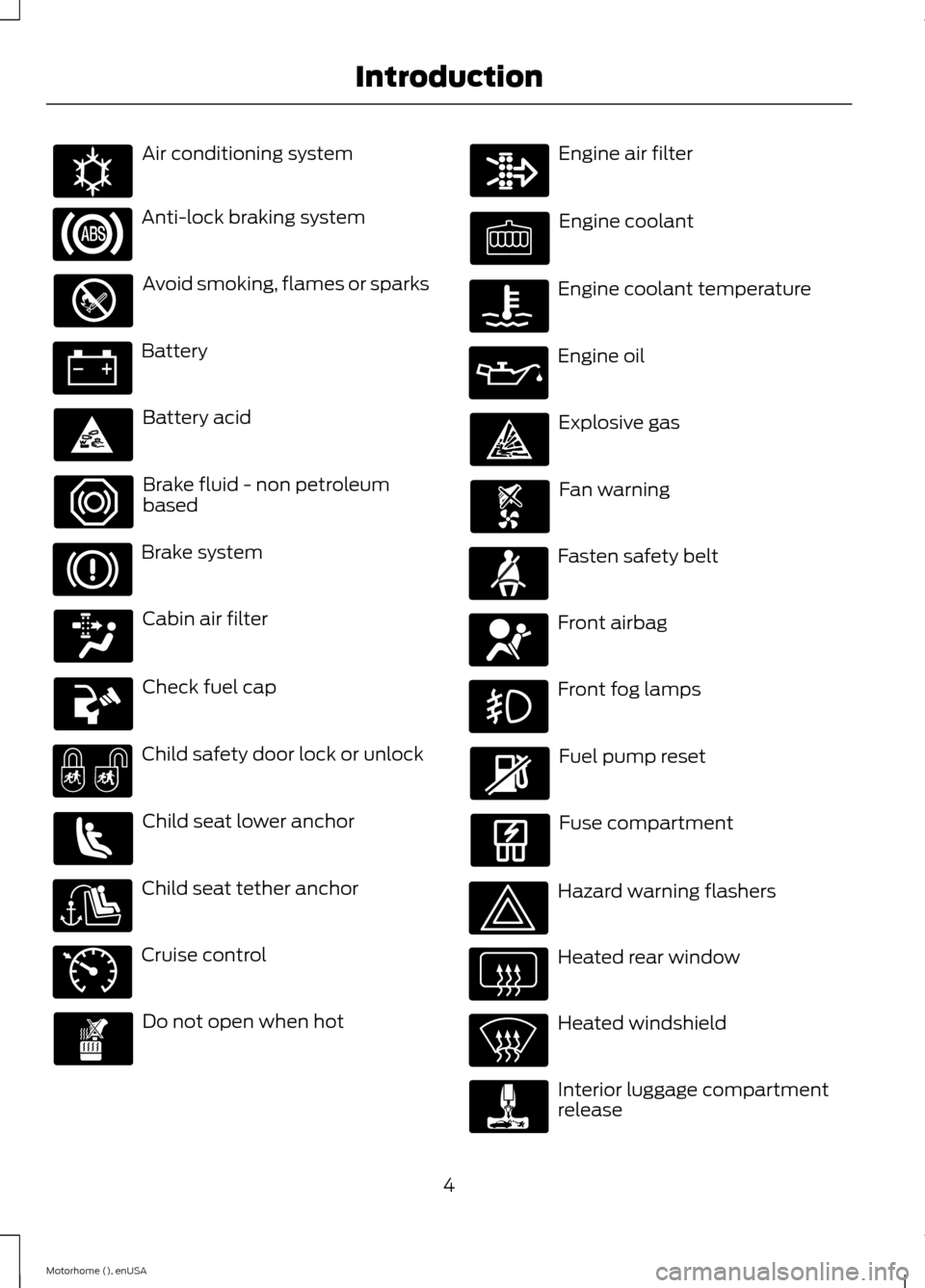
Air conditioning system
Anti-lock braking system
Avoid smoking, flames or sparks
Battery
Battery acid
Brake fluid - non petroleumbased
Brake system
Cabin air filter
Check fuel cap
Child safety door lock or unlock
Child seat lower anchor
Child seat tether anchor
Cruise control
Do not open when hot
Engine air filter
Engine coolant
Engine coolant temperature
Engine oil
Explosive gas
Fan warning
Fasten safety belt
Front airbag
Front fog lamps
Fuel pump reset
Fuse compartment
Hazard warning flashers
Heated rear window
Heated windshield
Interior luggage compartmentrelease
4Motorhome (), enUSAIntroductionE162384 E71340
Page 11 of 144
ADJUSTING THE STEERING
WHEEL
WARNING
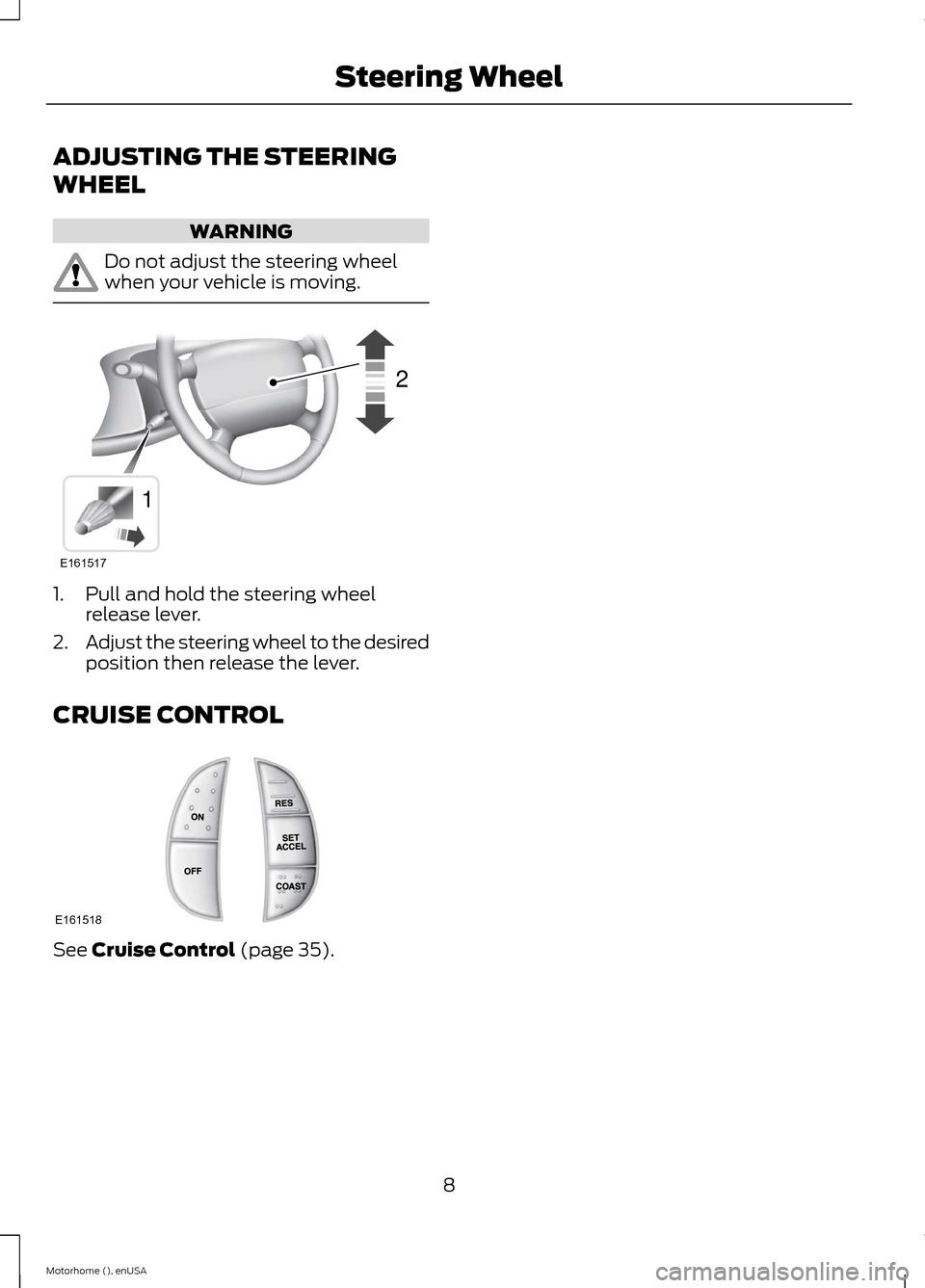
Do not adjust the steering wheelwhen your vehicle is moving.
1.Pull and hold the steering wheelrelease lever.
2.Adjust the steering wheel to the desiredposition then release the lever.
CRUISE CONTROL
See Cruise Control (page 35).
8Motorhome (), enUSASteering WheelE16151712 E161518
Page 17 of 144
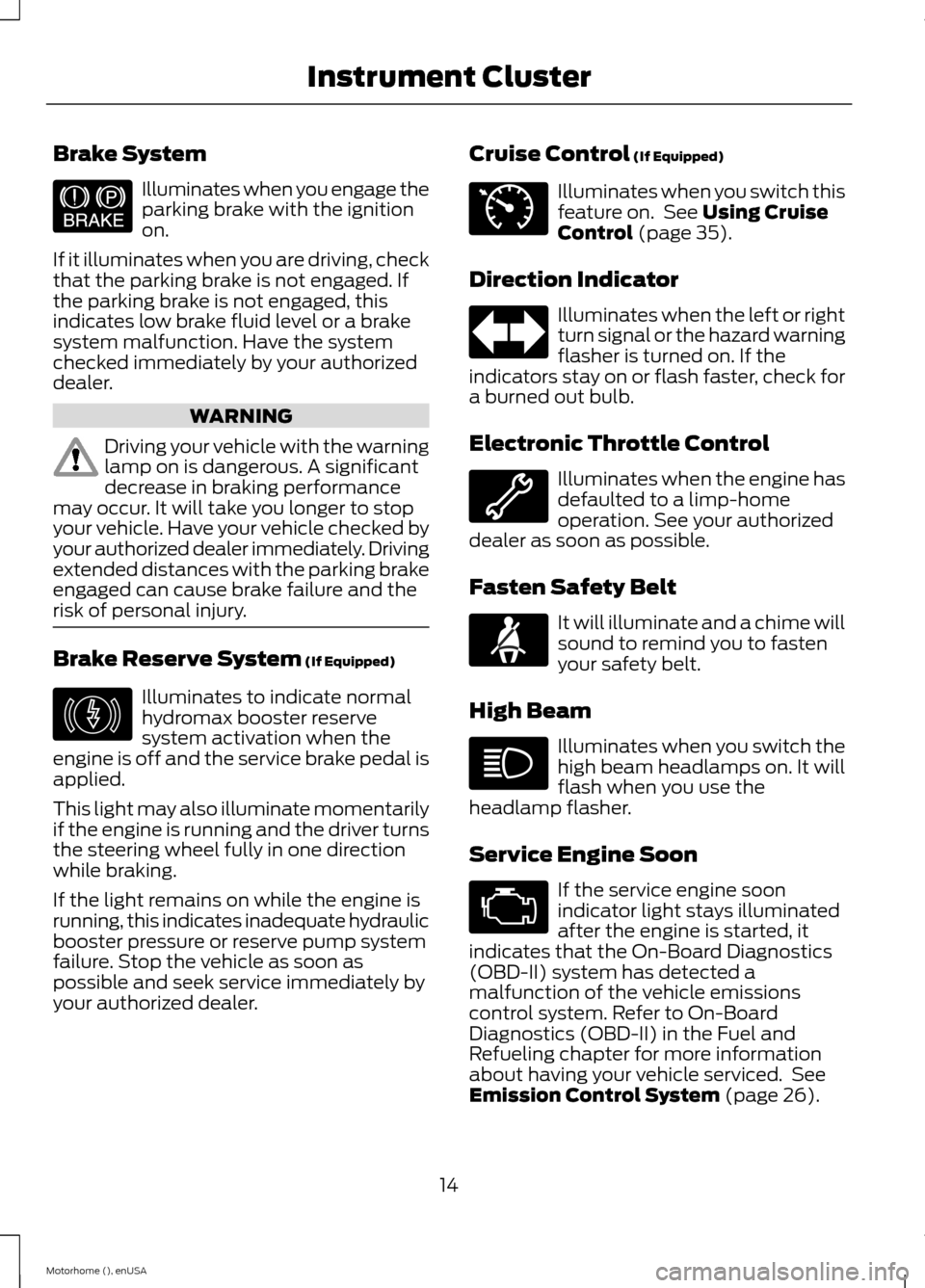
Brake System
Illuminates when you engage theparking brake with the ignitionon.
If it illuminates when you are driving, checkthat the parking brake is not engaged. Ifthe parking brake is not engaged, thisindicates low brake fluid level or a brakesystem malfunction. Have the systemchecked immediately by your authorizeddealer.
WARNING
Driving your vehicle with the warninglamp on is dangerous. A significantdecrease in braking performancemay occur. It will take you longer to stopyour vehicle. Have your vehicle checked byyour authorized dealer immediately. Drivingextended distances with the parking brakeengaged can cause brake failure and therisk of personal injury.
Brake Reserve System (If Equipped)
Illuminates to indicate normalhydromax booster reservesystem activation when theengine is off and the service brake pedal isapplied.
This light may also illuminate momentarilyif the engine is running and the driver turnsthe steering wheel fully in one directionwhile braking.
If the light remains on while the engine isrunning, this indicates inadequate hydraulicbooster pressure or reserve pump systemfailure. Stop the vehicle as soon aspossible and seek service immediately byyour authorized dealer.
Cruise Control (If Equipped)
Illuminates when you switch thisfeature on. See Using CruiseControl (page 35).
Direction Indicator
Illuminates when the left or rightturn signal or the hazard warningflasher is turned on. If theindicators stay on or flash faster, check fora burned out bulb.
Electronic Throttle Control
Illuminates when the engine hasdefaulted to a limp-homeoperation. See your authorizeddealer as soon as possible.
Fasten Safety Belt
It will illuminate and a chime willsound to remind you to fastenyour safety belt.
High Beam
Illuminates when you switch thehigh beam headlamps on. It willflash when you use theheadlamp flasher.
Service Engine Soon
If the service engine soonindicator light stays illuminatedafter the engine is started, itindicates that the On-Board Diagnostics(OBD-II) system has detected amalfunction of the vehicle emissionscontrol system. Refer to On-BoardDiagnostics (OBD-II) in the Fuel andRefueling chapter for more informationabout having your vehicle serviced. SeeEmission Control System (page 26).
14Motorhome (), enUSAInstrument ClusterE144522 E146190 E71340
Page 29 of 144
Keep a record for at least 1 month andrecord the type of driving (city or highway).This provides an accurate estimate of thevehicle’s fuel economy under currentdriving conditions. Additionally, keepingrecords during summer and winter showhow temperature impacts fuel economy.In general, lower temperatures mean lowerfuel economy.
Conditions
•Heavily loading a vehicle or towing atrailer may reduce fuel economy at anyspeed.
•Carrying unnecessary weight mayreduce fuel economy (approximately1 mpg [0.4 km/L] is lost for every 400pounds [180 kilograms] of weightcarried).
•Adding certain accessories to yourvehicle (for example bug deflectors,rollbars/light bars, running boards, skiracks) may reduce fuel economy.
•Using fuel blended with alcohol maylower fuel economy.
•Fuel economy may decrease with lowertemperatures during the first 8–10miles (12–16 kilometers) of driving.
•Driving on flat terrain offers improvedfuel economy as compared to drivingon hilly terrain.
•Transmissions give their best fueleconomy when operated in the topcruise gear and with steady pressureon the gas pedal.
•Close windows for high speed driving.
EMISSION CONTROL SYSTEM
WARNINGS
Do not park, idle, or drive your vehiclein dry grass or other dry ground cover.The emission system heats up theengine compartment and exhaust system,which can start a fire.
Exhaust leaks may result in entry ofharmful and potentially lethal fumesinto the passenger compartment. Ifyou smell exhaust fumes inside yourvehicle, have your dealer inspect yourvehicle immediately. Do not drive if yousmell exhaust fumes.
Your vehicle is equipped with variousemission control components and acatalytic converter that will enable yourvehicle to comply with applicable exhaustemission standards. To make sure that thecatalytic converter and other emissioncontrol components continue to workproperly:
•Use only the specified fuel listed.
•Avoid running out of fuel.
•Do not turn off the ignition while yourvehicle is moving, especially at highspeeds.
•Have the items listed in scheduledmaintenance information performedaccording to the specified schedule.
The scheduled maintenance items listedin scheduled maintenance information areessential to the life and performance ofyour vehicle and to its emissions system.
If you use parts other than Ford, Motorcraftor Ford-authorized parts for maintenancereplacements, or for service ofcomponents affecting emission control,such non-Ford parts should be theequivalent to genuine Ford Motor Companyparts in performance and durability.
26Motorhome (), enUSAFuel and Refueling
Page 38 of 144
PRINCIPLE OF OPERATION
Cruise control lets you maintain a setspeed without keeping your foot on theaccelerator pedal. You can use cruisecontrol when your vehicle speed is greaterthan 20 mph (30 km/h).
USING CRUISE CONTROL
WARNINGS
Do not use cruise control in heavytraffic, on winding roads or when theroad surface is slippery. This couldresult in loss of vehicle control, seriousinjury or death.
When you are going downhill, yourvehicle speed may increase abovethe set speed. The system will notapply the brakes. Change down a gear toassist the system in maintaining the setspeed. Failure to do so could result in lossof vehicle control, serious injury or death.
Note:Cruise control will disengage if yourvehicle speed decreases more than 10 mph(16 km/h) below your set speed whiledriving uphill.
The cruise controls are located on thesteering wheel.
Switching Cruise Control On
Press and release ON.
The indicator will display in theinstrument cluster.
Setting a Speed
1.Accelerate to the desired speed.
2.Press and release SET ACCEL.
3.Take your foot off the acceleratorpedal.
Changing the Set Speed
•Press and hold SET ACCEL to increaseor COAST to decrease the set speed.Release the control when you reachthe desired speed.
•Press and release SET ACCEL toincrease or COAST to decrease. Theset speed will change in approximately1 mph (2 km/h) increments.
•Press the accelerator or brake pedaluntil you reach the desired speed. Pressand release SET ACCEL.
Canceling the Set Speed
Tap the brake pedal. The set speed willnot erase.
Resuming the Set Speed
Press and release RES.
Switching Cruise Control Off
Note:You will erase the set speed if youswitch the system off.
Press and release OFF or switch theignition off.
35Motorhome (), enUSACruise ControlE161518 E71340
Page 53 of 144
•Transmissions give their best fueleconomy when operated in the topcruise gear and with steady pressureon the gas pedal.
•Four-wheel-drive operation (ifequipped) is less fuel efficient thantwo-wheel-drive operation.
•Close the windows for high-speeddriving.
DRIVING THROUGH WATER
WARNING
Do not drive through flowing or deepwater as you may lose control of yourvehicle.
Note:Driving through standing water cancause vehicle damage.
Note:Engine damage can occur if waterenters the air filter.
Before driving through standing water,check the depth. Never drive through waterthat is higher than the bottom of the wheelhubs.
When driving through standing water, drivevery slowly and do not stop your vehicle.Your brake performance and traction maybe limited. After driving through water andas soon as it is safe to do so:
•Lightly press the brake pedal to dry thebrakes and to check that they work.
•Check that the horn works.
•Check that the exterior lights work.
•Turn the steering wheel to check thatthe steering power assist works.
50Motorhome (), enUSADriving HintsE176913
Page 140 of 144
A
About This Manual...........................................3Protecting the Environment................................3ABSSee: Brakes.............................................................33ABS driving hintsSee: Hints on Driving With Anti-LockBrakes..................................................................33AccessoriesSee: Replacement PartsRecommendation..............................................6Adjusting the Steering Wheel......................8Audible Warnings and Indicators..............15Fail-Safe Cooling Warning Chime...................15Headlamps On Warning Chime.......................15Key in Ignition Warning Chime..........................15Parking Brake On Warning Chime...................15Automatic Transmission.............................29Brake-Shift Interlock............................................31If Your Vehicle Gets Stuck In Mud orSnow....................................................................32Understanding the Positions of YourAutomatic Transmission..............................29Automatic Transmission FluidCheck...............................................................78Adjusting automatic transmission fluidlevels....................................................................79Automatic transmission fluid filter................79Correct fluid level..................................................78High fluid level.......................................................79Low fluid level........................................................78
B
Brake Fluid Check...........................................79Hydroboost............................................................80Hydromax...............................................................80Parking brake fluid................................................81Brakes.................................................................33General Information............................................33Breaking-In.......................................................49
C
California Proposition 65...............................5
Capacities and Specifications -6.8L..................................................................114Specifications.......................................................115Capacities and Specifications..................110Car WashSee: Cleaning the Exterior................................86Changing a Fuse.............................................70Fuses.........................................................................70Changing a Road Wheel............................106Dissimilar Spare Wheel and Tire AssemblyInformation......................................................106Tire Change Procedure.....................................107Changing the 12V Battery............................82Battery relearn.......................................................83Changing the Engine Air Filter...................84Cleaning the Alloy Wheels..........................87Cleaning the Engine......................................86Cleaning the Exterior....................................86Cleaning Plastic Exterior Parts.......................86Exterior Chrome...................................................86Stripes or Graphics (if equipped)..................86Underbody.............................................................86Coolant CheckSee: Engine Coolant Check...............................75Cruise Control....................................................8Principle of Operation.........................................35Cruise controlSee: Using Cruise Control..................................35Customer Assistance...................................55
D
Daytime Running Lamps...............................11Direction Indicators..........................................11Driving Hints.....................................................49Driving Through Water.................................50DRLSee: Daytime Running Lamps...........................11
E
Economical Driving.......................................49Emission Control System............................26On-Board Diagnostics (OBD-II)......................27Readiness for Inspection/Maintenance(I/M) Testing......................................................27
137Motorhome (), enUSAIndex