Page 7 of 144
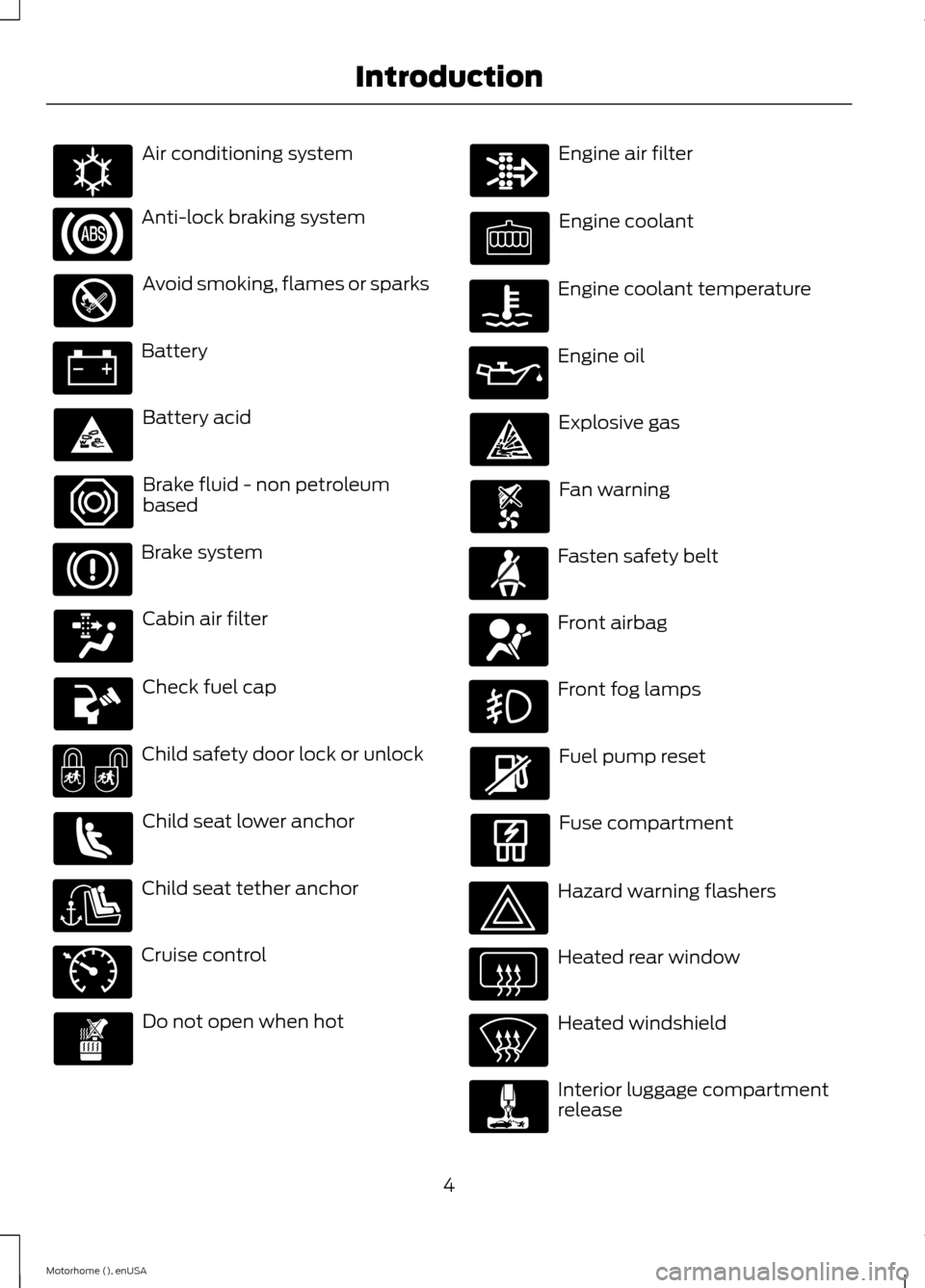
Air conditioning system
Anti-lock braking system
Avoid smoking, flames or sparks
Battery
Battery acid
Brake fluid - non petroleumbased
Brake system
Cabin air filter
Check fuel cap
Child safety door lock or unlock
Child seat lower anchor
Child seat tether anchor
Cruise control
Do not open when hot
Engine air filter
Engine coolant
Engine coolant temperature
Engine oil
Explosive gas
Fan warning
Fasten safety belt
Front airbag
Front fog lamps
Fuel pump reset
Fuse compartment
Hazard warning flashers
Heated rear window
Heated windshield
Interior luggage compartmentrelease
4Motorhome (), enUSAIntroductionE162384 E71340
Page 49 of 144
Before Towing a Trailer
Practice turning, stopping andbacking up to get the feel of yourvehicle-trailer combination beforestarting on a trip. When turning,make wider turns so the trailerwheels clear curbs and otherobstacles.
When Towing a Trailer
•Do not drive faster than70 mph (113 km/h) during thefirst 500 mi (800 km).
•Do not make full-throttlestarts.
•Check your hitch, electricalconnections and trailer wheellug nuts thoroughly after youhave traveled 50 mi (80 km).
•When stopped in congested orheavy traffic during hotweather, place the gearshift inpark (P) to aid engine andtransmission cooling and tohelp air conditioningperformance.
•Switch off the speed controlwith heavy loads or in hillyterrain. The speed control mayturn off automatically whenyou are towing on long, steep
grades.
•Shift to a lower gear whendriving down a long or steephill. Do not apply the brakescontinuously, as they mayoverheat and become lesseffective.
•If your transmission is equippedwith a Grade Assist orTow/Haul feature, use thisfeature when towing. Thisprovides engine braking andhelps eliminate excessivetransmission shifting foroptimum fuel economy andtransmission cooling.
•Allow more distance forstopping with a trailerattached. Anticipate stops andbrake gradually.
•Avoid parking on a grade.However, if you must park on agrade:
1.Turn the steering wheel topoint your vehicle tires awayfrom traffic flow.
2.Set your vehicle parking brake.
3.Place the automatictransmission in park (P).
4.Place wheel chocks in the frontand back of the trailer wheels.(Chocks not included withvehicle.)
Launching or Retrieving a Boator Personal Watercraft (PWC)
Note:Disconnect the wiring to thetrailer before backing the trailerinto the water.
Note:Reconnect the wiring to thetrailer after removing the trailerfrom the water.
46Motorhome (), enUSATowing
Page 64 of 144
FUSE SPECIFICATION CHART
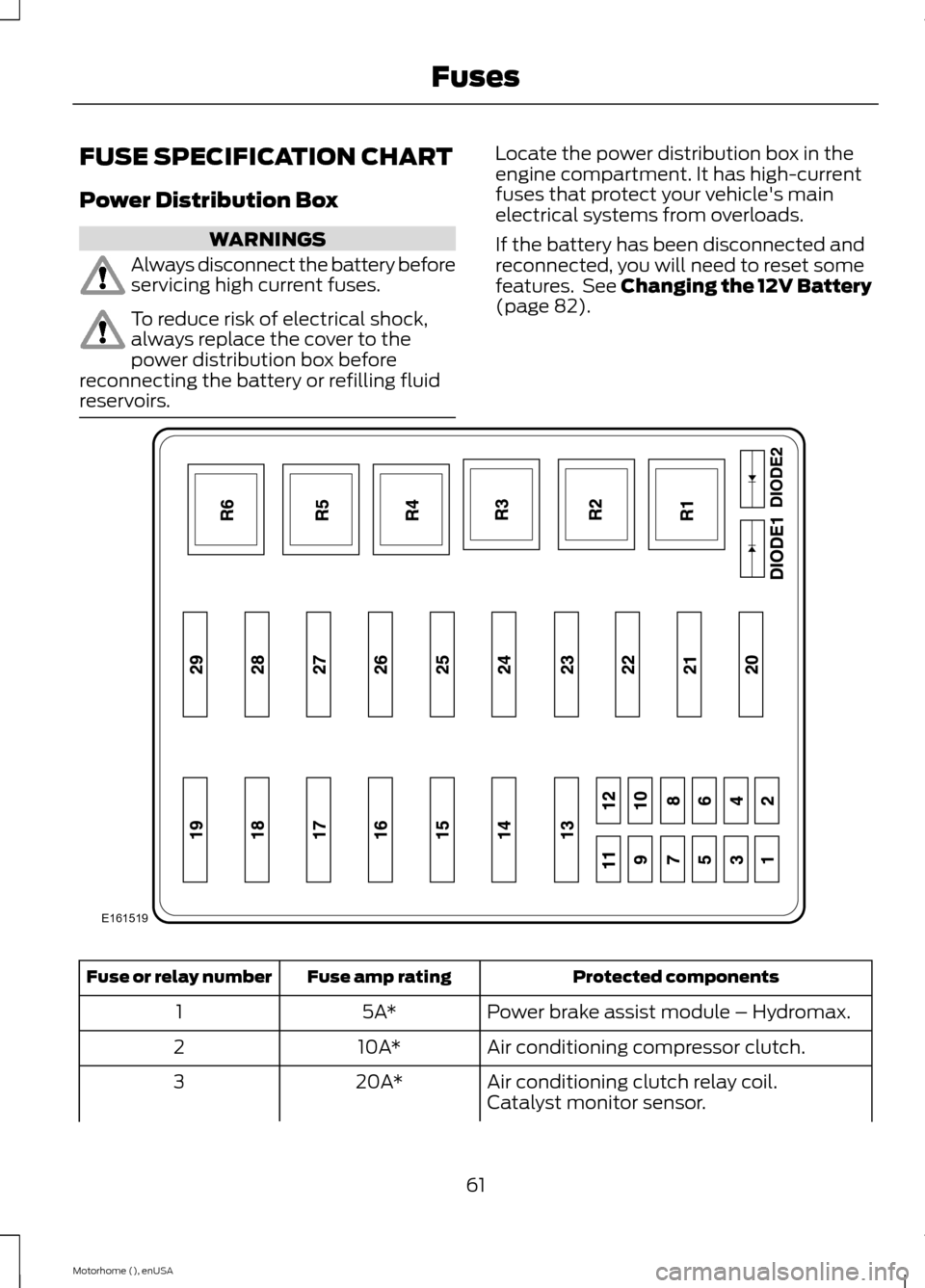
Power Distribution Box
WARNINGS
Always disconnect the battery beforeservicing high current fuses.
To reduce risk of electrical shock,always replace the cover to thepower distribution box beforereconnecting the battery or refilling fluidreservoirs.
Locate the power distribution box in theengine compartment. It has high-currentfuses that protect your vehicle's mainelectrical systems from overloads.
If the battery has been disconnected andreconnected, you will need to reset somefeatures. See Changing the 12V Battery(page 82).
Protected componentsFuse amp ratingFuse or relay number
Power brake assist module – Hydromax.5A*1
Air conditioning compressor clutch.10A*2
Air conditioning clutch relay coil.20A*3Catalyst monitor sensor.
61Motorhome (), enUSAFusesE161519
Page 66 of 144
Protected componentsFuse amp ratingFuse or relay number
Backup lamp feed.20A**18Tow/haul switch.Transmission control indicator light.
Not used.—19
Powertrain control module relay coil.30A**20Powertrain control module relay (Powerdistribution box fuses # 3, 5, 7, 18).
Fuel injectors.20A**21Fuel pump motor.
Cigar lighter feed.20A**22Diagnostic tool connector.
Blower motor feed.40A**23
Instrument panel battery feed (fuses #4,10, 16, 22).50A**24
Ignition switch feed (Instrument panelfuses #1, 5, 7, 11, 13, 14, 17, 19, 23; Powerdistribution box fuses #9, 11).
40A**25
Ignition switch feed (Instrument panelfuses #5, 11, 17, 23, 26, 38).40A**26
Multi-function switch (headlamps).30A**27
Starter solenoid.30A**28
Power brake assist motor – Hydromax.60A**29
Anti-lock brake system module – Hydro-boost.40A**
Air conditioning clutch relay.—R1
Fuel pump relay.—R2
Horn relay.—R3
Starter relay.—R4
Blower motor relay.—R5
Powertrain control module relay.—R6
63Motorhome (), enUSAFuses
Page 67 of 144
Protected componentsFuse amp ratingFuse or relay number
Fuel pump diode.—Diode 1
Air conditioning clutch diode.—Diode 2
*Mini fuses.
**Maxi fuses.
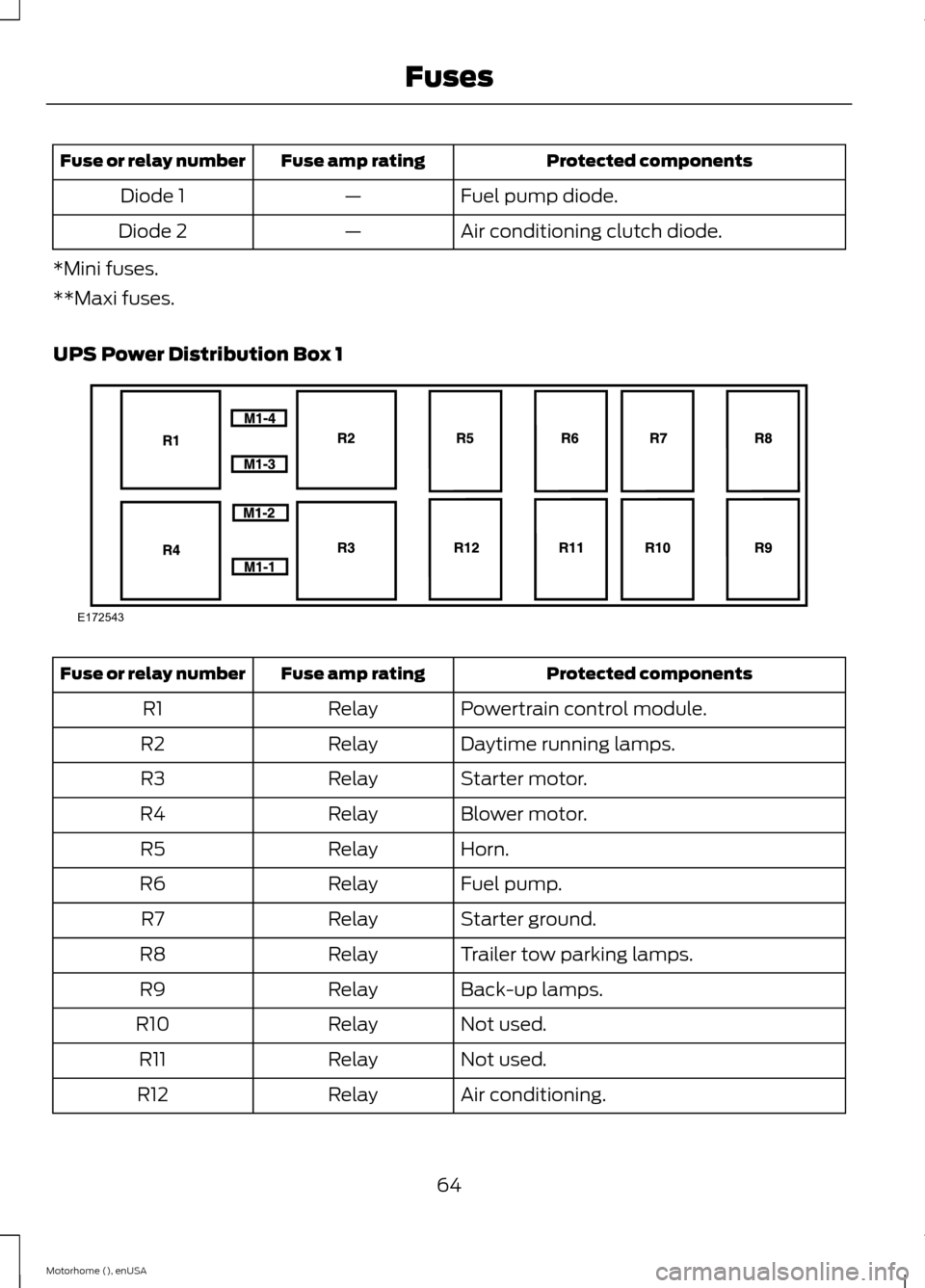
UPS Power Distribution Box 1
Protected componentsFuse amp ratingFuse or relay number
Powertrain control module.RelayR1
Daytime running lamps.RelayR2
Starter motor.RelayR3
Blower motor.RelayR4
Horn.RelayR5
Fuel pump.RelayR6
Starter ground.RelayR7
Trailer tow parking lamps.RelayR8
Back-up lamps.RelayR9
Not used.RelayR10
Not used.RelayR11
Air conditioning.RelayR12
64Motorhome (), enUSAFusesE172543
Page 68 of 144
Protected componentsFuse amp ratingFuse or relay number
Hydromax brake on/off relay.10AM1-1
Not used.—M1-2
Not used.—M1-3
Not used.—M1-4
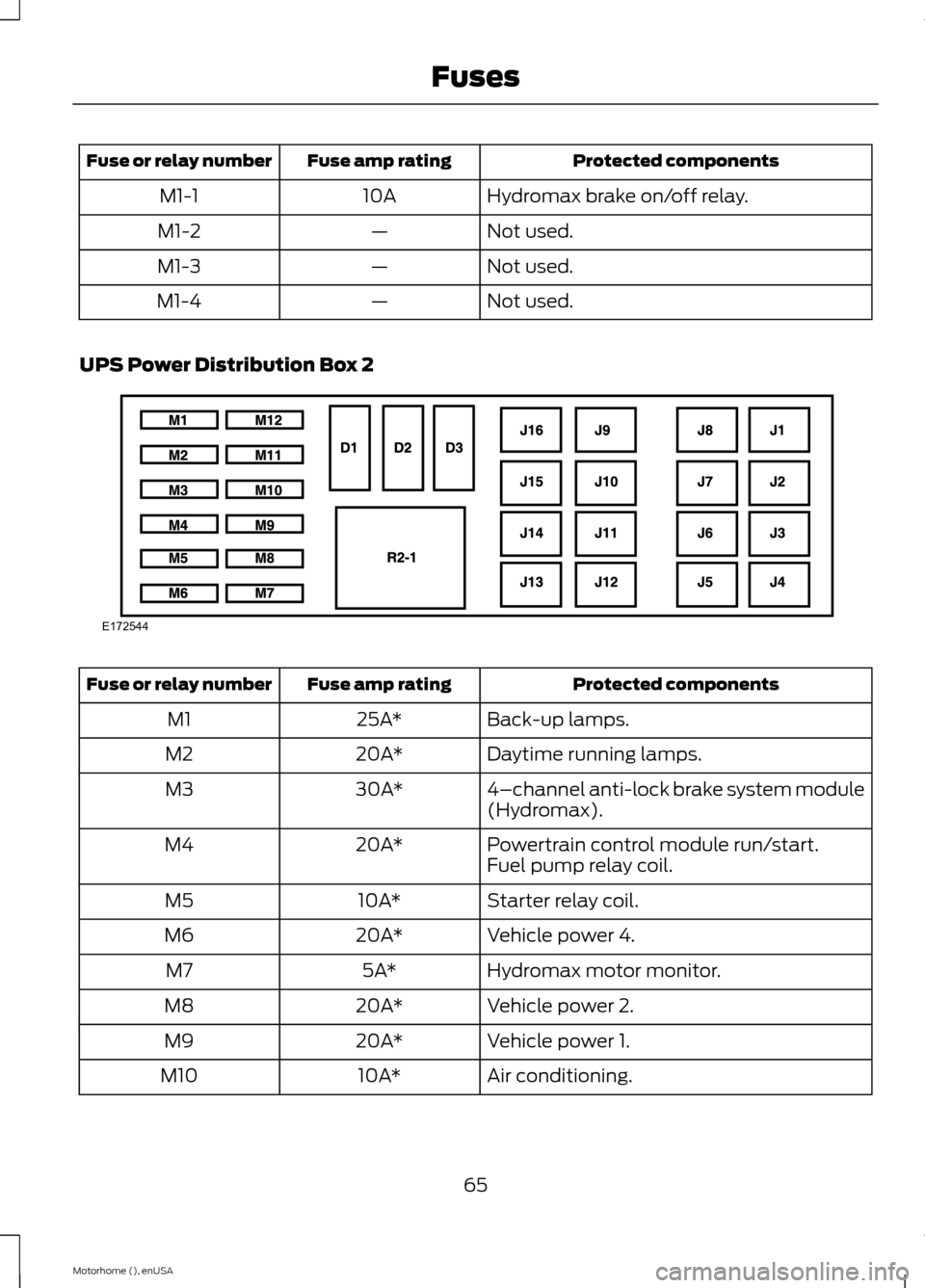
UPS Power Distribution Box 2
Protected componentsFuse amp ratingFuse or relay number
Back-up lamps.25A*M1
Daytime running lamps.20A*M2
4–channel anti-lock brake system module(Hydromax).30A*M3
Powertrain control module run/start.20A*M4Fuel pump relay coil.
Starter relay coil.10A*M5
Vehicle power 4.20A*M6
Hydromax motor monitor.5A*M7
Vehicle power 2.20A*M8
Vehicle power 1.20A*M9
Air conditioning.10A*M10
65Motorhome (), enUSAFusesE172544
Page 69 of 144
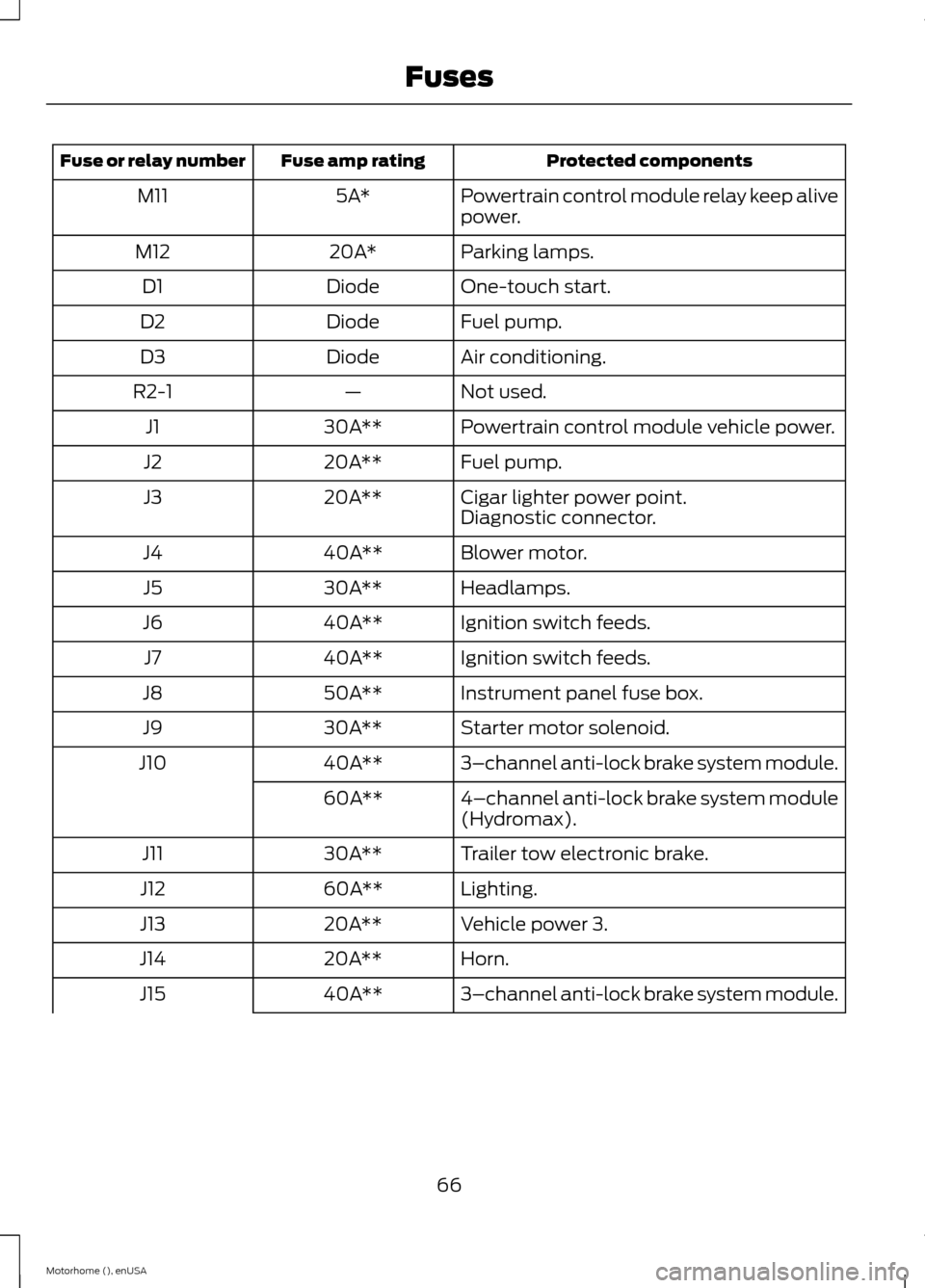
Protected componentsFuse amp ratingFuse or relay number
Powertrain control module relay keep alivepower.5A*M11
Parking lamps.20A*M12
One-touch start.DiodeD1
Fuel pump.DiodeD2
Air conditioning.DiodeD3
Not used.—R2-1
Powertrain control module vehicle power.30A**J1
Fuel pump.20A**J2
Cigar lighter power point.20A**J3Diagnostic connector.
Blower motor.40A**J4
Headlamps.30A**J5
Ignition switch feeds.40A**J6
Ignition switch feeds.40A**J7
Instrument panel fuse box.50A**J8
Starter motor solenoid.30A**J9
3–channel anti-lock brake system module.40A**J10
4–channel anti-lock brake system module(Hydromax).60A**
Trailer tow electronic brake.30A**J11
Lighting.60A**J12
Vehicle power 3.20A**J13
Horn.20A**J14
3–channel anti-lock brake system module.40A**J15
66Motorhome (), enUSAFuses
Page 80 of 144
What you Should Know About Fail-Safe Cooling
If you deplete the engine coolant supply,this feature allows you to drive your vehicletemporarily before you incur incrementalcomponent damage. The fail-safe distancedepends on ambient temperatures, vehicleload and terrain.
How Fail-Safe Cooling Works
If the engine begins to overheat, the enginecoolant temperature gauge will move tothe red (hot) area and:
The coolant temperaturewarning indicator will light.
The service engine soonindicator will light.
If the engine reaches a presetover-temperature condition, the enginewill automatically switch to alternatingcylinder operation. Each disabled cylinderacts as an air pump and cools the engine.
When this occurs, the vehicle will stilloperate. However:
•The engine power will be limited.
•This will disable the air conditioningsystem.
Continued operation will increase theengine temperature and the engine willcompletely shut down, causing steeringand braking effort to increase.
Once the engine temperature cools, theengine can be re-started. Take your vehicleto an authorized dealer as soon as possibleto minimize engine damage.
When Fail-Safe Mode Is Activated
WARNINGS
Fail-safe mode is for use duringemergencies only. Operate thevehicle in fail-safe mode only as longas necessary to bring the vehicle to rest ina safe location and seek immediate repairs.When in fail-safe mode, the vehicle willhave limited power, will not be able tomaintain high-speed operation and maycompletely shut down without warning,potentially losing engine power, powersteering assist and power brake assist,which may increase the possibility of acrash resulting in serious injury.
Never remove the coolant reservoircap while the engine is running or hot.
You have limited engine power when in thefail-safe mode, so drive the vehicle withcaution. The vehicle will not be able tomaintain high-speed operation and theengine will run rough. Remember that theengine is capable of completely shuttingdown automatically to prevent enginedamage, therefore:
1.Pull off the road as soon as safelypossible and switch off the engine.
2.Have your vehicle towed to anauthorized dealer.
3.If this is not possible, wait a shortperiod for the engine to cool.
4.Check the coolant level and replenishif low.
5.Re-start the engine and take yourvehicle to an authorized dealer.
Note:Driving the vehicle without repairingthe engine problem increases the chance ofengine damage. Take your vehicle to anauthorized dealer as soon as possible.
77Motorhome (), enUSAMaintenance