2015 FORD EXPLORER warning
[x] Cancel search: warningPage 47 of 596

3. Wait 10 seconds after the safety belt warning light turns off.
•Step 4 must be completed within 20 seconds after the completion of
Step 3.
4. For the seating position being disabled, buckle then unbuckle the
safety belt three times at a moderate speed, ending in the unbuckled
state.
•After Step 4, the safety belt warning light will be turned on for three
seconds.
5. Within about seven seconds of the light turning off, buckle then
unbuckle the safety belt.
•This will disable the feature for that seating position if it is currently
enabled.
•This will enable the feature for that seating position if it is currently
disabled.
REAR INFLATABLE SAFETY BELT (IF EQUIPPED)
WARNING:Do not attempt to service, repair, or modify the rear
inflatable safety belt as you could be seriously injured or killed.
Note:The rear inflatable safety belts are compatible with most infant
and child safety car seats and belt positioning booster seats when
properly installed. This is because they are designed to fill with a cool
gas at a lower pressure and at a slower rate than traditional airbags.
After inflation, the shoulder portion of the safety belt remains cool to the
touch.
The rear inflatable safety belts are located in the shoulder portion of the
safety belts of the second-row outboard seating positions.
The rear inflatable safety belt consists of the following:
•An inflatable bag located in the shoulder safety belt webbing.
•Lap safety belt webbing with automatic locking mode.
•Crash sensors and monitoring system with readiness
indicator.
SeeCrash Sensors and Airbag Indicatorin theSupplemental
Restraint Systemchapter.
46Safety Belts
2015 Explorer(exp)
Owners Guide gf, 2nd Printing, September 2014
USA(fus)
Page 48 of 596
How Does the Rear Inflatable Safety Belt System Work?
WARNING:If the rear inflatable safety belt has deployed, it will
not function again. The rear inflatable safety belt system must be
replaced by an authorized dealer.
•The rear inflatable safety belts will function like standard restraints in
everyday usage.
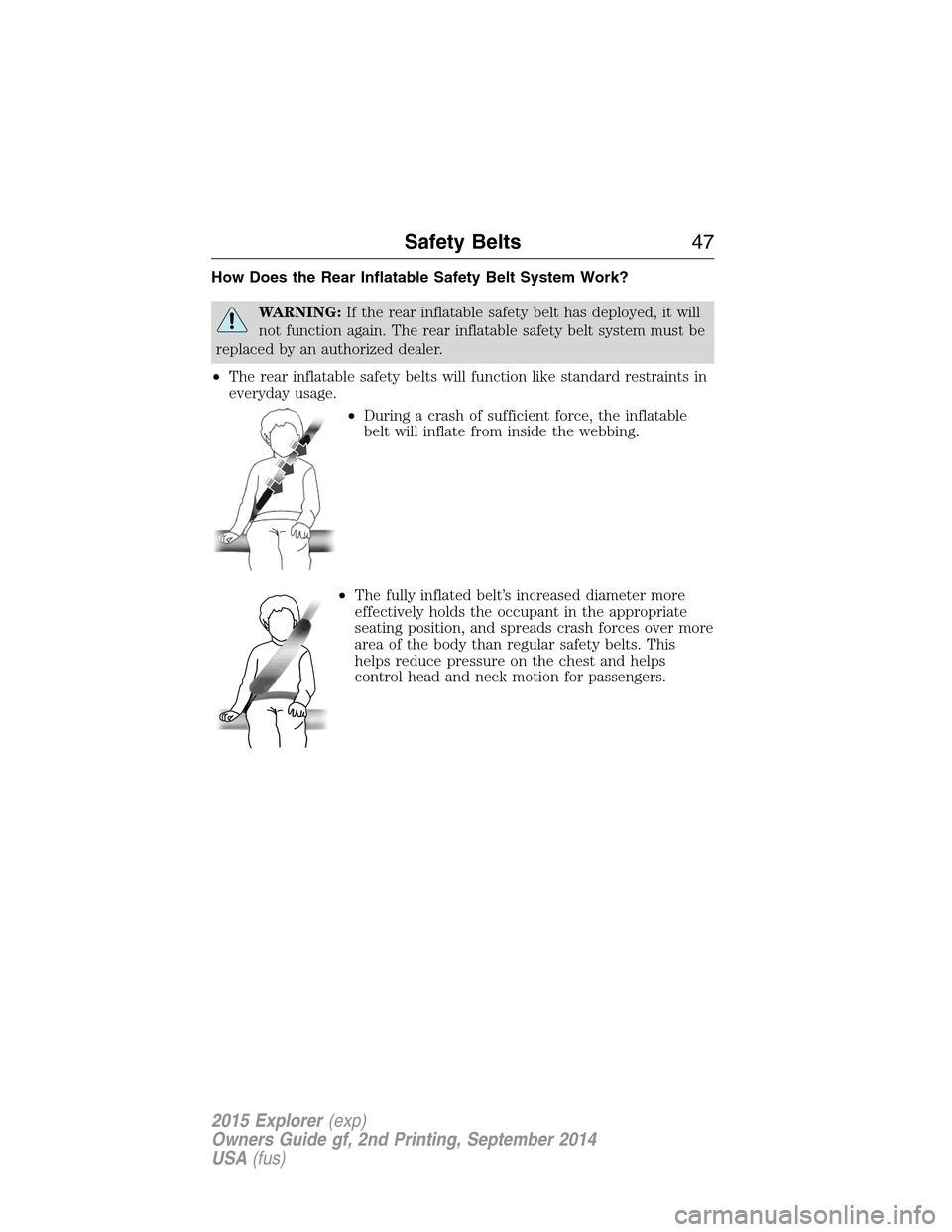
•During a crash of sufficient force, the inflatable
belt will inflate from inside the webbing.
•The fully inflated belt’s increased diameter more
effectively holds the occupant in the appropriate
seating position, and spreads crash forces over more
area of the body than regular safety belts. This
helps reduce pressure on the chest and helps
control head and neck motion for passengers.
Safety Belts47
2015 Explorer(exp)
Owners Guide gf, 2nd Printing, September 2014
USA(fus)
Page 50 of 596

PERSONAL SAFETY SYSTEM™
The Personal Safety System provides an improved overall level of frontal
crash protection to front seat occupants and is designed to help further
reduce the risk of airbag-related injuries. The system is able to analyze
different occupant conditions and crash severity before activating the
appropriate safety devices to help better protect a range of occupants in
a variety of frontal crash situations.
Your vehicle’s Personal Safety System consists of:
•Driver and passenger dual-stage airbag supplemental restraints.
•Front outboard safety belts with pretensioners, energy management
retractors (first row only), and safety belt usage sensors.
•Driver seat position sensor.
•Front passenger sensing system.
•Passenger airbag off and on indicator lamp.
•Front crash severity sensors.
•Restraints control module with impact and safing sensors.
•Restraint system warning light and backup tone.
•The electrical wiring for the airbags, crash sensor(s), safety belt
pretensioners, front safety belt usage sensors, driver seat position
sensor, front passenger sensing system, and indicator lights.
How Does the Personal Safety System Work?
The Personal Safety System can adapt the deployment strategy of your
vehicle’s safety devices according to crash severity and occupant
conditions. A collection of crash and occupant sensors provides
information to the restraints control module. During a crash, the
restraints control module may activate the safety belt pretensioners
and/or either one or both stages of the dual-stage airbag supplemental
restraints based on crash severity and occupant conditions.
Personal Safety System49
2015 Explorer(exp)
Owners Guide gf, 2nd Printing, September 2014
USA(fus)
Page 51 of 596
PRINCIPLES OF OPERATION
WARNING:Airbags do not inflate slowly or gently, and the risk
of injury from a deploying airbag is the greatest close to the trim
covering the airbag module.
WARNING:All occupants of your vehicle, including the driver,
should always properly wear their safety belts, even when an
airbag supplemental restraint system is provided. Failure to properly
wear your safety belt could seriously increase the risk of injury or
death.
WARNING:Airbags can kill or injure a child in a child seat.
Always transport children 12 years old and under in the back
seat and always properly use appropriate child restraints.
WARNING:Never place your arm over the airbag module, as a
deploying airbag can result in serious arm fractures or other
injuries.
WARNING:Airbags can kill or injure a child in a child seat.
Never place a rear-facing child seat in front of an active airbag. If
you must use a forward-facing child seat in the front seat, move the
seat upon which the child seat is installed all the way back.
WARNING:Do not attempt to service, repair, or modify the
airbag supplemental restraint systems or its fuses as you could be
seriously injured or killed. Contact your authorized dealer as soon as
possible.
WARNING:Several airbag system components get hot after
inflation. Do not touch them after inflation as this may result in
serious injury.
50Supplementary Restraints System
2015 Explorer(exp)
Owners Guide gf, 2nd Printing, September 2014
USA(fus)
Page 52 of 596
WARNING:If the airbag has deployed, the airbag will not
function again and must be replaced immediately. If the airbag is
not replaced, the unrepaired area will increase the risk of injury in a
crash.
The airbags are a supplemental restraint system and are designed to
work with the safety belts to help protect the driver and right front
passenger from certain upper body injuries. Airbags do not inflate slowly;
there is a risk of injury from a deploying airbag.
Note:You will hear a loud bang and see a cloud of harmless powdery
residue if an airbag deploys. This is normal.
The airbags inflate and deflate rapidly upon activation. After airbag
deployment, it is normal to notice a smoke-like, powdery residue or smell
the burnt propellant. This may consist of cornstarch, talcum powder (to
lubricate the bag) or sodium compounds (for example, baking soda) that
result from the combustion process that inflates the airbag. Small
amounts of sodium hydroxide may be present which may irritate the skin
and eyes, but none of the residue is toxic.
While the system is designed to help reduce serious injuries, contact
with a deploying airbag may also cause abrasions or swelling. Temporary
hearing loss is also a possibility as a result of the noise associated with a
deploying airbag. Because airbags must inflate rapidly and with
considerable force, there is the risk of death or serious injuries, such as
fractures, facial and eye injuries or internal injuries, particularly to
occupants who are not properly restrained or are otherwise out of
position at the time of airbag deployment. Thus, it is extremely
important that occupants be properly restrained as far away from the
airbag module as possible while maintaining vehicle control.
Routine maintenance of the airbags is not required.
SOS POST-CRASH ALERT SYSTEM™
The system flashes the direction indicator lamps and the horn sounds
(intermittently) in the event of a serious impact that deploys an airbag
equipped on your vehicle.
The horn and lamps turn off when:
•You press the hazard button.
•You press the panic button (if equipped) on the remote entry
transmitter.
•Your vehicle runs out of power.
Supplementary Restraints System51
2015 Explorer(exp)
Owners Guide gf, 2nd Printing, September 2014
USA(fus)
Page 53 of 596

DRIVER AND PASSENGER AIRBAGS
WARNING:Never place your arm or any objects over an airbag
module. Placing your arm over a deploying airbag can result in
serious arm fractures or other injuries. Objects placed on or over the
airbag inflation area may cause those objects to be propelled by the
airbag into your face and torso causing serious injury.
WARNING:Airbags can kill or injure a child in a child seat.
Never place a rear-facing child seat in front of an active airbag. If
you must use a forward-facing child seat in the front seat, move the
seat upon which the child seat is installed all the way back.
The driver and front passenger
airbags will deploy during significant
frontal and near-frontal crashes.
The driver and passenger front airbag system consists of:
•Driver and passenger airbag modules.
•Front passenger sensing system.
•Crash sensors and monitoring system with readiness
indicator. SeeCrash Sensors and Airbag Indicatorlater in
this chapter.
Proper Driver and Front Passenger Seating Adjustment
WARNING:The National Highway Traffic Safety Administration
recommends a minimum distance of at least 10 inches (25
centimeters) between an occupant’s chest and the driver airbag module.
To properly position yourself away from the airbag:
•Move your seat to the rear as far as you can while still reaching the
pedals comfortably.
52Supplementary Restraints System
2015 Explorer(exp)
Owners Guide gf, 2nd Printing, September 2014
USA(fus)
Page 54 of 596

•Recline the seat slightly (one or two degrees) from the upright
position.
After all occupants have adjusted their seats and put on safety belts, it is
very important that they continue to sit properly. Properly seated
occupants sit upright, lean against the seat back, and center themselves
on the seat cushion, with their feet comfortably extended on the floor.
Sitting improperly can increase the chance of injury in a crash event. For
example, if an occupant slouches, lies down, turns sideways, sits forward,
leans forward or sideways, or puts one or both feet up, the chance of
injury during a crash is greatly increased.
Children and Airbags
WARNING:Airbags can kill or injure a child in a child seat.
Never place a rear-facing child seat in front of an active airbag. If
you must use a forward-facing child seat in the front seat, move the
seat upon which the child seat is installed all the way back.
Children must always be properly
restrained. Accident statistics
suggest that children are safer when
properly restrained in the rear
seating positions than in the front
seating position. Failure to follow
these instructions may increase the
risk of injury in a crash.
Knee Airbag System (Passenger Side Only)
The knee airbag is located under the instrument panel. During a crash,
the restraints control module may activate the passenger knee airbag
based on crash severity and occupant conditions. Under certain crash
and occupant conditions, the passenger knee airbag may deploy but the
passenger front airbag may not activate.
As with front and side airbags, it is important to be properly seated and
restrained to reduce the risk of death or serious injury.
Supplementary Restraints System53
2015 Explorer(exp)
Owners Guide gf, 2nd Printing, September 2014
USA(fus)
Page 55 of 596

FRONT PASSENGER SENSING SYSTEM
WARNING:Even with Advanced Restraints Systems, children 12
and under should be properly restrained in a rear seating position.
Failure to follow this could seriously increase the risk of injury or death.
WARNING:Sitting improperly out of position or with the seat
back reclined too far can take off weight from the seat cushion
and affect the decision of the front passenger sensing system, resulting
in serious injury or death in a crash.
Always sit upright against your seat back, with your feet on the floor.
WARNING:Any alteration or modification to the front passenger
seat may affect the performance of the front passenger sensing
system which could seriously increase the risk of injury or death.
This system works with sensors that are part of the front passenger’s
seat and safety belt to detect the presence of a properly seated occupant
and determine if the front passenger’s frontal airbag should be enabled
(may inflate) or not.
The front passenger sensing system
uses a passenger airbag status
indicator which will illuminate
indicating that the front passenger
frontal airbag is either ON (enabled)
or OFF (disabled). The indicator
lamp is located in the center stack of
the instrument panel.
Note:When the ignition is first turned on, the passenger airbag status
indicator OFF and ON lamps will illuminate for a short period of time to
confirm they are functional.
54Supplementary Restraints System
2015 Explorer(exp)
Owners Guide gf, 2nd Printing, September 2014
USA(fus)