2015 FORD EXPEDITION air suspension
[x] Cancel search: air suspensionPage 212 of 564
Avoid sudden applications of power and quick changes of direction on
snow and ice. Apply the accelerator slowly and steadily when starting
from a full stop.
Avoid sudden braking as well. Although a 4WD vehicle may accelerate
better than a two-wheel drive vehicle in snow and ice, it won’t stop any
faster, because as in other vehicles, braking occurs at all four wheels. Do
not become overconfident as to road conditions.
Make sure you allow sufficient distance between you and other vehicles
for stopping. Drive slower than usual and consider using one of the lower
gears. In emergency stopping situations, apply the brake steadily. Do not
pump the brakes. Refer to theBrakessection of this chapter for
additional information on the operation of the Anti-lock Brake System
(ABS).
Maintenance and modifications
The suspension and steering systems on your vehicle have been designed
and tested to provide predictable performance whether loaded or empty
and durable load carrying capability. For this reason, Ford Motor
Company strongly recommends that you do not make modifications such
as adding or removing parts (such as lift kits or stabilizer bars) or by
using replacement parts not equivalent to the original factory equipment.
Any modifications to a vehicle that raise the center of gravity can make
it more likely the vehicle will roll over as a result of a loss of control.
Ford Motor Company recommends that caution be used with any vehicle
equipped with a high load or device (such as ladder racks or pickup box
cover).
Failure to maintain your vehicle properly may void the warranty, increase
your repair cost, reduce vehicle performance and operational capabilities
and adversely affect driver and passenger safety. Frequent inspection of
vehicle chassis components is recommended if the vehicle is subjected to
heavy off-road usage.
Four-Wheel Drive (If Equipped)211
2015 Expedition(exd)
Owners Guide gf, 1st Printing, July 2014
USA(fus)
Page 341 of 564
WARNING:Do not spin the wheels at over 35 mph (56 km/h).
The tires may fail and injure a passenger or bystander.
Driving habits have a great deal to do with your tire mileage and safety.
•Observe posted speed limits.
•Avoid fast starts, stops and turns.
•Avoid potholes and objects on the road.
•Do not run over curbs or hit the tire against a curb when parking.
Highway Hazards
No matter how carefully you drive, there is always the possibility that
you may eventually have a flat tire on the highway. Drive slowly to the
closest safe area out of traffic. This may further damage the flat tire, but
your safety is more important.
If you feel a sudden vibration or ride disturbance while driving, or you
suspect your tire or vehicle has been damaged, immediately reduce your
speed. Drive with caution until you can safely pull off the road. Stop and
inspect the tires for damage. If a tire is under-inflated or damaged,
deflate it, remove the wheel and replace it with your spare tire and
wheel. If you cannot detect a cause, have the vehicle towed to the
nearest repair facility or tire dealer to have the vehicle inspected.
Tire and Wheel Alignment
A bad jolt from hitting a curb or pothole can cause the front end of your
vehicle to become misaligned or cause damage to your tires. If your
vehicle seems to pull to one side when you are driving, the wheels may
be out of alignment. Have an authorized dealer check the wheel
alignment periodically.
Wheel misalignment in the front or the rear can cause uneven and rapid
treadwear of your tires and should be corrected by an authorized dealer.
Front-wheel drive vehicles and those with an independent rear
suspension may require alignment of all four wheels.
The tires should also be balanced periodically. An unbalanced tire and
wheel assembly may result in irregular tire wear.
Tire Rotation
Note:If your tires show uneven wear ask an authorized dealer to check
for and correct any wheel misalignment, tire imbalance or mechanical
problem involved before tire rotation.
Note:Your vehicle may be equipped with a dissimilar spare tire and
wheel assembly. A dissimilar spare tire and wheel assembly is defined as
340Wheels and Tires
2015 Expedition(exd)
Owners Guide gf, 1st Printing, July 2014
USA(fus)
Page 343 of 564
The tires on your vehicle have all-weather treads to provide traction in
rain and snow. However, in some climates, you may need to use snow
tires and chains. If you need to use chains, it is recommended that steel
wheels (of the same size and specifications) be used, as chains may chip
aluminum wheels.
Follow these guidelines when using snow tires and chains:
•If possible, avoid fully loading your vehicle.
•Use only cable type chains or chains offered by Ford/Lincoln as an
accessory or equivalent. Other conventional link type chains may
contact and cause damage to the vehicle’s wheel house and/or body.
•Do not install chains on the front wheels as this may interfere with
suspension components.
•Only certain snow cables or chains have been approved by
Ford/Lincoln as safe for use on your vehicle with the following tires:
265/70R17 and 275/65R18.
•You should only install snow cables or chains that have been rated as
SAE Class S.
•Install chains securely, verifying that the chains do not touch any
wiring, brake lines or fuel lines.
•Do not exceed 30 mph (50 km/h) or less if recommended by the chain
manufacturer while using snow chains.
•Drive cautiously. If you hear the chains rub or bang against your
vehicle, stop and retighten the chains. If this does not work, remove
the chains to prevent damage to your vehicle.
•Remove the tire chains when they are no longer needed. Do not use
tire chains on dry roads.
•Purchase chains or cables from a manufacturer that clearly labels body
to tire dimension restrictions. The snow chains or cables must be
mounted in pairs on the rear tires only.
If you have any questions regarding snow chains or cables, please
contact your Ford/Lincoln dealer.
342Wheels and Tires
2015 Expedition(exd)
Owners Guide gf, 1st Printing, July 2014
USA(fus)
Page 542 of 564
Multi-point Inspection
In order to keep your vehicle running right, it is important to have the
systems on your vehicle checked regularly. This can help identify
potential issues and prevent major problems. Ford Motor Company
recommends the following multi-point inspection be performed at every
scheduled maintenance interval to help make sure your vehicle keeps
running great.
Multi-point inspection
Accessory drive belt(s) Hazard warning system operation
Battery performance Horn operation
Engine air filter Radiator, cooler, heater and A/C hoses
Exhaust system Suspension components for leaks or
damage
Exterior lamps operation Steering and linkage
Fluid levels
*; fill if necessary Tires (including spare) for wear and
proper pressure**
For oil and fluid leaks Windshield for cracks, chips or pits
Half-shaft dust boots Washer spray and wiper operation
*Brake, coolant recovery reservoir, automatic transmission, power
steering (if equipped) and window washer.
**If your vehicle is equipped with a temporary mobility kit, check the tire
sealant expiration Use By date on the canister. Replace as needed.
Be sure to ask your dealership service advisor or technician about the
multi-point vehicle inspection. It is a comprehensive way to perform a
thorough inspection of your vehicle. It is your checklist that gives you
immediate feedback on the overall condition of your vehicle. You will
know what has been checked, what is okay, as well as those things that
may require future or immediate attention. The multi-point vehicle
inspection is one more way to keep your vehicle running great!
Scheduled Maintenance541
2015 Expedition(exd)
Owners Guide gf, 1st Printing, July 2014
USA(fus)
Page 563 of 564
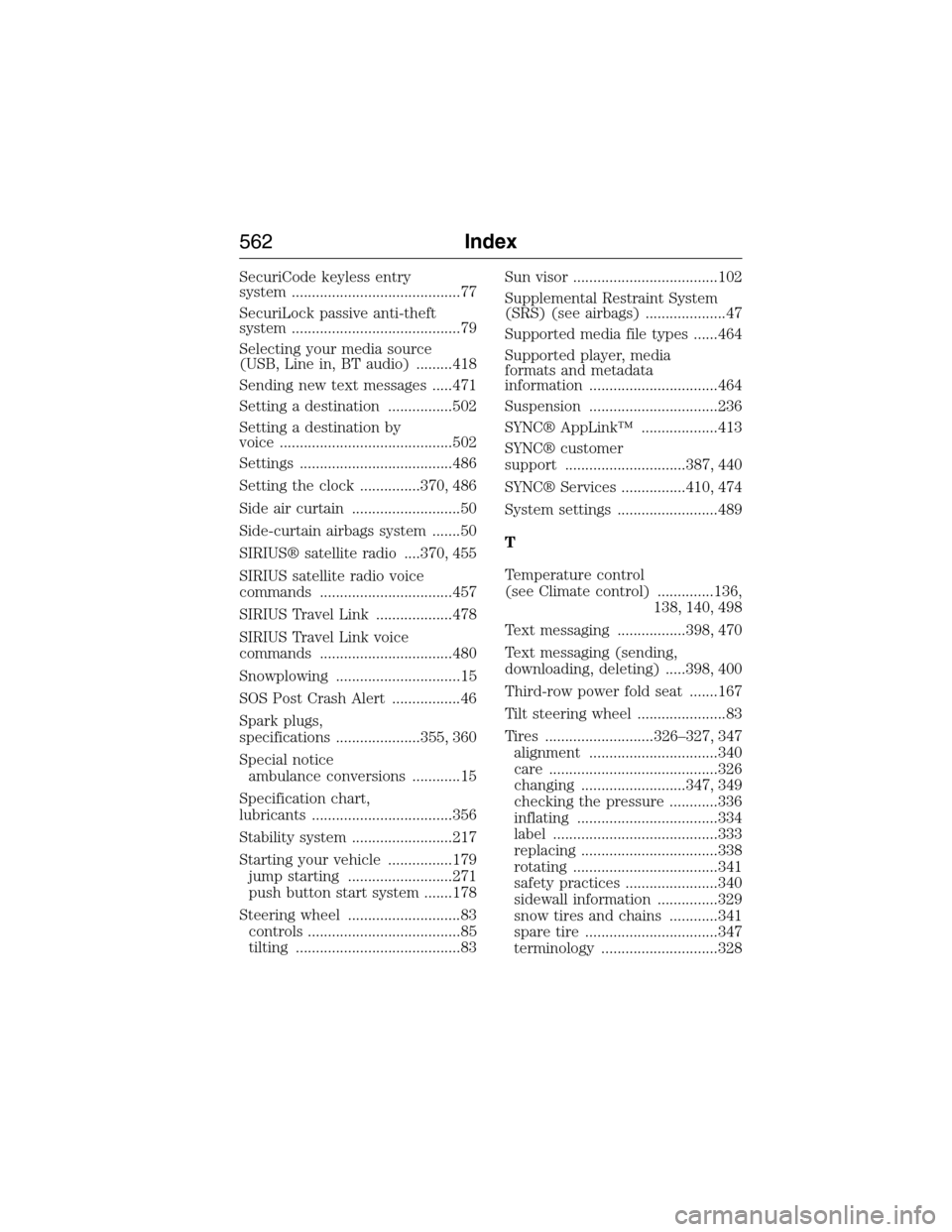
SecuriCode keyless entry
system ..........................................77
SecuriLock passive anti-theft
system ..........................................79
Selecting your media source
(USB, Line in, BT audio) .........418
Sending new text messages .....471
Setting a destination ................502
Setting a destination by
voice ...........................................502
Settings ......................................486
Setting the clock ...............370, 486
Side air curtain ...........................50
Side-curtain airbags system .......50
SIRIUS® satellite radio ....370, 455
SIRIUS satellite radio voice
commands .................................457
SIRIUS Travel Link ...................478
SIRIUS Travel Link voice
commands .................................480
Snowplowing ...............................15
SOS Post Crash Alert .................46
Spark plugs,
specifications .....................355, 360
Special notice
ambulance conversions ............15
Specification chart,
lubricants ...................................356
Stability system .........................217
Starting your vehicle ................179
jump starting ..........................271
push button start system .......178
Steering wheel ............................83
controls ......................................85
tilting .........................................83Sun visor ....................................102
Supplemental Restraint System
(SRS) (see airbags) ....................47
Supported media file types ......464
Supported player, media
formats and metadata
information ................................464
Suspension ................................236
SYNC® AppLink™ ...................413
SYNC® customer
support ..............................387, 440
SYNC® Services ................410, 474
System settings .........................489
T
Temperature control
(see Climate control) ..............136,
138, 140, 498
Text messaging .................398, 470
Text messaging (sending,
downloading, deleting) .....398, 400
Third-row power fold seat .......167
Tilt steering wheel ......................83
Tires ...........................326–327, 347
alignment ................................340
care ..........................................326
changing ..........................347, 349
checking the pressure ............336
inflating ...................................334
label .........................................333
replacing ..................................338
rotating ....................................341
safety practices .......................340
sidewall information ...............329
snow tires and chains ............341
spare tire .................................347
terminology .............................328
562Index
2015 Expedition(exd)
Owners Guide gf, 1st Printing, July 2014
USA(fus)