Page 160 of 323

TOWING TRAILERS
IMPORTANT
The vehicle must be equipped with
a type-approved tow hook and
adequate electrical system to tow
trailers. Installation should be carried
out by specialised personnel who
will issue the required papers for
travelling on roads.
Install any specific and/or additional
door mirrors as specified by the
Highway Code.
Remember that when towing a
trailer, steep hills are harder to climb,
braking spaces increase and
overtaking takes longer depending
on the overall weight.
Engage a low gear when driving
downhill, rather than constantly
using the brake.
The weight of the trailer on the
vehicle tow hook will reduce the
loading capacity of the vehicle by
the same amount.To make sure that the maximum
towable weight is not exceeded
(given in the vehicle registration
document) account should be taken
of the fully laden trailer, including
accessories and luggage.
Do not exceed the speed limits
specific to each country you are
driving in, in the case of vehicles
towing trailers. In any case, the top
speed must not exceed 80 km/h.
99) 100)
WARNING
99) The ABS device with which the
vehicle is equipped will not
control the braking system of the
trailer. Particular caution is
required on slippery roads.
100) Never modify the braking
system of the vehicle to control
the trailer brake. The trailer
braking system must be fully
independent from the hydraulic
system of the vehicle.
SNOW TYRES
Fiat Dealerships will be happy to
provide advice concerning the most
suitable type of tyres for the
customer's requirements.
For the type of tyre to be used,
inflation pressures and the
specifications of snow tyres, follow
the instructions given in the
"Wheels" paragraph of the
"Technical specifications" section.
The winter features of these tyres
are reduced considerably when the
tread depth is below 4 mm. Replace
them in this case.
Due to snow tyre characteristics,
under normal conditions of use
or on long motorway journeys, the
performance of these tyres is lower
than that of standard tyres. Limit
performance according to the use
for which they were approved.
156
STARTING AND DRIVING
Page 169 of 323
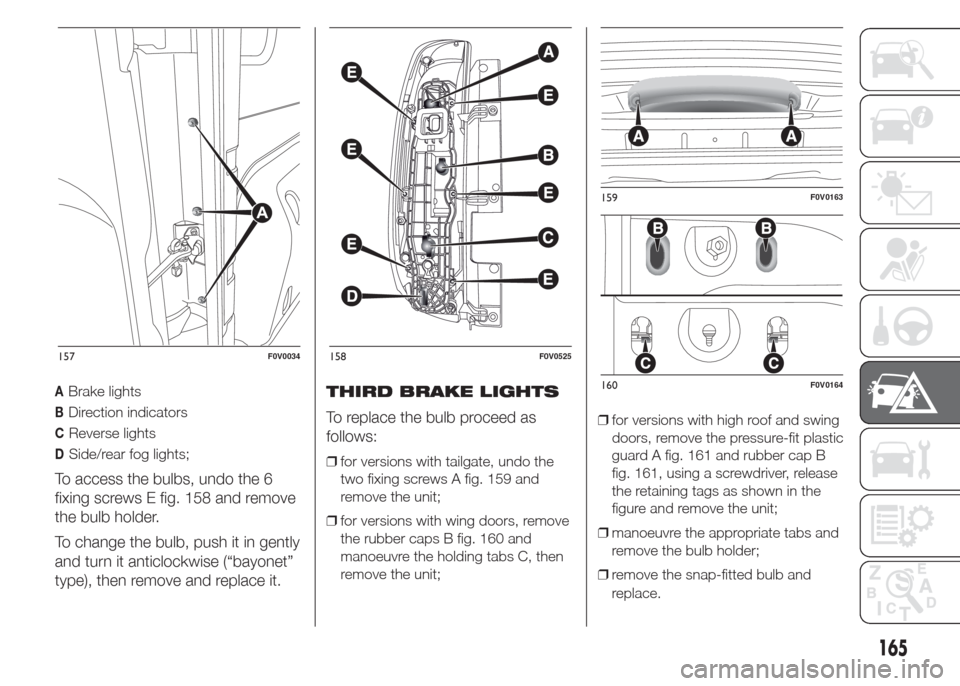
ABrake lights
BDirection indicators
CReverse lights
DSide/rear fog lights;
To access the bulbs, undo the 6
fixing screws E fig. 158 and remove
the bulb holder.
To change the bulb, push it in gently
and turn it anticlockwise (“bayonet”
type), then remove and replace it.THIRD BRAKE LIGHTS
To replace the bulb proceed as
follows:
❒for versions with tailgate, undo the
two fixing screws A fig. 159 and
remove the unit;
❒for versions with wing doors, remove
the rubber caps B fig. 160 and
manoeuvre the holding tabs C, then
remove the unit;❒for versions with high roof and swing
doors, remove the pressure-fit plastic
guard A fig. 161 and rubber cap B
fig. 161, using a screwdriver, release
the retaining tags as shown in the
figure and remove the unit;
❒manoeuvre the appropriate tabs and
remove the bulb holder;
❒remove the snap-fitted bulb and
replace.
157F0V0034158F0V0525
159F0V0163
160F0V0164
165
Page 170 of 323
NUMBER PLATE
LIGHTS (for
hatchback versions)
Proceed as follows to replace the
bulbs A fig. 162:
❒manoeuvre the holding tabs at the
points indicated by the arrows, and
remove the bulb holder;❒turn the bulb holder B fig. 163
anticlockwise, then remove bulb C.
NUMBER PLATE
LIGHTS (for versions
with wing doors)
Proceed as follows to replace the
bulbs A fig. 164:
❒manoeuvre the holding tabs at the
points indicated in the diagram,
and remove the lens by lifting to the
left;
❒remove the bulbs by releasing them
from the side contacts; insert the
new bulbs and make sure they are
correctly clamped between these
contacts.
161F0V0231
162F0V0179
163F0V0037
164F0V0036
166
IN AN EMERGENCY
Page 210 of 323

Check fluid level through the
reservoir.
Close cap D by pressing on the
central section.
129)
BRAKE FLUID
Undo the cap E fig. 207 - fig. 208 -
fig. 209 - fig. 210 - fig. 211 - fig.
212: check that the fluid contained
in the reservoir is at the maximum
level.
The fluid level in the reservoir must
not exceed the MAX mark.
Use the brake fluid shown in the
"Fluids and lubricants" table (see
"Technical Specifications").
NB Carefully clean the reservoir cap
E and surrounding surfaces.
Take great care to ensure that
impurities do not enter the reservoir
when the cap is opened.
For topping-up, always use a funnel
with integrated filter with mesh
equal to or lower than 0.12 mm.IMPORTANT Brake fluid absorbs
moisture. For this reason, if the
vehicle is mainly used in areas with a
high degree of atmospheric
humidity, the fluid should be
replaced at more frequent intervals
than specified in the “Scheduled
Servicing Plan”.
34)
130) 131)
POWER STEERING
FLUID
Check that the oil level with the
vehicle on flat ground and the
engine cold is between the MIN and
MAX marks on the reservoir body
G fig. 207 - fig. 208 - fig. 209 -
fig. 210 - fig. 211 - fig. 212.
The level may exceed the MAX mark
when the oil is hot.
If topping up is required, make sure
the oil you use has the same
specifications as that already in the
system.
132)
4)
35)
WARNING
126) Never smoke while working in
the engine compartment: gas
and flammable vapours may be
present, with the risk of fire.
127) When the engine is hot, take
care when working inside the
engine compartment to avoid
burns. Remember that when the
engine is hot, the fan may
operate: danger of injury. Scarves,
ties and other loose clothing may
be pulled by moving parts.
128) The cooling system is
pressurised. If necessary, only
replace the cap with another
original one or the operation of
the system may be adversely
affected. Do not remove the cap
from the reservoir when the
engine is hot: danger of scalding.
206
SERVICING AND MAINTENANCE
Page 213 of 323

USEFUL TIPS FOR
EXTENDING BATTERY
LIFE
To avoid draining your battery and
make it last longer, observe the
following instructions:
❒when you park the vehicle, ensure
that the doors, tailgate and bonnet
are closed properly, to prevent any
roof lights from remaining on inside
the passenger's compartment;
❒switch off all roof lights inside the
vehicle: the vehicle is however
equipped with a system which
switches all internal lights off
automatically;
❒do not keep accessories (e.g. radio,
hazard warning lights, etc.) switched
on for a long time when the engine
is not running;
❒before performing any operation on
the electrical system, disconnect
the negative battery pole;
❒completely tighten the battery
terminals.
IMPORTANT If the charge level
remains under 50% for a long time,
the battery is damaged by
sulphation, reducing its capacity and
efficiency at starting.The battery is also more prone to
the risk of freezing (already at
temperatures of -10°C). Refer to the
paragraph "Vehicle inactivity" in
"Starting and driving" if the vehicle is
left parked for a long time.
If, after buying the vehicle, you want
to install electric accessories which
require permanent electric supply
(alarm, etc.) contact a Fiat
Dealership whose qualified
personnel, in addition to suggesting
the most suitable devices from the
Lineaccessori Fiat, will evaluate
the overall electric absorption,
checking whether the vehicle's
electrical system is capable of
withstanding the load required, or
whether it should be integrated with
a more powerful battery.
Since some of these devices
continue to consume electricity even
when the engine is off, they
gradually run down the battery.
WARNING
133) Battery fluid is poisonous and
corrosive. Avoid contact with
skin and eyes. Keep naked flames
or possible sources of sparks
away from the battery: risk
of explosion or fire.
134) Using the battery when the fluid
is too low can damage it
irreparably and generate a risk of
explosion.
135) When performing any operation
on the battery or near it, always
protect your eyes with special
goggles.
209
Page 214 of 323

IMPORTANT
37) Incorrect assembly of electrical
and electronic devices may cause
severe damage to your vehicle.
Contact a Fiat Dealership if you
want to install accessories
(alarms, radiophone, etc.): they
will suggest the most suitable
devices and advise you if a higher
capacity battery needs to be
installed.
38) If the vehicle needs to be off the
road for a long period under
conditions of intense cold, remove
the battery and take it to a
heated location, otherwise it may
freeze.
IMPORTANT
5) Batteries contain substances
which are very dangerous for the
environment. To replace your
battery, we recommend
contacting your Fiat Dealership to
dispose of your old battery in full
respect of the environment and in
compliance with all applicable
laws and regulations.
BATTERY
RECHARGING
IMPORTANT The battery recharging
procedure is given as information
only. This operation should be
performed at a Fiat Dealership.
Charging should be slow at a low
ampere rating for approximately 24
hours. Charging for a long time
may damage the battery.
To recharge, proceed as follows:
IN THE ABSENCE OF
THE START&STOP
SYSTEM
❒disconnect the terminal from the
negative battery pole;
❒connect the charger cables to the
battery terminals, observing the
poles;
❒turn on the charger;
❒when you have finished, turn the
charger off before disconnecting
it from the battery;
❒reconnect the negative battery
terminal.
210
SERVICING AND MAINTENANCE
Page 235 of 323
SUSPENSION
Versions Front Rear
Front
independent wheel MacPherson typeMulti-link independent, coil springs,
telescopic shock absorbers and anti-roll bar
(according to version) Rear
231
Page 279 of 323

SUPPLIES
1.4 1.4 T-JETPrescribed fuels and
original lubricants
Fuel tank: 60 litres 60Unleaded petrol not less than
95 RON (EN 228
specification) including a reserve of: 8–10 litres 8-10
Engine cooling system: 5 litres 5.8 litresMixture of demineralised
water and 50% PARAFLU
UP
(***)
Engine sump: 2.35 litres/2kg 2.1kg
SELENIA K P.E.
Engine sump and filter: 2.7 litres / 2.3 kg 2.45 kg
Gearbox casing/differential: 1.76 litres / 1.5 kg 1.5 kgTUTELA TRANSMISSION
GEARFORCE
Hydraulic brake circuit with
ABS anti-lock device:0.450 kg 0.450 kg TUTELA TOP 4
Hydraulic power steering: 0.900 kg 0.900 kgTUTELA TRANSMISSION
GI/E
Windscreen / rear window
washer fluid reservoir (litres):2,2 (*)
/6(**)litres2,2 (*)/6(**)litres
Mixture of water and
TUTELA PROFESSIONAL
SC35
(***) When the vehicle is used in particularly harsh weather conditions, we recommend using a 60-40 mixture of PARAFLUUPand demineralised water.
(*) For Doblò versions without headlamp washers.
(**) For Doblò/Doblò Combi/Doblò Cargo versions with headlamp washers.
275