2015 FIAT 500X parking brake
[x] Cancel search: parking brakePage 4 of 240

READ THIS CAREFULLYREFUELLING
Petrol engines: only refuel with unleaded petrol with octane rating (RON) not less than 95 in compliance with the European specification
EN228. Do not use petrol containing methanol or ethanol E85. Using these mixtures may cause misfiring and driving issues, as well as
damage fundamental components of the supply system.
For further details on the use of the correct fuel see the "Refuelling the vehicle" paragraph in the "Starting and driving" chapter.
Diesel engines: refuel only with diesel fuel conforming to the European specification EN590. The use of other products or mixtures may
damage the engine beyond repair and consequently invalidate the warranty, due to the damage caused.
For further details on the use of the correct fuel see the "Refuelling the vehicle" paragraph in the "Starting and driving" chapter.
STARTING THE ENGINE
Versions with manual gearbox (petrol engines): make sure that the handbrake is engaged; set the gear lever to neutral, fully depress the
clutch pedal without pressing the accelerator, then turn the ignition key to AVV or press the ignition device button; release the key or the
button as soon as the engine has started.
Versions with manual gearbox (diesel engines): make sure that the handbrake is engaged; set the gear lever to neutral, fully depress the
clutch pedal without pressing the accelerator, then turn the ignition key to MAR and wait for the
warning light to switch off. Bring the
ignition key to AVV or press the ignition device button; release the key or the button as soon as the engine has started.
Versions with automatic transmission: make sure that the handbrake is engaged and that the gear lever is in P (Parking) or N (Neutral),
depress the brake pedal, without pressing the accelerator pedal, then turn the ignition key to AVV or press the ignition device button; release
the key or the button as soon as the engine has started.
PARKING ON FLAMMABLE MATERIAL
The catalytic converter develops high temperatures during operation. Do not park the vehicle on grass, dry leaves, pine needles or other
flammable material: fire hazard.
RESPECTING THE ENVIRONMENT
The vehicle is fitted with a system that carries out a continuous diagnosis of the emission-related components in order to help protect the
environment.
ELECTRICAL ACCESSORIES
If, after buying the vehicle, you decide to add electrical accessories (with the risk of gradually draining the battery), contact a Fiat Dealership.
They can calculate the overall electrical requirement and check that the vehicle's electric system can support the required load.
SCHEDULED SERVICING
Correct maintenance of the vehicle is essential for ensuring that it maintains its performance and its safety features, its environmental
friendliness and low running costs unchanged in time.
15-12-2014 8:23 Pagina 2
Page 12 of 240

NOTE The ignition device does NOT
activate if the electronic key is inside
the boot and this is open.
NOTE With the ignition device at MAR,
if 30 minutes pass with the vehicle
stationary (versions with manual
gearbox) or with the gear lever at P
(Park) (versions with automatic
transmission) and the engine off, the
ignition device will automatically move
to the STOP position.
NOTE With engine started, it is possible
to go away from the vehicle taking the
electronic key with you. The engine
will still be running. The vehicle will
indicate the absence of the key
on board when the door is closed.
For more information on the engine
start-up, see the description in the
"Starting the engine" paragraph, in the
"Starting and driving" chapter.
4) 5)
STEERING LOCK
ActivationVersions with key without remote
control: with the device at STOP,
remove the key and turn the steering
wheel until it locks.IMPORTANT If the ignition key has
been moved from the MAR to the
STOP position, the steering lock cannot
engage until the key is removed from
the ignition device.
Versions with electronic key: the
steering lock engages when the driver
door is opened, with the ignition device
button at STOP and speed below 3
km/h.
DeactivationVersions with key without remote
control: slightly moving the steering
wheel, turn the key to the MAR
position.
Versions with electronic key: the
steering lock disengages when the
ignition device is pressed and the
electronic key is recognised.
6) 7)
WARNING
2)If the ignition device is tampered with
(e.g.: attempted theft), have it checked
over by a Fiat Dealership as soon as
possible.
3)When getting out of the vehicle, always
take the key with you to prevent any
occupants from accidentally activating the
controls. Remember to engage the electric
parking brake. Never leave children
unattended in the vehicle.4)It is absolutely forbidden to carry out any
after-market operation involving steering
system or steering column modifications
(e.g.: installation of anti-theft device).
This could badly affect performance and
safety, invalidate the warranty and also
result in the non-compliance of the vehicle
with type-approval requirements.
5)Never remove the key without remote
control while the vehicle is moving. The
steering wheel will automatically lock as
soon as it is turned. This also applies
to cases in which the vehicle is towed.
6)Before exiting the vehicle, ALWAYS
engage the parking brake, steer the
wheels, engage the first gear if uphill and
the reverse if downhill. On versions with
automatic transmission, bring the gear
lever to P (Park) and press the ignition
device to bring it to STOP. If the vehicle is
parked on a steep slope, chock the wheels
with wedges or stones. When leaving the
vehicle, always lock all the doors by
pressing the dedicated button on the
handle (see "Keyless Entry" in the "Doors"
paragraph).
7)On versions equipped with Full Keyless
system, do not leave the electronic key
inside or near the vehicle or in a place
accessible to children. Do not leave the
vehicle with the ignition device in the MAR
position. A child could operate the electric
windows, other controls or even start
the vehicle.
10
GETTING TO KNOW YOUR CAR
15-12-2014 8:23 Pagina 10
Page 17 of 240

WARNING
8)Once the Dead Lock system is
engaged, it is impossible to open the
doors from inside the vehicle. Before
getting out of the vehicle, please therefore
check that there is no-one left on board.
9)NEVER leave children unattended inside
the vehicle, nor leave the vehicle with the
doors unlocked in a place that children can
access easily. Children may seriously, or
even fatally, injure themselves. Also ensure
that children do not inadvertently operate
the electric parking brake, the brake pedal
or the automatic transmission lever.
10)Always use this device when carrying
children. After engaging the child lock
on both rear doors, check for proper
engagement by trying to open a rear door
with the internal handle.
WARNING
2)Make sure to take the key with you once
a door or the tailgate is locked, to prevent
locking the same key inside the vehicle.
Once it has been left inside, the key can be
collected only using the second key
supplied.3)The operation of the recognition system
depends on various factors, such as, for
example, any electromagnetic wave
interference from external sources (e.g.
mobile phones), the charge of the battery
in the electronic key and the presence
of metal objects near the key or the vehicle.
In these cases it is still possible to unlock
the doors by using the metal insert in
the electronic key (see description on the
following pages).
SEATSFRONT SEATS WITH
MANUAL ADJUSTMENT
11)4)
Longitudinal adjustmentLift lever A fig. 13 and push the seat
forwards or backwards.
12)
IMPORTANT Carry out the adjustment
while sitting on the seat involved (driver
side or passenger side).13
F1B0019C
15
15-12-2014 8:23 Pagina 15
Page 37 of 240

❒lower the bonnet to approximately 40
centimetres from the engine
compartment and let it drop. Make sure
that the bonnet is completely closed
and not only fastened by the locking
device by trying to open it. If it is not
perfectly closed, do not try to press the
bonnet lid down but open it and repeat
the procedure.
IMPORTANT Always check that the
bonnet is closed correctly to prevent it
from opening while the vehicle is
travelling.
WARNING
23)Perform these operations only when
the vehicle is stationary.
24)Wrong positioning of the bonnet stay
may cause the bonnet to fall abruptly.
25)Raise the bonnet using both hands.
Before raising the bonnet make sure that
the windscreen wipers are not lifted from
the windscreen, that the vehicle is at a
standstill and that the electric parking brake
is engaged.26)For safety reasons the bonnet must
always be correctly closed while driving.
Therefore, make sure that the bonnet
is properly closed and that the lock
is engaged. If you discover that the bonnet
is not perfectly closed during travel, stop
immediately and close the bonnet in the
correct manner.
BOOTThe boot unlocking is electrically
operated and is deactivated when the
vehicle is in motion.OPENING
27)
Opening from the outsideWhen unlocked, the tailgate can be
opened from outside the vehicle using
the electric opening handle A fig. 43
located under the handle until the
unlocking click is heard or by quickly
pressing button
on the remote
control twice.
43
F1B0074C
35
15-12-2014 8:23 Pagina 35
Page 46 of 240

WARNING LIGHTS AND MESSAGESIMPORTANT The warning light switches on in the instrument panel together with a dedicated message and/or acoustic signal
when applicable. These indications are indicative and precautionary and as such must not be considered as exhaustive and/or
alternative to the information contained in the Owner Handbook, which you are advised to read carefully in all cases. Always
refer to the information in this chapter in the event of a failure indication.
IMPORTANT Failure indications displayed are divided into two categories: serious and less serious failures. Serious failures are
indicated by a repeated and prolonged warning "cycle". Less serious failures are indicated by a warning "cycle" with a shorter
duration. The display cycle of both categories can be interrupted. The instrument panel warning light will stay on until the cause
of the failure is eliminated.
Warning light What it means
INSUFFICIENT BRAKE FLUID / ELECTRIC PARKING BRAKE ON
Low brake fluid level
The warning light switches on when the brake fluid in the reservoir falls below the minimum level, possibly
due to a leak in the circuit. Restore the brake fluid level, then check that the warning light has switched off.
If the warning light stays on, contact a Fiat Dealership.
Electric parking brake on
The warning light switches on when the electric parking brake is engaged. Release the electric parking
brake, then check that the warning light has switched off. If the warning light stays on, contact a Fiat
Dealership.EBD FAILURE
The simultaneous switching on of the
(red) and
(amber) warning lights with the engine on
indicates either a failure of the EBD system or that the system is not available. In this case, the rear wheels
may suddenly lock and the vehicle may swerve when braking sharply.
Drive very carefully to the nearest Fiat Dealership to have the system inspected immediately.
44
KNOWING THE INSTRUMENT PANEL
15-12-2014 8:23 Pagina 44
Page 50 of 240
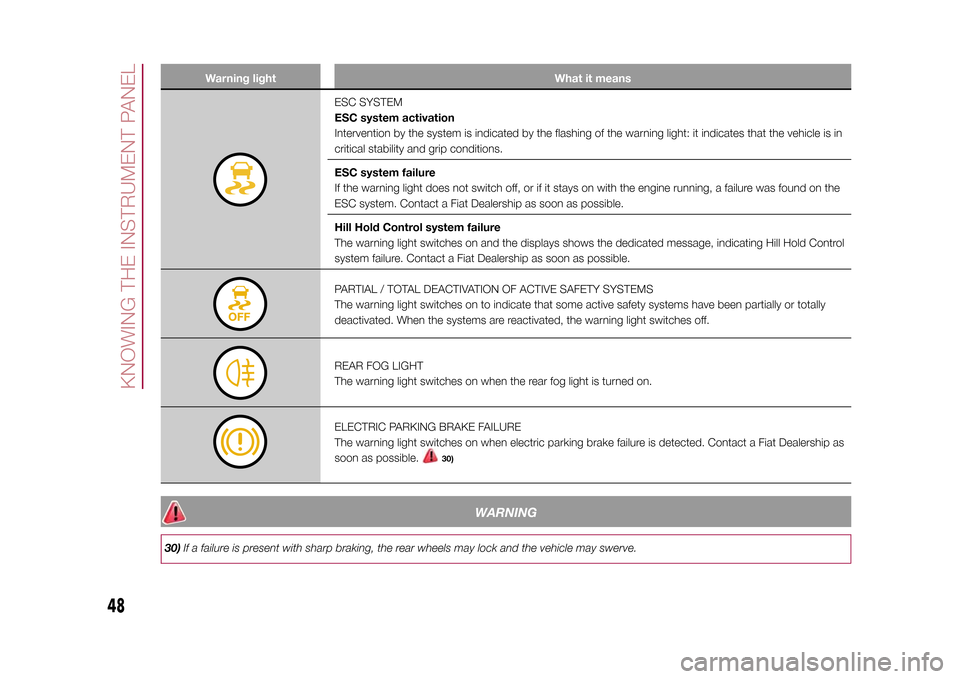
Warning light What it means
ESC SYSTEM
ESC system activation
Intervention by the system is indicated by the flashing of the warning light: it indicates that the vehicle is in
critical stability and grip conditions.
ESC system failure
If the warning light does not switch off, or if it stays on with the engine running, a failure was found on the
ESC system. Contact a Fiat Dealership as soon as possible.
Hill Hold Control system failure
The warning light switches on and the displays shows the dedicated message, indicating Hill Hold Control
system failure. Contact a Fiat Dealership as soon as possible.PARTIAL / TOTAL DEACTIVATION OF ACTIVE SAFETY SYSTEMS
The warning light switches on to indicate that some active safety systems have been partially or totally
deactivated. When the systems are reactivated, the warning light switches off.REAR FOG LIGHT
The warning light switches on when the rear fog light is turned on.ELECTRIC PARKING BRAKE FAILURE
The warning light switches on when electric parking brake failure is detected. Contact a Fiat Dealership as
soon as possible.
30)
WARNING
30)If a failure is present with sharp braking, the rear wheels may lock and the vehicle may swerve.
48
KNOWING THE INSTRUMENT PANEL
15-12-2014 8:23 Pagina 48
Page 59 of 240

Symbol What it means
RAIN SENSOR FAILURE
The symbol switches on in the case of failure of the rain sensor. Contact a Fiat Dealership as soon as
possible.START&STOP SYSTEM FAILURE
The symbol switches on to report a failure of the Start&Stop system. The display will show a dedicated
message. Contact a Fiat Dealership as soon as possible.KEYLESS GO SYSTEM FAILURE
The symbol switches on in the event of Keyless Go system failure. Contact a Fiat Dealership as soon as
possible.POSSIBLE ICE ON ROAD
The symbol turns on when the outside temperature falls to or below 3°C.
IMPORTANT In the case of outside temperature sensor failure, the digits that indicate the value are
replaced by dashes.SPEED LIMITER FAILURE
The symbol switches on in the case of failure of the Speed Limiter device. Contact a Fiat Dealership as
soon as possible to have the failure eliminated.4x4 DRIVE SYSTEM FAILURE
The symbol turns on to indicate that there is a failure in the 4x4 drive system. Contact a Fiat Dealership as
soon as possible.EXTERIOR LIGHTS FAILURE
The symbol switches on to indicate a failure on the following lights: daytime running lights (DRLs); parking
lights; side lights; direction indicators; rear fog light; reversing light; number plate lights.
The failure may be caused by a blown bulb, a blown protection fuse or an interruption of the electrical
connection.BRAKE LIGHT FAILURE
The symbol switches on to indicate a failure of the brake lights (STOP).
57
15-12-2014 8:23 Pagina 57
Page 67 of 240

32)To obtain the maximum efficiency of
the braking system, a bedding-in period of
about 500 km is needed: during this period
it is better to avoid sharp, repeated and
prolonged braking.
33)If the ABS system intervenes, this
indicates that the traction of the tyres on
the road is about to reach its limit. You
must slow down to a speed compatible
with the available grip.
34)The ABS cannot overrule the natural
laws of physics, and cannot increase
the grip available according to the
condition of the road.
35)The ABS cannot prevent accidents,
including those due to excessive speed on
corners, driving on low-grip surfaces or
aquaplaning.
36)The capability of the ABS must never
be tested irresponsibly and dangerously, in
such a way as to compromise personal
safety and the safety of others.
37)For the correct operation of the ABS, it
is essential that the tyres are of the same
make and type on all wheels, in perfect
condition and, above all, of the specified
type and dimensions.
38)The ESC system can’t alter the natural
laws of physics, and can’t increase grip
which depends on the condition of the
road.
39)The ESC system cannot prevent
accidents, including those due to excessive
speed on corners, driving on low-grip
surfaces or aquaplaning.40)The capability of the ESC system must
never be tested irresponsibly and
dangerously, in such a way as to
compromise personal safety and the safety
of others.
41)For the correct operation of the ESC
system, the tyres must of necessity be the
same make and type on all wheels, in
perfect condition and, above all, of the
prescribed type and dimensions.
42)ESC performance features must not
induce the driver to take unnecessary
or unwarranted risks. Your driving style
must always be suited to the road
conditions, visibility and traffic. The driver
is, in any case, responsible for safe driving.
43)For the correct operation of the TC
system, the tyres must of necessity be the
same make and type on all wheels, in
perfect condition and, above all, of the
prescribed type and dimensions.
44)TC performance features must not
induce the driver to take unnecessary or
unwarranted risks. Your driving style must
always be suited to the road conditions,
visibility and traffic. The driver is, in any
case, responsible for safe driving.
45)The TC system cannot overrule the
natural laws of physics, and cannot
increase the grip available according to the
condition of the road.
46)The TC system cannot prevent
accidents, including those due to excessive
speed on corners, driving on low-grip
surfaces or aquaplaning.
47)The capability of the TC must never be
tested irresponsibly and dangerously, in
such a way as to compromise personal
safety and the safety of others.48)The PBA system can’t overrule the
natural laws of physics, and can’t increase
the grip available according to the
condition of the road.
49)The PBA system cannot prevent
accidents, including those due to excessive
speed on corners, driving on low-grip
surfaces or aquaplaning.
50)The capability of the PBA system must
never be tested irresponsibly and
dangerously, in such a way as to
compromise the safety of the driver, the
other occupants of the vehicle or any other
road user.
51)The Hill Hold Control system is not a
parking brake; therefore, never leave the
vehicle without having engaged the electric
parking brake, turned the engine off and
engaged first gear, so that it is parked
in safe conditions (for further information
read the "Parking" paragraph in the
"Starting and driving" chapter).
52)There may be situations on small
gradients (less than 8%), with vehicle
laden, in which the Hill Hold Control system
may not activate, causing a slight reversing
motion and increasing the risk of collision
with another vehicle or object. The driver is,
in any case, responsible for safe driving.
53)DST is an aid for driving and does not
relieve the driver of responsibility for driving
the vehicle.
54)The performance of a vehicle with ERM
must never be tested in imprudent or
dangerous ways, with the possibility of
putting the safety of the driver or other
people at risk.
65
15-12-2014 8:23 Pagina 65