Page 522 of 703

TIRE CHAINS (TRACTION DEVICES)
Use of traction devices require sufficient tire-to-body
clearance. Follow these recommendations to guard
against damage:
•Traction device must be of proper size for the tire, as
recommended by the traction device manufacturer.
•Install on front tires only.
•Due to limited clearance, a 225/65R17 tire with a
Security Chain Company (SCC) Super Z6 low profile
traction device or equivalent is recommended.
WARNING!
Using tires of different size and type (M+S, Snow)
between front and rear axles can cause unpredictable
handling. You could lose control and have a collision.
CAUTION!
To avoid damage to your vehicle or tires, observe the
following precautions:
•Because of restricted traction device clearance be-
tween tires and other suspension components, it is
important that only traction devices in good condi-
tion are used. Broken devices can cause serious
damage. Stop the vehicle immediately if noise
occurs that could indicate device breakage. Remove
the damaged parts of the device before further use.
•Install device as tightly as possible and then re-
tighten after driving about½mile (0.8 km).
•Do not exceed 30 mph (48 km/h).
•Drive cautiously and avoid severe turns and large
bumps, especially with a loaded vehicle.
•Do not drive for a prolonged period on dry pave-
ment.
(Continued)
520 STARTING AND OPERATING
Page 526 of 703

CAUTION!
•The TPMS has been optimized for the original
equipment tires and wheels. TPMS pressures have
been established for the tire size equipped on your
vehicle. Undesirable system operation or sensor
damage may result when using replacement equip-
ment that is not of the same size, type, and/or style.
Aftermarket wheels can cause sensor damage. Us-
ing aftermarket tire sealants may cause the Tire
Pressure Monitoring System (TPMS) sensor to be-
come inoperable. After using an aftermarket tire
sealant it is recommended that you take your
vehicle to an authorized service center to have your
sensor function checked.
•After inspecting or adjusting the tire pressure al-
ways reinstall the valve stem cap. This will prevent
moisture and dirt from entering the valve stem,
which could damage the TPMS sensor.
NOTE:
•The TPMS is not intended to replace normal tire care
and maintenance, or to provide warning of a tire
failure or condition.
•The TPMS should not be used as a tire pressure gauge
while adjusting your tire pressure.
•Driving on a significantly under-inflated tire causes
the tire to overheat and can lead to tire failure.
Under-inflation also reduces fuel efficiency and tire
tread life, and may affect the vehicle’s handling and
stopping ability.
•The TPMS is not a substitute for proper tire mainte-
nance, and it is the driver’s responsibility to maintain
correct tire pressure, using an accurate tire pressure
gage, even if under-inflation has not reached the level
to trigger illumination of the “Tire Pressure Monitor-
ing Telltale Light.”
524 STARTING AND OPERATING
Page 545 of 703
Gross Axle Weight Rating (GAWR)
The GAWR is the maximum capacity of the front and rear
axles. Distribute the load over the front and rear axles
evenly. Make sure that you do not exceed either front or
rear GAWR.
WARNING!
Because the front wheels steer the vehicle, it is
important that you do not exceed the maximum front
or rear GAWR. A dangerous driving condition can
result if either rating is exceeded. You could lose
control of the vehicle and have a collision.
Tire Size
The tire size on the Vehicle Certification Label represents
the actual tire size on your vehicle. Replacement tires
must be equal to the load capacity of this tire size.
Rim Size
This is the rim size that is appropriate for the tire size
listed.
Inflation Pressure
This is the cold tire inflation pressure for your vehicle for
all loading conditions up to full GAWR.
Curb Weight
The curb weight of a vehicle is defined as the total weight
of the vehicle with all fluids, including vehicle fuel, at full
capacity conditions, and with no occupants or cargo
loaded into the vehicle. The front and rear curb weight
values are determined by weighing your vehicle on a
commercial scale before any occupants or cargo are
added.
5
STARTING AND OPERATING 543
Page 575 of 703
4. Clean any remaining sealant from the Tire Service Kit
housing.
5. Position the new Sealant Bottle (1) in the housing so
that the Sealant Hose (6) aligns with the hose slot in
the front of the housing. Press the bottle into the
housing. An audible click will be heard indicating the
bottle is locked into place.
6. Verify that the cap is installed on the fitting at the end
of the Sealant Hose (6) and return the hose to its
storage area (located on the bottom of the air pump).
7. Return the Tire Service Kit to its storage location in the
vehicle.
WHEEL AND TIRE TORQUE SPECIFICATIONS
Proper lug nut/bolt torque is very important to ensure
that the wheel is properly mounted to the vehicle. Any
time a wheel has been removed and reinstalled on the
vehicle the lug nuts/bolts should be torqued using a
properly calibrated torque wrench.
Torque Specifications
Lug Nut/Bolt Torque **Lug Nut/
Bolt Size
Lug Nut/
Bolt
Socket
Size
100 Ft-Lbs (135 N·m) M12 x 1.25 19 mm
**Use only Chrysler recommended lug nuts/bolts and
clean or remove any dirt or oil before tightening.
6
WHAT TO DO IN EMERGENCIES 573
Page 591 of 703
WARNING!
To avoid the risk of forcing the vehicle off the jack,
do not tighten the wheel nuts fully until the vehicle
has been lowered. Failure to follow this warning may
result in personal injury.
NOTE:Do not install the wheel cover on the compact
spare.
7. Lower the vehicle by turning the jack screw to the left.
8. Refer to “Torque Specifications” in this section for
proper wheel lug nut torque.
9. Lower the jack to its fully-closed position.
WARNING!
A loose tire or jack thrown forward in a collision or
hard stop could endanger the occupants of the ve-
hicle. Always stow the jack parts and the spare tire in
the places provided. Have the deflated (flat) tire
repaired or replaced immediately.
10. Place the deflated (flat) tire and compact spare tire
cover assembly in the rear cargo area.Do not stow
the deflated tire in the compact spare tire location.
Have the full-sized tire repaired or replaced, as soon
as possible.
11. Stow the cable and wheel spacer before driving the
vehicle. Reassemble the winch handle extensions to
form a “T” and fit the winch T-handle over the drive
nut. Rotate the nut to the right until the winch
mechanism clicks at least three times.
6
WHAT TO DO IN EMERGENCIES 589
Page 594 of 703
CAUTION!
The winch mechanism is designed specifically to
stow a compact spare tire only. Do not attempt to use
the winch to stow the full size deflated tire, or any
other full-size tire, as the tire may not be held
securely. Vehicle damage may result.
Road Tire Installation
Vehicles Equipped With Wheel Covers
1. Mount the road tire on the axle.
2. To ease the installation process for steel wheels with
wheel covers, install two lug nuts on the mounting
studs which are on each side of the valve stem. Install
the lug nuts with the cone shaped end of the nut
toward the wheel. Lightly tighten the lug nuts.3. Align the valve notch in the wheel cover with the
valve stem on the wheel. Install the cover by hand,
Tire And Wheel Cover Or Center Cap
1 — Valve Stem4 — Wheel Cover2—ValveNotch5—MountingStud3—WheelLugNut
592 WHAT TO DO IN EMERGENCIES
Page 699 of 703
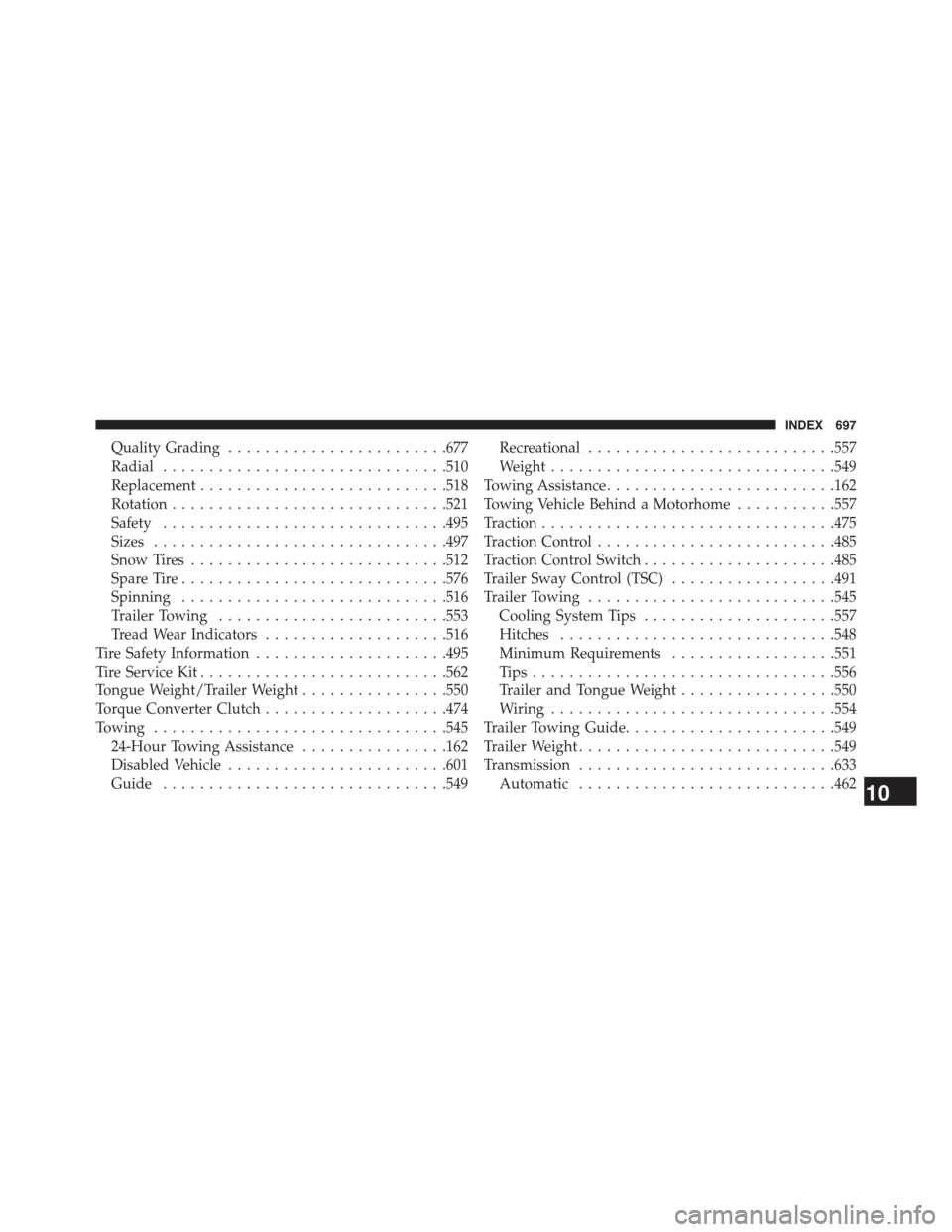
Quality Grading........................677
Radial...............................510
Replacement...........................518
Rotation..............................521
Safety...............................495
Sizes................................497
Snow Tires............................512
Spare Tire.............................576
Spinning.............................516
Trailer Towing.........................553
Tread Wear Indicators....................516
Tire Safety Information.....................495
Tire Service Kit...........................562
Tongue Weight/Trailer Weight................550
Torque Converter Clutch....................474
Towing................................545
24-Hour Towing Assistance................162
Disabled Vehicle........................601
Guide...............................549
Recreational...........................557
Weight...............................549
Towing Assistance.........................162
Towing Vehicle Behind a Motorhome...........557
Traction................................475
Traction Control..........................485
Traction Control Switch.....................485
Trailer Sway Control (TSC)..................491
Trailer Towing...........................545
Cooling System Tips.....................557
Hitches..............................548
Minimum Requirements..................551
Ti p s . . . . . . . . . . . . . . . . . . . . . . . . . . . . . . . ..556
Trailer and Tongue Weight.................550
Wiring...............................554
Trailer Towing Guide.......................549
Trailer Weight............................549
Transmission............................633
Automatic............................46210
INDEX 697
Page:
< prev 1-8 9-16 17-24