2015 Citroen C3 lock
[x] Cancel search: lockPage 122 of 401

120
Switching the engine off
F Immobilise the vehicle.
F W ith the engine at idle, turn the key fully
towards you to position 1 (Stop) .
F
R
emove the key from the ignition switch.
F
T
o lock the steering column, turn the
steering wheel until it locks.
Never switch the ignition off until the
vehicle has come to a complete stop
and the parking brake has been applied.
With the engine stopped, the braking and
steering assistance systems are also cut
off: risk of loss of control of the vehicle. To facilitate unlocking of the steering
column, put the front wheels in the
straight ahead position before switching
the ignition off.
When you leave the vehicle, take the
key with you and lock the vehicle.Key reminder
If the key is left in the ignition switch, an
audible signal sounds when the driver's
door is opened.
For more information, refer to the
"Energy economy mode" section.
F
E
nsure that the parking brake is applied
correctly, particularly when on a slope.
Energy economy mode
After switching off the engine (position 1 - Stop ),
you can still use functions such as the audio
and telematic system, the wipers, dipped beam,
courtesy lamps, etc., for maximum cumulative
period of 30 minutes.
Driving
Page 132 of 401

130
Manual operation
F Select position M for sequential changing
of the four gears.
F
P
ush the selector towards the + sign to
change up a gear.
F
P
ull the selector towards the - sign to
change down a gear.
It is only possible to change from one gear to
another if the vehicle speed and engine speed
permit; other wise, the gearbox will operate
temporarily in automatic mode.
D disappears and the gears
engaged appear in succession in the
instrument panel.
If the engine speed is too low or too high, the
gear selected flashes for a few seconds, then
the actual gear engaged is displayed.
It is possible to change from position D
(automatic) to position M (manual) at any time.
When the vehicle is stationary or moving
very slowly, the gearbox selects gear M1
automatically.
The sport and snow programmes do not
operate in manual mode.Invalid value during manual
operation
This symbol is displayed if a gear
is not engaged correctly (selector
between two positions).
Stopping the vehicle
Before switching off the engine, you can
engage position P or N to place the gearbox in
neutral.
In both cases, apply the parking brake to
immobilise the vehicle.
If the selector is not in position P ,
when the driver's door is opened or
approximately 45 seconds after the
ignition is switched off, a warning
message appears in the screen.
F
R
eturn the selector to position P ;
the message disappears.
When driving on flooded roads or when
crossing a ford, proceed at walking
pace. When the ignition is on, the lighting
of this warning lamp, accompanied
by an audible signal and a message in the
multifunction screen, indicates a gearbox fault.
In this case, the gearbox switches to back-up
mode and is locked in 3rd gear. You may feel
a substantial knock when changing from P
to R and from N to R . This will not cause any
damage to the gearbox.
Do not exceed 60 mph (100 km/h), local speed
restrictions permitting.
Contact a CITR
oËn
dealer or a qualified
workshop as soon as possible.
Operating fault
There is a risk of damage to the gearbox:
- i f you press the accelerator and
brake pedals at the same time,
-
i
f you force the movement of the
selector from the P position to
another position when the battery
is
flat.
To reduce fuel consumption when at
a prolonged standstill with the engine
running (traffic jam...), put the selector
in the N position and apply the parking
brake.
Driving
Page 142 of 401

140
Rear parking sensors
Activation
This detects any obstacle (person, vehicle,
tree, gate, etc.) behind the vehicle, except
obstacles located just below the bumper.The system is activated as soon as reverse
gear is engaged, accompanied by an audible
signal. The proximity information is given by:
-
a
n audible signal, which becomes more
rapid as the vehicle approaches the
obstacle.
-
a g
raphic (according to version) in the
multifunction screen, with blocks which
become increasingly closer to the vehicle. On completion of the manoeuvre, when you
exit reverse gear, the system becomes inactive.
An object, such as a stake, a roadworks
cone or any other similar object may be
detected at the beginning of the manoeuvre,
but may no longer be detected when the
vehicle comes close to it.The parking sensor system cannot in
any circumstances be a substitute for
vigilance on the part of the driver.
System consisting of four proximity sensors,
located in the rear bumper.
When the distance between the rear of the
vehicle and the obstacle is less than thirty
centimetres, the audible signal becomes
continuous and the "
da
nger" symbol appears
in the multifunction screen.
driving
Page 152 of 401

150
according to your version of instrument panel, the
start of saturation of the particle filter is indicated by:
- fixed illumination of the particle filter warning lamp, accompanied
by an audible signal,
or
-
t
emporary illumination of
the service warning lamp,
accompanied by an audible signal
and a message that there is a risk
of blockage of the particle filter.
as s
oon as the traffic conditions permit, regenerate
the filter by driving at a speed of at least 40
mph
(60
km/h) until the warning lamp goes off.
If the warning lamp stays on, refer to the "Additive
level" section.
Checks
12 V battery
The battery does not require any maintenance.
However, check that the terminals are clean
and correctly tightened, particularly in summer
and winter.
The presence of this label, in particular with
the Stop & Start system, indicates the use of
a specific 12
V lead-acid battery with special
technology and specification. The involvement
of a CITROËN dealer or a qualified workshop
is essential when replacing or disconnecting
the battery. When carrying out work on the battery, refer
to the "12 V battery" section for details of the
precautions to be taken before disconnecting
the battery and following its reconnection. Unless other wise indicated, check these components in accordance with the manufacturer's
service schedule and according to your engine.
Other wise, have them checked by a CITROËN dealer or a qualified workshop.
On a new vehicle, the first operations of
regeneration of the particle filter may be
accompanied by the smell of "burning",
which is per fectly normal.
Following prolonged operation of the
vehicle at very low speed or at idle,
you may, in exceptional circumstances,
notice the emission of water vapour at
the exhaust on acceleration. This does
not affect the behaviour of the vehicle
or the environment.
Particle filter (Diesel)
Air filter and passenger compartment filter
Refer to the manufacturer's
service schedule for details of the
replacement intervals for these
components.
Depending on the environment (e.g. dusty
atmosphere) and the use of the vehicle
(e.g.
city driving), replace them twice as often
if necessary .
a c
logged passenger compartment filter may
have an adverse effect on the per formance
of the air conditioning system and generate
undesirable odours.
Replace the oil filter each time the
engine oil is changed.
Refer to the manufacturer's
service schedule for details of
the replacement interval for this
component.
Oil filter
Checks
Page 154 of 401

152
Fuel tank
Low fuel level
When the fuel tank minimum level is
reached this warning lamp comes on
on the instrument panel. When it first
comes on there remains approximately
5 litres of fuel in the tank.
Filling
A label affixed to the inside of the flap reminds
you of the type of fuel to be used depending on
your engine.
Additions of fuel must be of at least 7 litres, in
order to be registered by the fuel gauge.To fill the tank safely:
F
t
he engine must be switched off,
F
o
pen the fuel filler flap,
F
i
nsert the key in the cap, then turn it to the
left,
F
r
emove the cap and hook it onto the clip
located on the inside of the flap,
F
f
ill the tank, but do not continue after
the 3rd cut- off of the pump
; this could
cause malfunctions.
When you have filled the tank:
F
p
ut the cap back in place,
F
t
urn the key to the right, then remove it
from the cap,
F
c
lose the flap.
You must refuel as soon as possible to avoid
running out of fuel.
If you run out of fuel (Diesel), refer also to the
"Checks" section. Fuel tank capacity: approximately
50 litres (petrol) or 46 litres (Diesel) or
37 litres (LPG); (Depending on version:
approximately 30 litres (petrol or Diesel)).
With Stop & Start, never refuel with the
system in STOP mode; you must switch
off the ignition with the key. The key cannot be removed from the
lock until the cap is refitted.
op
ening the filler cap may create a
noise caused by an inrush of air. This
vacuum is entirely normal, resulting
from the sealing of the fuel system.
Practical information
Page 166 of 401
164
never store bottles of adbl ue® in your
vehicle.
a
d
blu
e
® freezes at about -11°C and
deteriorates above 25°C. It is recommended
that bottles be stored in a cool area and
protected from direct sunlight.
Under these conditions, the additive can be
kept for at least a year.
If the additive has frozen, it can be used once it
has completely thawed out.
Recommendations on storage
before topping-up, ensure that the vehicle is
parked on a flat and level sur face.
In wintry conditions, ensure that the
temperature of the vehicle is above -11°C.
Other wise, by freezing, the AdBlue
® cannot
be poured into its tank. Park your vehicle in a
warmer area for a few hours to allow the top-up
to be carried out.
Procedure
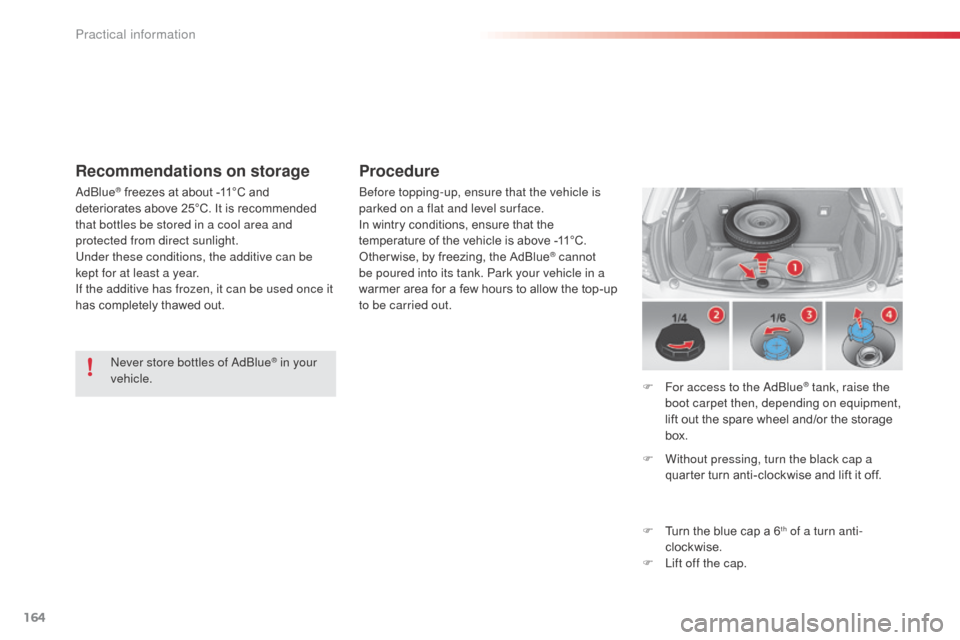
F For access to the adbl ue® tank, raise the
boot carpet then, depending on equipment,
lift out the spare wheel and/or the storage
box.
F
W
ithout pressing, turn the black cap a
quarter turn anti-clockwise and lift it off.
F
T
urn the blue cap a 6
th of a turn anti-
clockwise.
F
L
ift off the cap.
Practical information
Page 167 of 401

165
F obtain a bottle of adbl ue®. after first
checking the use-by date, read carefully
the instructions on use on the label before
pouring the contents of the bottle into your
vehicle's
a
d
blu
e
® tank.
Important : if your vehicle's
a
d
blu
e
® tank is completely empty -
w
hich is confirmed by the alert
messages and the impossibility of
starting the engine, you must add at
least 3.8 litres (so two 1.89 litre bottles). If any additive is split or splashed, wash
immediately with cold water or wipe with
a damp cloth.
If the additive has crystallised, clean it
off using a sponge and hot water.
Important: in the event of a top-
up after a breakdown because of
a lack of additive
, you must wait
around 5 minutes before switching
on the ignition, without opening the
driver's door, locking the vehicle or
introducing the key into the ignition
switch .
Switch on the ignition, then, after
10 seconds, start the engine.
ne
ver dispose of a
dbl
ue
® additive
bottles in the household waste. Place
them in a special container provided
this purpose or take them to your dealer.
F
A
fter emptying the bottle, wipe away any
spillage around the tank filler using a damp
cloth.
F
R
efit the blue cap to the tank and turn it a
6th of a turn clockwise, to its stop.
F
R
efit the black cap and turn it a quarter of
a turn clockwise without pressing. Ensure
that the indicator on the cap lines up with
the indicator on the support.
F
d
e
pending on equipment, return the spare
wheel and/or the storage box to the bottom
of the boot.
F
R
efit the boot carpet and close the tailgate.
11
Practical information
Page 176 of 401

174
Removing a wheel
List of operations
F Remove the bolt cover from each of the bolts using the tool 3 (with alloy wheels
only).
F
F
it the security bolt socket 4 on the
wheelbrace 1 to slacken the security bolt
(if your vehicle has them).
F
S
lacken the other bolts using the
wheelbrace 1 o n l y.
Parking the vehicle
Immobilise the vehicle where it does not
block traffic: the ground must be level,
stable and not slippery.
Apply the parking brake, switch off the
ignition and engage first gear* to lock
the wheels.
If necessary, place a chock under the
wheel diagonally opposite the wheel to
be changed.
You must ensure that the occupants get
out of the vehicle and wait where they
are safe.
ne
ver go underneath a vehicle raised
using a jack; use an axle stand.
*
position R for an electronic gearbox;
position
P for an automatic gearbox.
Practical information