2015 AUDI TT ROADSTER window
[x] Cancel search: windowPage 93 of 244
Driving Safely
General notes
Safe driving habits
Please remember -safety first!
This chapter contains important information,
tips, instructions and warnings that you need
to read and observe for your own safety, the
safety of your passengers and others . We have
summarized here what you need to know
about safety belts, airbags, child restraints as
well as child safety. Your safety is for us
priori
ty number 1.
Always observe the information
and warnings in this section - for your own
safety as well as for that of your passengers.
The information in this section applies to all
model versions of your vehicle . Some of the
features described in this sections may be
standard equipment on some models, or may
be optional equipment on others. If you are
not sure, ask your authorized Audi dealer.
A WARNING
- Make certain that you follow the instruc
tions and heed the WARNINGS in this
Manual. It is in your interest and in the
interest of your passengers.
- Always keep the complete Owner's Liter
ature in your Audi when you lend or sell
your vehicle so that this important infor
mation will always be available to the
driver and passengers.
- Always keep the Owner's literature handy
so that you can find it easily if you have
questions.
Safety equipment
The safety features are part of the occupant
restraint system and work together to help
reduce the risk of injury in a wide variety of
accident situations .
Your safety and the safety of your passengers
should not be left to chance. Advances in
technology have made a variety of features
available to help reduce the risk of injury in an
Driving Safely 91
accident. The following is a listing of just a
few of the safety features in your Audi:
- sophisticated safety belts for driver and all
passenger seating positions,
- safety belt pre-tensioners,
- front airbags,
- knee airbags for the front seats,
- side airbags in the front seats,
- LATCH anchorages for child restraints,
- adjustable steering column.
These individual safety features can work to
gether as a system to help protect you and
your passengers in a wide range of accidents.
These features cannot work as a system if
they are not always properly adjusted and
properly used!
Safety is everybody's responsibility!
Important things to do before driving
Safety is everybody's job! Vehicle and occu
pant safety always depends on the informed and careful driver.
For your safety and the safety of your passen
gers,
before driving always:
~ Make sure that all lights and signals are op
erating correctly .
~ Make sure that the tire pressure is correct.
~ Make sure that all windows are clean and af
ford good visibility to the outside.
~ Secure all luggage and other items carefully
c::> page 65.
~ Make sure that nothing can interfere with
the pedals.
~ Adjust front seat, head restraint and mirrors
correctly for your height .
~ Instruct passengers to adjust the head re
straints according to their height .
~ Make sure to use the right child restraint
correctly to protect children¢
page 129,
Child Safety.
~ Sit properly in your seat and make sure that
your passengers do the same¢
page 59,
General recommendations. .,..
•
•
Page 97 of 244
-Never attempt to adjust head restraint
while driving. If you have driven off and
must adjust the driver headrest for any
reason, first stop the vehicle safely be
fore attempting to adjust the head re
straint.
- Children must always be properly re
strained in a child restraint that is appro
priate for their age and size¢
page 129.
Examples of improper seating positions
The occupant restraint system can only re
duce the risk of injury if vehicle occupants are
properly seated.
Improper seating positions can cause serious
injury or death . Safety belts can only work
when they are properly positioned on the body. Improper seating positions reduce the
effectiveness of safety belts and will even in
crease the risk of injury and death by moving
the safety belt to critical areas of the body.
Improper seating positions also increase the
risk of serious injury and death when an air
bag deploys and strikes an occupant who is
not in the proper seating position. A driver is
responsible for the safety of all vehicle occu
pants and especially for children. Therefore:
.. Never allow anyone to assume an incorrect
seating position when the vehicle is being
used ¢,&. .
T he following bullets list only some sample
positions that will increase the risk of serious
injury and death. Our hope is that these exam
ples will make you more aware of seating po
sitions that are dangerous .
Therefore, whenever the vehicle is
moving :
-never stand up in the vehicle
- never stand on the seats
- never kneel on the seats
- never ride with the seatback reclined
- never lie down on the rear seat
- never lean up against the instrument panel
- never sit on the edge of the seat
- never sit sideways
Driving Safely 95
- never lean out the window
- never put your feet out the window
- never put your feet on the instrument panel
- never rest your feet on the seat cushion or
back of the seat
- never ride in the footwell
- never ride in the cargo area
A WARNING ,~
Improper seating positions increase the
risk of serious personal injury and death
whenever a vehicle is being used.
- Always make sure that all vehicle occu
pants stay in a proper seating position
and are properly restrained whenever the
vehicle is being used.
Driver and passenger
side footwell
Important safety instructions
A WARNING ~
Always make sure that the knee airbag can
inflate without interference. Objects be
tween yourself and the airbag can increase
the risk of injury in an accident by interfer
ing with the way the airbag deploys or by
being pushed into you as the airbag de
ploys.
- No persons (children) or animals should
ride in the footwell in front of the pas
senger seat. If the airbag deploys, this
can result in serious or fatal injuries.
- No objects of any kind should be carried
in the footwell area in front of the driv
er's or passenger's seat. Bulky objects
(shopping bags, for example) can ham
per or prevent proper deployment of the
airbag. Small objects can be thrown
through the vehicle if the airbag deploys
and injure you or your passengers.
-
•
•
Page 99 of 244
~ Distribute the load evenly in the luggage
compartment.
~ Always place and properly secure heavy items in the luggage compartment as far
forward as possible.
& WARNING
Improperly stored luggage or other items
can fly through the vehicle causing serious
personal injury in the event of hard brak
ing or an accident. To help reduce the risk
of serious personal injury :
- Always put objects, for example, luggage
or other heavy items in the luggage com
partment.
- Always secure objects in the luggage
compartment using the tie-down eyelets
and suitable straps.
& WARNING , ~
Heavy loads will influence the way your ve
hicle handles. To help reduce the risk of a
loss of control leading to serious personal
injury:
- Always keep in mind when transporting
heavy objects, that a change in the cen
ter of gravity can also cause changes in
vehicle handling:
- Always distribute the load as evenly as
possible.
- Place heavy objects as far forward in
the luggage compartment as possible.
- Never exceed the Gross Axle Weight Rat
ing or the Gross Vehicle Weight Rating
specified on the safety compliance stick
er on the left door jamb. Exceeding per
missible weight standards can cause the
vehicle to slide and handle differently.
- Please observe information on safe driv
ing
~ page 91.
& WARNING
To help prevent poisonous exhaust gas
from being drawn into the vehicle, always
keep the rear lid closed while driving.
- Never transport objects larger than
-
those fitting completely into the luggage
Driving Safely 97
area because the rear lid cannot be fully
closed.
- If you absolutely must drive with the rear
lid open, observe the following notes to
reduce the risk of poisoning:
- Close all windows,
- Close the convertible top,
- Open all air outlets in the instrument
panel,
- Switch off the air recirculation,
- Set the fresh air fan to the highest
speed.
& WARNING ~
Always make sure that the doors, all win-
dows, the convertible top and the rear lid
are securely closed and locked to reduce
the risk of injury when the vehicle is not
being used.
- After closing the rear lid, always make
sure that it is properly closed and locked .
- Never leave your vehicle unattended es
pecially with the rear lid left open . A
child could crawl into the vehicle through
the luggage compartment and close the
rear lid becoming trapped and unable to
get out. Being trapped in a vehicle can
lead to serious personal injury.
- Never let children play in or around the
vehicle.
- Never let passengers ride in the luggage
compartment. Vehicle occupants must
always be properly restrained in one of
the vehicle's seating positions.
(D Tips
- Air circulation helps to reduce window
fogging. Stale air escapes to the outside
through vents in the trim panel, on the
left side of the luggage compartment. Be sure to keep these slots free and
open.
- The tire pressure must correspond to the
load. The tire pressure is shown on the
tire pressure label. The tire pressure la
bel is located on the driver's side B-pillar .
The tire pressure label lists the ..,_ •
•
Page 105 of 244
-Never strap more than one person, in
cluding small children, into any single
safety belt.
- Never place a safety belt over a child sit
ting on your lap.
- Always keep feet in the footwell in front
of the seat while the vehicle is being driv
en.
- Never let any person ride with feet on
the instrument panel or sticking out the
window or on the seat.
- Never remove a safety belt while the ve hicle is moving. Doing so will increase
your risk of being injured or killed.
- Never wear belts twisted.
- Never wear belts over rigid or breakable
objects in or on your clothing, such as
eye glasses, pens, keys, etc., as these
may cause injury.
- Never wear the shoulder part of the belt under your arm or otherwise out of posi
tion.
- Several layers of heavy clothing may in
terfere with correct positioning of belts
and reduce their effectiveness.
- Always keep belt buckles free of anything
that may prevent the buckle from latch
ing securely .
- Never use comfort clips or devices that
create slack in the shoulder belt. Howev
er, special clips may be required for the
correct use of some child restraint sys
tems.
- Never allow safety belts to become dam
aged by being caught in door or seat hardware.
- Torn or frayed safety belts can tear and
damaged belt ha rdware can break in an
accident. Inspect belts regularly.
If web
bing, bindings, buckles, or retractors are
damaged, have belts replaced by an au
thorized Audi dealer or qualified work
shop.
- Safety belts that have been worn and
loaded in an accident must be replaced
with the correct replacement safety belt by an authorized Audi dealer or qualified
workshop . Replacement may be necessa-
Safety belts 103
ry even if damage cannot be clearly seen.
Anchorages that were loaded must also be inspected.
- Never remove, modify, disassemble, or
try to repair the safety belts yourself .
- Always keep the belts clean . Dirty be lts
may not work properly and can impair
the function of the inertia reel¢
ta
ble Cleaning interior on page 156.
Safety belts
Fastening safety belts
Seat first -everybody buckle up!
Fig. 106 Belt buck le and to ngue on t he driv er's se at
To provide maximum protection, safety belts
must always be positioned correctly on the
wearer's body.
.,. Adjust the front seat and head restraint
properly ¢
page 59, General recommenda
tions.
.,. Hold the belt by the tongue and pull it even
ly across the chest and pelvis
c:> _& .
.,. Insert the tongue into the correct buckle of
your seat until you hear it latch securely
¢fig . 106.
.,. Pull on the belt to make sure that it is se-
curely latched in the buckle.
Automatic safety belt retractors
Every safety belt is equipped with an automat
ic belt retractor on the shoulder belt . This fea
ture locks the belt when the belt is pulled out
fast, during hard braking and in an accident .
The belt may a lso lock when you drive up or
down a steep hill or through a sha rp curve.
Page 129 of 244

Important safety instructions on the
side airbag system
Airbags are only supplemental restraints. Al
ways properly wear safety belts and ride in a
proper seating position.
There is a lot that you and your passengers
must know and act accordingly to help the
safety belts and airbags do their job to pro
vide supplemental protection .
A WARNING
An inflating side airbag can cause serious
or fatal injury. Improperly wearing safety
belts and improper seating positions in
crease the risk of serious personal injury
and death whenever a vehicle is being
used .
- In order to reduce the risk of injury when
the supplemental side airbag inflates:
-Always sit in an upright position and
never lean against the area where the
supplemental side airbag is located.
- Never let a child or anyone else rest
their head against the side trim panel
in the area where the supplemental
side airbag inflates.
- Always make sure that safety belts are worn correctly,
- Do not let anyone sitting in the front
seat put their hand or any other parts
of their body out of the window.
- Always make sure that the side airbag can inflate without interference.
- Never install seat covers or replace
ment upholstery over the front seat backs that have not been specifically
approved by Audi.
- Never use additional seat cushions that
cover the areas where the side airbags
deploy.
- Damage to the original seat covers or
to the seam in the area of the side air bag module must always be repaired
immediately by an authorized Audi
dealer.
Airbag system 127
- Objects between you and the airbag can
increase the risk of injury in an accident
by interfering with the way the airbag
unfolds or by being pushed into you as
the airbag inflates.
- Never place or attach accessories or
other objects (such as cup holders, tel ephone brackets, or even large, bulky
objects) on the doors, over or near the
area marked "AIRBAG" on the seat backrests .
- Such objects and accessories can be come dangerous projectiles and cause injury when the supplemental side air
bag deploys.
- Never carry any objects or pets in the
deployment space between them and
the airbags or allow children or other passengers to travel in this position .
- Always prevent the side airbags from be
ing damaged by heavy objects knocking
against or hitting the sides of the seat backs.
- The airbag system can only be triggered
once . If the airbag has been triggered,
the system must be replaced by an au
thorized Audi dealership.
- Damage (cracks, deep scratches etc.) to
the original seat covers or to the seam in
the area of the side airbag module must
always be repaired immediately by an au
thorized Audi dealer.
- If children are seated improperly , their
risk of injury increases in the case of an
accident
c:> page 129, Child Safety.
- Never attempt to modify any compo
nents of the airbag system in any way .
- In a side collision, side airbags will not
function properly if sensors cannot cor
rectly measure increasing air pressure in
side the doors when air escapes through
larger , unclosed openings in the door
panel.
- Never drive with interior door trim pan
els removed.
- Never drive when parts have been re
moved from the inside door panel and
•
•
Page 150 of 244

148 Intelligent technology
To bring the energy balance back into equilibrium, consumers which require especia lly
l arge amo unts of energy are temporari ly c ut
back or switched off. Heating systems in par
ticular requ ire a great dea l of energy. If you
n otice, for example, that the heated seats * or
the heated rea r window a re not heating, they
have been temporar ily cut back o r switched
off. These sys tems will be ava ilable again as
soon as the energy ba lance has bee n restored.
You will also not ice that engine idle speed has
been inc reased slightly. This is no rma l and not
a cause fo r concern . By increas ing engine idle
spee d the add itiona l ene rgy required is gener
ated and the ba ttery is charged .
Driver notification in the instrument
cluster display
If battery power drops into the range where it
can limit the ability of the engine to start, th is
i s shown in the instrument cluster display
with the following driver message:
(•) Low battery charge : battery will be
cha rged while dri ving
This notification reminds you that the starti ng
capability of the engine may be limited. As
soon as you start driving aga in, the battery
will be recharged and the notification will go
out .
Driv er notificat ion appears and goes out
again
If t his driver notification appears after the ig
ni tion is turned on or while driv ing and it goes
out again after a while, the battery has been
adequately rec harged.
Driver notification appears and does not
go out again
If t his driver notification appears after the ig
n ition is turn ed on or while driv ing and does
n ot go ou t aga in, t he battery's s tate of charge
is not i n the opt imal range. St arting ability is
restricte d. Have the bat tery checked as soon
as possible by a n authorized Audi dealer or
q ua lified workshop.
Page 156 of 244

154 Vehicle care and cleaning
Vehicle care and
cleaning
General information
Regular, proper care helps to maintain your
vehicle 's value. It can also be a requirement
when subm itting warranty claims for corro
sion damage and paint defects on the body .
The required cleaning and care products can be obtained from your authorized Audi dealer
or a qualified workshop. Read and follow the instructions for use on the packaging .
A WARNING
-Us ing cleaning and care products incor
rectly can be dangerous to your hea lth .
- Always store cleaning and care products
out of reach of children to reduce the ris k
of poisoning.
@ For the sake of the environment
-Preferably use environmentally-friendly
products when buying cleaning agents .
- Do not d ispose of leftover cleaning and
ca re products with household trash .
Car washes
-
The longer that deposits such as insects, bird
droppings , tree sap or road salt rema in on the
vehicle, the more the surface can be dam
aged. High temperatures such as those
caused by s unligh t increase the corrosive ef
fect.
Before washing, wet heavy deposits with plen
ty of water.
Also, wash the underside of your vehicle once
road salt stops be ing used for the season .
Pressure wa shers
When washing your vehicles with a pressure
washer, always follow the operating instruc
tions provided w ith the pressure washer. Th is
is especially important in regard to the pres
sure and spray ing distance . Do not aim the
spray directly at seals on side w indows, doors, the
hood, the rear lid or the convertible top or
at tires, rubber hoses, insulating material
orsensors* . Keep a distance of at least 16 in
ches (40 cm) .
Do not remove snow and ice with a pressure
washer.
Never use rotary nozzles or high pressure noz
zles.
The water temperature must not be above
140
°F (60 °() .
Automatic car washes
Spray off the vehicle before washing.
Make sure that the windows are closed and
the windshie ld wipers are off. Follow instruc
tions from the car wash operator, especially if
there are accessories attached to your vehicle .
If possible, use car washes that do not have
brushes .
Washing by hand
Clean the vehicle starting from the top and
working down using a soft sponge or cleaning
brush . Use solvent-free cleaning products.
Washing vehicles with matte finish paint
by hand
To avoid damaging the paint when washing,
first remove dust and large particles from
your vehicle. Insects, grease spots and finger
prints are best removed with a special cleaner
for matte finish paint .
Apply the product using a microfiber cloth. To
avoid damaging the paint surface, do not use
too much pressure.
Rinse the vehicle thoroughly with water. Then
clean using a neutra l shampoo and a soft mi
crofiber cloth.
Rinse the vehicl e thoroughly again and let it
air dry. Remove any water residue using a sham my.
Stubbo rn deposits such as bird droppings o r
tree sap are best removed with p lenty of wa-
ter and a microfiber cloth. .,.
Page 158 of 244
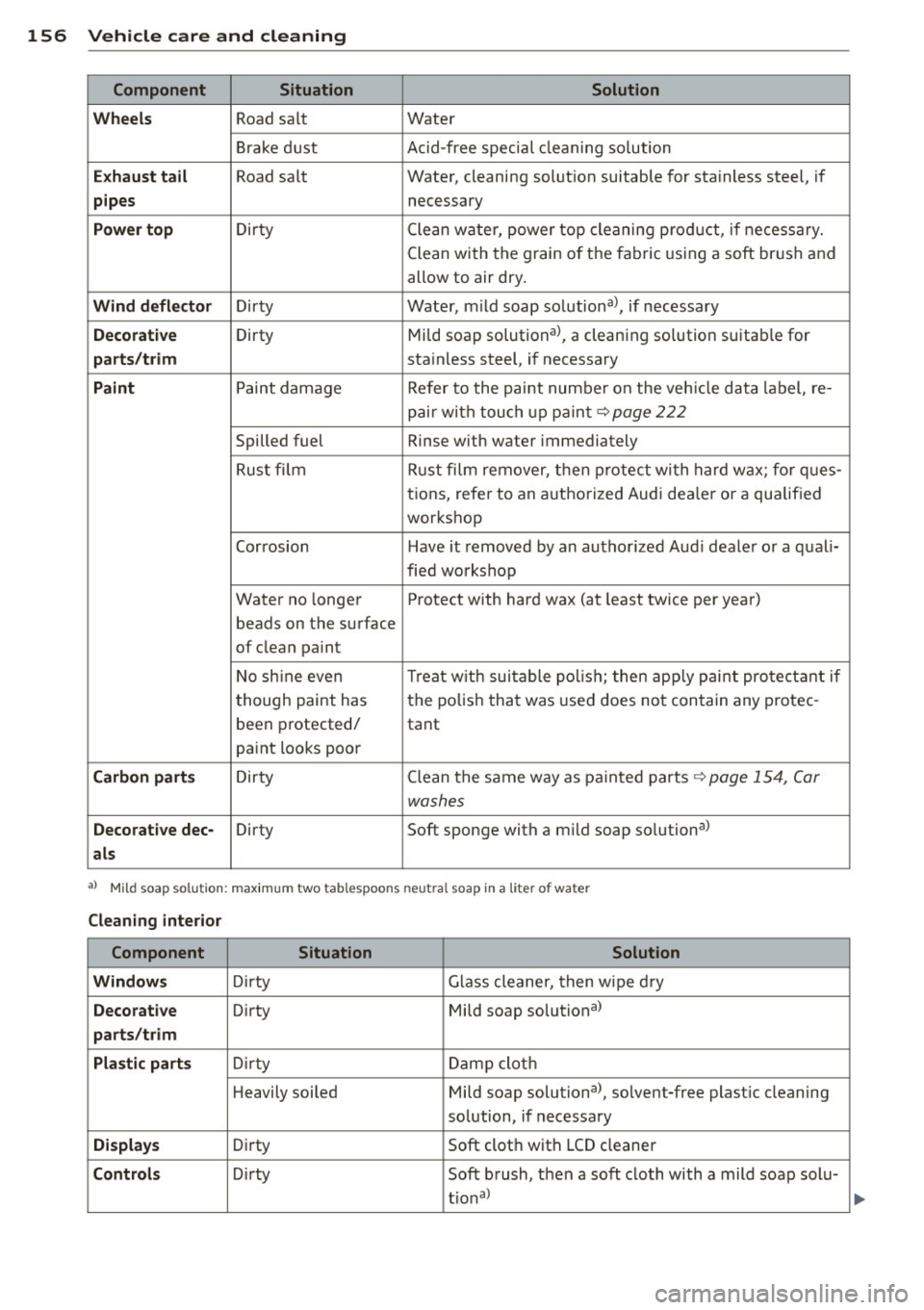
156 Vehicle care and cleaning
Component Situation Solution
Wheels
Road sa lt Water
Brake dust Acid-free special cleaning so lution
E x haust tail Road sa lt Water, cleaning solut ion suitable for sta inless steel, if
pipes necessary
Power top D irty Clean w ater, powe r top cleaning p rod uct, if necessa ry.
Clean with the grain o f the fabric using a soft br ush and
allow to air dry.
Wind d eflector Dirty Water, mild soap solutiona>, if necessary
Decorative Dirty Mild soap solutiona>, a cleaning solution suitab le for
parts/t rim sta inless steel, if necessary
Paint P aint damage Refer to the paint numbe r on the veh icle data label, re-
p air wi th tou ch up pa in t
9 page 222
Spilled fuel Rinse with water immediately
Rust fi lm Rust film remover, t hen protect wi th hard wax; fo r q ues-
t ions, refe r to an a utho rized Audi dea le r or a qualif ied
wor kshop
Corrosion Have it removed by an autho rized Aud i deale r or a qual i-
fied wo rkshop
Water no longer Protect with hard wax (at least twice per year)
beads on the surface
o f clean paint
N o sh ine even Treat w ith sui table po lish ; t hen app ly pain t pro tectan t if
t hough paint has the po
lish tha t was used does not con tain any protec -
been p rotected/
tant
pa int looks poo r
Carbon part s Dirty Clean tlhe same way as painted parts 9page 154, Car
washes
Decorat ive dee -
Dirty Soft sponge with a mild soap solutional
als
al M ild soap so lu tion : max imu m tw o tab lesp oon s ne utr al s oa p in a liter of wa ter
Cleaning interior
Component Situation Solution
Windows
Dir ty Glass cleaner, then wipe d ry
Decorat ive D irty Mild soap solutional
parts/trim
Plastic parts
D irt y Damp cloth
H eavily soi led Mild soap solutional, solvent-free plast ic cleaning
so lution, if necessary
Di splays Dir ty Soft cloth with LCD cleaner
Controls D irty Soft brush, then a soft cloth with a mild soap solu-
t io nal
...