2015 AUDI TT ROADSTER ECU
[x] Cancel search: ECUPage 178 of 244
176 Check ing and filling
must not be replace with a conventional
battery .
- Make sure the ventilat ion hose on the
side of the battery is connected, other
wise fumes or battery acid can leak out.
- Battery ho lder and terminals a lways
have to be secured cor rectly.
- Befo re a ll work on the battery fo llow the
warning s below c::, & in Working on the
battery on page 176.
@ For the sake of the environment
Because of the problem of proper d isposa l
of a battery, we recommend your author
ized Au di dealer change the battery for
you. Batter ies contain su lf u ric ac id and
lead and m ust always be disposed of prop
erly in compliance w ith all environmental
regulations . D isposing of vehicle batteries
improperly is very dangerous to the envi
ronment. Make sure that the removed bat
t ery cannot overbalan ce, o therw ise sulfu
r ic acid mig ht escape!
Q Tips
If you r vehicle is left standing for severa l
weeks at extremely low tempe rat ures, t he
veh icle b attery should be remove d and
sto red whe re it will not freeze . This w ill
prevent it from being damage d and hav ing
to be replaced .
Working on the battery
Be especially careful when working on or near
the battery!
T he ba tte ry is loca ted in the luggage compart
men t under the floor . Before yo u work on or
near the battery,
read and heed all WARN
INGS
c::, ,& .
Always heed the sa fet y warning s, when wor k
ing on the vehicle battery o r the ve hicle elec
trica l system to preve nt injury.
The following WARNINGS are very
i mportant when working on the battery :
Alway s heed the followin g WARNING SYM·
BOLS and safety precaution s when working
on the battery.
®
Always wear eye protection .
~
Battery acid contains sulfuric acid . Al-
ways w ear glov es and eye prot ection.
@
No
- spa rks
- flames
- smo king.
~
When a batter y is charged, it produ ce s
hydrogen gas which is ex plosive and
could cau se pe rsonal injury.
®
Always keep the batt ery well out of
reach of childr en.
& WARNING ~ -
Wheneve r working on t he battery o r on
the electrical system, there is t he risk of
injury, accident and even fire . Read and
heed the following WARNINGS:
- Always wear eye protection. Do not let
battery ac id or any lead particles get on
your skin or clothing. Shield you r eyes.
Exp losive gases can cause blindness or
other injury.
- Battery acid conta ins sulfuric acid. Sulfu
ric acid can ca use blindness and severe
burns.
- Always wear g loves and eye prote ction.
Do no t tilt the ba ttery because acid
could leak out of the ventilation open
ings .
- If you get battery ac id in your eyes or
on your skin, immediately rinse with
cold water for several minutes and get
med ica l attent ion.
- If you shou ld ingest any battery acid,
seek medical attention immediately .
- Do not expose the battery to an open
flame, e lectr ic sparks or an open light.
- Do not smoke .
Page 190 of 244
188 Tire s and wheel s
-If the tire pressure is too low or too high,
the tires w ill wear prematurely and the
vehicle will not handle well.
- If the t ire is not flat and you do not have
to change a wheel immed iately, drive at
reduced speed to the nearest service sta
t ion to check the tire pressure and add
air as required.
(D Note
Dr iving without va lve stem caps can cause
damage to the t ire va lves. To prevent this ,
always make sure that facto ry installed
valve stem caps on all wheels a re securely
mounted on the valve.
@ For the sake of the environment
Underinf lated tires will a lso increase t he
fue l cons umption .
Tires and vehicle load limits
There are limits to the amount of load or
weight that any veh icle and any t ire can c arry.
A vehicle that is overloaded w ill not h andle
well and is more difficult to s top. Over load ing
can not on ly lead to loss of vehicle contro l,
but can a lso damage important parts of the
ve hicle and can lead to sudden tire failure, in
cluding a blowout and sudden deflation that
can cause the veh icle to crash .
Your safety and that of your passengers a lso
depends on making sure that load limits are
not exceeded. Vehicle load includes everybody
and eve ryth ing in and on the vehicle . These
l oad limits a re tech nica lly refe rred to as the
ve hicl e's
Gross V ehicle Weight Rating
("GVWR").
The "GVWR" includes the we ight of the basic
vehicle , all factory insta lled accesso ries , a fu ll
tank of f uel, oi l, coo lant and othe r fluids pl us
maximum load. The maxim um load includes
the number o f passenge rs that t he vehi cle is
intended to carry ("seating capacity") with an
assumed weig ht of 150 lbs (68 kg) for each
passenger at a designated seating position and the total weight of any luggage
in the ve
hicle .
T he
Gro ss Axle Weight Rating (" G AWR") is
the max imum load th at ca n be applied at e ach
of the vehicle's two axles .
T he Gross Vehicle Weight Rat ing and the
G ross Ax le Weight Ra ting are listed on the
sa fety comp liance s ticke r label lo cated on the
driver's side B-pillar. Yo ur Audi has 2 seat ing
positions . Each seating position has a safety
belt
~ page 100, Safety belts.
T he fac t th at there is an upper limit to yo ur
vehicle's G ross Vehicle Weight Rating means
t h at the total weight of whatever is being car
ried in the vehicle is lim ited . T he more passen
gers in the vehicle or passengers who are
heavier than the standard we ights assumed
mea n that less we ight can be carried as lug
gage.
The tire pressure label on your Aud i also lists
the maximum combined weig ht of a ll of the
occupants and luggage or other cargo t hat
the vehicle can ca rry . For t he loca tion of the
label
~ page 184, fig . 136 .
.&, WARNING
Overloadi ng a veh icle can cause loss of ve
hicl e co ntr ol, a crash or o the r ac cident, se
rious personal injury, and even dea th .
- Ca rrying more we igh t tha n your ve hicle
was des igned to carry wi ll preve nt the
veh icle from handling proper ly an d in
crease the risk of the loss of ve hicle con
trol.
- The brakes on a ve hicle that has been
overloaded may not be able to stop the
veh icle w ith in a safe distance.
- Tires on a vehicle t hat has been over load
ed can fail s udden ly, incl uding a blowout
and sudden deflation, causing loss of
control and a crash .
Page 199 of 244
snow c hains are suitably cove red . Check
the position of the snow chains after
driving a few yards and correct if neces
sary. Follow the instructions from the
snow cha in manufacturer when doing so.
Where snow cha ins are mandatory oncer
tain roads, this normally also applies to
veh icles with all-wheel dr ive.
Wheel bolts
Wheel bolts must always be tightened to the
correct torque.
The design of whee l bolts is matched to the
factory insta lled r ims . If different rims are fit
ted, the correct wheel bo lts with the right
length and correctly shaped bolt heads must
be used. This ensures t hat wheels are fitted
securely and that the brake system functions
correctly .
In certain circumstances, you may not use
wheel bo lts from a different vehicle -even if it
i s the same model
¢ page 227.
A WARNING
Imprope rly tig htened or maintained wh eel
bolts can become loose ca using loss of
con trol, a collision and serious person al in
jury.
- Always keep the w heel bolts and the
threads in the wheel hubs clea n so the
wheel bolts can tu rn easily and be p rop
er ly tightened .
- Never grease or oil the wheel bo lts and
the threads in the wheel hubs. They can become loose w hile driving if greased or
o iled, even if tig htened to the specif ied
torque.
- Only use whee l bolts that belong to the
rim being installed.
- Never use different whee ls bolts on your
vehicle.
- Always maintai n the co rrect tig htening
torq ue fo r the wheel bo lts to reduce the
risk of a wheel loss. If the tightening tor-
Tire s an d wheel s 197
que of t he whee l bolts is too low, they
can loosen and come out when the vehi
cle is mov ing. If the tig htening torq ue is
too high, the wheel bolts and threads
can be damaged and the whee l can be
come loose.
(D Note
The specified torque for the whee l bolts is
90 ft lb (120 Nm) with a tolerance of± 7,4
ft lb(± 10 Nm). Torq ue whee l bolts diago
nally. After changing a whee l, the tor que
must be checked as soon as possible with a
torq ue w rench -prefe rably by an au thor
iz ed A udi de aler or qu alified workshop .
Low aspect ratio tires
Your Audi is factory -eq uipped w ith low aspect
r atio tires . These tires have been tho roughly
tested and been se lected specifically for your
model for their superb performance, road fee l
and handli ng under a var iety of driving condi
tions . Ask your authorized Audi dealer for
more d etails.
The low aspect ratio of these t ires is ind icated
by a numeral of
55 or less in the tire's s ize
designation . The numeral represents the ratio
of the t ire's sidewa ll height in relation to its
t read width exp ressed in pe rce ntage. Conven
t iona l tires have a he ight/w idth rat io of 60 or
more.
The performanc e of low-a spect-ratio tire s is
particularly sensitive to impr oper inflation
pre ssure .
It is therefore important that low
a spect ratio tire s are inflated to the specified
pres sure and that the inflation pressure is
regularly checked and maintained. Tire pre s
sures should be checked at least once a month and always befo re a long trip
¢ page 186, Checking tire pressure.
What you can do to avoid tire and rim
damage
Low aspect ratio tires can be damaged mo re
easily by impact w it h potholes, curbs, gul lies ..,.
•
•
Page 206 of 244
204 What do I do now ?
What do I do now?
Trunk escape handle
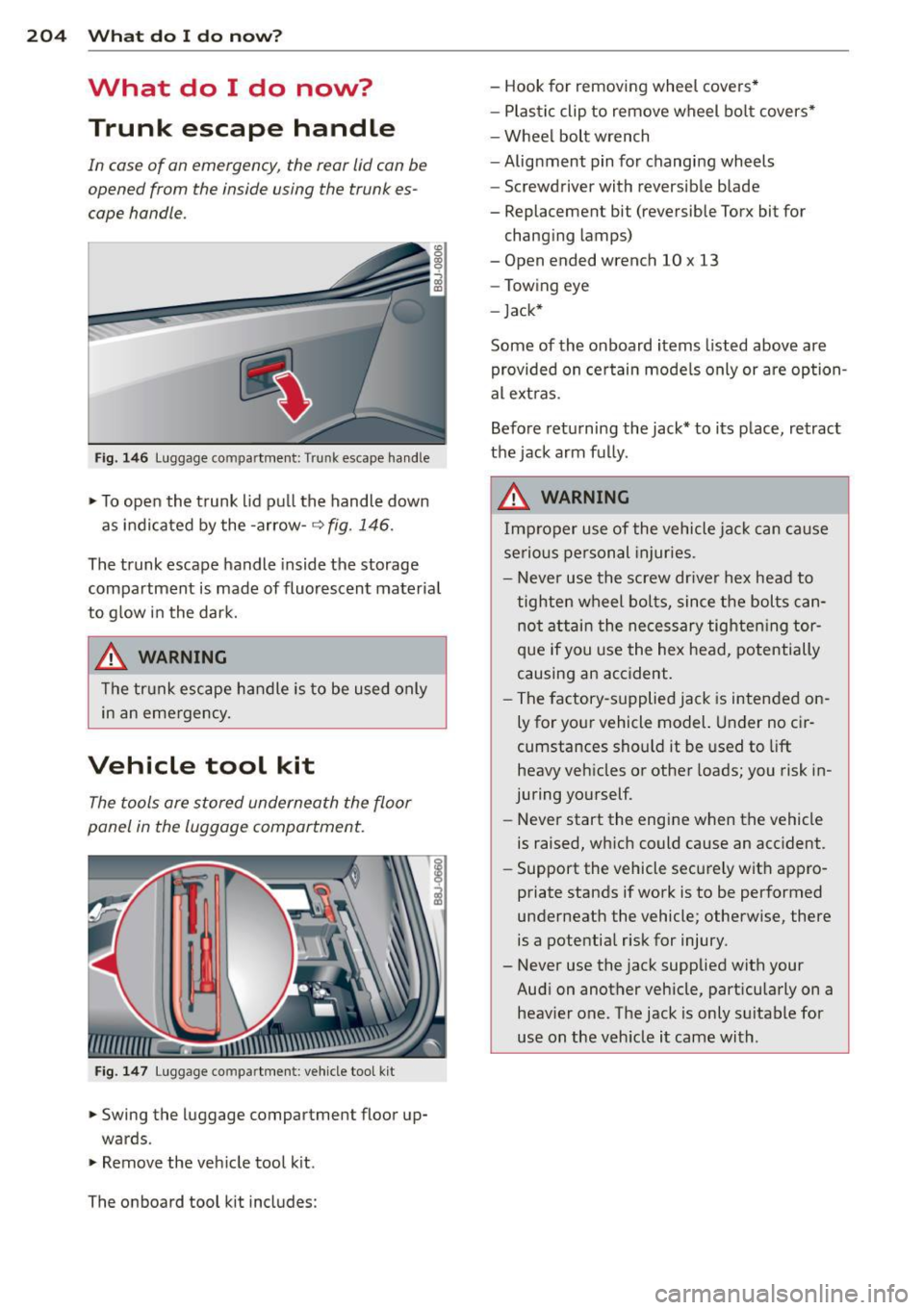
In case of an emergency, the rear lid can be
opened from the inside using the trunk es
cape handle.
Fig. 1 46 Luggage compartment: Trunk escape handle
... To open the trunk lid pu ll the handle down
as indicated by the -arrow-~
fig. 146.
The trunk escape handle inside the storage
compartment is made of fluorescent materia l
to g low in the dark.
A WARNING
The trunk escape handle is to be used only
in an emergency.
Vehicle tool kit
The tools are stored underneath the floor
panel in the luggage compartment.
Fig. 1 47 Luggage co mpa rtment : veh icle too l kit
... Swing the luggage compartment floor up
wards .
... Remove the veh icle tool k it.
The on board tool kit includes: -
Hook for removing wheel covers *
- Plastic clip to remove wheel bo lt covers•
- Wheel bolt wrench
-Alignment pin for changing wheels
- Screwdriver with reversible blade
- Replacement bit (reversible Torx bit for
chang ing lamps)
- Open ended wrench 10 x 13
- Towing eye
- Jack*
Some of the on board items listed above are
provided on certain mode ls only or are option
al ext ras.
Before returning the jack* to its place, retract
the jack arm fully .
A WARNING
Im proper use of the vehicle jac k can cause
serious personal injuries .
- Never use the screw driver hex head to tighten wheel bo lts, since the bolts can
not attain the ne cessary tighten ing tor
que if you use the hex head, potentially
causing an accident.
- The factory-supplied jack is intended on ly for your vehicle model. Under no cir
cumstances should it be used to lift
heavy vehicles or other loads; you risk in
juring yourself.
- Never start the engine when the vehicle
is raised, wh ich could cause an acc ident.
- Support the vehicle secure ly wit h appro
priate stands if work is to be performed
underneath the vehicle; otherwise, there
is a potential risk for injury.
- Never use the jack supplied with your
Audi on another vehicle, part icularly on a
heavier one. The jack is only su itable for
use on the veh icle it came with .
Page 212 of 244
210 What do I do now?
slip and cause an injury if it does not
have sufficient hold on the vehicle.
- A soft or unstable surface under the
jack may cause the vehicle to slip off
the jack. Always provide a firm base for
the jack on the ground . If necessary,
use a sturdy board under the jack.
- On hard, slippery surface (such as tiles)
use a rubber mat or similar to prevent
the jack from slipp ing .
- To help prevent injury to yourself and
your passengers:
- Do not raise the vehicle unti l yo u are
sure the jack is securely engaged.
- Passengers must not remain in the ve
hicle when it is jacked up.
- Make sure that passengers wait in a
safe p lace away from the vehicle and
well away from the roadway and traffic.
- Make sure jack position is correct, ad
just as necessa ry and then continue to
ra ise the jack .
(D Note
A floor jack or the pads on the hoist arms
must
not be posit ioned at the points
shown
-arrows- .
Taking the wheel off
Follow these instructions step-by-step for
changing the wheel.
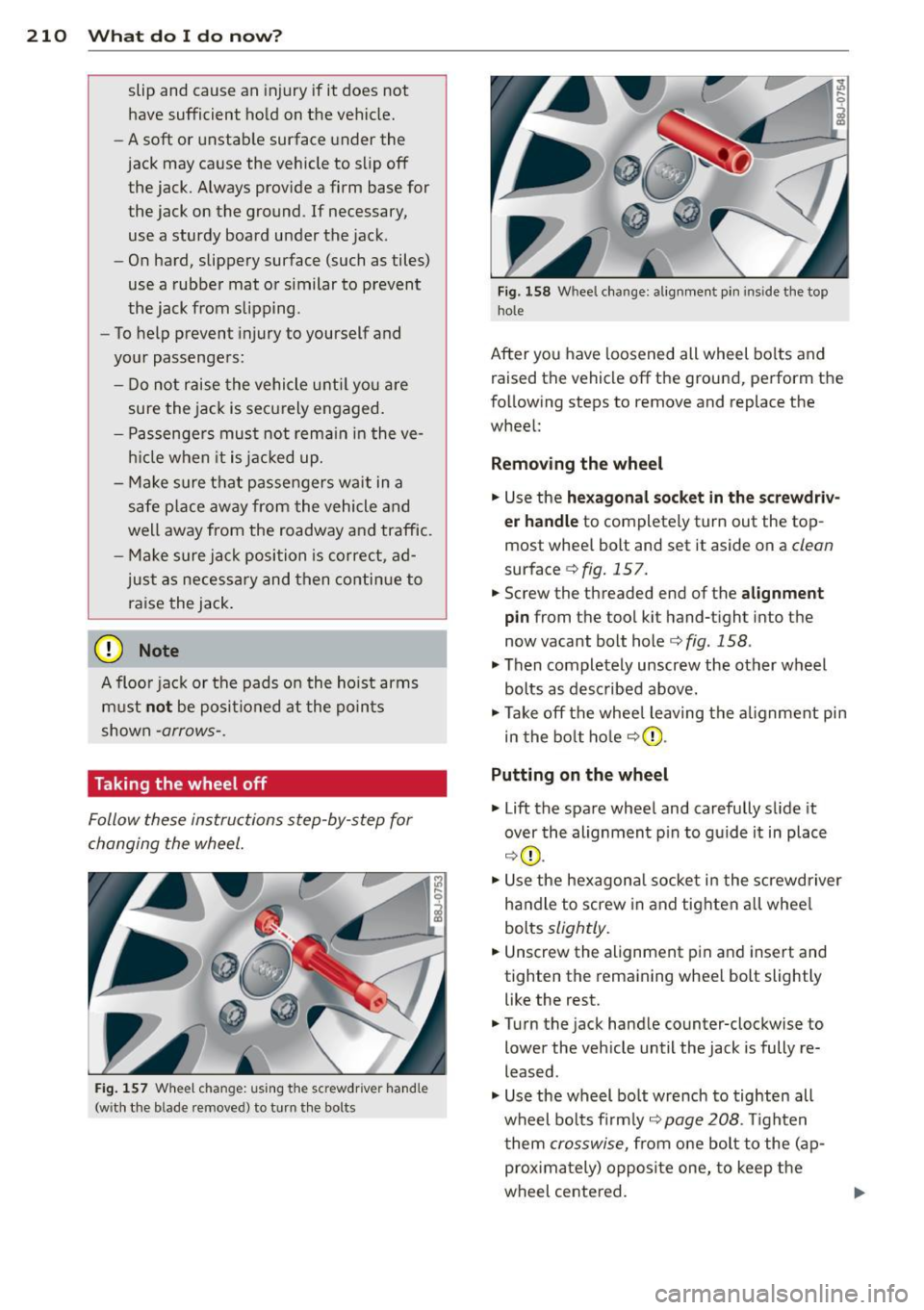
Fig. 157 Wheel ch an ge: us ing the sc rewdrive r hand le
(w ith the b lade removed) to turn the bolts
Fig. 158 Whee l change : alignmen t pin inside the top
hol e
After you have loosened all wheel bolts and
raised the vehicle off the ground, perform the
following steps to remove and replace the
wheel:
Removing the wheel
.,. Use the hexagonal socket in the screwdriv
er handle
to completely turn out the top
most whee l bolt and set it aside on a
clean
surface c;, fig. 15 7.
.,. Screw the threaded end of the
alignment
pin from the tool kit hand-tight into the
now vacant bolt hole <=>
fig. 158 .
.,. Then completely unscrew the other wheel
bolts as described above.
.,. Take off the whee l leaving the alignment pin
in the bolt hole
c;,(D .
Putting on the wheel
.,. Lift the spare wheel and carefully s lide it
over the alignment p in to guide it in place
c;,(D .
.,. Use the hexagonal socket in the screwdriver
handle to screw in and tighten all whee l
bolts
slightly .
.,. Unscrew the alignment p in and insert and
tighten the remaining wheel bolt slightly like the rest .
.,. Turn the jack handle counter-clockwise to
lower the vehicle until the jack is fully re
leased .
.,. Use the wheel bo lt wrench to tighten all
wheel bolts firmly ,=:,
page 208 . Tighten
t hem
crosswise, from one bolt to the ( ap
proximately) opposite one, to keep the
wheel centered.
Page 213 of 244

(D Note
When removing or installing the wheel,
the rim could hit the bra ke rotor and dam
age the rotor . Wor k carefully and have a
second person help you.
N ever use the hexa gonal s ocket in the ha n
d le of the screwdriver to loosen or t ighten
the wheel bolts.
- Pull the reversib le blade from the screw
drive r before yo u use the hexagonal
socket in t he handle to t urn the whee l
bo lts .
- When mounting tires with
unid irectional
tread design
make s ure the tread pat
te rn is poi nte d the r ight way
¢pag e 211.
- The wheel bolts should be clea n and easy
to tu rn . Ch eck for dirt and corros ion on
the mat ing su rfaces of both the whee l
a nd th e hu b. Remove a ll dir t fro m these
s ur fa ces before remo unting the wheel.
Notes on wheel change
Pl ease rea d the information ¢ page 191, New
tires and replacing tires and wheels,
i f you are
going to use a spare t ire which is different
from the tires on your ve hicle.
Afte r you change a tire:
- Check the tire pressure on the spare imme
diately after mounting .
- Have the wheel bolt tightening torque
che cked with a torque wrench as soon as
possible by your authorized Audi dealer or
a qualified service station.
- With steel and alloy wheel rims, the wheel
bolts are correctly tightened at a torque of
90 ft lb (120 Nm) .
- If you notice while changing a tire that the
wheel bolt s are co rroded and diffi cult to
turn , then they should be replaced before
you check the t ightening torque.
What do I do now? 211
- Replace the flat tire with a new one and
have it installed on your vehicle as soon as
possible. Remount the wheel cover .
Until then , drive with extra care and at re
duced speeds.
A WARNING
-
- If you are go ing to e quip your ve hicl e
wit h tires o r rims which differ from those
which were factory installed, t hen be
sure to read the information¢
page 191,
New tires and replacing tires and
wheels .
-Always sto re the tools secu rely in lug
gage compartment. Othe rwise, in a n ac
cident o r su dd en maneuv er they cou ld fly
forwa rd, causi ng injury to passe ngers in
the vehicle.
Tires with unidirectional tread design
Tires with unidirectional tr ead design must be
mounted with their tread pattern pointed the
right dire ction.
A u nidirectional tire can be identified by ar
rows on the sidewall,
which point in the direc
tion of t he rota tion. Yo u m ust follow the
s p ecifie d direction of rot ation. This i s nece ssa
r y in order fo r these tires to develop t heir op
timum charac ter istics regard ing grip, road
no ise, wear, and hydrop la ning.
•
•
Page 220 of 244

218 Emergency sit uat ions
instructions of the jumper cable
manufacturer. If in doubt, call for road
service.
- Jumper cables must be long enough so
that the vehicles do not touch.
- When connecting jumper cables, make
sure that they cannot get ca ught in any
moving parts in the eng ine compart
ment.
- Before you check anything in the engine
compartment, always read and heed all
WARNINGS
¢ page 164, Working in the
engine compartment.
@ Note
Improper hook-up of jumper cables can ru
in the generator.
- Always connect POSITIVE(+) to POSI TIVE(+), and NEGATIVE( -) to NEGATIVE
( - ) ground post of the battery manager
control unit.
- Check that all screw plugs on the battery
cells are screwed in firmly . If not, tighten
plugs prior to connecting clamp on nega
tive battery terminal.
- Please note that the procedure for con nect ing a jumper cable as desc ribed
above applies spec ifically to the case of
you r vehicle being j ump s tarted. When
you are giv ing a jump star t to anothe r ve
hicle, do
not connect the negat ive (-) ca
ble to the negative(-) terminal on the
discharged battery ©- Instead, securely
connect the negative(-) cable to either a
solid metal component that is firmly
bo lted to the engine block or to the en
gine block itself. If the battery that is be
i ng charged does not vent to t he outside,
escaping batte ry gas cou ld ig nite and ex
plode!
Emergency towing
with commercial tow
truck
General hints
Your Audi requires special handling for tow
ing.
T he following information is to be used by
commercial tow truck operators who know
how to operate their equipment safely.
- Nev er tow your Audi , towing will cau se
damage to the engine and tr an smi ssion .
- Ne ver wrap th e safet y chain s or winch ca
ble s ar ound the brak e lines.
- To prevent unne ces sary damage , your Audi
must be tran sp o rt ed with a car carrier
(flatbed truck ).
- To load th e vehi cle on t o the flat bed , u se
the t owing loop found in t he vehicle tools
and attach to the front o r rear ancho rage
¢page 219 and ¢page 220 .
A WARNING
-A vehicle being towed is not safe for pas-
sengers. Never allow anyone to ride in a
vehicle be ing towed, for any reason.
-
Page 222 of 244
220 Emergency situations
Remove the towing loop when you are done
using it and place it back in the vehicle tool
kit. Always keep the towing loop in the vehi
cle .
When installing the air intake grille, insert the
tabs on the grille in the mounts on the vehicle
f ir st. Then press the grille in to secure it.
A WARNING
If the towing loop is not tightened until it
stops when installing, the threads may be
pulled out when tow ing the vehicle and
that could cause an accident .
Rear towing loop
Do not install the rear towing loop until it is
needed.
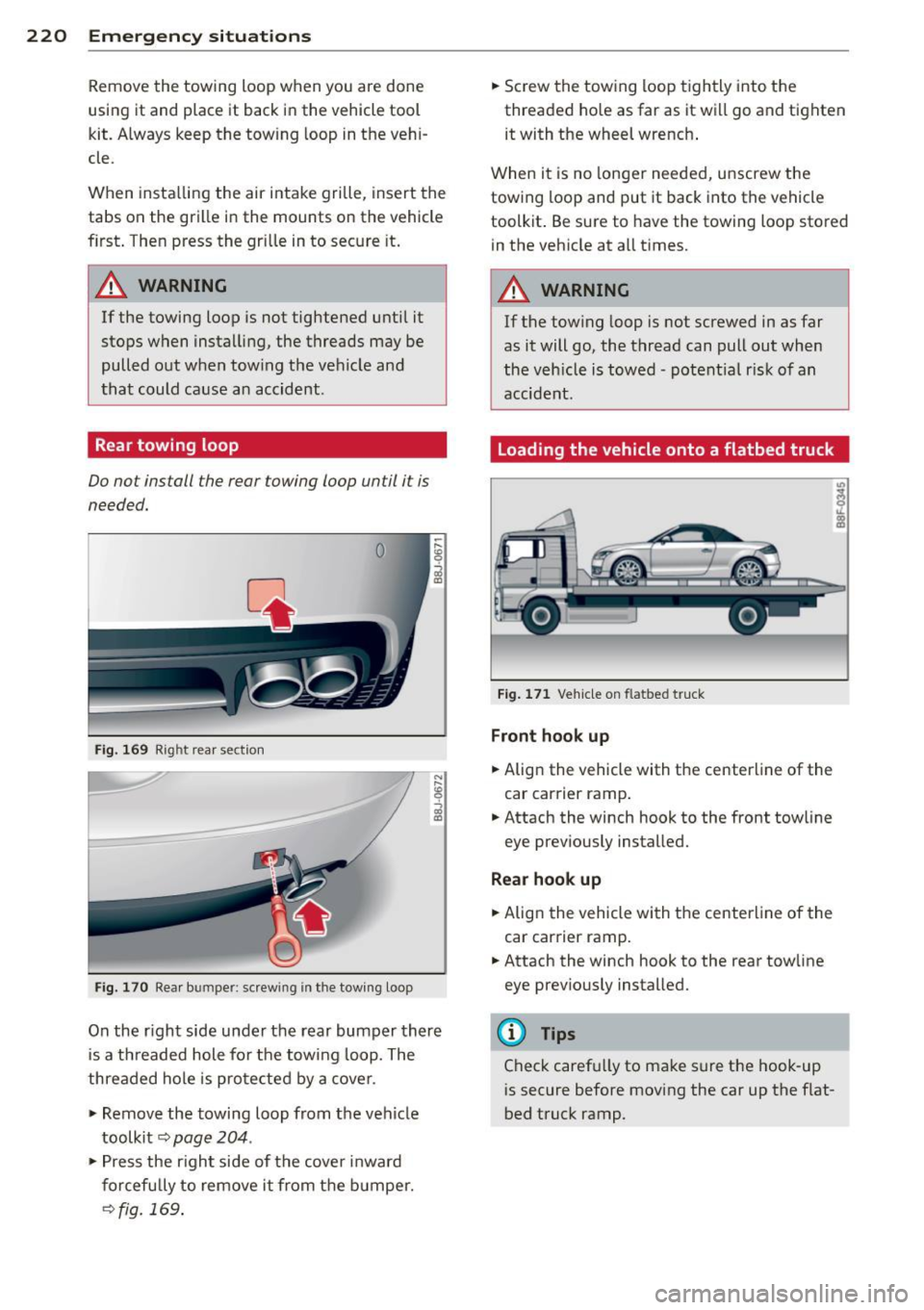
Fig. 169 Right rear section
Fig. 170 Rear bum per: screw ing in the towing loop
On the r ight side under the rear bumper there
is a threaded hole for the towing loop. The
threaded hole is protected by a cover.
"' Remove the towing loop from the vehicle
toolkit ~
page 204 .
"'Press the right side of the cover inward
forcefully to remove it from the bumper.
~fig. 169.
"' Screw the towing loop tightly into the
threaded hole as far as it will go and tighten
it with the wheel wrench .
When it is no longer needed, unscrew the
towing loop and put it back into the vehicle
toolkit . Be sure to have the towing loop stored
in the vehicle at all times.
A WARNING
-If the towing loop is not screwed in as far
as it will go, the thread can pull out when
the veh icle is towed -potent ial risk of an
accident.
Loading the vehicle onto a flatbed truck
Fig. 171 Vehicle on flatbed t ruck
Front hook up
"' Align the vehicle with the centerline of the
car carrier ramp .
"' Attach the winch hook to the front towline
eye previously installed.
Rea r hook up
"' Align the vehicle with the centerline of the
car carrier ramp.
"' Attach the winch hook to the rear towline
eye previously installed.
(D Tips
Check carefu lly to make sure the hook-up
is secure before moving the car up the flat
bed truck ramp.