2015 AUDI TT ROADSTER warning
[x] Cancel search: warningPage 126 of 244
124 Airbag system
-in the event of a system malfunction (warn
ing/indicator light is on )
r=:> page 15.
.&_ WARNING
-Safety belts and the airbag system can
only provide protection when occupants
are in the proper seating position
¢page 117.
-If the airbag indicator light comes when
the vehicle is being used, have the sys
tem inspected immediately by your au
tho rized Aud i deale r.
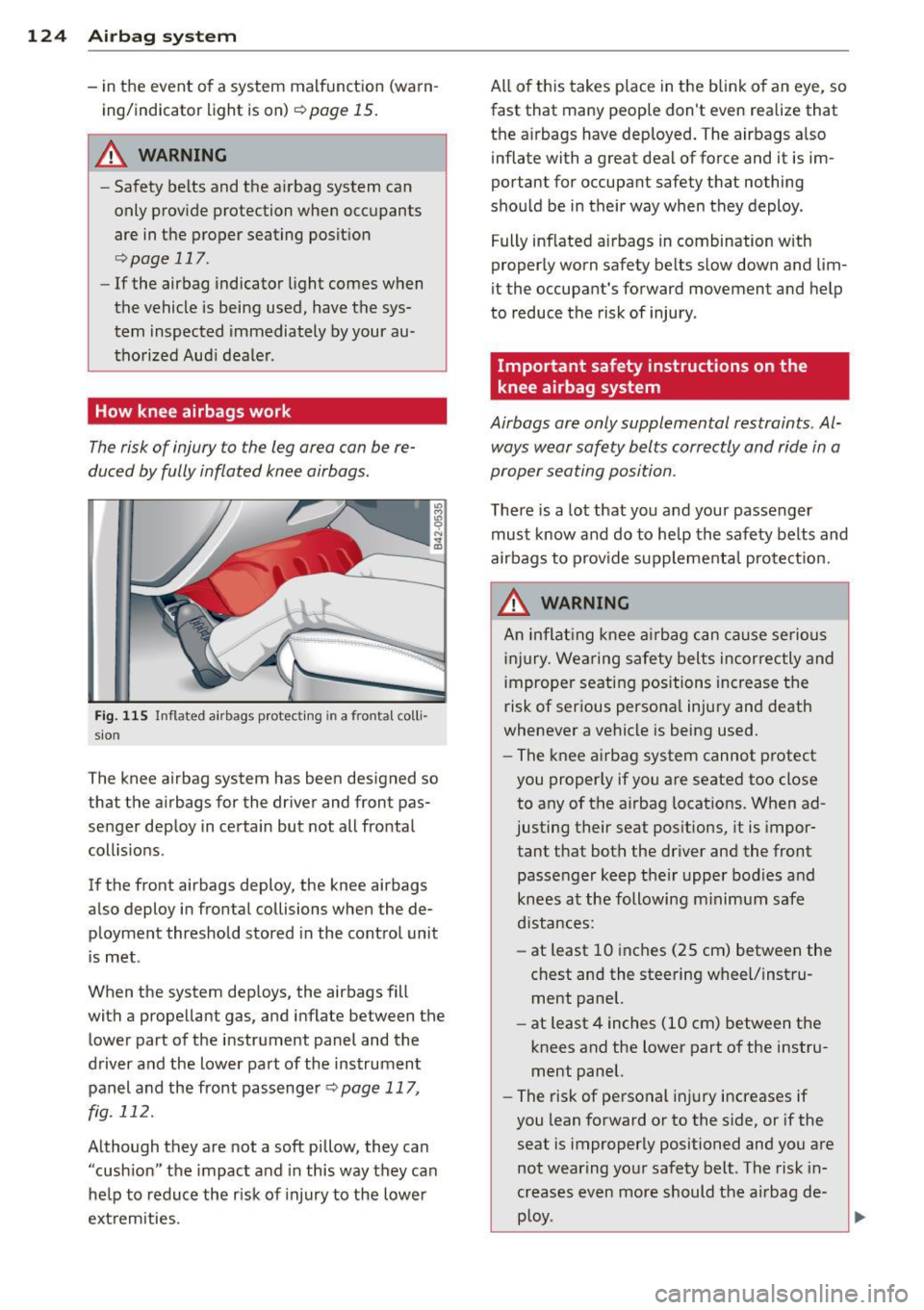
How knee airbags work
The risk of injury to the leg area can be re
duced by fully inflated knee airbags.
F ig . 115 Inflated a irbags p rotecti ng in a fro ntal coll i
s ion
The knee airbag system has been designed so
that the airbags for the driver and front pas
senger deploy in certain but not all frontal
coll is ions.
If the front airbags deploy, the knee airbags
also deploy in frontal collisions when the de p loyment threshold stored in the control unit
i s met.
When the system dep loys, the airbags fill
with a propellant gas, and inflate between the lower part of the instrument panel and the
d river and the lower part of the instrument
panel and the front passenge r<=>
page 117,
fig. 112.
Although they are not a soft pillow, they can
"cush ion" the impact and in this way they can
he lp to reduce the r isk of injury to the lowe r
extremities. All o
f th is takes place in the b link o f an eye, so
fast that many peop le don't even realize that
the a irbags have deployed. The airbags a lso
inflate with a great deal of force and it is im
portant for occupant safety that nothing
shou ld be in their way when they deploy.
Fully inflated a irbags in combination with
proper ly worn safety belts s low down and lim
it the occupant's forward movement and help
to reduce the risk of injury .
Important safety instructions on the
knee airbag system
Airbags are only supplemental restraints . Al
ways wear safety belts correctly and ride in a
proper seating position.
The re is a lot that you and you r passenger
must know and do to he lp the safety belts and
airbags to prov ide s upplemen ta l pro te ct io n .
.&_ WARNING
An inflat ing knee a irbag c an cause se rious
in ju ry. Wea ring safety belts incorrectly and
improper seat ing positions increase the
risk of ser ious persona l injury and death
whenever a vehicle is being used.
- The knee airbag system cannot protect
you properly if you a re seated too close
to any of the airbag locat ions. When ad
justing their seat pos itions, it is impor
tant that bot h the driver and the front
passenger keep the ir upper bod ies and
knees at the following minimum safe
d istances:
- at least 10 inches (25 cm) between the
chest and the steering wheel/inst ru
ment panel.
- at least 4 inches (10 cm) between the
knees and the lower part of the instru
ment panel.
- The risk of personal inj ury increases if
you lean forward or to the s ide, or if the
seat is improperly positioned and you are
not wearing yo ur safety belt . The risk in
creases even more should the a irbag de
p loy .
Page 127 of 244

-Always make sure that the knee airbag
can inflate without interference. Objects
between you and the airbag can increase
the risk of injury in an accident by inter
fering with the way the airbag deploys or by being pushed into you as the airbag
deploys.
- Never let anybody, especially children
or animals ride in the footwell in front
of the passenger seat.
If the airbag de
ploys, this can result in serious or fatal
injuries.
- Never carry objects of any kind in the
footwell area in front of the driver's or passenger's seat. Bulky objects (shop
ping bags, for example) can interfere
with or prevent proper deployment of
the airbag. Small objects can be
thrown through the vehicle if the air
bag deploys and injure you or your pas
sengers.
- Make sure there are no cracks, deep
scratches or other damage in the area of
the instrument panel where the knee air
bags are located.
- If children are incorrectly seated, their
risk of injury increases in a collision
Q page 129, Child Safety.
Side airbags
Description of side airbags
The airbag system can provide supplemental
protection to properly restrained front seat occupants.
Fig . 116 Side airbag location in the driver 's seat
The s ide airbags are located in the sides of the
front seat backrests
¢ fig. 116facing the
Airbag system 125
doors. They are identified by the word "AIR
BAG".
The side airbag system basically consists of:
- the electron ic control module and external
side impact sensors
- the two side airbags located in the sides of the front backrests
- the airbag warning light in the instrument
cluster.
The airbag system is monitored electronically
to make certain that it is functioni ng properly
at all times. Each time you turn on the igni
tion, the airbag system indicator light will
come on for a few seconds (self diagnostics).
The side airbag system supplements the safe
ty belts and can help to reduce the risk of in
jury to the driver's and front passenger's up
per torso on the s ide of the vehicle that is
struck in a side collision. The airbag deploys in
side impacts and only when the vehicle accel
eration registered by the control unit is high
enough. If this rate is below the reference val
ue programmed into the control unit, the side
airbags will not be triggered, even though the
car may be badly damaged as a result of the
collision . It is not possible to define an airbag
triggering range that will cover every possible
angle of impact, since the circumstances will
vary considerably between one collision and
another. Important factors include, for exam
ple, the nature (hard or soft) of the impacting
object, the angle of impact, vehicle speed,
etc.
¢ page 127, Important safety instruc
tions on the side airbag system .
Aside from their normal safety function, safe
ty belts work to help keep the driver or front
passenger in position in the event of a side
collision so that the side airbags can provide
protection.
The airbag system is
not a substitute for your
safety belt. Rather, it is part of the overall oc
cupant restraint system in your vehicle. Al
ways remember that the side airbag system
can only help to protect you if you are wearing
your safety belt and wearing it properly. This is another reason why you should always wear
IIJJ,
Page 128 of 244

126 Airbag system
your safety belts, not just because the law re
quires you to do so¢
page 100, General
notes.
It is impor tant to remember that while the
supp lemental side airbag system is designed
to reduce the likelihood of serious injuries,
other injuries, for example, swelling, bruising,
and minor abrasions can also be associated
with deployed side airbags. Remember too,
side airbags will deploy only once and only in
certain k inds of acc idents -your safety belts
are a lways there to offer protect ion.
Vehicle damage, repair costs or even the lack
of vehicle damage are not necessari ly an indi
cation of over-sensit ive or failed airbag activa
tion . In some co llisions, both front and s ide
a irbags may inflate. Remember too, that air
bags will deploy only once and only in certa in
kinds of co llisions -your safety belts are al
ways there to offer protection in those acci
dents in which airbags are not supposed to
deploy or when they have already deployed.
The side airbag system will not depl oy:
- when the ign ition is turned off
- i n s ide collisions when the accelerat ion
measured by the sensor is too low
- i n rear-end collisions
- in rollovers.
In some types of accidents the front airbags
and side airbags may be triggered together.
A WARNING
-Safety belts and the a irbag system will
only prov ide protection when occupants
are in the p roper seating posit ion
~page 127.
-If the airbag indicator light comes on
when the veh icle is being used, have the
system inspected immediately by your
au thori zed Audi dealer. The a irbag may
not work properly when the vehicle ac
celeration in a side co llision is h igh
enough to activate the airbag.
-
How supplemental side airbags work
Side airbags deploy instantly and can help re
duce the risk of upper torso injuries for occu
pants who are properly restrained.
F ig . 1 17 Inflated side airbags on left side of veh icle
When the system is triggered, the airbag is
filled with propellant gas and breaks through a seam in the seat surface area marked "AIR
BAG".
It expands between the side trim panel
and the passenger. In order to help provide
th is additional protection, the side airbag
must inflate w ithin a fraction of a second at
very h igh speed and with great force. The sup
pleme nta l side airbag could injure you if your
seat ing pos it ion is not proper or upright or if
items are loca ted in the area where the s up
plementa l side airbag expands. This applies
especially to children¢
page 129, Child Safe
ty .
Supplemental side airbags inflate between
the occupant and the door panel on the side
of the vehicle that is struck in certain side col
lis ion ¢
fig. 117.
Although they are not a soft pillow, they can
"cushion" the impact and in this way they can
help to reduce the risk of injury to the upper
part of the body.
A fine dust may deve lop when the airbag de
ploys. This is normal and does not mean there
is a fire in the vehicle.
Page 129 of 244

Important safety instructions on the
side airbag system
Airbags are only supplemental restraints. Al
ways properly wear safety belts and ride in a
proper seating position.
There is a lot that you and your passengers
must know and act accordingly to help the
safety belts and airbags do their job to pro
vide supplemental protection .
A WARNING
An inflating side airbag can cause serious
or fatal injury. Improperly wearing safety
belts and improper seating positions in
crease the risk of serious personal injury
and death whenever a vehicle is being
used .
- In order to reduce the risk of injury when
the supplemental side airbag inflates:
-Always sit in an upright position and
never lean against the area where the
supplemental side airbag is located.
- Never let a child or anyone else rest
their head against the side trim panel
in the area where the supplemental
side airbag inflates.
- Always make sure that safety belts are worn correctly,
- Do not let anyone sitting in the front
seat put their hand or any other parts
of their body out of the window.
- Always make sure that the side airbag can inflate without interference.
- Never install seat covers or replace
ment upholstery over the front seat backs that have not been specifically
approved by Audi.
- Never use additional seat cushions that
cover the areas where the side airbags
deploy.
- Damage to the original seat covers or
to the seam in the area of the side air bag module must always be repaired
immediately by an authorized Audi
dealer.
Airbag system 127
- Objects between you and the airbag can
increase the risk of injury in an accident
by interfering with the way the airbag
unfolds or by being pushed into you as
the airbag inflates.
- Never place or attach accessories or
other objects (such as cup holders, tel ephone brackets, or even large, bulky
objects) on the doors, over or near the
area marked "AIRBAG" on the seat backrests .
- Such objects and accessories can be come dangerous projectiles and cause injury when the supplemental side air
bag deploys.
- Never carry any objects or pets in the
deployment space between them and
the airbags or allow children or other passengers to travel in this position .
- Always prevent the side airbags from be
ing damaged by heavy objects knocking
against or hitting the sides of the seat backs.
- The airbag system can only be triggered
once . If the airbag has been triggered,
the system must be replaced by an au
thorized Audi dealership.
- Damage (cracks, deep scratches etc.) to
the original seat covers or to the seam in
the area of the side airbag module must
always be repaired immediately by an au
thorized Audi dealer.
- If children are seated improperly , their
risk of injury increases in the case of an
accident
c:> page 129, Child Safety.
- Never attempt to modify any compo
nents of the airbag system in any way .
- In a side collision, side airbags will not
function properly if sensors cannot cor
rectly measure increasing air pressure in
side the doors when air escapes through
larger , unclosed openings in the door
panel.
- Never drive with interior door trim pan
els removed.
- Never drive when parts have been re
moved from the inside door panel and
•
•
Page 131 of 244
Child Safety
Important things to know
Introduction
The physical principles o f what happens when
your ve hicle is in a crash app ly also to chi ldren
c::> page 101, What happens to occupants not
wearing safety belts? .
But unlike adults and
teenagers, the ir muscles and bones are no t
fully developed . In many respects children are
at greater risk of serious injury in crashes than
adu lts.
Because children's bod ies are no t fully devel
oped, they require restra int systems especial
l y designed for the ir size, weight, and body
structure . Many count ries and all states of the
United States and provinces of Canada have
l aws req uiring the use of approved ch ild re
straint systems for in fants and small chi ldren.
I n a fronta l crash at a speed of 20-35 mph
(30-56 km/ h) the fo rces acting on a 13-po und
(6 kg) inf ant will be more than 20 t imes the
weight of the child. This means the weight of
the child would suddenly be more than
260 pounds ( 120 kg) . Under these conditions,
only an appropriate chi ld restraint properly
used can reduce the risk of ser ious injury.
C hi ld restra ints, like adult safety belts, must
be used properly to be effective . Used improp
erly , they can increase the risk of ser ious in
ju ry in an accident.
Consult the child safety seat manufacturer's i nstructions in order to be sure the seat is
right fo r you r ch ild 's s ize
c::> page 132, Impor
tant safety instructions for using child safety
sea ts.
P lease be su re to read and heed all of
the impo rtan t informat io n a nd WAR NINGS
about child safety, Advanced A irbags, and the
installation of child rest raints in this chapter .
There is a lot you need to know abou t the Ad
vance d Airbags in yo ur vehicle and how they
wo rk when infants and children in child re
straints are o n the front passenger seat. Be
cause of the large amount of important infor -
Child Safet y 129
mation, we cannot repeat it a ll here . We urge
yo u to read the detai led information in this
owner 's man ua l about ai rbags and the Ad
vanced Airbag System in your vehicle and the
very important information about transport
ing ch ildren on the front passenger seat.
Please be sure to heed the WARNINGS -they
ar e extremely importa nt for your safety and
the safety of you r passenge rs, especially in
f an ts a nd small chi ld ren.
A WARNING
-
A ll vehicle occupants and especially chi l
d ren must be restra ined properly w henev
er riding in a vehicle. An unrestrained or
improperly restra ined child could be in
jured by str iking the interior or by being
e jected from the vehicle dur ing a sudden
maneuve r or impact. A n unrestra ined o r
improperly restr ained child is also at great
e r r isk of inju ry or d eath thro ugh contact
wi th an inflat ing a irbag.
_& WARNING
C hildren on the front seat of any car even
wi th Advanced Airbag s can be ser io usly in
j ur ed or even kil led when an a irba g in
flates. A child in a rearwar d-fac ing ch ild
safety seat insta lled on t he front passen
ger seat will be ser iously injured and can
be killed if the front airbag inflates .
- The inflating airbag will h it the ch ild
safety seat or infant carrier with great
force and will smas h the child safety seat
a nd chi ld agai nst the bac krest , door or
roof.
- Never i nstall a rearward faci ng child
safety seat on the front passenger s eat
un less the
PASSENGER AIR BAG OFF
light comes o n and stays on. If the PAS·
SENGER AIR BAG OFF
l ight does no t
come on and st ay on, have the air bag
sys tem inspected immediately by your
Aud i dea le r.
•
•
Page 132 of 244

130 Child Safety
8_ WARNING
If, in exceptional circumstances, you must
install a forward-facing child restraint on
the front passenger's seat:
- Always make sure the forward-facing
seat has been designed and certified by
its manufacturer for use on a front seat
with a passenger front and side airbag.
-Always follow the manufacturer's in
structions provided with the child safety
seat or carrier.
-Always move the passenger seat into its
rearmost position in the seat's fore and
aft adjustment range, as far away from
the airbag as possible before installing
the child restraint. The backrest must be adjusted to an upright position.
- Always make sure that the
PASSENGER
AIR BAG OFF
light comes on and stays
on all the time whenever the ignition is
switched on.
(D Tips
Always replace child restraints that were
installed in a vehicle during a crash. Dam
age to a child restraint that is not visible
could cause it to fail in another collision
situation.
Advanced front airbag system and children
Your vehicle is equipped with an "Advanced
Airbag System" in compliance with United
States Federal Motor Vehicle Safety Standard
(FMVSS) 208 as applicable at the time your
vehicle was manufactured.
The Advanced Airbag system in your vehicle
has been certified to meet the "low-risk " re
quirements for 3- and 6-year old children on
the passenger side and small adults on the
driver side. The low risk deployment criteria
are intended to reduce the risk of injury
through interaction with the airbag that can
occur, for example, by being too close to the
steering wheel and instrument panel when
the airbag inflates. In addition , the system has been certified to comply with the "sup
pression" requirements of the Safety Stand
ard, to turn off the front airbag for infants up
to 12 months who are restrained on the front
passenger seat in child restraints that are list
ed in the Standard.
Even though your vehicle is equipped with an
Advanced Airbag system, a child should al
ways ride in the seat properly restrained for
its age and size. The airbag on the passenger
side makes the front seat a potentially dan
gerous place for a child to ride. The front seat
is not the safest place for a child in a forward
facing child safety seat. It can be a very dan
gerous place for an infant or a larger child in a
rearward-facing seat.
Advanced Airbags and the weight
sensing mat in the front seat
The Advanced Airbag System in your vehicle
detects the presence of an infant or child in a
child restraint on the front passenger seat us
ing the weight-sensing mat in the seat cush
ion and the sensor below the safety belt latch
on the front passenger seat that measures the
tension on the safety belt.
The weight-sensing mat measures total
weight of the child and the child safety seat
and a child blanket on the front passenger
seat. The weight on the front passenger seat
is related to the design of the child restraint
and its "footprint", the size and shape of the
bottom of the child restraint as it sits on the
seat. The weight of a child restraint and its
"footprint" vary for different kinds of child re
straints and for the different models of the
same kind of child restraint offered by child
restraint manufacturers.
The weight ranges for the individual types,
makes and models of child restraints that the
NHTSA has specified in the Safety Standard
together with the weight ranges of typical in
fants and typical 1 year-old child have been
stored in the control unit of the Advanced Air
bag System. When a child restraint is being
used on the front passenger seat with a .,..
Page 134 of 244
132 Child Saf ety
Model Manufactured on or
a fter
Cosco Summit Deluxe September 25, 2007
High Back Booster
22-262
Cosco High Back September 2S, 2007
Booster 22-209
Evenflo Tribute V September 2S, 2007
379xxxx
Evenflo Medallion December 1, 1999
2S4
Evenflo Generations September 2S, 2007
3S2xxxx
Graco ComfortSport September 2S, 2007
Graco Toddler Safety September 25, 2007
Seat Step 2
Graco Platinum Cargo September 25, 2007
_& WARNING
To reduce the risk of serious injury, make sure that the
PA SSENGER AIR BAG OFF
light comes on and stays on whenever a
child restraint is installed on the front pas
senger seat and the ignition is switched
on.
- Never install a rearward facing child
safety seat on the front passenger seat
unless the
PASSENGER AIR BAG OFF
light comes on and stays on. If the PA S
SENGER AIR BAG OFF
light does not
come on and stay on the inflating airbag
wi ll hi t the child safety seat o r infant car
rier with great force and will smash the
child safety seat and child against the
backrest, door or roo f. Have the airbag
system inspected immediately by your
Audi dealer.
@ Tips
The ch ild seats listed in categories A to C
have been statica lly tested by Aud i only for
the Advanced Airbag function.
Important safety instructions for using
child safety seats
Correct use of child safety seats substantially
reduces the risk of injury in an accident!
As the dr iver, you are respons ible for the safe
ty of everybody in the veh icle, especially ch il
dren:
.,. Always use the right ch ild safety seat for
each child and always use it properly
~page 134.
.,. Always carefully fo llow the child safety seat
manufac turer's inst ruct ions on how to ro ute
the sa fety belt properly through the child
safety seat .
.,. When using the vehicle safety belt to install
a child safety seat, you must first activate
the convertible locking retractor on the
safety belt to prevent the child safety seat
from mov ing
r=> page 137 .
.,. Push the ch ild safety seat down with you r
full weight to get the safety be lt really tight
s o that t he seat canno t move fo rward o r
sideways more th an one inch
(2.5 cm).
Always remember : Even though you r vehicle is
equipped with an Advanced Airbag system, a
c hi ld shou ld always ride i n the seat properly
r estrained for its age and s ize.
_& WARNING ,..___
Not using a child safety seat, using the
wrong child safety seat o r improperly in
stalling a ch ild restra int increases the risk
of ser ious personal in jury and death.
- All vehicle occupants and especially chil
dren must always be restrained properly
whenever rid ing i n a vehicle.
- An un rest rained or imp roperly restrain
ed ch ild ca n be injured or killed by be
ing t hrown agains t th e ins ide of the ve
hicle or by being e jected from it during
a sud den mane uver or impact.
- An unrestrained or improper ly res train
ed ch ild is at much greater risk of injury
or death by be ing struck by an inflating
airbag.
Page 135 of 244
-Commercially available child safety seats
are required to comply with U.S. Federal
Motor Vehicle Safety Standard (FMVSS)
213 (in Canada CMVSS 213).
- When buying a child restraint, select
one that fits your child and the vehicle.
- Only use child restraint systems that
fully contact the flat portion of the
seat cushion. The child restraint must not tip or lean to either side. Audi does
not recommend using child safety
seats that rest on legs or tube-like
frames. They do not provide adequate contact with the seat.
- Always heed all legal requirements per
taining to the installation and use of
child safety seats and carefully follow
the instructions provided by the manu
facturer of the seat you are using .
- Never let more than one child occupy a
child safety seat .
- Never let babies or older children ride in
a vehicle while sitting on the lap of an
other passenger .
- Holding a child in your arms is never a substitute for a child restraint system.
- The strongest person could not hold
the child with the forces that exist in
an accident. The child will strike the in
terior of the vehicle and can also be
struck by the passenger .
- The child and the passenger can also
injure each another in an accident.
- Never install a rearward facing child
safety seat on the front passenger seat
unless the
PASSENGER AIR BAG OFF
light comes on and stays on . If the PAS
SENGER AIR BAG OFF
light does not
come on and stay on the inflating airbag
will hit the child safety seat or infant car
rier with great force and will smash the
child safety seat and child against the
backrest, door or roof. Have the airbag
system inspected immediately by your
Audi dealer.
- Forward-facing child safety seats instal
led on the front passenger's seat can in-
Child Safety 133
terfere with the airbag when it inflates
and cause serious injury to the child.
- If exceptional circumstances require the
use of a forward-facing child restraint on
the front passenger's seat, the child's
safety and well-being require that the
following special precautions be taken:
- Make sure the forward-facing seat has
been designed and certified by its man
ufacturer for use on a front seat with a
passenger front and side airbag.
- Always carefully follow the manufac
turer's instructions provided with the
child safety seat or carrier.
- Always move the front passenger seat
into the rearmost position of the pas
senger seat's fore and aft adjustment range, and as far away from the airbag
as possible before installing the child restraint.
- Always make sure that nothing pre
vents the front passenger's seat from
being moved to the rearmost position
in its fore and aft adjustment range .
- Always make sure that the backrest is
in the upright position .
- Always buckle the child safety seat firmly
in place even if a child is not sitting in it.
A loose child safety seat can fly around
during a sudden stop or in a collision.
- Always read and heed all WARNINGS
whenever using a child restrained in ave hicle is being used<=>
page 100, Safety
belts,
<=> page 108, Airbag system and
<=> page 129, Child Safety.
A WARNING
To reduce the risk of serious injury, make
sure that the
PASSENGER AIR BAG OFF
light comes on and stays on whenever a
child restraint is installed on the front pas
senger seat and the ignition is switched
on .
- Never install a rearward facing child
safety seat on the front passenger seat
unless the
PASSENGER AIR BAG OFF
•
•