2015 AUDI S3 SEDAN lock
[x] Cancel search: lockPage 208 of 282

Checking and Fill in g
system and could result in damage not cov
ered by your New Vehicle Limited Warranty.
Adding coolant
Fig. 162 Eng ine compartment: ma rkings on the coola nt
expans ion tank
Read an d follo wing the WARNINGS before
checking anything in the engine compartment
r::;,page 198.
Checking the engine coolant level
.. Park your vehicle on a level surface.
.. switch the ignition off.
.. Read the coolant level on the coolant expansion
tank
r::;, fig . 162 . The coolant level must be be
tween the mark ings when the engine in cold .
When the engine is warm it can be slightly
above the upper marking .
Adding coolant
Requirement: there must be a residual amount of
coolant in the expans ion tank
c> Q).
.. Let the engine cool down.
.. Place a cloth over the coolant expansion tank
cap and unscrew the cap counterclockwise
<=>& .
.,. Add coolant mixed in the correct ratio
r::;, page 205 up to the upper marking .
.. Make sure that the fluid level rema ins stable.
Add more coolant if necessary.
.. Close the cap secure ly.
A coolant loss s uggests a leak. Immediate ly drive
your veh icle to an authorized A udi dealer or au
thor ized Audi Service Facility and have the cool
ing system inspected.
If the cooling system is not
leaking, a loss can come from the coolant boiling
206
thro ugh ove rheating and being pushed out o f the
cooling system.
A WARNING
The cooling system is pressurized and can be
come very hot. To reduce the risk of burns
from hot coolant:
- Do not open the coolant expansion tank cap
w ith the engine hot. There is a risk of burns .
- Stop the eng ine and a llow it to cool.
- Protect your face, hands and arms from es-
caping coolant and steam by covering the
coo lant tank cap with a large, thick cloth.
- Turn the coolant tank cap counterclockwise
slowly and keep light pressure on the cap.
- To reduce the risk of burns, do not allow any
antifreeze or coolant to drip onto the e x
haust system or hot engine components.
The ethy lene glycol in engine coola nt can
catch fire under certa in circumstances.
- The coolant additive and the coolant can be
dangerous to your health. For this reason,
keep the coolant in the o riginal container
away from ch ildren . The re is a risk of poison
ing .
- W hen working in the engine compartment,
remember that the rad iator fa n can switch
on ev en if the ignition is switched off, wh ich
increases the risk of pe rsonal injury.
@ Note
Do not add coolant if the expans ion tank is
empty . Air cou ld enter the cooling system and
damage the eng ine. If this is the case, do not
continue driving. See an author ized Audi deal
er or a uth ori zed Audi Service Facility for a ssis
ta nce .
. Radiator fan
The radiator fan switches on automatically by it
self
An a uxiliary electric radiato r fan switches on and
off depending on coolan t temperature and other
vehicle ope rat ing cond itions .
After yo u sw itch the engine off, the aux ilia ry fan
can continue running for up to 10 m inutes -even .,,.
Page 210 of 282
Checking and F ill in g
sure you are using the correct brake f luid .
The correct type of brake fluid is also indi
cated on the brake fluid reservoir .
- The brake fluid must be new. Heavy use of
the brakes can cause a vapor lock if the
brake fluid is left in the system too long.
This can ser iously affect the effic iency of
the brakes as well as your safety . This
could res ult in an accident.
(D Note
Brake flu id will damage the paint of your vehi
cle .
@ For the sake of the environment
Because of the problem of proper d isposa l of
brake fluid as well as the spec ia l tools re-
quired and the necessary expertise, we rec
ommend tha t you have the b rake fluid
changed by your author ized Audi dealer.
Battery
General information
The battery in yo ur Audi does not need any ma in
tenance under normal operating conditions. Aud i
recommends having the electro lyte level check by
an author ized Audi dealer or author ized Audi
Service Fac ility when the re a re
high outside tem
pe ratu res or when dr iv ing a ll day. The electroly te
leve l sho uld also be checked ea ch t ime the bat
t ery is charged
9 page 210 .
Have the battery checked when you br ing you r ve
hicle in fo r an inspec tio n. It is a good idea to re
p la ce the batte ry if i t is more than 5 ye ars old .
During certai n types of a irbag dep loyments, the
battery is disconnect ed from the vehicle electr i
cal system fo r safety reasons
9 .&. in Repair, care
and disposal of the airbags on page 163.
Disconnecting the battery terminals
Some veh icle functions (such as power windows)
are not ava ilable when the batte ry is disco nnect
ed. These functions must be programmed after
the ba ttery is reconnec ted. To avoid havi ng to do
t his , on ly disconnect the b attery from the veh icle
208
electrica l sys tem when that is necessa ry to pe r
form repairs.
To reprogram the func tion s, proceed as fo llows:
Function Reprogramming
P owe r window one-
9 page 41, Correcting
to uch up/down f unc-power window malfunc-
tion tions
Remote control key o r If the vehicle does not
Conve nience key reac t to the key , it must
be synchronized
9 page 35
Digita l clock 9 page 10
ESC indi cato r light The ind icator lig ht goes
o ut afte r driving a few
meters
Not running the vehicle for long periods of
time
If you do not d rive yo ur vehicle for several days or
weeks, e lectr ica l components are gradua lly re
duced or switched off. Th is red uces energy con
s u mption and maintains the vehicle's ability to
start over a long per iod of t ime ¢
page 128.
Some conven ience functions , such as inter ior
li ght ing or power seats* may not wo rk . These
convenienc e functions w ill be availabl e agai n
o nce you swi tch the ig nition on and sta rt the en
gine.
Winter operation Du ring the winter months , it is common for the
batte ry capaci ty to dec rease as the tempe rat ur es
become lower . This is because more powe r is
needed to start the vehicle and componen ts such
as the he ad lights and the rear window defogger
are used more frequent ly.
Avoid using powe r unnecessar ily, especially in
c ity dr iv ing o r o n short trips . H ave yo ur au thor
iz ed Audi de aler or author ized A udi Se rv ice Facili
ty check the ba ttery capacity before the start of
winter ¢
page 210. A well-charged battery will
not only reduce starting problems in co ld weath
er, but it will a lso last longer .
Page 232 of 282
Tires and wheel s
-Always adapt your driving to the road and
traff ic conditions. Dr ive carefully and red uce
yo ur speed on icy or slippery roads. Even
winter tires can lose tract io n on black ice .
@ For the sake of the environment
Reinstall summer tires at the appropriate
time, because they provide better handling
when roads are free of snow a nd ice. Summer
tires cause less road noise, tire wear and fuel
consumptio n.
(D Tips
You can also use all season tires instead of
w inte r tires. Please note that in some coun
t ries w here winter tires are requ ired, on ly win
t er tire s wi th the .& symbol may be pe rm it
t ed.
Snow chains
Snow chains improve traction in the snow .
.,. Only install snow chains on the front wheels.
Th is applies also to veh icles with all wheel
drive* .
.,. Ch eck and correct the seating of th e snow
c h ains if necessa ry afte r dri ving a few feet. Fo l
l ow the ins tructions from the manuf acturer.
.,. Note t he max imum permit ted speed w hen driv
ing with snow chains . Do not exceed 30 mph
(SO km/h).
Snow chains not only improve the
driving in win
ter road conditions, but a lso t he
braking .
Use of s now chai ns is o nly pe rm itted with certa in
r im/t ire comb ina tion s due to techn ica l reason s.
Chec k w ith an au thori zed A udi d ealer or au tho r
ized A udi Service Facility to see if yo u may use
snow cha ins.
Use
fine -mesh snow chain s. They mus t not add
mo re th an 0 .5 3 inch ( 13.S mm) in height, in clu d
ing the chain lock.
You must remove the chai ns when dr iv ing on
roads tha t are
free of snow. W hen r oads are free
of snow, snow chains can imp air handling an d
230
'
damage the tires, and the chains wi ll quick ly be
dest royed.
A WARNING
Using incorrect snow chains o r insta lling snow
cha ins incor rectly can res ult in loss of veh icle
c o ntrol, which increases the risk of an acc i
dent.
(D Note
- Snow chains can damage the rims/wheel
cove rs* if the c hains come into direct c on
tact with them. Remove the wheel covers*
first . Use coa ted snow cha ins.
Low aspect ratio tires
Your A udi is fac to ry-eq uipped w ith low aspect ra
t io t ires. These t ires have been thoroug hly tes ted
a nd been sele cted specifi ca lly f or your mode l for
the ir su perb pe rformance, r oad fee l and h andlin g
u nder a var iety of dr iv ing con ditions. As k your au
t h orized Aud i dea le r fo r more details .
The low aspe ct ratio of these tires is ind icated by
a n umer al of
55 or less in the t ire's s ize design a
tion . The nume ral represents the ratio of the
ti re's si dewall height in relatio n to its tread width
expressed i n pe rcentage. Conventional tires have
a height/width rat io o f 60 o r more .
The performance of low-aspect-ratio tire s is par
ticularly sensitive to imprope r inflation pres
sure. It is therefore important that low aspect ratio tires are inflated to the specified pressure
and that the inflation pressure is regularly
checked and maintained. Tire pressures should be checked at least once a month and always
b efor e a long trip
Q page 224 .
What you can do to avoid tire and rim
damage
Low aspect rat io tires can be damaged mo re eas i
l y by impact w ith potho les, c urbs , g ull ies o r
r idges on t he road, pa rti cularly if th e tire is un
der i nflated.
Page 239 of 282
M N
0 > co ,...., \!) 1.1'1
1.1'1
1.1'1
,....,
Care and cleaning
Component Situation Solution
Paint
Paint damage Refer to the paint number on the vehicle data label, repair
with touch up paint
c> page 258
Spilled fuel Rinse with water immediately
Surface rust Rust remover, then protect with hard wax; for questions,
consult an authorized Audi dealer or authorized Audi Serv-
ice Facility.
Corrosion Have it
removed by an authorized Audi dealer or author -
ized Audi Service Facility .
Water no longer Proteclt with hard wax (at least tw ice per year)
beads on the surface
of clean paint
No shine even though Treat with suitable polish; then apply paint protectant if
paint has been pro- the polish that was used does not contain any protectant
tected/paint looks
poor
Deposits such as in-Dampen with water immediately and remove with a micro-
sects, bird droppings, fiber cloth
tree sap and road salt
Grease-based con-Remove immediately
with a mi ld soap solution a) and a
taminants such as soft cloth
cosmetics or sunb lock
Carbon parts Deposits clean the same way as painted parts c> page 235
Decorative decals Deposits Soft sponge with a mild soap solutiona>
al
Mild soap solut ion: maximum two tablespoons of neutral soap in 1 quart (1 liter) of water
Internal cleaning
Component Situation Solution
Windows
Deposits Glass cleaner, then wipe dry
Decorative parts/ Deposits Mild
soap solution a>
trim
Plastic parts
Deposits Damp cloth
Heavier deposits Mild
soap so lution al, detergent-free plastic cleaning solu-
tion, if necessary
Displays Deposits Soft cloth with LCD cleaner
Controls Deposits Soft brush, then a soft cloth with a m
ild soap solutiona>
Safety belts Deposits Mild soap solution a>, allow to dry before letting them re-
tract
237
Page 242 of 282
Emergency assistance
Emergency assistance
Luggage compartment
lid emergency release
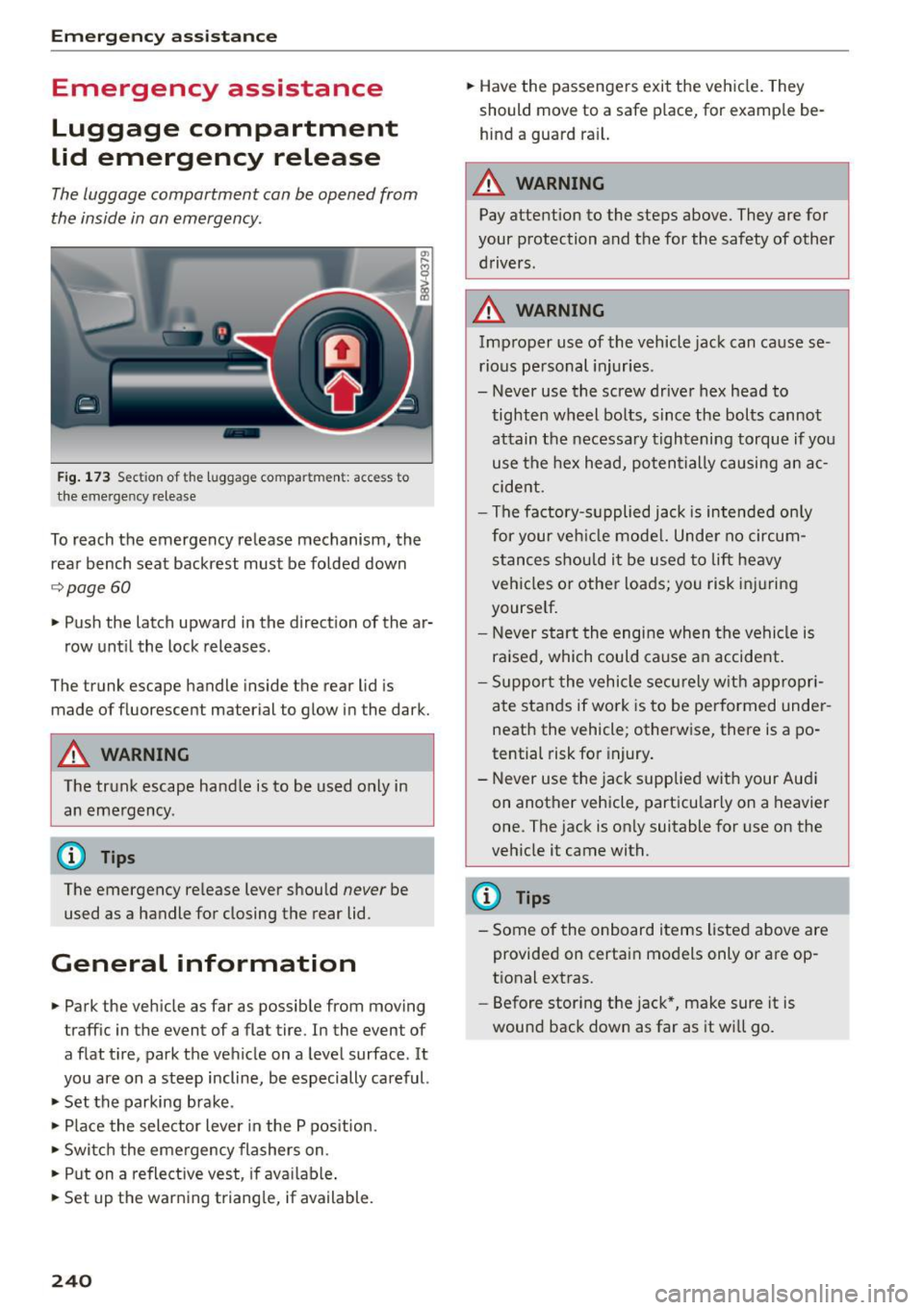
The luggage compartment can be opened from
the inside in an emergency.
F ig. 1 73 Sect ion of t he luggage compartment: access to
t h e emergency release
To reach the emergency release mechanism, the
rear bench seat backrest must be folded down
~page 60
.,. Push the latch upward in the direct ion of the ar
row unt il the lock releases.
The trunk escape handle inside th e rear lid is
made of fluorescent material to glow in the dark.
A WARNING
The trunk escape handle is to be used only in
an eme rgency .
(D Tips
The emergency re lease lever should never be
used as a handle for closing the rear lid.
General information
.,. Park the veh icle as far as possib le from moving
traffic in the event of a flat tire. In the event of
a flat tire, park the vehicle on a leve l surface . It
you are on a steep incline, be especially careful.
.,. Set the parking brake .
.,. Place the selector lever in the P pos ition .
.,. Swi tc h the eme rgency flashers on .
.,. Put on a reflective vest, if ava ila b le .
.,. Set up the war ning triang le, if available.
240
.,. Have the passengers exit the vehicle. They
should move to a safe p lace, for example be
hind a guard ra il.
A WARNING
Pay attention to the steps above. They are for
your p rotection and the for the safety of other
drivers.
A WARNING
"'
Imp roper use of the vehicle jack can cause se-
rious pe rsonal injuries.
- Never use the screw driver hex head to
tighten wheel bolts, since the bolts cannot
attain the necessa ry tight ening torque if yo u
use the hex head, p oten tially cau sing an ac
cide nt.
- The factory-s upplied jack is intended only
for your veh icle mode l. Unde r no c ircum
s tances shou ld i t b e used t o lift heavy
veh icles or othe r loads; you risk inj uring
yourse lf.
- Never start the engi ne when t he vehicle is
raised, which could ca use a n accident .
- Suppor t the vehicle secu rely w it h a ppropri
ate stands if work is to be performed under
neath the vehicle; otherw ise, there is a po
tential risk for injury .
- Never use the jac k supplied with your Aud i
on another vehicle, part icu lar ly on a heavier
one. The jack is on ly suitable for use on the
veh icle it came with.
(D Tips
-Some of the onboard it ems listed above are
provided on certai n models only or are op
t ional extras.
- Before stor ing the jack*, make sure it is
wound back down as far as it wi ll go.
Page 243 of 282
....,
N
0 > co
rl I.O
"'
"'
"'
rl
Equipment
Vehicle tool kit
Applies to vehicles: with vehicle tool kit
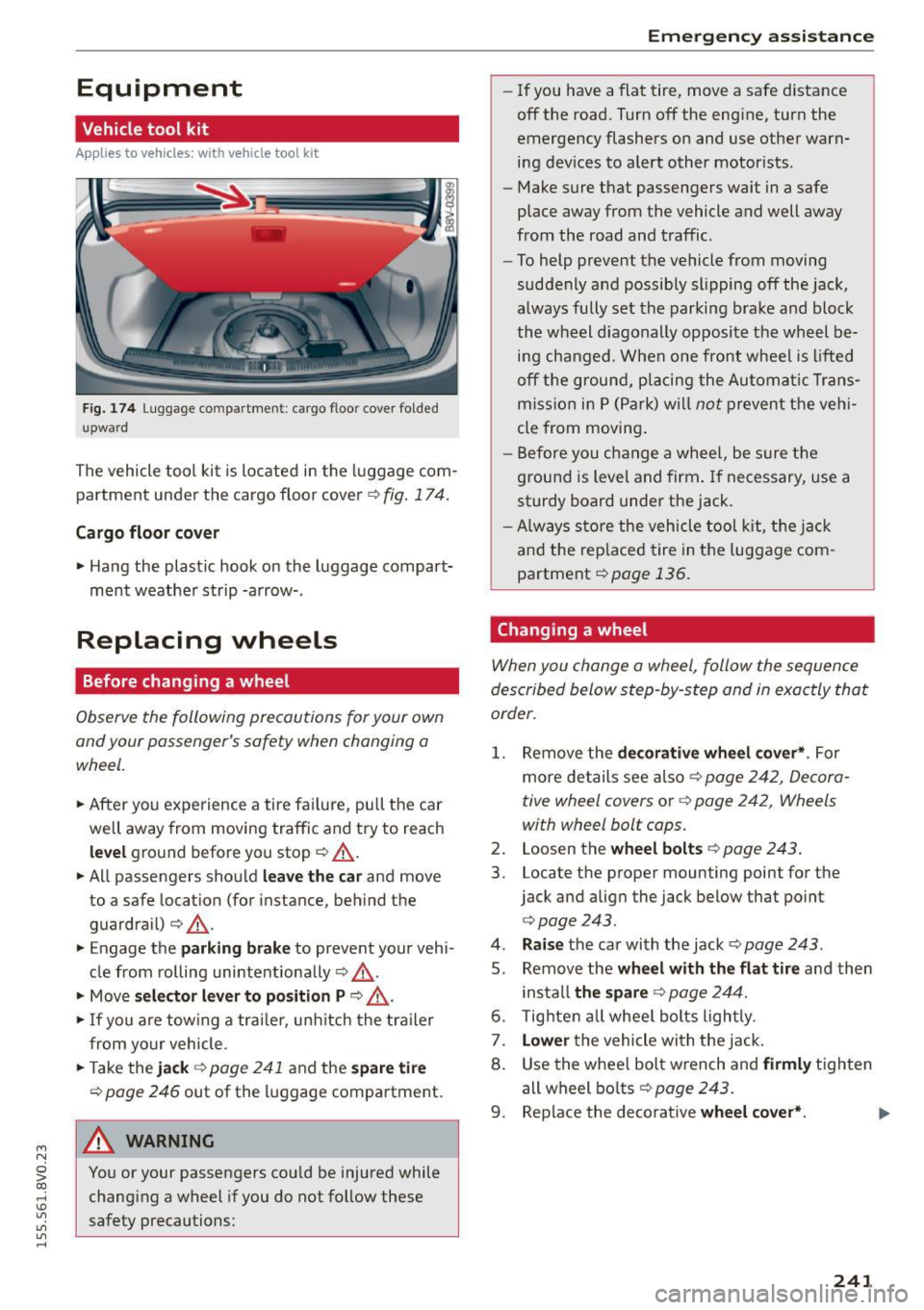
Fig. 174 Luggage co mpa rtmen t: ca rgo floo r cover folded
up ward
The vehicle tool kit is located in the luggage com
partment under the cargo floor cove r
r::!;> fig. 174.
Cargo floor cover
• Hang the plastic hook on the luggage compart
ment weather strip -arrow- .
Replacing wheels
Before changing a wheel
Observe the following precautions for your own
and your passenger's safety when changing a
wheel.
• After you experience a tire fa ilure, pu ll the car
well away from moving traffic and try to reach
le vel ground before you stop r::!;> _A .
• All passengers should leav e the ca r and move
to a safe location (for instance, beh ind the
guardrail) c:>
_A.
• Engage the parking b ra ke to prevent your vehi
cle from rolling unintentionally c:> ,& .
• Move
se le cto r le ver to p osition P c:> ,& .
• If you are tow ing a tra iler, unh itch the tra iler
from your vehicle.
• Take the
jack c:> pag e 241 and the sp ar e tire
c:> page 246 out of the l uggage compartment .
A WARNING
You or your passengers cou ld be injured while
chang ing a wheel if you do not follow these
safety precautions:
Em erg en cy ass is tan ce
-If you have a flat tire, move a safe d istance
off the road. Turn off the eng ine, turn the
emergency flashers on and use other warn
ing dev ices to alert other motor ists .
- Make sure that passengers wait in a safe
place away from the vehicle and well away
from the road and traffic.
- To help prevent the vehicle from moving
suddenly and possibly slipping
off the jack,
always fully set the parking brake and block
the wheel diagonally opposite the wheel be ing changed . When one front wheel is lifted
off the g round, placing the Automatic Trans
miss ion in P (Pa rk) w ill
not prevent the veh i
cle from moving .
- B efore you change a wheel, be sure the
ground is level and firm . If necessary, use a
sturdy board under the jack.
- Always s tore the veh icle tool kit, t he jack
a nd the rep laced tire in the luggage com
partment
r::!;> page 136.
Changing a wheel
When you change a wheel, follow the sequence
described below step-by -step and in exactly that
order.
1. Remove the dec orative whe el co ve r*. For
more details see also
c:> page 242, Decora
tive wheel covers
or c:> page 242, Wheels
with wheel bolt caps .
2. Loosen the wheel bolts r::!;>page 243.
3. Locate the proper mounting point for the
jack and align the jack below that point
r::!;> page 243.
4. Rai se the car with the jack~ page 243 .
5. Remove the wheel wit h th e fla t tir e and then
i ns tall
th e s pare c:> page 244.
6. Tighte n all whee l bolts lightly.
7.
L o wer the vehicle with the jack.
8 . Use the wheel bolt wrench and
firml y tighten
all wheel bo lts
c:> page 243.
9. Replace the decorative w hee l co ve r* . ..,.
241
Page 245 of 282
....,
N
0 > co
rl I.O
"'
"'
"'
rl
Loosening and tightening the wheel bolts
The wheel bolts must be loosened before raising
the vehicle.
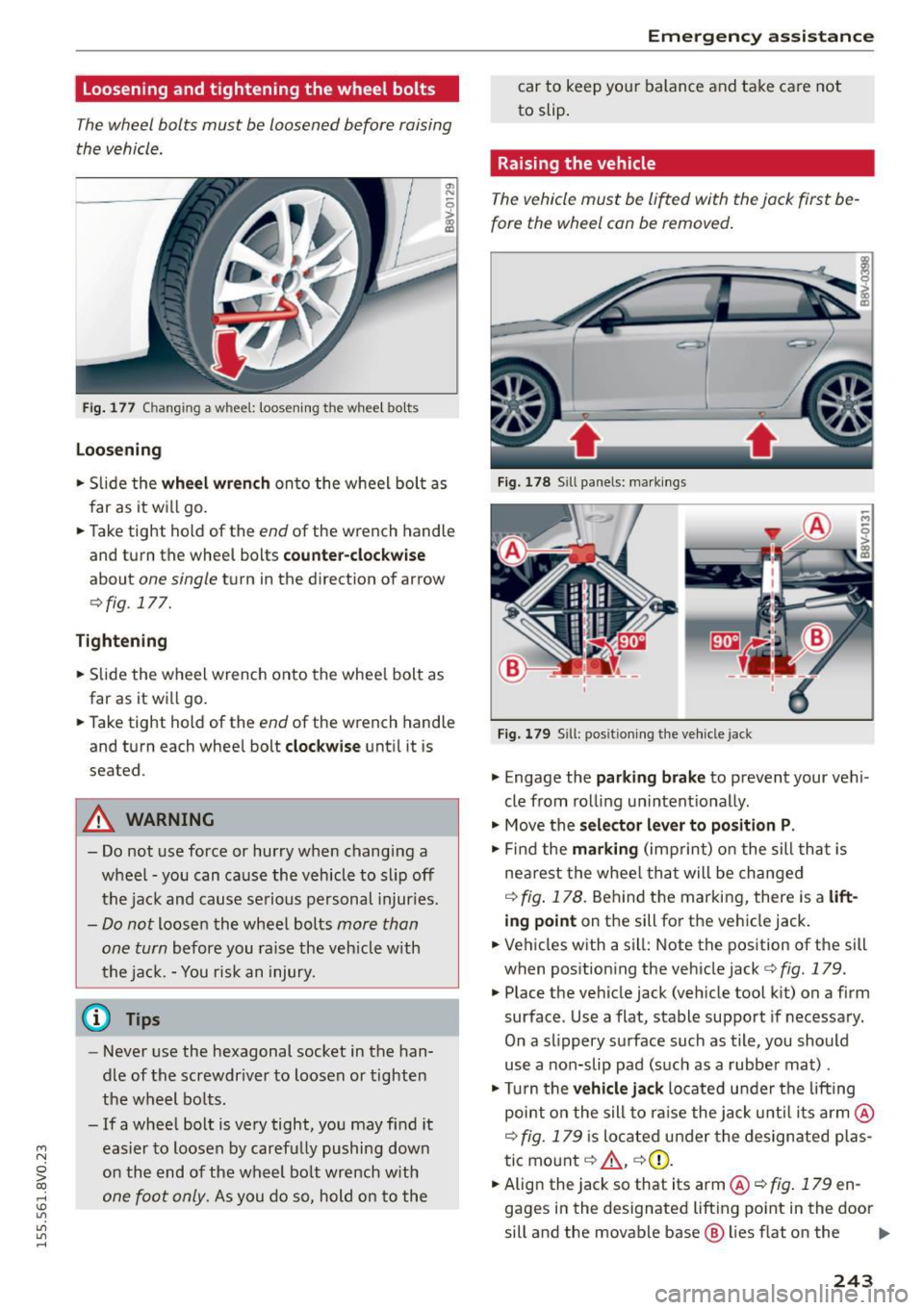
Fig . 177 Changing a wheel: loosening the whee l bo lts
Loosening
... Slid e the wheel wren ch onto the wheel bolt as
far as it will go .
... Take tight hold of the
end of the wrench handle
and turn the wheel bolts
counter-clockwise
about one single turn in the direction of arrow
r:=>fig. 177.
Tightening
... Slide the wheel wrench onto the whee l bolt as
far as it will go .
... Take tight hold of the
end of the wrench handle
and turn each whee l bolt
clockwise until it is
seated.
A WARNING
- Do not use force or hurry when changing a
wheel -you can ca use the vehicle to sl ip off
the jack and cause serious personal injuries.
-Do not loose n the wheel bolts more than
one turn
before you raise the vehicle with
the jack. -You risk an injury.
(D Tips
-Never use the hexagonal socket in the han
dle of the screwdriver to loosen or tighten
the wheel bolts.
- If a whee l bolt is very tight, you may find it
easier to loosen by carefully pushing down
on the end of the wheel bolt wrench with
one foot only . As you do so, hold on to the
Emergen cy assistance
car to keep your balance and take ca re not
to slip .
Raising the vehicle
The vehicle must be lifted with the jack first be
fore the wheel can be removed .
Fig. 178 Sill panels: marking s
Fig. 179 Sill: pos itio ning the vehicle jack
... Engage the parking brake to prevent your vehi
cle from rolling unintent ionally .
... Move the
selector lever to position P .
... Find the marking (imprint) on the sill that is
nea rest the wheel that will be changed
q fig. 178. Behind the marking, there is a lift
ing point on the sill for the vehicle jack.
... Vehicles with a si ll: Note the position of the sill
when position ing the vehicle jack
q fig. 179.
... Place the vehicle jack (vehicle tool k it) on a firm
surface. Use a flat, stable support if necessary.
On a slippery surface such as tile, you should
use a non-slip pad (such as a rubber mat) .
... Turn the
vehicle jack located under the lifting
point on the sill to ra is e the jack u ntil its arm@
Q fig. 179 is located under the designated plas
tic mount
q .&., q(j) _
... Align the jack so that its arm @ c:::> fig. 179 en
gages in the designated lifting point in the door
sill and the movable base @ lies flat on the ..,.
243
Page 247 of 282

M N
0 > co ,...., \!) 1.1'1
1.1'1
1.1'1
,....,
After you have loosened all wheel bolts and
raised the vehicle
off the ground, remove and re
place the whee l as fo llows:
Removing the wheel
.,. Use the hexagonal socket in the screwdriver
handle
to completely remove the topmost
whee l bolt and set it aside on a
clean surface
¢ fig. 180 .
.,. Screw the threaded end of the alignment pin
from the tool kit hand-tight into the empty bolt
hole¢
fig. 181.
.,. Then remove the other wheel bolts as descr ibed
above .
.,. Take
off the wheel leav ing the alignment pin in
the bolt hole ¢Q).
Putting on the compact spare wheel
.,. Lift the spare wheel and carefully slide it over
the a lignment pin to guide it in place ¢0 .
.,. Use the hexagonal socket in the screwdr iver
handle to screw in and tighten all wheel bolts
slightly.
.,. Remove the alignment pin and insert and tight
en the remaining whee l bolt slightly like the
rest .
.,. Turn the jack handle counter-clockwise to lower
the vehicle until the jack is fully released.
.,. Use the wheel bolt wrench to t ighten all wheel
bolts firmly¢
page 243. Tighten them cross
wise,
from one bolt to the (approx imately) op
pos ite one, to keep the wheel centered .
0 Note
When removing or installing the wheel, the
r im could hit the brake rotor and damage the
rotor. Work carefully and have a second per
son help you.
@ Tips
Never use the hexagonal socket in the handle
of the screwdr iver to loosen or tighten the
wheel bolts.
- Pull the reversible blade from the screwdriv
er before you use the hexagonal socket in
the handle to turn the wheel bolts.
Emergency assistance
-When mounting tires with unidirectional
tread design
make sure the tread pattern is
pointed the right way¢
page 245 .
-The wheel bolts shou ld be clean and easy to
t ur n. Check for dirt and corrosion on the
mating surfaces of both the wheel and the
hub. Remove all dirt from these surfaces be
fore remounting the wheel.
Tires with unidirectional tread design
Tires with unidirectional tread design must be
mounted with their tread pattern pointed in the
right direction .
U sing a spare tire with a tread pattern
intended for use in a specific direction
When using a spare t ire with a tread pattern in
tended for use in a specific direction, please note
the following:
- The direct ion of rotation is marked by an arrow
on the side of the tire.
- If the spare tire has to be insta lled in the incor
rect direction, use the spare tire only tempora
r ily since the tire w ill not be able to achieve its
optimum performance characteristics with re
gard to aquaplaning, noise and wear .
- We recommend that you pay part icular atten
tion to th is fact during wet weather and that
you adjust your speed to match road condi
tions.
- Replace the flat tire with a new one and have it
installed on your veh icle as soon as possible to
restore the handling advantages of a unidirec
tional tire.
Notes on wheel changing
Please read the information ¢ page 221 if you
are going to use a spare tire which is different
from the tires on your vehicle.
After yo u change a tire:
-Check the tire pressure on the spare immedi-
ately after installation.
lill-
245