2015 AUDI S3 SEDAN lock
[x] Cancel search: lockPage 184 of 282
Child safet y
In order for the airbag to offer protection, it is
important that all vehicle occupants, especially
any children, who must be in the front seat be
cause of except ional circumstances, be proper ly
restrained and as far away from the airbag as
possible . By keeping room between the child's
body and the front of the passenger compart
ment, the airbag can inflate comp letely and pro
vide supp lemental protection in ce rtain frontal
coll is ions .
A WARNING
Not using a booster seat, using the booster
seat improperly, incorrect ly installing a boos
ter seat or using the vehicle safety belt im
properly increases the risk of serious personal
injury and death in a collision or other emer
gency situat ion. To help reduce the risk of se
r ious personal injury and/or death:
- The shoulder belt must lie as close to the
center of the child's collar bone as possible
and must lie flat and snug on the upper
body .
It must never lie across the throat or
neck. The lap belt must lie across the pelv is
and never across the stomach or abdomen.
Make sure that the be lt lies flat and snug.
Pull on the belt to tighten i f necessa ry .
- Failure to properly route safety be lts over a
child 's body will cause severe injuries in an
accident or other emergency sit uation
¢ page 140.
- The rear side of the child safety seat shou ld
be positioned as close as possible to the
backrest on the vehicle seat.
- For adjustable head restraints: adjust or re
move the rear seat head restraint if it is dif
ficult to install the child seat with the head
restraint in place¢
page 56. Install the
head restraint again immediately once the
child seat is removed . Driv ing without head
restraints or with head restraints that are
not properly adjusted increases the r isk of
serious o r fatal neck injury dramatically .
- Children on the front seat of any car, even
with Advanced Airbags, can be ser iously in
jured or even killed when an airbag inflates.
- Never let a child stand or knee l on any seat,
for example the front seat.
182
-
- Never let a child ride in the cargo area of
your veh icle.
- Always remember that a child leaning for
ward, sitting sideways or out of position in any way during an acc ident can be struck by
a deploying airbag. This will resu lt in serious
personal injury or death.
- If you must install a booster seat on the
front passenger seat because of exceptional
circumstances the
PASSENGER AIR BAG
OFF
li ght must come on and stay on, when
eve r the ign it ion is switched on.
- If the
PASSENGER AIR B AG OF F light does
not come on and stay on, perform the
checks described ¢
page 160, Monitoring
the Advanced Airbag System.
- Ta ke the child restraint off the front passen
ge r seat and install it properly at one of the
rear seat positions if the
PA SSENGER AIR
BAG OFF
light does not stay on whenever
the ignition is switched on .
- Always read and heed a ll WARNINGS when
ever using a child restrained in a vehicle is
being used¢
page 140, Safety belts,
¢page 148, Airbag system
and
¢ page 172, Important information.
Securing child seats
Securing a child safety seat using a safety
belt
Safety belts for the rear seats and the front pas
senger can be locked with the convertible lo cking
retractor to properly secure child safety seats .
The safety belts emergency locking retracto rs fo r
the rear seats safety belts and for the front pas
senger's seat safety be lt have a convert ible lock
ing retractor for chi ld restraints. The safety belt
must be locked so that belt webbing cannot un
reel. The retractor can be activated to lock the
safety belt and prevent the safety be lt webbing
from loosening up during normal driving. A child
safety seat can on ly be properly installed when
the safety belt is locked so that the child and
c hi ld safety seat will stay in p lace .
Always remember: Even though your vehicle is
equipped with an Advanced Airbag system, all
Page 185 of 282
M N
0 > co ,...., \!) ..,.,
..,.,
..,., ,....,
children, especially those 12 years and younger,
should always ride in the back seat properly re
strained for their age and size.
A WARNING
-
Improperly installed child safety seats in
crease the risk of serious personal injury and
death in a collision.
- Always make sure that the safety belt re
tractor is locked when installing a child safe
ty seat. An unlocked safety belt retractor
cannot hold the child safety seat in place
during normal driving or in a crash.
- Always buckle the child safety seat firmly in
place even if a child is not sitting in it . A
loose child safety seat can fly around during
a sudden stop or in a collision.
- Always make sure that the rear seat back
rest to which the center rear safety belt* is
attached is securely latched whenever the
rear center safety belt is being used to se
cure a child restraint.
- If the backrest is not securely latched, the
child and the child restraint will be thrown
forward together with the backrest and will strike parts of the vehicle interior. The child
can be seriously injured or killed.
- Never install rear-facing child safety seats or
infant carriers on the front passenger seat.
A child will be seriously injured and can be killed when the passenger airbag inflates.
- The inflating airbag will hit the child safety seat or infant carrier with great force and
will smash the child safety seat and child
against the backrest, center armrest, door
or roof.
- Always install rear-facing child safety seats or infant carriers on the rear seat.
- Forward-facing child safety seats or infant
carriers installed on the front passenger's
seat may interfere with the deployment of
the airbag and cause serious injury to the child.
- It is safer to install a forward-facing child
safety seat on the rear seat.
- Always read and heed all WARNINGS when
ever using a child restrained in a vehicle is
being used
r:::> page 172 . Special precautions
Child safety
apply when installing a child safety seat on
the front passenger seat
r:::> page 149, Child
restraints on the front seat -some impor
tant things to know .
A WARNING
Always take special precautions if you must
install a forward or rearward-facing child re
straint on the front passenger's seat in excep
tional situations:
- Whenever a forward or rearward-facing
child restraint is installed on the front pas
senger seat, the
PASSENGER AIR BAG OFF
light must come on and stay on whenever
the ignition is switched on.
- If the
PASSENGER AIR BAG OFF light does
not come on and stay on, perform the
checks described
r:::> page 160, Monitoring
the Advanced Airbag System.
- Take the child restraint off the front passen
ger seat and install it properly at one of the
rear seat positions if the
PASSENGER AIR
BAG OFF
light does not stay on whenever
the ignition is switched on.
- Improper installation of child restraints can
reduce their effectiveness or even prevent
them from providing any protection.
-An improperly installed child restraint can interfere with the airbag as it deploys and
seriously injure or even kill the child.
-Always carefully follow the manufacturer's
instructions provided with the child safety
seat or carrier.
- After checking to make sure that the child
restraint is properly installed, make certain
that the child restraint is correctly recog nized by the capacitive passenger detection
system in the front passenger seat and that
the
PASSENGER AIR BAG OFF light signals
the correct front passenger frontal airbag
status.
A WARNING
Forward-facing child restraints:
-
183
Page 186 of 282
Child safety
-Always make sure the forward-facing seat
has been designed and certified by its man
ufacturer for use on a front seat with a
passenger front and side airbag.
- Never put the forward-facing child restraint
up, aga inst or very near the instrument pan
el.
- Always move the passenger seat into its
rearmost position in the seat's fore and aft
adjustment range, as far away from the air
bag as possible before installing the for
ward-fac ing child restraint. The backrest
must be adjusted to an upright posit ion.
- Make sure that the
PASSENGER AIR BAG
OFF
light comes on and stays on all the time
whenever the ignition is switched on.
_&. WARNING
Rearward-fac ing ch ild restra ints:
- A child in a rearward-facing child safety seat
installed on the front passenger seat will be
seriously injured and can be killed if the
front airbag inflates -even with an Ad
vanced Airbag System .
- T he inflating airbag wil l hit the child safety
seat or infant carrier with great force and
will smash the chi ld safety seat and child
against the backrest, center armrest, door
or roof.
- Always be especially carefu l if you must in
stall a rearward facing child safety seat on
the front passenger seat in exceptional cir
cumstances.
- Make sure that the
PASSENGER AIR BAG
OFF
light comes on and stays on all the t ime
whenever the ignition is switched on .
- If the
PASSENGER AIR BAG OFF light does
not come on and stay on, immed iately in
stall the rear-fac ing ch ild safety seat in a
rear seating position and have the airbag
system inspected by your Aud i dealer.
184
· Activating the convertible locking retractor
Use the convertible locking retractor to secure a
child restraint.
Always heed the child safety seat manufacturer's
instructions when installing a child restraint in
your vehicle . T o activate the convert ible locking
retractor:
.. Place the child restraint on a seat, preferably on
the rear seat .
.. Slowly pull the belt
all the way out.
.. Route it around or through the child restraint
belt pat h
c::> ,&..
.. Push the ch ild safety seat down with your full
weight to get the safety belt really tight.
.. Insert the belt tongue into the buckle for that
seating position.
.. Guide the safety be lt back into the retractor un
til the belt lies flat and snug on the ch ild safety
seat.
.. You should hear a "clicking" noise as the belt
w inds back into the inertia reel. Test the con
vert ible lock ing retractor by pulling on the belt .
You should no longer be able to pull the belt
out of the ret ractor. The convertible locking re
tractor is now activated .
.. Make sure that the red release button is facing
away from the child restraint so that it can be
unbuckled quickly .
.. Pull on the belt to make sure the safety belt is
properly tight and fastened so that the seat
cannot move forward or s ideways more than
one inch (2 .5 cm).
_&. WARNING
Using the wrong child restraint or an improp
erly installed child restraint can cause serious
personal injury or death in a crash.
- Always make sure that the safety belt re
tractor is loc ked when insta lling a child safe
ty seat. An unlocked safety belt retractor
cannot hold the child safety seat in place
during normal driving or in a crash.
- Always buckle the child safety seat firmly in
place even if a chi ld is not sitting in it. A
loose child safety seat can fly around during
a sudden stop or in a crash.
.
Page 187 of 282
M N
0 > co ,...., \!) 1.1'1
1.1'1
1.1'1
,....,
-Always make sure the seat backrest to which
the ch ild restraint is installed is in an up
right position and securely latched into
place and cannot fold forward. Otherw ise,
the seatback with the ch ild safety seat at
tached to it co uld f ly forward in the event of
an acc ident or o ther emergency si tuat ion.
- Always read and heed all WARNINGS when
ever using a child rest rained in a vehicle is
being used
r=;, page 172. Spec ia l precautions
apply when ins talling a child s afety se at on
the front passenger seat¢
page 149, Child
restraints on the front seat -some impor
tant things to know.
Deactivating the convertible locking
retractor
The convertible locking retractor for child re
straints will be deactivated automatically when
the belt is wound all the way back in to the re
tractor .
~ Press the red button on the safety belt buck le.
The belt tongue will pop out of the buckle.
~ Guide the safety belt all the way back into its
stowed position .
Always let the safety belt retract comp lete ly into
its stowed position . The safety be lt can now be
used as an ordinary safety belt without the con
ve rtible locking retrac to r fo r child restra ints .
If the convert ible locking retractor shou ld be ac
tivated inadvertently, the safety belt must be un
fastened and gu ided completely back into its
stowed position to deact ivate this feature .
If the
convert ible lock ing retractor is not deactivated,
the safety belt w ill gradua lly become tighter and
uncomfo rt a ble to wear .
_& WARNING
-
Imprope rly insta lled child sa fe ty se ats in
crease the risk of ser ious personal inju ry and
death in a co llision.
- Never unfasten the sa fe ty belt to deac tiva te
the conve rtible locking retractor for child re
straints while the veh icle is moving. You
Child sa fety
wou ld not be restra ined and cou ld be ser i
ously injured in an accident.
- Always read and heed all WAR NINGS when
ever using a child restrained in a vehicle is
be ing used
¢ page 172. Special precaut ions
apply when install ing a child safety seat on
the front passenger seat
c:> page 149, Child
restraints on the front seat -some impor
tant things to know .
LATCH system (Lower
anchorages and tethers
for children)
Child Restraint System anchors and how
are they related to child safety
T o provide a simpler and more practicable way to
attach the ch ild restra int on the veh icle seat, Fed
eral regulations require special lower anchorages
in vehicles a nd devices on new child restraints to
attach to the vehicle anchorages .
The combination of the tether anchorages and
the lower anchorages is now generally ca lled the
LATCH system f or " Lower Anchorages and
T ethers for Child ren ."
Forward -facing chi ld restraints manufactured af
ter September 1, 1999, are requ ired by U.S. fed
eral regulations to comp ly w ith new ch ild head
movement performance requ irements . These
new pe rformance requ irements make a te ther
necessary on most new ch ild seats .
Installing a ch ild restra int that requires a top
tethe r without one can seriously impair the per
fo rmance of the child restra int and its ability to
protect the ch ild in a co llision . Installing a ch ild
r est rain t that requ ires a top te ther w it h out t he
top tether m ay be a vio lation o f st ate l aw .
Child rest raint manufacturers offer LA T CH lower
anchorages on the ir chil d seats with hook-o n or
push-on connec tors attached to adjustab le
str aps.
In add ition to the LATCH lower anchorages, these
c hi ld restra int systems usually requ ire the use of
te the r straps to he lp keep the c hild restra int
firmly in pla ce. .,..
185
Page 189 of 282
M N
0 > co
Please remember that the lower anchorage
points are only intended for installation and at
tachment of child restraints specif ica lly certif ied
for use w ith
LATCH l ower anchorages . Child re
straints that are not equipped w ith the lower an
chorage attachments can still be installed in
compliance w ith the child rest raint manufactur
er 's instructions on using vehicle safety belts .
.8, WARNING
Improper use of LATCH lower anchorages can
cause serious personal injury in an accident.
- Always ca refully fo llow the ch ild restra ints
man ufactu rer's instr uctio ns for proper i n
sta llation of the child restrain t and proper
u se of the lower anchorages or safety belts
in yo ur vehicle.
- Never se cure o r attach any l uggage or other
items to the
LATCH lower anchorages .
- Always read and heed the impor tan t infor
mation about child restraints in this chapter
and WARNINGS
¢ page 172, Child safety.
Installing a child restraint with LATCH
lower anchorages
App lies to vehicles: with top tether
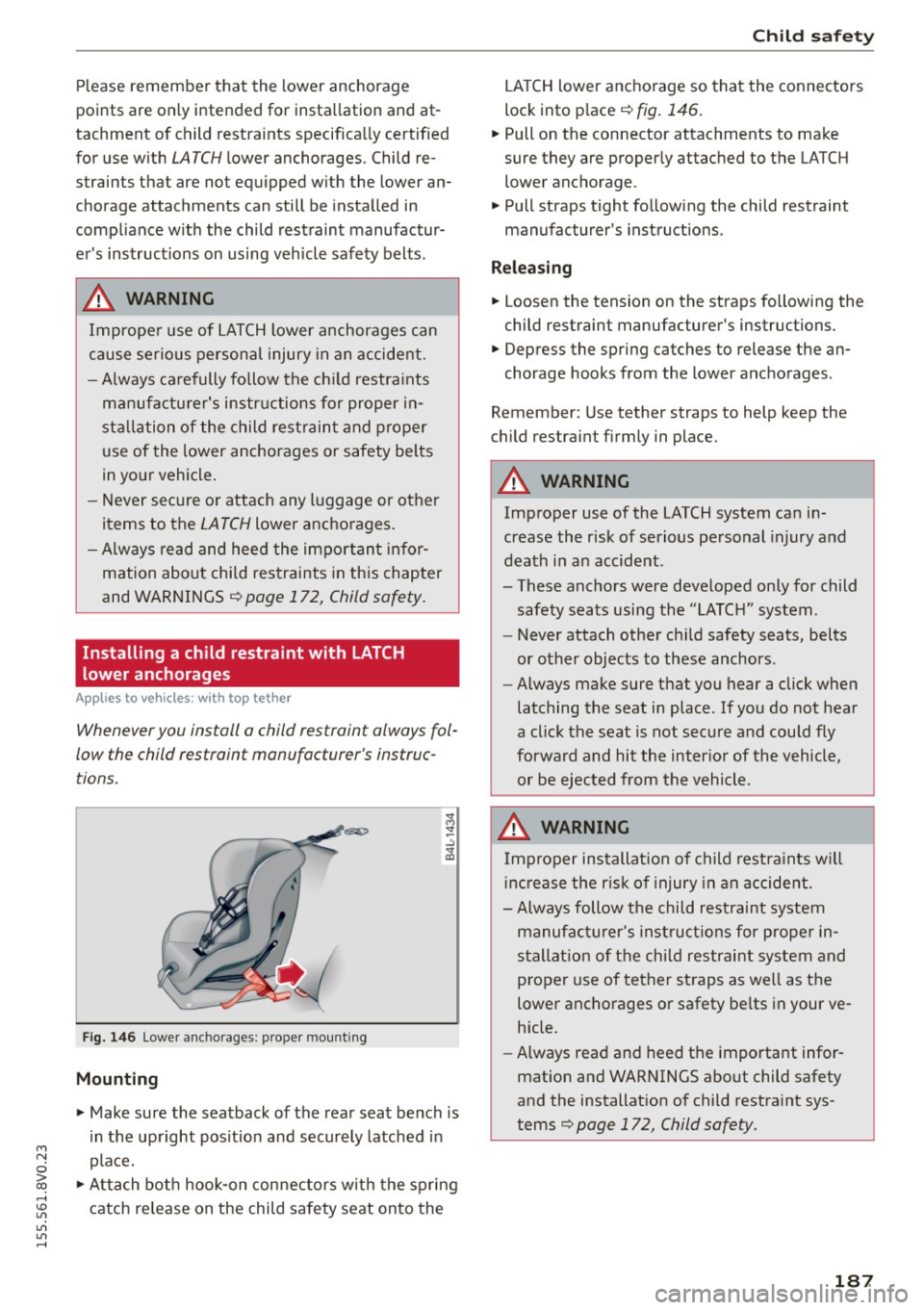
Whenever you install a child restraint always fol
low the child restraint manufacturer's instruc
tions.
F ig . 14 6 Lower anchorages: p roper mount ing
Mounting
.,. Make sure the seatback of the rear seat bench is
in the upright pos ition and secure ly latched in
place.
.,. Attach both hook-on con nectors with the spring
,....,
~ catch release on the child safety seat onto the
Vl
Vl
,....,
Child sa fety
LA TCH lower ancho rage so that the connecto rs
lock into p lace
¢ fig. 146 .
.,. Pull on the connector attachments to make
sure they are properly attached to the LATCH lower anchorage .
.,. Pull straps tight fo llow ing the child restraint
manufacturer's instruct ions .
Releasing
.,. Loosen the tension on the straps following the
child restraint manufacturer's instructions.
.,. Depress the spring catches to release the an
chorage hooks from the lower anchorages .
Remember: Use tether straps to help keep the
child restra int firmly in place.
.8, WARNING "---Improper use of the LATCH system can in
crease the r isk of serious pe rsonal injury and
death in an accident.
- These anchors were developed only for child safety seats using the "LATC H" system .
- Never attach other ch ild safety seats, belts
or other objects to these anchors.
- Always make sure that you hear a click when
latching the seat in place. If you do not hear
a cl ick the seat is not sec ure and could fly
forward and hit the inter io r of the vehicle,
or be ejec ted from the vehicle .
.8, WARNING
Improper installat ion of child restra ints w il l
i nc rease the r is k of i njury in an accide nt.
- Always follow the child res traint system
manufac turer's ins truct ions for proper in
s tallat ion of the ch ild restrai nt system and
proper use of tether straps as we ll as the
lower ancho rages or safety be lts in your ve
h icle.
- Always read a nd heed t he important infor
matio n and WARNINGS about child safety
and the installat ion of child restra int sys
tems
¢ page 172, Child safety .
187
Page 194 of 282

Checking and Fill in g
These fuels contain substances that can se
verely damage the fuel system and the en
gine if the engine is started .
- If the diesel f uel quality is poor, it may be
necessary to have the water d rained from
the water separator in the
fuel filter more
often than specified in the maintenance
schedule. This can help reduce engine ma l
funct ions
c:> page 2 3.
Refueling
Fuel filler neck
The fuel filler neck is located on the right rear
side pane l behind the fuel f iller flap.
If the power locking sys tem should fail, you can
still open the flap manua lly -for detai led instruc
tions see
c:> page 194.
You can find the fue l tank capacity of you r vehicle
in
c:> page 260.
The label on the inside of the fue l filler flap te lls
you t he cor rect fuel for your vehicle. For more in
form ation abo ut fue l specifications, see
c:> page 190 .
Your vehicle fuel tank has an on board refue lling
vapor re cove ry system . This feature helps to p re
ve nt fuel vapors from escaping from the tank and
pollut ing t he environment w hile you refue l yo ur
ve hicle. In orde r to fill the tank p roperly whi le
protecting the environment, please follow this
refueling procedure carefully.
A WARNING
Under normal operating conditions, never ca r
ry additional fuel containers in your car . Gas
canisters and ot her conta iners used to trans
port fuel can be dangerous . Such contai ners,
full or empty, may leak and could cause a fire
in a collision. If yo u m ust t ransport fue l to
use fo r yo ur l awn m owe r, snow b lower, etc.,
be very ca re ful and a lways observe loca l and
state laws rega rding the use, transportation
and sto rage of such fuel containe rs . Make cer
tain the container meets industry standards (ANSI/ASTM F852 - 86).
192
(D Note
Never drive your vehicle until the fue l tank is
complete ly empty . The irregular supply of
f u el can cause misfiring. Gasoline could enter
the exhaust system and damage the catalytic converter.
Fueling procedure
F ig . 149 Righ t rea r ve hicle s ide: open ing t he fuel filler
door
Fi g. 15 0 Fuel fill er doo r wit h attac hed fuel cap
Re ad a nd fo llow the informa tion and war ning s
whe n filling AdB lue
c:> page 195 .
The fuel filler doo r is u nlocked or locked by the
cent ral lock ing system.
Opening the fuel flap
--0 ~
ffl
.,.. Press the left side of the fuel f iller door to open
it -arrow-
c:> fig. 149 .
.,.. Unscrew the tank cap counterclockw ise .
.,.. Place the cap from above on the open fue l filler
door
c:> fig . 150.
Closing the fuel cap
.,.. Turn the f uel cap clockwise until you hear it
lock .
.,.. Close fuel fi ller door until it latches.
Page 196 of 282

Checking and Fill in g
the expansion space in the tank will fi ll,
which can result in fuel spilling out when it
becomes warm and polluting the environ
ment.
(D Tips
- If
the engine is running while fueling, va
pors can escape or the fuel can spill over.
Because of th is, the fuel nozz le switches off
before th e tank is full.
- Do not fue l the vehicle when the ignition is
switc hed on. Otherwise, the fuel gauge may
not show the correct level after fueling the
vehicle.
- Diesel vehicles are equipped with a diesel
misfueling guard
l). It allows the vehicle to
be fueled on ly w ith a diesel fuel p ump noz
zle .
- A worn o r damaged nozzle or a nozz le that
i s too sma ll may not be able to open the die
se l m isfue ling protector. If this is the case,
try turning the no zzle before inser ting it in
the fue l filler neck, use a different fuel
p ump or see an a uthorized Audi dea le r or
a uthorized Audi Service Facility for assis
tance .
- The misfueling guard does not o pen whe n
adding fue l from a fuel contai ne r. Yo u can
bypass it by adding the diese l fuel s low ly .
- The fuel filler door on your vehicle does not
l ock when you lock the vehicle from the in
side.
l l Market -spec ifi c
194
Fuel filler door emergency release
If the central locking system is faulty, the fuel
filler door can be unlocked manually .
Fig. 15 1 Rig ht rear luggage compartme nt: emergency re
lease
The emergency release mechanism is located be
hind the right side trim panel in the luggage
compartment.
.,. Remove the cover in the side panel.
.,. Loosen the loop from the retainer and then pull
on the loop ca refully-ar row-
c::> 0 . The fuel fill
er door is released .
.,. To open the fue l filler door, press o n the left
side
opage 192, fig. 149 .
(D Note
Only pull on t he loop u ntil yo u feel resistance.
You will not he ar it release. O therwise you
could damage the emergency rele ase mecha
nism.
Catalytic converter
App lies to vehicles: with gasoline e ngine
It is very important that your emission control
system (catalytic converter) is functioning prop
erly to ensure that your vehicle is running in an
environmentally sound manner .
.,. Always use lead-free gasoline c::> page 190, Fuel
supply .
.,. Never run the tank down all the way to empty .
.,. Never put too much motor o il in yo ur engine
o page 203, Adding engine oil 'l:::11 .
.,. Never try to push- or tow-sta rt you r vehicle .
Page 199 of 282

....,
N
0 > co
rl I.O
"'
"'
"'
rl
This message appears if the system has detected
that the tank was filled incorrectly or that there
is a malfunction. Drive immediately to the near
est authori zed Aud i dealer or authori zed Audi
Service Facility to have the malfunction correct
ed . Otherwise you will not be able to start the en
g in e again once you stop it.
Filling the Ad Blue
Applies to vehicles: with selective catalyt ic red uctio n
A special refill bottle must be used to fill the
AdBlue.
Fig. 153 Right rear vehicle s ide: removing the Ad B lue cap
Fig. 154 Ad Blue filler tube: inserting the refi ll bott le
The Ad Blue tank opening is located near the die
sel tank opening. Add at least 1 gallon (3.8 lit
ers) of AdBlue (two bottles). This is the minimum
amount required to ensure the system detects
the refilling and to start the engine. You can add
a maximum of approximately 4 gallons (15 lit
ers) .
Opening the filler tube and adding AdBlue
Requirement: the request to add Ad Blue must
appear in the instrument cluster display.
• Park your vehicle on a level surface.
• switch the ignition off .
Checking and Filling
• Open the tank door q page 192.
• Tur n the cap on the tank opening to the left to
remove
q fig. 153.
• Remove the cap from the refill bottle.
• Position the refill bottle on the filler tube and
turn the bottle clockwise until it stops turning
@ qfig. 154.
• Press lightly against the bottom of the bottle
@ to empty it. Con tinue pressing the bottom
of the bottle unti l it is empty or until flu id
stops flowing into the tank.
• Turn the bottle to the left without pressing on
the bottom.
Closing the filler neck
• Turn the Ad Blue cap to the right on the filler
tube until the cap clicks into place.
• Close the tank cover.
After filling
The vehicle must be driven. The system may take
up to two minutes to detect that the AdBlue has
been filled.
• If there was no Ad Blue left in the tank and a
range of
O mi (0 km ) was displayed in the in
strument cluster, switch the ignition on fo r
about 30 seconds before start ing the engine.
_& WARNING
=
Ad Blue can irritate the skin, eyes and respira-
tory system . If there is contact with the fluid,
flush immediate ly with plenty of water. Con
sult a physician if necessary.
(D Note
- Only use Ad Blue that conforms to the
standard ISO 22241-1. Do not mix any addi
tives with the Ad Blue and do not dilute it
with water.
- Do not add AdBlue to the diese l tank or add
diesel fuel to the Ad B lue tank. Mixing can
lead to damage to the engine and the Ad Bl
ue tank system. Warranty does not cover
damage caused by this .
- Ad Blue attacks surfaces such as painted ve
hicle components, plastic and carpet. Re-
move the fluid as quickly as possible with a ..,.
197