2015 AUDI S3 SEDAN ECU
[x] Cancel search: ECUPage 188 of 282
Child safety
_& WARNING
Improper installation of child restraints will
increase the risk of injury and death in a crash.
- Always follow the instructions provided by
the manufacturer of the child restraint you
intend to install in your vehicle.
- Never install a child restraint without a properly attached top tether strap if the
child restraint manufacturer's instructions
require the top tether strap to be used .
- Improper use of child restraint LATCH lower
anchorage points can lead to injury in a colli
sion. The LATCH lower anchorage points are
designed to withstand only those loads im
posed by correctly fitted child restraints .
- Never mount two child restraint systems on
one LATCH lower anchorage point .
- Never secure or attach any luggage or other
item to the LATCH lower anchorages .
(D Tips
-In Canada, the terms "top tether" with
"lower universal anchorages" (or "lower uni
versal anchorage bars") are used to describe
the system.
- In other countries, the term "ISO FIX" is
used to describe the lower anchorages.
Location
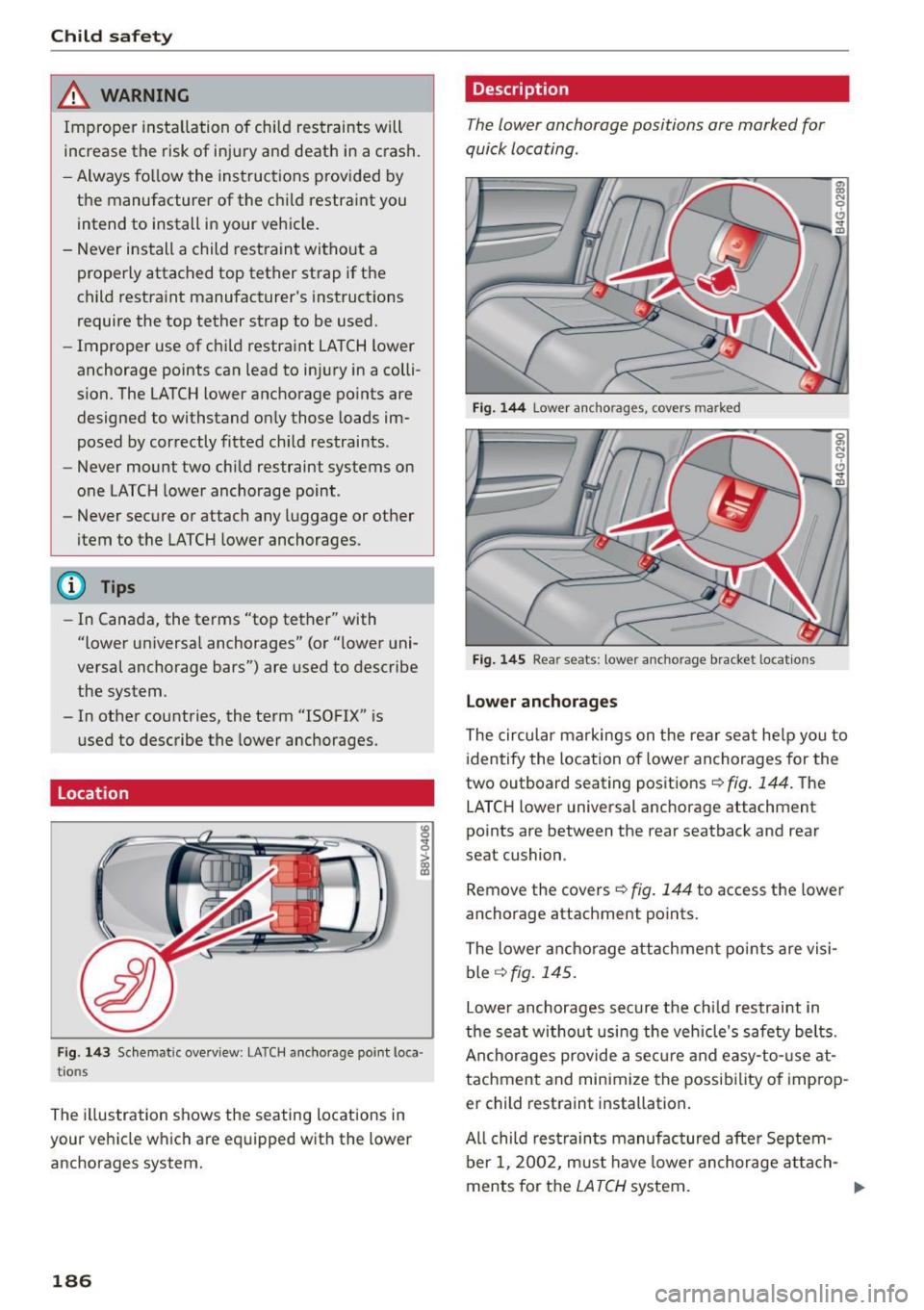
Fig. 143 Schemat ic overv iew : LATCH an cho rage po int lo ca ·
tio ns
The illustrat ion shows the seat ing locations in
your vehicle which are equipped with the lower
anchorages system.
186
Description
T he lower an chorage positions are marked for
quick locating .
Fig. 144 Lower an cho rag es, cov ers m ark ed
Fig. 145 Rear se ats : low er an cho rage bra cke t lo cation s
Lower anchorages
The circular markings on the rear seat help you to
ident ify the location of lower anchorages for the
two outboard seating positions~
fig. 144. The
LATCH lower universal anchorage attachment
points a re between the rear seatback and rear
seat cushion .
Remove the covers~
fig. 144 to access the lower
anchorage attachment points.
The lower anchorage attachment points are visi
ble
~ fig. 145.
Lower anchorages secure the child restraint in
the seat without using the vehicle's safety belts.
Anchorages provide a secure and easy-to-use at
tachment and m inimize the possibility of improp
er child restraint installation.
All child restraints manufactured after Septem
ber 1, 2002, must have lower anchorage attach-
ments for the
LATCH system. ..,.
Page 189 of 282
M N
0 > co
Please remember that the lower anchorage
points are only intended for installation and at
tachment of child restraints specif ica lly certif ied
for use w ith
LATCH l ower anchorages . Child re
straints that are not equipped w ith the lower an
chorage attachments can still be installed in
compliance w ith the child rest raint manufactur
er 's instructions on using vehicle safety belts .
.8, WARNING
Improper use of LATCH lower anchorages can
cause serious personal injury in an accident.
- Always ca refully fo llow the ch ild restra ints
man ufactu rer's instr uctio ns for proper i n
sta llation of the child restrain t and proper
u se of the lower anchorages or safety belts
in yo ur vehicle.
- Never se cure o r attach any l uggage or other
items to the
LATCH lower anchorages .
- Always read and heed the impor tan t infor
mation about child restraints in this chapter
and WARNINGS
¢ page 172, Child safety.
Installing a child restraint with LATCH
lower anchorages
App lies to vehicles: with top tether
Whenever you install a child restraint always fol
low the child restraint manufacturer's instruc
tions.
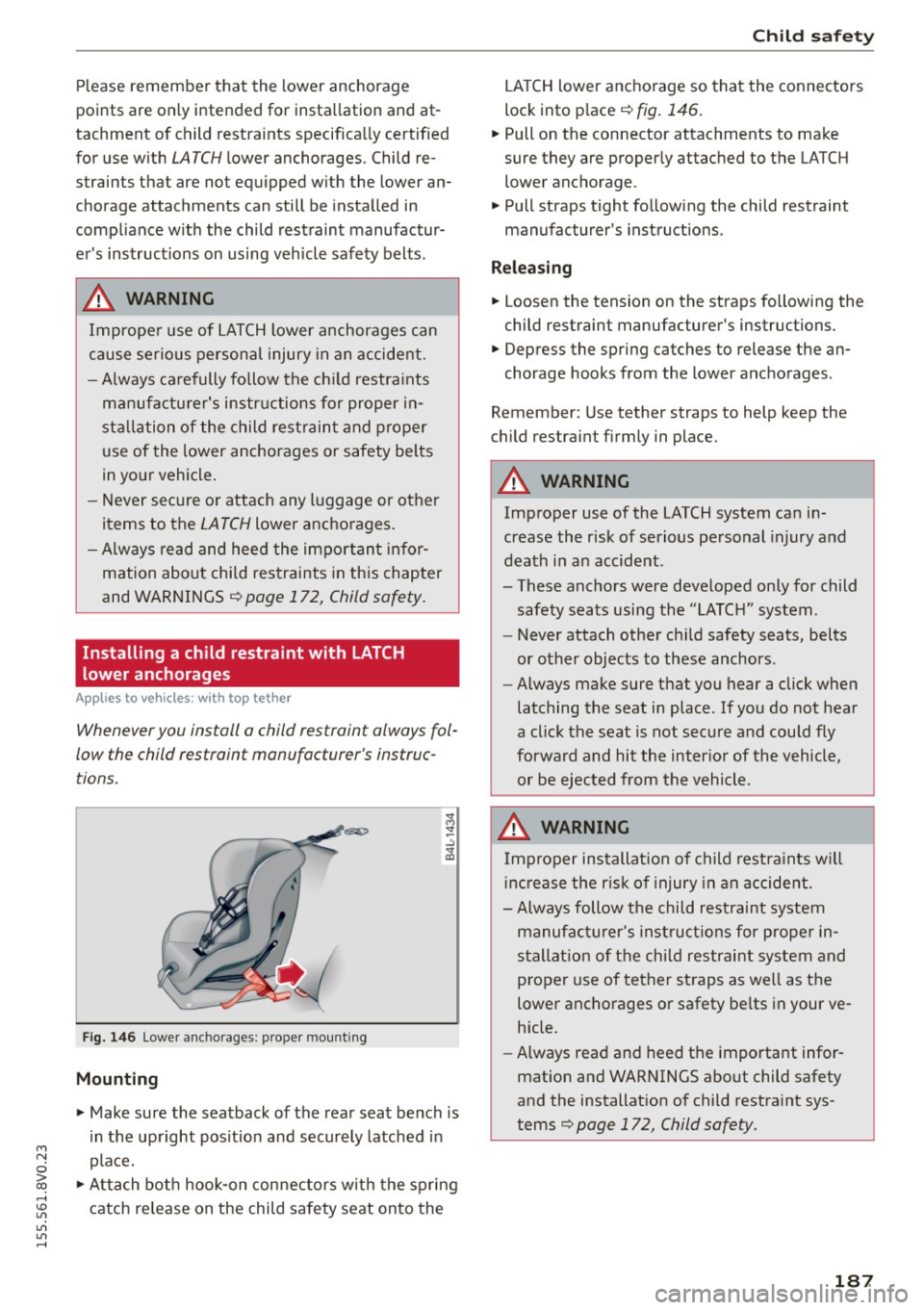
F ig . 14 6 Lower anchorages: p roper mount ing
Mounting
.,. Make sure the seatback of the rear seat bench is
in the upright pos ition and secure ly latched in
place.
.,. Attach both hook-on con nectors with the spring
,....,
~ catch release on the child safety seat onto the
Vl
Vl
,....,
Child sa fety
LA TCH lower ancho rage so that the connecto rs
lock into p lace
¢ fig. 146 .
.,. Pull on the connector attachments to make
sure they are properly attached to the LATCH lower anchorage .
.,. Pull straps tight fo llow ing the child restraint
manufacturer's instruct ions .
Releasing
.,. Loosen the tension on the straps following the
child restraint manufacturer's instructions.
.,. Depress the spring catches to release the an
chorage hooks from the lower anchorages .
Remember: Use tether straps to help keep the
child restra int firmly in place.
.8, WARNING "---Improper use of the LATCH system can in
crease the r isk of serious pe rsonal injury and
death in an accident.
- These anchors were developed only for child safety seats using the "LATC H" system .
- Never attach other ch ild safety seats, belts
or other objects to these anchors.
- Always make sure that you hear a click when
latching the seat in place. If you do not hear
a cl ick the seat is not sec ure and could fly
forward and hit the inter io r of the vehicle,
or be ejec ted from the vehicle .
.8, WARNING
Improper installat ion of child restra ints w il l
i nc rease the r is k of i njury in an accide nt.
- Always follow the child res traint system
manufac turer's ins truct ions for proper in
s tallat ion of the ch ild restrai nt system and
proper use of tether straps as we ll as the
lower ancho rages or safety be lts in your ve
h icle.
- Always read a nd heed t he important infor
matio n and WARNINGS about child safety
and the installat ion of child restra int sys
tems
¢ page 172, Child safety .
187
Page 190 of 282
Child safety
Tether anchors and tether straps
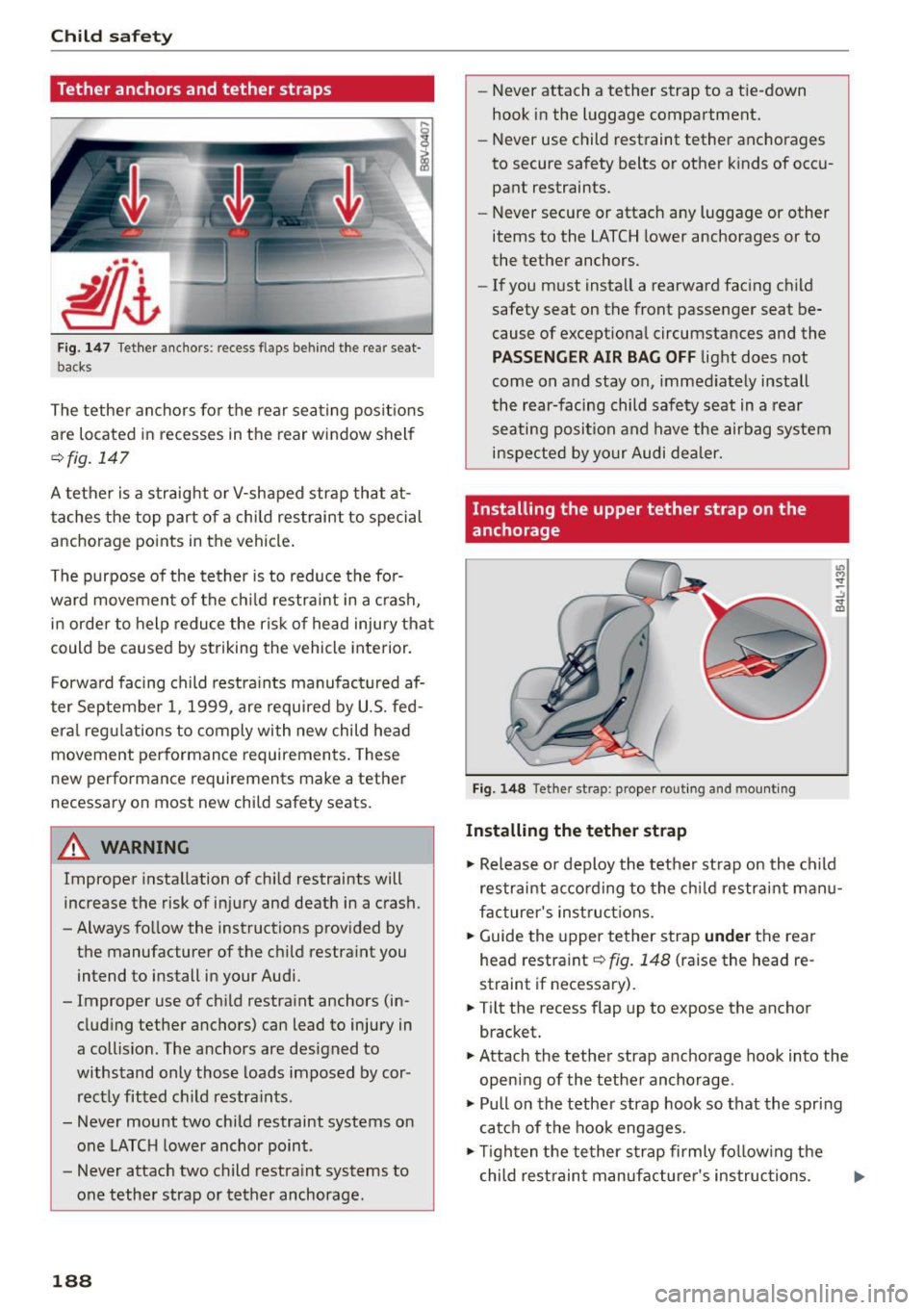
Fig. 147 Tether anchors: recess flaps behind the rear seat
ba cks
The tether anchors for the rear seating positions
are located in recesses in the rear window shelf
~fig. 147
A tether is a straight or V-shaped strap that at
taches the top part of a child restraint to special
anchorage points in the vehicle.
The purpose of the tether is to reduce the for ward movement of the child restraint in a crash,
in order to help reduce the risk of head injury that
could be caused by striking the vehicle interior.
Forward facing child restraints manufactured af
ter September 1, 1999, are required by U.S. fed
eral regulations to comply with new child head
movement performance requirements. These
new performance requirements make a tether
necessary on most new child safety seats.
&_ WARNING
Improper installation of child restraints will
increase the risk of injury and death in a crash.
- Always follow the instructions provided by
the manufacturer of the child restraint you
intend to install in your Audi.
- Improper use of child restraint anchors (in
cluding tether anchors) can lead to injury in
a collision. The anchors are designed to
withstand only those loads imposed by cor
rectly fitted child restraints .
- Never mount two child restraint systems on
one LATCH lower anchor point .
- Never attach two child restraint systems to
one tether strap or tether anchorage.
188
.
- Never attach a tether strap to a tie-down
hook in the luggage compartment.
- Never use child restraint tether anchorages
to secure safety belts or other kinds of occu
pant restraints.
- Never secure or attach any luggage or other
items to the LATCH lower anchorages or to
the tether anchors.
- If you must install a rearward facing child
safety seat on the front passenger seat be
cause of exceptional circumstances and the
PASSENGER AIR BAG OFF light does not
come on and stay on , immediately install
the rear-facing child safety seat in a rear
seating position and have the airbag system
inspected by your Audi dealer.
Installing the upper tether strap on the
anchorage
Fig. 148 Tether st ra p : proper routing and mounting
Installing the tether strap
11> Release or deploy the tether strap on the child
restraint according to the child restraint manu
facturer's instructions.
"Guide the upper tether strap
under the rear
head restraint ~
fig. 148 (raise the head re
straint if necessary) .
"Tilt the recess flap up to expose the anchor
bracket.
"Attach the tether strap anchorage hook into the
opening of the tether anchorage .
11o Pull on the tether strap hook so that the spring
catch of the hook engages.
11> Tighten the tether strap firmly following the
child restraint manufacturer's instructions.
Page 202 of 282

Checking and Fill in g
Closing the hood
.. Push the hood down until the force of the strut
is overcome.
.. Let the hood fall light ly into the Latch.
Do not
press it in.
c::> _&. .
A WARNING
If the hood is not latched completely, it cou ld
fly up while you are driving and obstruct your
vision.
Gasoline engine compartment overview
The most important check points .
-For safety reasons, the hood must always be
closed securely wh ile d riving. Because of
this, always check the hood after closing it
to make sure it is Latched correctly . The
hood is Latched if the front corne rs cannot
be Lifted.
- If you notice that the hood is not Latched while you are dr iving, stop immediately and
close it, because this increases the risk of an
accident.
F ig . 1 57 Typica l locat io n of th e reservo ir, eng ine oil dipstick, a nd engine o il filler opening
(D Coolant expansion tank (_L) .....
@
@
©
®
®
0
®
Eng ine oil dipstick ......... ... .
E ng ine oil filler opening
("!:::r.) .. .
Brake fluid reservoir((())) ...... .
Ba ttery(+) under a cover
Body ground point(-)
Washer fluid reservoir
(W) ... .. .
Fu se housing ... ......... .... .
200
206
203
203
207
209
212
248
The engine oil filler opening and the dipstick
( items @and
@) c::> fig. 157 may be Located in a
different area depending on engine vers io n.
A WARNING -
Read and following the WARNINGS before
checking anyth ing in the eng ine compartment
c::> pag e 198.
Page 206 of 282

Checking and Filling
"' Check the oil level again after two minutes
¢ page 203 , Checking the engine oil level.
"'Add oil, if necessary.
"'Close the engine oil filler cap and push the dip
stick all the way in.
A WARNING
- When adding oil, do not let oil drip onto hot
engine components. There could be risk of a
fire.
- You must secure the cap on the oil filler
opening correctly so that oil does not leak
out onto the hot engine and exhaust system
when the engine is running, because this is
a fire hazard.
- Always clean skin thoroughly if it comes into
contact with engine oil.
(D Note
- Applies to vehicles with gasoline engines:
the oil level cannot be above the
0 range
¢ page 203, fig. 159, because this can
cause damage to the catalytic converter or
the engine. Contact an authorized Audi
dealer or authorized Audi Service Facility to
have excess oil extracted if necessary.
- Applies to vehicles with diesel engines: the
oil level must not be in the
(v range
¢ page 203, fig. 160 -The oil must not be
extracted, because this can damage the en
gine. Drive to an authorized Audi dealer or
authorized Audi Service Facility immediate ly .
- Do not mix any additional lubricants into
the engine oil. Damage cause by such addi
tives is not covered by the warranty.
@ For the sake of the environment
- Oil should never enter the sewer system or
come into contact with the ground.
- Pay attention to legal requirements when
disposing of empty oil containers .
204
· Changing the engine oil
We recommend that have your oil changed by an
authorized Audi dealer or a qualified service sta tion.
Before you check anything in the engine compart
ment,
always read and heed all WARNINGS
¢ page 198.
The engine oil must be changed according to the
intervals specified in your Warranty & Mainte
nance booklet . This is very important because the
lubricating properties of oil diminish gradually
during normal vehicle use.
Under some circumstances the engine oil should
be changed more frequently. Change oil more of
ten if you drive mostly short distances, operate
the vehicle in dusty areas or under predominantly stop-and-go traffic conditions, or have your vehi
cle where temperatures remain below freezing
for extended periods.
Detergent additives in the oil will make fresh oil
look dark after the engine has been running for a
short time. This is normal and is not a reason to
change the oil more often than recommended.
Because of the problem of proper disposal, along
with the special tools and necessary expertise re
quired, we strongly recommend that you have
your oil changed by an authorized
Audi dealer or
a qualified service station.
If you choose to change your oil yourself , please
note the following important information:
A WARNING
To reduce the risk of personal injury if you
must change the engine oil in your vehicle
yourself:
- Wear eye protection.
-
- To reduce the risk of burns from hot engine
oil, let the engine cool down to the touch.
- When removing the oil drain plug with your
fingers, stay as far away as possible. Always
keep your forearm parallel to the ground to
help prevent hot oil from running down your
arm.
Page 208 of 282

Checking and Fill in g
system and could result in damage not cov
ered by your New Vehicle Limited Warranty.
Adding coolant
Fig. 162 Eng ine compartment: ma rkings on the coola nt
expans ion tank
Read an d follo wing the WARNINGS before
checking anything in the engine compartment
r::;,page 198.
Checking the engine coolant level
.. Park your vehicle on a level surface.
.. switch the ignition off.
.. Read the coolant level on the coolant expansion
tank
r::;, fig . 162 . The coolant level must be be
tween the mark ings when the engine in cold .
When the engine is warm it can be slightly
above the upper marking .
Adding coolant
Requirement: there must be a residual amount of
coolant in the expans ion tank
c> Q).
.. Let the engine cool down.
.. Place a cloth over the coolant expansion tank
cap and unscrew the cap counterclockwise
<=>& .
.,. Add coolant mixed in the correct ratio
r::;, page 205 up to the upper marking .
.. Make sure that the fluid level rema ins stable.
Add more coolant if necessary.
.. Close the cap secure ly.
A coolant loss s uggests a leak. Immediate ly drive
your veh icle to an authorized A udi dealer or au
thor ized Audi Service Facility and have the cool
ing system inspected.
If the cooling system is not
leaking, a loss can come from the coolant boiling
206
thro ugh ove rheating and being pushed out o f the
cooling system.
A WARNING
The cooling system is pressurized and can be
come very hot. To reduce the risk of burns
from hot coolant:
- Do not open the coolant expansion tank cap
w ith the engine hot. There is a risk of burns .
- Stop the eng ine and a llow it to cool.
- Protect your face, hands and arms from es-
caping coolant and steam by covering the
coo lant tank cap with a large, thick cloth.
- Turn the coolant tank cap counterclockwise
slowly and keep light pressure on the cap.
- To reduce the risk of burns, do not allow any
antifreeze or coolant to drip onto the e x
haust system or hot engine components.
The ethy lene glycol in engine coola nt can
catch fire under certa in circumstances.
- The coolant additive and the coolant can be
dangerous to your health. For this reason,
keep the coolant in the o riginal container
away from ch ildren . The re is a risk of poison
ing .
- W hen working in the engine compartment,
remember that the rad iator fa n can switch
on ev en if the ignition is switched off, wh ich
increases the risk of pe rsonal injury.
@ Note
Do not add coolant if the expans ion tank is
empty . Air cou ld enter the cooling system and
damage the eng ine. If this is the case, do not
continue driving. See an author ized Audi deal
er or a uth ori zed Audi Service Facility for a ssis
ta nce .
. Radiator fan
The radiator fan switches on automatically by it
self
An a uxiliary electric radiato r fan switches on and
off depending on coolan t temperature and other
vehicle ope rat ing cond itions .
After yo u sw itch the engine off, the aux ilia ry fan
can continue running for up to 10 m inutes -even .,,.
Page 242 of 282
Emergency assistance
Emergency assistance
Luggage compartment
lid emergency release
The luggage compartment can be opened from
the inside in an emergency.
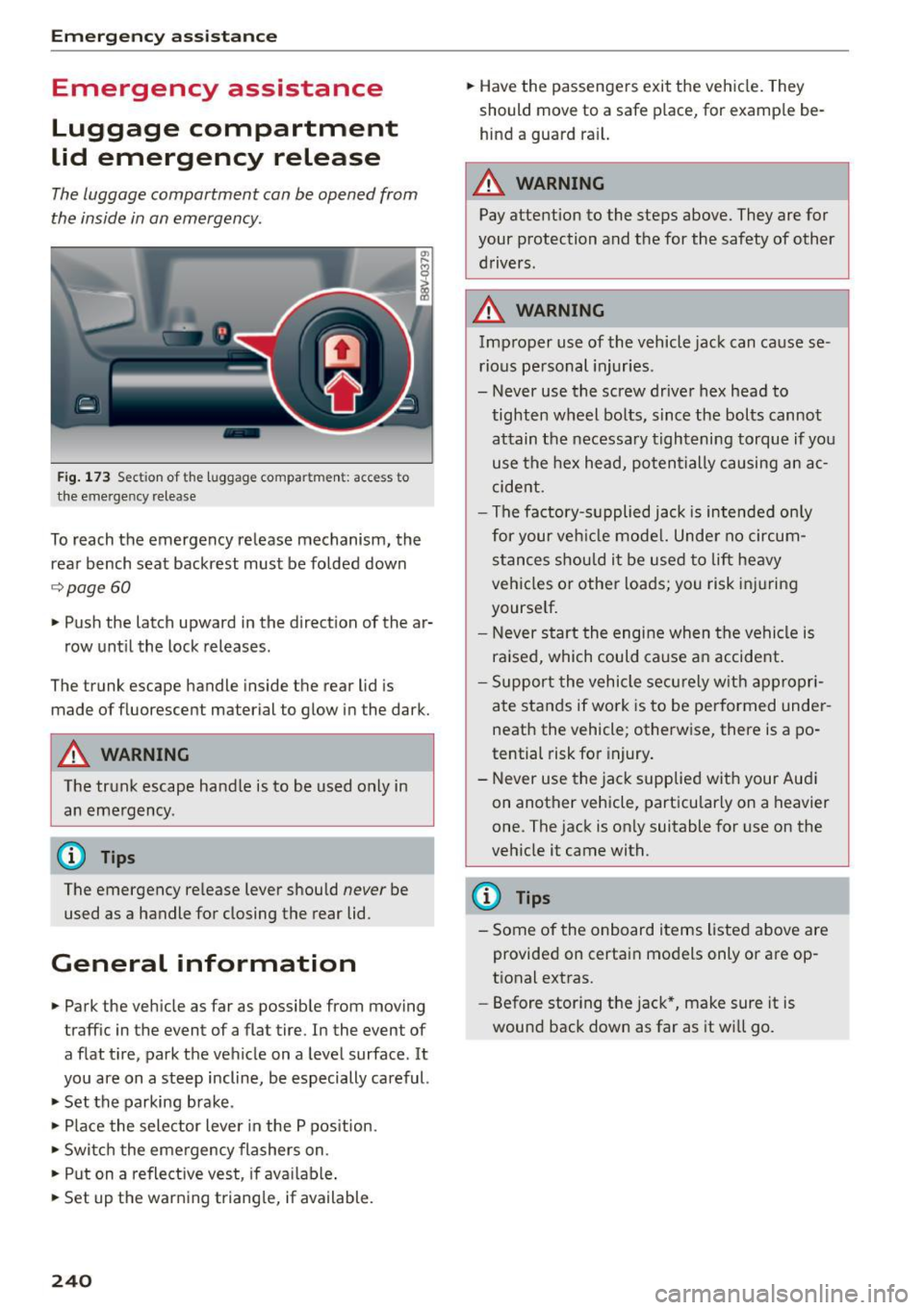
F ig. 1 73 Sect ion of t he luggage compartment: access to
t h e emergency release
To reach the emergency release mechanism, the
rear bench seat backrest must be folded down
~page 60
.,. Push the latch upward in the direct ion of the ar
row unt il the lock releases.
The trunk escape handle inside th e rear lid is
made of fluorescent material to glow in the dark.
A WARNING
The trunk escape handle is to be used only in
an eme rgency .
(D Tips
The emergency re lease lever should never be
used as a handle for closing the rear lid.
General information
.,. Park the veh icle as far as possib le from moving
traffic in the event of a flat tire. In the event of
a flat tire, park the vehicle on a leve l surface . It
you are on a steep incline, be especially careful.
.,. Set the parking brake .
.,. Place the selector lever in the P pos ition .
.,. Swi tc h the eme rgency flashers on .
.,. Put on a reflective vest, if ava ila b le .
.,. Set up the war ning triang le, if available.
240
.,. Have the passengers exit the vehicle. They
should move to a safe p lace, for example be
hind a guard ra il.
A WARNING
Pay attention to the steps above. They are for
your p rotection and the for the safety of other
drivers.
A WARNING
"'
Imp roper use of the vehicle jack can cause se-
rious pe rsonal injuries.
- Never use the screw driver hex head to
tighten wheel bolts, since the bolts cannot
attain the necessa ry tight ening torque if yo u
use the hex head, p oten tially cau sing an ac
cide nt.
- The factory-s upplied jack is intended only
for your veh icle mode l. Unde r no c ircum
s tances shou ld i t b e used t o lift heavy
veh icles or othe r loads; you risk inj uring
yourse lf.
- Never start the engi ne when t he vehicle is
raised, which could ca use a n accident .
- Suppor t the vehicle secu rely w it h a ppropri
ate stands if work is to be performed under
neath the vehicle; otherw ise, there is a po
tential risk for injury .
- Never use the jac k supplied with your Aud i
on another vehicle, part icu lar ly on a heavier
one. The jack is on ly suitable for use on the
veh icle it came with.
(D Tips
-Some of the onboard it ems listed above are
provided on certai n models only or are op
t ional extras.
- Before stor ing the jack*, make sure it is
wound back down as far as it wi ll go.
Page 246 of 282
Eme rge ncy ass ista nce
ground. The base @ must be vertical under the
lifting point @.
.. Wind the jack up further until the flat tire
comes off the ground
c> .&_.
Position the vehicle jack onl y under the designat
ed lifting points on the sill
c> fig. 178. There is ex
actly
one location for each wheel. The jack must
not be positioned at any other location
c> &c>Q) .
An uns table s urfac e under the jack can cause the
vehicle to slip off the jack. Always provide a firm
base for the jack on the ground . If necessary
place a sturdy board or similar support under the
jack. On
har d, sli ppery su rfaces (such as tiles)
use a rubber mat or similar to prevent the jack
from slipping
c> & .
A WARNING
-
-You or your passengers could be injured
wh ile chang ing a wheel if you do not follow
these safety precautions:
- Position the vehicle jack only at the desig
nated lifting points and align the jack.
Otherwise, the vehicle jack could slip and
cause an injury if it does not have suff i
cient hold on the vehicle.
-A soft or unstable surface under the jack may cause the vehicle to slip off the jack.
Always provide a firm base for the jack on
the ground. If necessa ry, use a sturdy
board under the jack.
- On ha rd, slippery surface (such as tiles)
use a rubber mat o r similar to prevent the
jack from slipping .
- On ly raise your vehicle with the vehicle
jack provided by the factory . If you use a
vehicle jack for another vehicle, your vehi
cle can slide and cause injury.
- Changes in temperature or load can affec t
the height o f the vehicle .
- Never start the engine when the vehicle is
raised, which could cause an accident.
- Support the vehicle securely with appro
priate stands if work is to be performed
underneath the vehicle; otherwise, there
is a potentia l risk for injury .
244
-To help prevent injury to yourself and your
passengers :
- Do not ra ise the vehicle until you are su re
the jack is securely engaged.
- Passengers must not remain in the veh icle
when it is jacked up.
- Make sure that passengers wait in a safe place away from the veh icle and we ll away
from the road and traffic.
- Make sure jack position is correct, adjust
as necessary and then continue to raise
the jack.
- Changes in temperature or load can affect
the height of the vehicle.
(D Note
Do not lift the vehicle by the sill. Position the
vehicle jack only at the des ignated lifting
po ints on the sill. Otherwise, your vehicle will
be damaged.
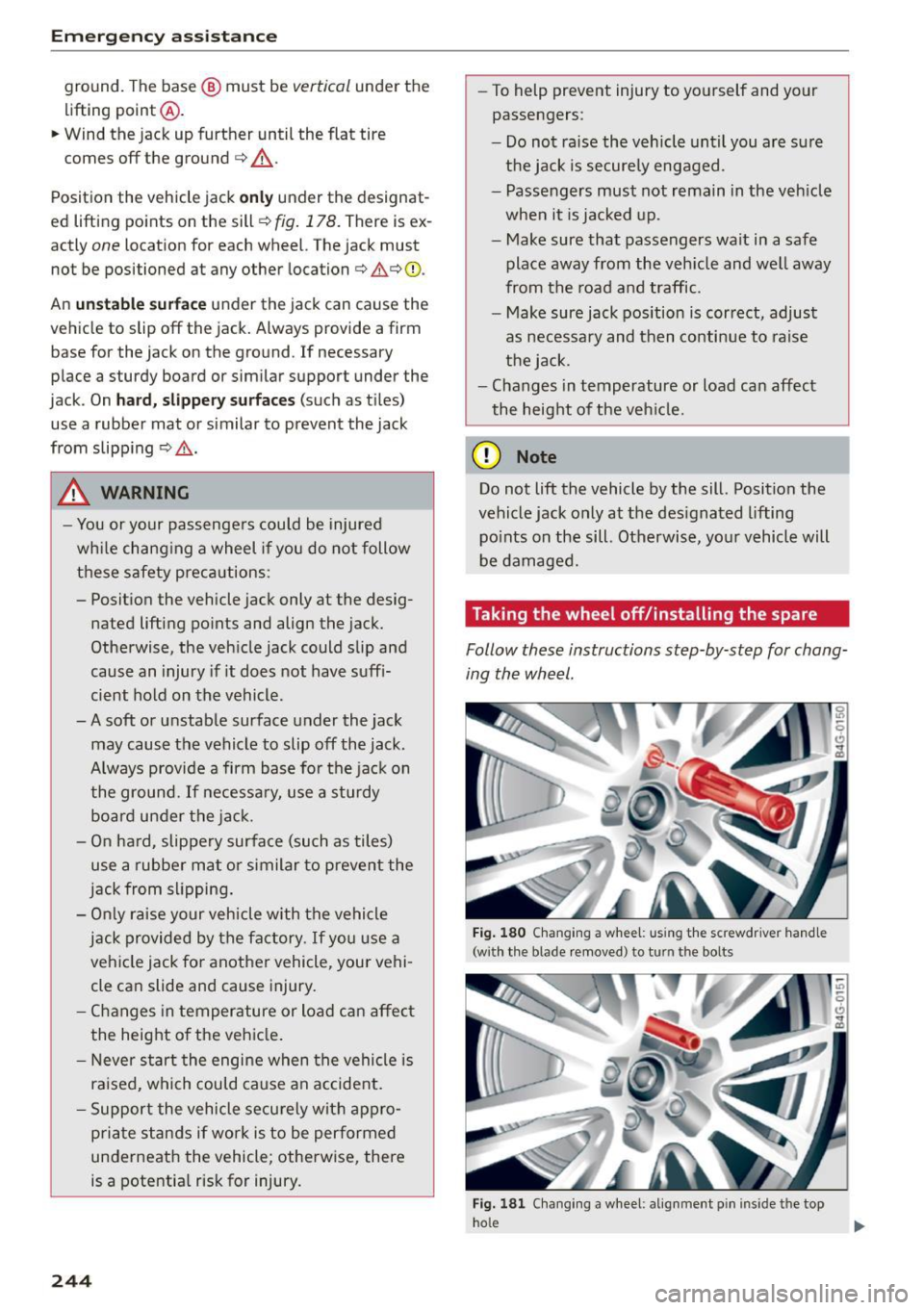
Taking the wheel off /installing the spare
Follow these instructions step-by-step for chang
ing the wheel.
Fig. 180 Chang ing a whee l: us ing the screwdriver hand le
(w ith the blade removed) to turn the bolts
Fig. 181 Changing a w heel: alignment pin inside the top
hole