2015 AUDI Q5 window
[x] Cancel search: windowPage 137 of 302

M N
co
a:
co
Driving safety
Basics
Safe driving habits
Please remember -safety first!
This chapter contains important information,
tips, instructions and warnings that you need to
read and observe for your own safety, the safety
of your passengers and others . We have summar
ized here what you need to know about safety
belts, airbags , chi ld restraints as well as child
safety. Your safety is for us
priority number 1. Al
ways observe the informat ion and warn ings in
this section - for your own safety as well as that
of your passengers .
The information in this section app lies to all
model ve rsions of your vehicle . Some of the fea
tures described in this sections may be standard
equipment on some models, or may be optional
eq uipment on others .
If you are not sure, ask
your authorized Audi dealer.
A WARNING
- Always make sure that you follow the in
struct ions and heed the WARNINGS in this
Manual. It is in your interest and in the in
terest of your passengers.
- Always keep the complete Owne r's Litera
ture in your Aud i when you lend or sell your
vehicle so that this important info rmation
will always be ava ilable to the driver and
passenge rs.
-
- Always keep the Owner's literature handy so
that you can find it easily if you have ques
tions.
Safety equipment
The safety features are part of the occupant re
straint system and work together to help reduce the risk of injury in a wide variety of accident sit
uations.
Your safety and the safety of your passenge rs
should not be left to chance. Advances in tec h-
; nology have made a var iety of fea tures available
~ to help reduce the r isk o f injury in an accident. ,....,
Dr ivin g sa fet y
The following is a list of just a few of the sa fety
features in your A udi:
- sophisticated s afety be lts fo r drive r and a ll pas-
senger seat ing pos itions,
- be lt fo rce limi ters for the front seats,
- belt pretensioners for the seats,
- be lt he ight adjustment for the front seats,
- head restra ints for each seating posit ion,
- front airbags,
- side airbags in the front seats and outer rear
seats *,
- side curtain airbags,
- specia l LATCH anchorages for child rest raints,
- adjustab le steering colum n.
These ind iv idual safety features, can work to
gether as a system to help protect you and your
passengers in a w ide range of accidents . T hese
features cannot work as a system if they are not always cor rect ly adjusted and co rrectly used.
S afet y is ev erybod y's re sponsibil it y !
Important things to do before driving
Safety is everybody 's job! Vehicle and occupant
safety always depends on the informed and care
ful driver .
For your safety and the safety of your passen
gers,
before driv ing alway s:
.,. Make s ure that all lights and signals are operat
ing correctly .
.,. Make sure that the tire pressure is correct .
.,. Make sure that all windows are clean and afford
good vis ibility to the outs ide .
.,. Secure all luggage and other items carefully
Q page 77 .
.,. Ma ke s ure that nothing can inte rfere wi th the
peda ls .
.,. Adjust front seat, head restraint and mirrors
correctly for your height.
.,. Instruct passengers to adjust the head re
straints according to the ir height.
.,. Make sure to use the r ight child restraint cor
rectly to protect ch ildren
Q page 172, Child
safety.
1 3 5
Page 140 of 302
Driving safety
-Always keep your feet on the floor in front
of the seat. Never rest them on the seat, in
strument panel, out of the window, etc. The airbag system and safety belt will not be
able to protect you properly and can even in
crease the risk of injury in a crash .
- Never drive with the backrest reclined or tilted far back! The farther the backrests are
tilted back, the greater the risk of injury due
to incorrect positioning of the safety belt
and improper seating position.
- Children must always ride in child safety
seats r=;,
page 172. Spec ial precautions ap
ply when installing a child safety seat on the
front passenger seat r=;,
page 152.
Proper seating positions for passengers in
rear seats
Rear seat passengers must sit upright with both
feet on the floor consistent with their physical
size and be properly restrained whenever the ve hicle is in use.
To reduce the risk of injury caused by an incorrect
seating position in the event of a sudden braking
maneuver or an accident, your passengers on the
rear bench seat must always observe the follow
ing:
~ If there is a passenger on the rear center seat
ing position, slide the center head restraint up
ward at least to the next notch r=;,
page 67.
~ Make sure that the seatback is securely latched
in the upright position
r:=:>page 69 .
~ Keep both feet flat in the footwell in front of
the rear seat.
~ Fasten and wear safety belts properly
r:=:> page 147.
~ Make sure that children are always properly re
strained in a child restraint that is appropriate
for their size and age r=;,
page 172.
A WARNING
Passengers who are improperly seated on the
rear seat can be seriously injured in a crash.
- Each passenger must always sit on a seat of their own and properly fasten and wear the
safety belt belonging to that seat.
138
- Safety belts only offer maximum protection
when the seatback is securely latched in the
upright position and the safety belts are properly positioned on the body. By not sit
ting upright, a rear seat passenger increases
the risk of personal injury from improperly
positioned safety belts!
- Always adjust the head restraint properly so
that it can give maximum protection.
Proper adjustment of head restraints
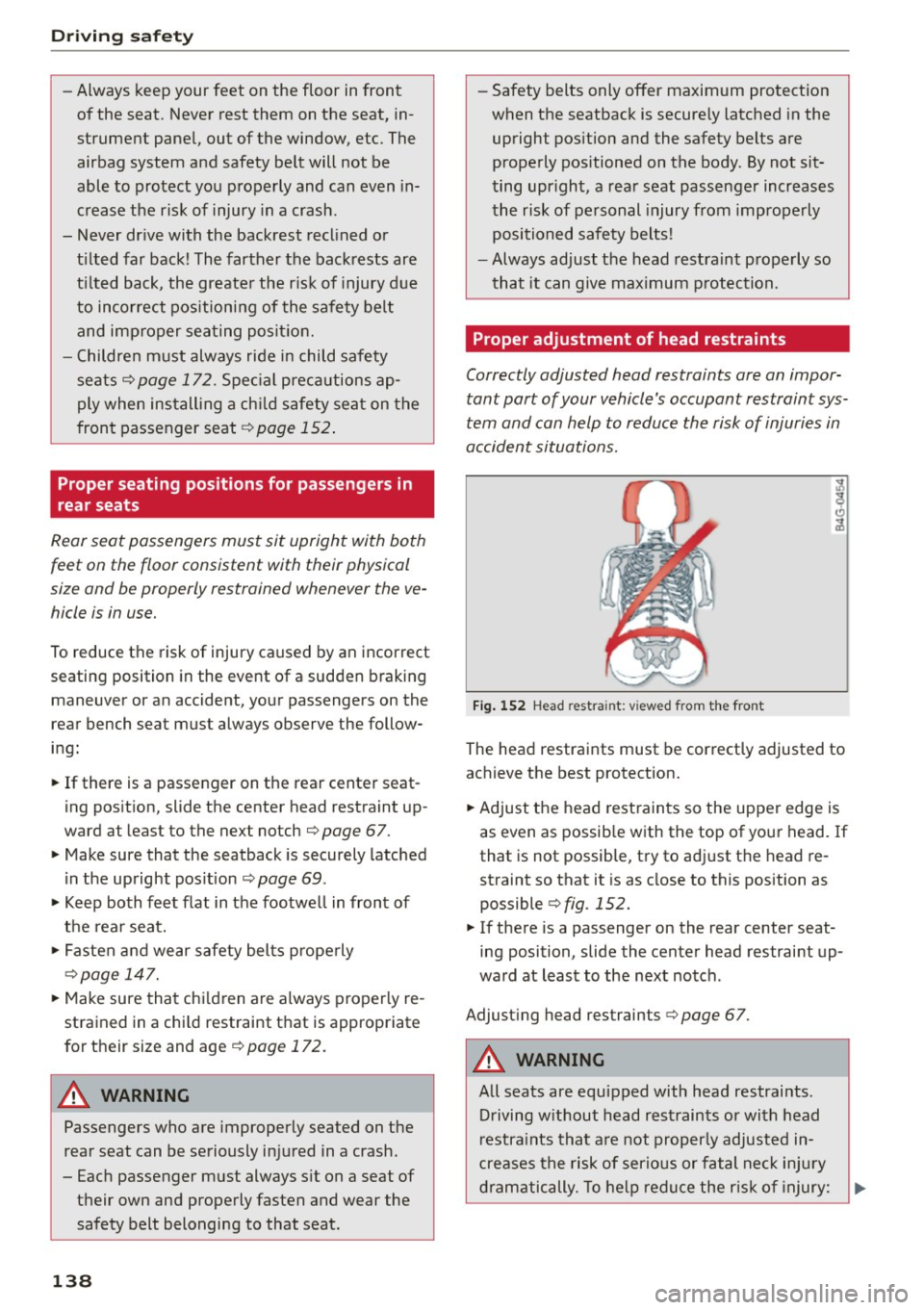
Correctly adjusted head restraints are an impor
tant part of your vehicle's occupant restraint sys
tem and can help to reduce the risk of injuries in
accident situations.
Fig. 152 Head rest ra in t: v iewed from the fro nt
The head restraints must be correctly adjusted to
achieve the best protection.
~ Adjust the head restraints so the upper edge is
as even as possible with the top of your head. If
that is not possible, try to adjust the head re
straint so that it is as close to this position as
possible r=;,
fig. 152.
~ If there is a passenger on the rear center seat
ing position, slide the center head restraint up
ward at least to the next notch .
Adjus ting head restraints r=;,
page 67.
A WARNING
All seats are equipped with head restraints.
Driving without head restraints or with head
restraints that are not properly adjusted in
creases the risk of serious or fatal neck injury
-
dramatically. To help reduce the risk of injury: ~
Page 141 of 302

M N
co
a:
co
,...., \!) 1.1"1
N 1.1"1 ,....,
-Always drive with the head restraints in
place and properly adjusted.
- Every person in the vehicle must have a
properly ad justed head restraint.
- Always make sure each person in the vehicle
properly adjusts their head restraint. Adjust
the head restraints so the upper edge is as even as possib le w ith the top of your head.
If that is not possib le, try to adjust the head
restraint so that it is as close to this position
as possib le.
- Never attempt to adjust head restraint
wh ile driving. If you have driven off and
must adjust the dr iver headrest for any rea
son, fi rst stop the veh icle safely before at
tempting to ad just the head restraint.
- Children must always be properly restrai ned
in a ch ild restraint that is appropria te fo r
their age and si ze
qpoge 172.
Examples of improper seating positions
The occupant restraint system con only reduce
the risk of injury if vehicle occupants ore properly
seated.
I mproper seat ing posit ions can ca use serious in
jury o r death . Safety be lts ca n only work when
they are prope rly positioned on t he body. Im
proper sea ting pos it ions reduce the effect iveness
of safety belts and wi ll even increase the risk of
in ju ry and death by moving the safety belt to cr it
i cal areas of the body. Improper seating positions
also increase the risk of serious injury and death
when an airbag deploys a nd strikes an occupant
who is not i n the proper seating position . A driver
i s responsible for the safety of all vehicle occu
pants and especia lly for children . Therefo re :
.. Never allow anyone to ass ume an incorrect
seat ing pos ition when the veh icle is being used
¢ ,&. .
The follow ing bulletins list only some sample po
sitions that will increase the risk of ser ious injury
and death. Our hope is that these examples will
make you more aware of seat ing pos itions that
are dangerous.
Dr ivin g s afet y
Therefore , whenever the vehicle is moving :
-never stand up in the vehicle
- never stand on the seats
- never kneel on the seats
- never ride w ith the seatback reclined
- never lie down on the rear seat
- never lean up against the instrument panel
- never sit on the edge of the seat
- neve r sit sideways
- neve r lean out t he window
- neve r put your feet out the window
- never put your feet on the instrument panel
- never rest your feet on the seat cush ion or back
of the seat
- never ride in the footwell
- never ride in the ca rgo a rea
A WARNING
Imp roper seating posit ions increase the risk
of ser ious personal in jury and death whenever
a veh icle is being used.
-Always make sure that all vehicle occupants stay in a proper seating position and are
properly restrained whenever the vehicle is
be ing used.
Pedal area
Pedals
The pedals must always be free to move and
must never be interfered with by a floor mot or
any other object .
Make sure that a ll peda ls move free ly without in
te rfe ren ce and t hat no thing prevents them from
re tu rning to t he ir o riginal posi tions.
Only use floor mats t hat leave the pedal a rea free
and can be secured with floor mat fastene rs.
If a brake circuit fa ils, increased brake pedal trav
el is required to bring the veh icle to a full stop .
A WARNING
-
Pedals that cannot move free ly can cause loss
of vehicle co ntrol and increase the risk of ser i-
ous injury.
~
1 39
Page 143 of 302

M N
co
a:
co
,...., \!) 1.1'1
N 1.1'1 ,....,
-Always put objects, for examp le, luggage or
other heavy items in the luggage c ompart
ment.
- Always secure objects in the luggage com
partment us ing the tie-down eye lets and
suitable straps.
A WARNING
Heavy loads will influence the way your vehi
cle handles. To help reduce the risk of a loss
of control leading to ser ious personal injury:
- Always keep in m ind when transporting
heavy objects, that a change in the center of
gravity can also cause changes in vehicle
hand ling:
- Always distribute the load as even ly as
possible.
- Place heavy objects as far forward in the
luggage compartment as possible.
- Never exceed the G ross Ax le Weight Rating
or the Gross Vehicle Weight Rating specified
on the safety compliance sticker on the left
doo r jamb. Exceeding permissible weight
standards can cause the vehicle to s lide and
hand le different ly.
- Please observe information on safe driving
r=>page 135.
A WARNING
To help prevent poisonous exhaust gas from
being drawn into the vehicle, always keep the
rear lid closed while driv ing.
- Never transport objects larger than those
fitt ing completely into the luggage a rea be
cause the rea r lid cannot be fully closed .
- If you absolutely must drive w ith the rear lid
open, observe the following notes to reduce
the risk of poisoning:
- Close a ll windows,
- Close the Panoramic sliding sunroof*,
- Open al l air outlets in the instrument pan-
el,
- Sw itch off the air recircu lation,
- Set the fresh ai r fan to the h ighest speed.
Dr ivin g s afet y
A WARNING
Always make sure that the doors, all windows,
the Panoramic sliding sunroof * and the rear
lid are securely closed and locked to reduce
the r is k of injury when the vehicle is not being
used.
- After closing the rear lid, always make sure
that it is p roperly closed and locked.
- Never leave your vehicle unattended espe
cially with the rea r lid left open . A child
could crawl into the ve hicle through the lug
g age compartmen t and clo se the re ar lid be
coming trapped and unable to get out. Be
ing trapped in a vehicle can lead to serious
pe rsonal injury .
- Never let children play in or around the vehi
cle.
- Never let passengers ride in the luggage
compa rtment . Vehicle occupants must al
ways be properly restrained in one of the ve
hicle's seating positions.
(D Tips
- Air circul ation helps to reduce window fog
ging . Stale ai r escapes to the outs ide
through vents in the t rim panel. Be sure to
keep these slots free and open.
- The tire pressure m ust correspond to the
load. The tire pressure is shown on the tire
pressure label. The t ire p ress ure label is lo
cated on the dr iver's side B-pillar. The tire
pressure label lists the recommended cold
t ire inflation pressures fo r the veh icle at its
maximum ca pac ity weight and the tires that
we re on your vehicle at the t ime it was man
ufac tured. For recommended tire pressures
for normal load condi tions, please see chap
ter
r=> page 246.
Tie-downs
The luggage compar tment is equipped wi th four
tie-downs to se cure luggage and other items .
Use the t ie-downs to secu re your cargo prope rly
r=> page 140, Loading the luggage compar tment. lliJ,
141
Page 149 of 302

M N
co ~ ex:, rl I.O
"' N
"' rl
A WARNING
Not wearing safety belts or wearing them im
properly increases the risk of serious personal
injury and death. Safety belts can work only
when used correctly .
- Always fasten your safety belts correctly be
fore driving off and make sure al l passen
gers are correctly restrained.
- For maximum protection, safety belts must
always be pos itioned properly on the body.
- Never strap more than one person, includ
ing small ch ildren, into any belt.
- Never place a safety belt over a child sitting
on your lap.
- Always keep feet in the footwell in front of
the seat while the vehicle is being driven.
- Never let any person ride with their feet on
the instrument panel or sticking out the
window or on the seat.
- Never remove a safety belt while the vehicle
is moving . Doing so will increase your risk of
being injured or killed.
- Never wear belts twisted.
- Never wear belts over rigid or breakable ob-
jects in or on your clothing, such as eye
glasses, pens, keys, etc., as these may cause
injury.
- Never allow safety belts to become dam
aged by being caught in door or seat hard
ware.
- Do not wear the shoulder part of the belt
under your arm or otherwise out of position.
- Several layers of heavy clothing may inter
fere with correct positioning of belts and re duce the overall effectiveness of the system.
- Always keep belt buckles free of anything
that may prevent the buckle from latching
securely.
- Never use comfort clips or devices that cre
ate slack in the shoulder be lt. However, spe
cial clips may be required for the proper use
of some child restraint systems.
- Torn or frayed safety belts can tear, and
damaged belt hardware can break in an acc i
dent. Inspect belts regularly. If webb ing,
bind ings, buckles, or retracto rs are dam-
Safety belts
aged, have belts replaced by an authorized
Audi dealer or qualified workshop.
- Safety belts that have been worn and loaded
in an accident must be replaced with the
correct replacement safety belt by an au
thorized Audi dealer. Replacement may be
necessary even if damage cannot be clearly
seen. Anchorages that were loaded must al
so be inspected.
- Never remove, modify, d isassemble, o r try
to repair the safety belts yourself.
-Always keep the belts clean. Dirty belts may not work properly and can impair the func
tion of the inertia reel~
table Internal
cleaning on page 210.
Safety belts
Fastening safety belts
Safety first -everybody buckle up!
Fig. 160 Belt buck le and tongue on the d rive r's seat
To provide maximum protection, safety belts
must always be positioned correctly on the wear
er's body.
.. Adjust the front seat and head restraint proper
ly
q page 63, General information.
.. Make sure the seatback of the rear seat bench is
in an upright position and securely latched in
place before using the belt
q .&, .
.. Ho ld the belt by the tongue and pull it even ly
across the chest and pelvis ¢.&_ .
.. Insert the tongue into the correct buckle of
your seat until you hear it latch securely
q fig. 160.
.. Pull on the belt to make sure that it is securely
latched in the buckle.
Ill>
147
Page 170 of 302

Airbag syste m
passenger. In order to help provide this addition
al protection, the side airbag must inflate within
a fraction of a second at very high speed and w ith
great force. The supplemental side airbag cou ld
injure you if your seating position is not proper or
upright or if items are located in the area where
the supplemental side airbag expands. This ap
plies especially to children
q page 172, Child
safety.
Supplemental side airbags inflate be
tween the occupant and the door pane l on the
side of the vehicle that is struck in certain side
collision
q fig . 170.
Although they are not a soft pillow, they can
"cush ion" the impact and in th is way they can
he lp to reduce the risk of injury to the upper part
of the body.
A fine dust may develop when the airbag deploys.
This is normal and does not mean there is a fire
in the vehicle.
Important safety instructions on the side
airbag system
Airbags ore only supplemental restraints . Always
properly wear safety belts and ride in a proper
seating position.
There is a lot that you and your passengers must
know and act accordingly to help the safety belts
and airbags do the ir job to provide s upplementa l
protection.
A WARNING
An inflating side airbag can cause ser ious or
fatal injury . Improperly wearing safety belts
and improper seating positions increase the
r isk of se rious personal injury and death
whenever a vehicle is being used .
- In order to reduce the risk of injury when
the supplemental s ide airbag inflates:
- Always sit in an upright position and never
lean aga inst the area where the supple-
mental side airbag is located.
- Never let a chi ld or anyone else rest their
head against the side trim panel in the
area where the supplementa l side airbag
inflates .
168
-Always make sure that safety be lts are
worn correctly,
- Do not let anyone sitting in the front seat
put their hand or any other parts of their
body out of the window.
- Always make sure that the s ide a irbag can
inflate w ithout interference .
- Never install seat covers or rep lacement
upholstery over the front seatbacks that
have not been specifically approved by
A udi.
- Never use addi tional seat cushions that
cover the areas where the side a irbags de
ploy .
- Damage to the orig inal seat cove rs or to
the seam in the area of the side ai rbag
module must a lways be repaired immedi
ate ly by an authorized Audi dealer.
- Objects between you and the airbag can in
crease the risk of injury in an accident by in
terfering with the way the airbag unfolds or
by being pushed into you as the airbag in
flates.
- Never place or attach accessor ies or other
obje cts (such as cupho lde rs, telephone
brackets, or even large, bu lky obje cts) on
the doors, ove r o r near the area marked
"AIRBAG" on the seat backrests.
- Such objec ts and accessories can become
dangerous projectiles and cause injury
when the supplemental side airbag de ploys .
- Never carry any objects o r pets in the de
ployment space between them and the
airbags or allow children or other passen
gers to travel in this posit ion.
- Always use the bu ilt-in coat hooks only for
lightweight clothing. Never leave any heavy
or sharp-edged objects in the pockets that
may interfere with side airbag dep loyment
and can cause personal injury in an accident .
- Always prevent the side airbags from being
damaged by heavy objects knock ing against
or hitting the sides of the seatbacks .
- The a irbag system can only be triggered
once . If the airbag has been triggered, the
system must be replaced by an authorized
Aud i dea le rship.
~
Page 172 of 302

Airbag system
The airbag system is not a substitute for your
safety belt. Rather, it is part of the overall occu
pant restraint system in your vehicle . Always re
member that the airbag system can only help to
protect you if you are wearing your safety belt
and wearing it prope rly. This is another reason
why you should always wear your safety belts, not just because the law requires you to do so
~ page 144, General information.
It is important to remember that while the side
curta in a irbag system is designed to help reduce
the likelihood of serious injuries, other injuries,
for example, swelling, bruising, and minor abra
sions can also be associated with these airbags.
Remember too, these airbags wi ll dep loy only
once and only in certain kinds of accidents -your
safety belts are always there to offer protection.
The side curtain airbag system basically
consists of:
-The electronic control modu le and externa l side
impact sensors
- The side curtain airbags above the front and
rear side w indows
- The airbag indicator light in the instrumen t
panel
The airbag system is monitored electron ically to
make certa in it is f uncti oning properly at all
times. Each time you turn on the ignition, the air
bag system indicator light wi ll come on for a few
seconds (self diagnostics).
The side curtain airbag is not activated:
-if the ignit ion is tu rned off,
- in s ide collisions when the acceleration meas-
ured by the sensor is too low,
- in rear-end collisions.
A WARNING
-Safety belts and the ai rbag system will on ly
provide protection when occupants are in
the proper sea ting position
~ page 63, Gen
eral information .
-If the airbag indicato r ligh t ~page 16
comes when the vehicle is being used, have
the system inspected immediate ly by your
authorized Aud i dealer. It is possible that
170
the airbag will inflate when it is not sup
posed to, or will not inflate when it should.
How side curtain airbags work
Side curtain airbags can work together with side
airbags to help reduce the risk of head and upper
torso injuries for occupants who ore properly re
strained.
Fig. 172 Illustration of principle: Inflated side curtain air
bags on the left side
The side curtain airbags inflate between the oc
cupant and the windows on the side of the vehi
cle that is struck in a side collision
~ fig. 172.
N 0
s ri: (X) m
When the system is triggered, the side curta in
airbag is filled with propellant gas and breaks
through a seam above the front and rear side
windows identified by the AIRBAG label. In order
to help provide this additional protection, the
side curtain airbag must inflate within the blink
of an eye at very high speed and with great force .
The side curtain airbag could injure you if your
seat ing position is not proper or upright or if
i tems are located in the area where the supple
mental sid e curtain airbag inflates. This applies
especially to chi ld ren
~ page 172.
Although they are not a soft pillow, side curtain
a irbags can "cush ion" the impact and in this way
they can help to reduce the risk of injury to the
head and the upper pa rt of the body.
A fine dust may develop when the airbag deploys.
This is quite normal and does not mean there is a
fire in the vehicle.
Page 199 of 302

M N
co
a:
co
,...., \!) ..,.,
N ..,., ,....,
electrical energy is not being used than is being
generated and ensures an optimal state of
charge for the battery.
(D Tips
- But even energy management cannot neg
ate the limits of physics. Consider that the power and life of a battery are limited.
- If starting ability is threatened, the indica
tor light (•] appears ~
page 33.
What you should know
The highest priority is given to maintaining start
ing capability.
The battery is severely taxed in short-distance
driving, in city traffic and during the co ld time of
year. Abundant electrical energy is required, but
only a little is generated. It is also critical if the
engine is not running and electrical components
are turned on. In this instance energy is being
consumed but none is being generated.
It is in precisely these situations that you wi ll no
tice energy management actively regulating the
d istribution of energy.
Vehicl e stands fo r an e xte nded p eriod
If you do not drive your vehicle over a period of
several days or weeks , e lectrica l components are
gradually cut back or switched off . This reduces
energy consumption and maintains starting ca
pability over a longer period . Some of the con
ve nience funct ions may not operate, such as the
interior lights or the power seat adjustment. The
conven ience functions wi ll be available again
when you switch on the ignit io n and start the en
g ine.
With the engine turned off
If you listen to the radio, for example, with the
engine turned off or use other MMI* functions ,
the battery is being d ischarged .
If starting capability is jeopardized due to energy
consumption, a message appears in the radio or MMI* display . The message indicates that the
system w ill be switched off automatically in a
Smart T echno log y
moment . If you wish to continue using the func
tions, you have to start the engine.
With the engin e running
Although electrical energy is generated when the
vehicle is be ing driven, the battery can become
discharged . This happens mostly when litt le en
ergy is being generated and a great dea l con
s u med and the batte ry's state of charge is not
opt imal.
T o bring the energy ba lance back into equilibri
u m, consumers which require especially large
amounts of ene rgy are temporarily cut back or
switched off. Heating systems in particu lar re
quire a great deal of energy. If you notice, for ex
amp le, that the heated seats* or the heated rear
window are not heating, they have been tempo
rar ily cut back or switched off . These systems w il l
be available again as soon as the energy ba lance
has been restored.
You w ill also notice that engi ne idle speed has
been increased slightly . T h is is normal and not a
cause for concern. By increasing eng ine idle
speed the additional energy requi red is generated
and the battery is ch arged .
197