2015 AUDI Q5 instrument panel
[x] Cancel search: instrument panelPage 167 of 302

M N
co
a:
co
,...., \!) 1.1"1
N 1.1"1 ,....,
@ Tips
If the weight-sensing mat in the front passen
ger seat detects an empty seat, the front air
bag on the passenger side will be turned off,
and
PASSENGER AIR BAG OFF will stay on.
Repair, care and disposal of the airbags
Parts of the airbag system are installed at many
different places on your Audi. Installing, remov ing , servicing or repairing a part in an area of the
vehicle can damage a part of an airbag system and prevent that system from working properly in a collision.
There are some important things you have to know to make sure that the effectiveness of the
system will not be impaired and that discarded
components do not cause injury or pollute the
environment.
A WARNING
-
Improper care, servicing and repair proce
dures can increase the risk of personal injury
and death by preventing an airbag from de
ploying when needed or deploying an airbag
unexpectedly:
- Never cover, obstruct, or change the steer
ing wheel horn pad or airbag cover or the in
strument panel or modify them in any way .
- Never attach any objects such as cup holders
or telephone mountings to the surfaces cov
ering the airbag units .
- For cleaning the horn pad or instrument panel, use only a soft, dry cloth or one mois
tened with plain water. Solvents or cleaners could damage the airbag cover or change
the stiffness or strength of the material so
that the airbag cannot deploy and protect
properly.
- Never repair, adjust, or change any parts of
the airbag system.
- All work on the steering wheel, instrument
panel, front seats or electrical system (in
cluding the installation of audio equipment,
cellular telephones and CB radios, etc.)
must be performed by a qualified technician
Airbag system
who has the training and special equipment
necessary.
- For any work on the airbag system, we
strongly recommend that you see your au
thorized Audi dealer or qualified workshop.
- Never modify the front bumper or parts of
the vehicle body.
- Always make sure that the side airbag can
inflate without interference:
- Never install seat covers or replacement
upholstery over the front seatbacks that
have not been specifically approved by
Audi .
- Never use additional seat cushions that
cover the areas where the side airbags in
flate.
- Damage to the original seat covers or to
the seam in the area of the side airbag
module must always be repaired immedi
ately by an authorized Audi dealer.
- The airbag system can be activated only
once. After an airbag has inflated, it must
be replaced by an authorized Audi dealer or
qualified technician who has the technical
information, training and special equipment
necessary.
- The airbag system can be deployed only
once . After an airbag has been deployed, it
must be replaced with new replacement
parts designed and approved especially for
your Audi model version. Replacement of complete airbag systems or airbag components must be performed by qualified work
shops only. Make sure that any airbag serv
ice action is entered in your Audi Warranty
&
Maintenance booklet under AIRBAG RE
PLACEMENT RECORD.
- In accidents when an airbag is deployed, the
vehicle battery separates the alternator and
the starter from the vehicle electrical sys tem for safety reasons with a pyrotechnic
circuit interrupter .
- Work on the pyrotechnic circuit interrupt
er must only be performed by a qualified
dealer -risk of an accident!
- If the vehicle or the circuit interrupter is
scrapped, all applicable safety precautions
must be followed.
165
Page 175 of 302

M N
co
a:
co
,...., \!) ..,.,
N ..,., ,....,
exceptional circumstances and the
PASSENGER AIR BAG OFF light does not
come on and stay on, immediately install
the rear-facing child safety seat in a rear
seating position and have the airbag system
inspected immediately by your Audi dealer .
A WARNING
If, in exceptional circumstances, you must in
stall a forward-facing child restraint on the
front passenger's seat:
- Always make sure the forward-facing seat
has been designed and certified by its man
ufacturer for use on a front seat with a pas
senger front and side airbag.
- Always follow the manufacturer's instruc
tions provided with the child safety seat or
carrier.
- Always move the passenger seat into its
rearmost position in the seat's fore and aft
adjustment range, as far away from the air
bag as possible before installing the child
restraint. The backrest must be adjusted to
an upright position.
- Always make sure that the
PASSENGER AIR
BAG OFF
light comes on and stays on all the
time whenever the ignition is switched on.
(D Tips
Always replace child restraints that were in
stalled in a vehicle during a crash. Damage to
a child restraint that is not visible could cause
it to fail in another collision situation.
Advanced front airbag system and children
Your vehicle is equipped with a front "Advanced
Airbag System " in compliance with United States
Federal Motor Vehicle Safety Standard (FMVSS)
208 as applicable at the time your vehicle was
manufactured.
The Advanced Airbag system in your vehicle has
been certified to meet the "low-risk" require
ments for 3- and 6-year old children on the pas
senger side and small adults on the driver side.
The low risk deployment criteria are intended to
reduce the risk of injury through interaction with
Child safety
the airbag that can occur, for example, by being
too close to the steering wheel and instrument
panel when the airbag inflates. In addition, the
system has been certified to comply with the "suppression" requirements of the Safety Stand
ard, to turn off the front airbag for infants up to 12 months who are restrained on the front pas
senger seat in child restraints that are listed in
the Standard.
Even though your vehicle is equipped with an Ad
vanced Airbag system, all children, especially
those 12 years and younger, should always ride in
the back seat properly restrained for their age
and size . The airbag on the passenger side makes
the front seat a potentially dangerous place for a child to ride. The front seat is not the safest place
for a child in a forward-facing child safety seat. It can be a very dangerous place for an infant or a
larger child in a rearward-facing seat.
Advanced Airbags and the weight-sensing mat in the front seat
The Advanced Airbag System in your vehicle de
tects the presence of an infant or child in a child
restraint on the front passenger seat using the
weight-sensing mat in the seat cushion and the
sensor below the safety belt latch on the front
passenger seat that measures the tension on the
safety belt .
The weight-sensing mat measures total weight of
the child and the child safety seat and a child blanket on the front passenger seat. The weight
on the front passenger seat is related to the de
sign of the child restraint and its "footprint", the
size and shape of the bottom of the child re straint as it sits on the seat . The weight of a child
restraint and its "footprint" vary for different
kinds of child restraints and for the different
models of the same kind of child restraint offered
by child restraint manufacturers.
The weight ranges for the individual types, makes
and models of child restraints that the NHTSA
has specified in the Safety Standard together
with the weight ranges of typical infants and typ
ical 1 year-old child have been stored in the con
trol unit of the Advanced Airbag System. When a
1iJ11-
173
Page 223 of 302

M N
Checking and Filling Hood
Releasing the engine hood
The engine hood is released from inside the vehi
cle .
Fig . 195 Drive r's side footwe ll: e ng ine hood re lease lever
"' Wi th the driver's door open, pu ll the leve r un
der the instrument panel in the direction of the
arrow
c::> fig . 195.
The hood pops up s light ly under spri ng press ure.
Opening the engine hood
Fig. 196 Relea se leve r un der the eng ine hood
Before opening the engine hood, make su re that
the w indshield wipers are flat aga inst the wind
shield. Otherwise, they could damage the paint
on the hood .
"' Pull up on the release under the hood
c:> fig . 196. This releases the catch.
"' Open the hood all the way
c::> A.
~ _&. WARNING
rl
:5: Hot engine coo lant can burn you.
N l/1 rl
Ch eck in g and Fillin g
-To reduce the risk of being burned, never
open the hood if you see or hear steam or
coolant escaping from the eng ine compart
ment. Wait until no steam or coolant can be
seen or heard before carefully opening the hood.
Closing the engine hood
"' Pull the hood down until the pressu re from the
struts is reduced.
"' Le t the hood
drop down and latch in p lace. Do
not try to push it shut;
it may fa il to engage
c::> A .
A WARNING
-
A hood that is not completely latched cou ld
fly up and block your view while driv ing.
-
- When you close the engine hood, check it to
make sure the safety catch has properly en
gaged . The hood should be flush with the
surrounding vehicle body parts .
- If you notice while driv ing that the hood is
not secured properly, stop at once and close
it .
Working in the engine compartment
Be especially careful whenever you work in the
engine compartment.
Wheneve r you must pe rfo rm an y wo rk in the
eng ine comp artment , for e xample chec king and
fi lling differen t fluids , ther e is a ri sk of i nju ry,
bu rn s and acci den ts. To p re ve nt pe rsonal injur y
al way s ob serve the follo wing WARN INGS . The
e ngi ne compartm ent of an y ve hicle is a haza rd
ou s area
~ ,&..
A WARNING
To help avoid injury, before you check any
thing under the hood:
- Turn off the eng ine.
- Remove the ignition key.
- Apply the parking brake.
-
- Move selector lever of automatic transmis-
sion to P (Park).
221
Page 269 of 302

M N
co ~ co
rl I.O
"' N
"' rl
Left cockpit fuse assignment
Fig. 224 Left side of the cockpit: fuse panel with plastic
clip
Fuse panel @ (black )
No. Equipment
1 Dynamic steering
2 ESC control module
A/C system pressure sensor, electrome-
3 chanical park
ing brake, Homelink, auto-
matic dimming interior rearview mirror, air
quality/outside air sensor, ESC button
5 Sound
actuator/exhaust sound tuning
6 Headlight range contro l/cornering light
7 Headlight (cornering light)
Control modu les (e lectromechanical park-
8 ing brake, shock absorber, quattro Sport,
trailer hitch), DCDC converter
9
Adaptive cruise control or high voltage
battery (hybrid drive)
11 Side assist
12 Headlight range control, parking system
13 Airbag
14 Rear w iper
15 Auxi
liary fuse (instrument panel)
1 6 Auxiliary fuse terminal 15 (engine area) Fuses
and bulbs
Fuse panel @ (brown)
No . Equipment
1 Electric exhaust door
2 Brake light sensor or brake pedal
move-
ment sensor (hybr id drive)
3 Fuel pump
4 AdBlue pumps
or brake booster power
supply (hybrid dr ive)
5 Left seat heating with/without seat venti-
lation
6 ESC
7 Horn
8 Left
front door (window regulator, central
locking, mirror, switch, lighting)
9 Wiper motor
10 ESC
11 Left
rear door (window regu lator, switch,
lighting)
12 Rain and light sensor
Fu
se panel © (re d)
No . Equipment
3 Lumbar support
4 Dynamic steering
5 Climatized cupholder
6 Windshie
ld washer system, headlamp
washer system
7 Vehicle electr ical system control module 1
8 Vehicle e
lectrica l system control module 1
9 Panorama sunroof
10 Vehicle e lectrica l system control module 1
11 Sun shade (pano rama sunroof)
12 Anti-theft a
larm system
267
Page 270 of 302

Fuses and bulbs
Right cockpit fuse assignment
Fig . 225 Right s ide of the cockpit: fuse panel wit h plastic
clip
Fuse panel @ (black)
No. Equipment
5 Steering column sw
itch module
7 Terminal 15 diagnostic connector
8 Gateway (Oatabus diagnostic interface)
9 Auxiliary heater
Fuse panel@ (brown)
No. Equipment
1 CD /DVD player
2 Wi-Fi
3 MM I/Radio
4 Instrument cluster
5
Gateway (instrument cluster control mod-
ule)
6 Ignition lock
7 Light dial
8 Climate control system blower
9 Steering column lock
10 Climate control system
268
No. Equipment
11 D
iagnost ic data link connecto r, terminal
30
12 Steering column switch module
Right luggage compartment fuse
assignment
Fig. 226 Righ t side of the lu ggage compartment: fuse pan
e l w ith plastic clip
Fuse panel @ (black)
No. Equipment
1 Luggag e compartm ent lid control module
2 Trailer contro
l module
3 Trailer con trol module
4 Trailer control module
s Elec trom echanica l parking brake
6 E lectronic damping control
7 Electromechanical parking brake
8 Tail lights
9 quattro Sport
10 Tail lights
11 Central locking
system
12 Termina l 30
Page 271 of 302
M N
co
a:
co
,...., \!) 1.1'1
N 1.1'1 ,....,
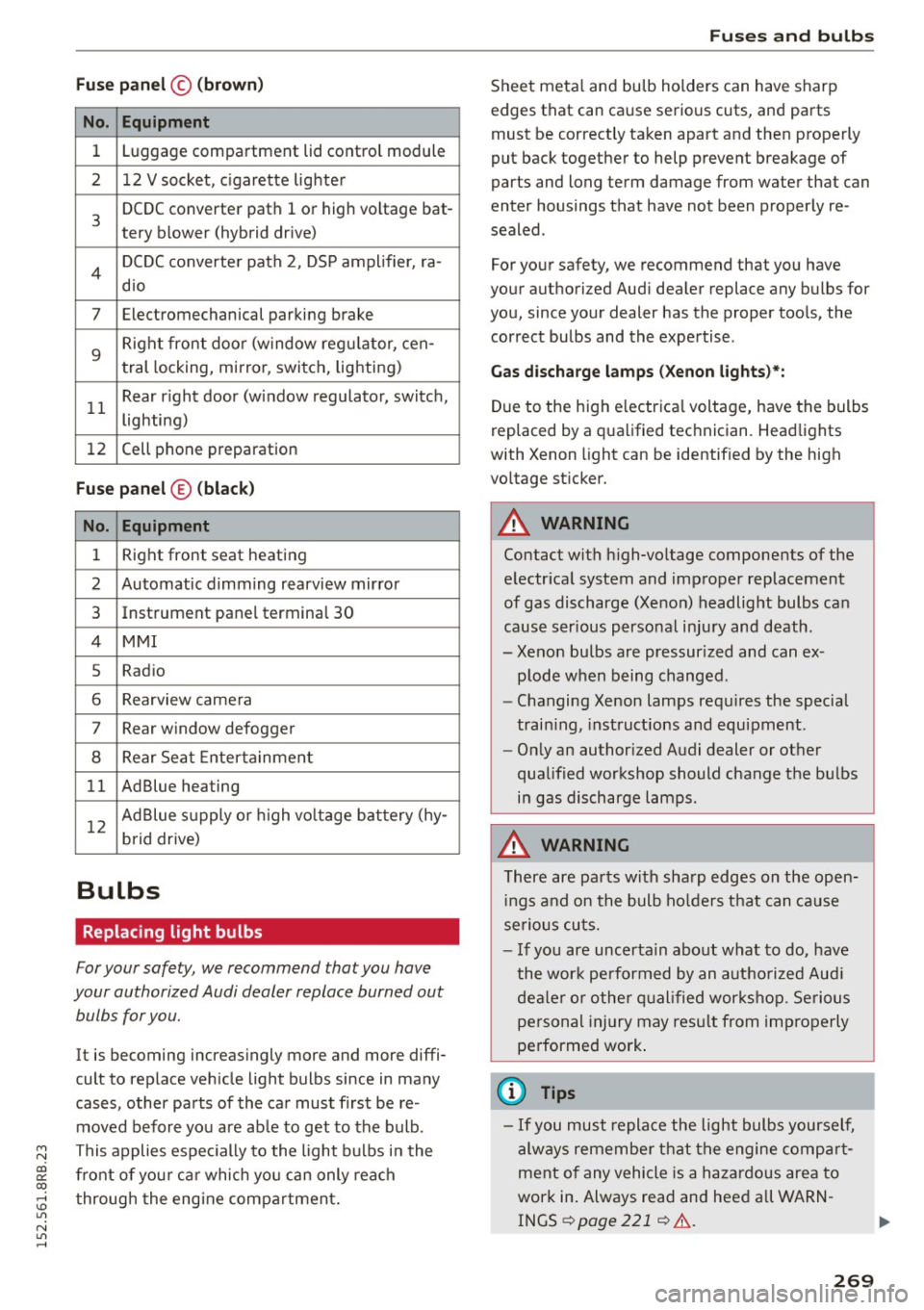
Fuse panel© (brown)
No. Equipment
1 Luggage compartment lid control module
2 12 V socket, c igarette lighter
3
DCDC converter path 1 or high vo ltage bat-
tery blower (hybrid drive)
4 DCDC converter path 2, DSP amplifier, ra-
dio
7 Electromechanical parking brake
9
Right front doo r (window reg ulator, cen-
tral locking, mirror, switch, lighting)
11 Rear r
ight door (window regulator, switch,
lighting)
12 Cell phone
preparation
Fuse panel ® (black)
No. Equipment
1 Right front seat heating
2 Automatic dimming rearview mirror
3 Instrument panel terminal 30
4 MMI
5 Radio
6 Rearview came
ra
7 Rear window defogger
8 Rear Seat Entertainment
11 AdBlue heating
12 Ad
Blue supply or high voltage battery (hy-
brid drive)
Bulbs
Replacing light bulbs
For your safety, we recommend that you have
your authorized Audi dealer replace burned out bulbs for you.
It is becoming increasingly more and more diffi
cult to replace vehicle light bulbs since in many
cases, other parts of the car must first be re
moved before you are ab le to get to the bulb.
This applies espec ially to the light bulbs in the
front of you r car which you can only reach
through the engine compartment.
Fuses and bulbs
Sheet metal and bulb holders can have sharp
edges that can cause serious cuts, and parts
must be correctly taken apart and then properly
put back together to help prevent breakage of
parts and long term damage from water that can
enter housings that have not been proper ly re
sealed .
For your safety, we recommend that you have
your authorized Aud i dealer replace any bulbs for
you, since your dealer has the proper too ls, the
correct bulbs and the expertise .
Gas discharge lamps (Xenon lights )*:
Due to the high e lectrica l voltage, have the bulbs
replaced by a qualified technician. Headlights
with Xenon light can be identif ied by the high
vo ltage sticker.
A WARNING
Contact with high-voltage components of the
electr ical system and improper replacement
of gas discharge (Xenon) headlight bulbs can
cause ser ious personal injury and death.
- Xenon bulbs are pressur ized and can ex-
plode when being changed.
- Changing Xenon lamps requ ires the special
train ing, instructions and equipment.
- Only an authorized Audi dealer or other
qualified workshop should change the bulbs
in gas discharge lamps.
A WARNING "'--
There are parts with sharp edges on the open-
in gs and on the bulb holders that can cause
serious cuts.
- If you are uncertain about what to do, have
the wor k performed by an authorized Aud i
dealer or other qualified workshop. Serious
personal injury may resu lt from improperly
performed work .
(D Tips
-If you must replace the light bulbs yourself,
always remember that the engine compart
ment of any vehicle is a hazardous area to
work in . Always read and heed all WARN
INGS¢ page 221 ¢ .&,.
269